
Wrestling Heritage welcomes memories, further information and corrections.
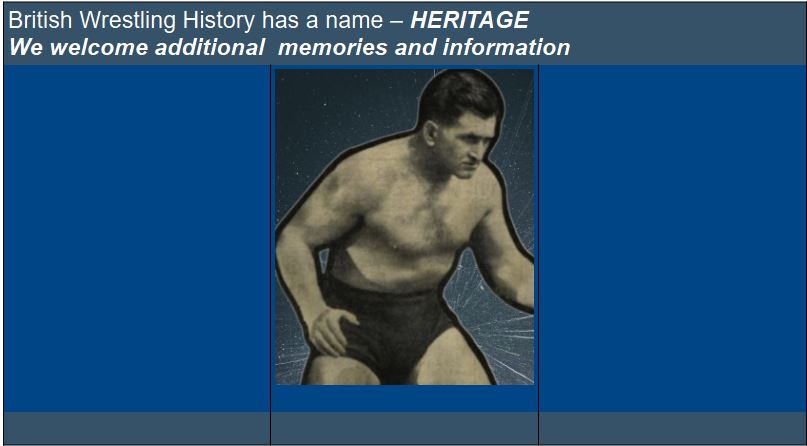
Earl McCready was a truly international star with a career that spanned all corners of the globe. One of the huge stars of Canadian wrestling Earl McCready came to Britain in the 1930s.
He was born, in Lansdowne, Ontario, his date of birth 15th June 1908 we have been unable to confirm. He moved and grew up on a farm in Saskatchewan, farm work giving him the strength and fitness for his later career.
A professional with almost eight years experience he arrived in Britain from Australia on 4th February, 1938, an imposing sight, standing six feet one and nearing seventeen stones. Brits were already aware of his credentials. McCready had represented Canada in the Freestyle heavyweight class in the 1928 Olympic Games (finishing 6th), and was a Gold medal winner in the 1930 Empire Games held in the Canadian city of Hamilton, turning professional shortly afterwards.
In 1933 he defeated Canadian Jack Taylor to win the British Empire Heavyweight Championship. In July, 1938, BBC National Programme (radio) broadcast was ringside, with a commentary of the Empire Catch as Catch Can Heavyweight Championship contest between champion Earl McCready and Tim Estelle. McCready retained his title with a fourth round win. When the fledgling BBC television channel, also in 1938, broadcast wrestling they included matches between McCready and Anaconda and George Boganski.
Earl McCready’s wish was to revive Catch as Catch Can style wrestling and he promoted a Catch show at the Royal Albert Hall on 23rd August, 1938. McCready appeared in the main event against a 19 stone 6’2” tall Texan by the name Reuben Wright. McCready and his friend, Kevin Staunton, invested £600 in the tournament, of which Daily Express reporter, John McAdam, said the wrestling was so good it had converted him to the wrestling business. Three thousand fans turned up to witness McCready win by one fall to nil in the sixth round. That just wasn’t enough to prevent McCready and Staunton losing most of their investment. For once the press were sympathetic, but McCready left Britain shortly afterwards to regain his losses wrestling in South Africa and onwards to New Zealand. In South Africa Johannes Van Der Walt also laid claim to the Empire heavyweight title. It took Earl just four rounds to put him away.
Into his forties Earl cut back on his travelling. He got involved with Stu Hart as he was setting up his Stampede Wrestling Promotions. Earl was one of the biggest stars of the new promotion, helping to establish Stampede as a major force in Western Canada. He retired from wrestling in 1958.
Earl McCready died 9th December, 1983.
Page added 24/11/2023
8513
 Wrestling Heritage