
Wrestling Heritage welcomes memories, further information and corrections.
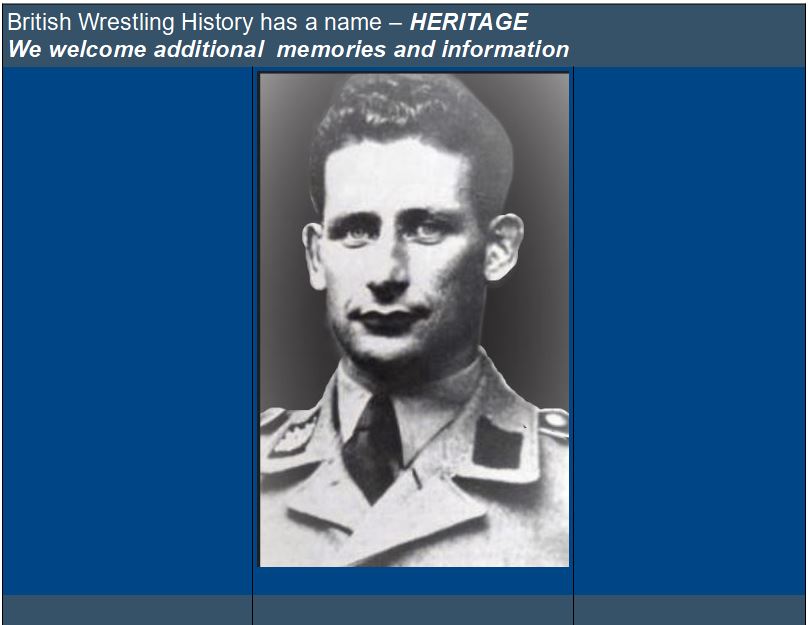
Sometimes the story is not about the wrestling. The story of Eric Pleasants is one of those sometimes. Eric’s CV makes interesting reading. A well known physical culturalist in the eastern counties, circus and cabaret performer, professional boxer, professional wrestler, Butlins redcoat as a PT Instructor, and then things get really interesting.
Let’s start with the wrestling. Eric turned to professional wrestling when his boxing career ended abruptly due to an eye injury following half a dozen or so matches. Although he may have started earlier we can find him wrestling between 1937 and 1939, always in Norfolk or Lincolnshire, against opponents that included Saxon Elliott, Stan Garside, Sonny Wallis and Babe Queseck. That’s not a lot to go on, and we can find no newspaper reports of his matches.
So let’s get onto the interesting stuff.
That moves us away from the wrestling.
Reginald Eric Pleasants was born in Norfolk, the village of Saxlingham Nethergate about ten miles south of Norwich. The mystery begins at the beginning. His registered date of birth at the time of his death was 17th May, 1913. Straightforward you think? In the 1939 census (the 1939 Register) he stated he was a Physical Training Instructor, born 17th May, 1915. Starting to wonder? There is more. We’ll come back to this at the end, there are bigger secrets to uncover first.
A web search for “Eric Pleasants” brings plentiful results. For our sources we have relied on his own memoirs and newspaper reports.
As war clouds had gathered across 1930s Europe Eric Pleasants thoughts had turned to the morality of warfare. In his memoirs he declared he didn’t need a label such as “pacifist” but that he knew that war was always wrong. He had no argument with any German and had no desire to get involved in the war. The Channel island of Jersey seemed like a good idea of a sanctuary at the time. Although other sources give alternative routes to his arrival in Jersey his memoirs tell us that he and his wife of just one year, Eileen, arrived in Jersey in May, 1940 to take up agricultural work for the Peace Pledge Union, a UK organisation that promoted pacifism. By his own admission the objective of their arrival was to avoid being forced into combat with those with whom he had no personal quarrel.
Things did not go well. Eric hated working for the Peace Pledge Union. He admitted he disliked taking orders from farmers who treated their workers as cheap labour. The present may not have been to his liking but the future looked even more uncertain as the islanders became aware of the imminent German invasion. Eric and Eileen tried to escape the island but to no avail. The Germans arrived.
A January 1954 article in the Jersey Evening Post reported that Eric Pleasants had refused agricultural work from the Germans as he wanted to keep his hands supple to pursue a career as a masseur. The article went on to say that he did accept employment by the Germans at the Commandant’s headquarters.
The arrival of the Germans made life even more difficult. At some point in 1941 his wife left him and took up employment as a housekeeper to a German. Eric moved into lodgings. He and his friends in the lodgings, one of whom he mentioned was wrestler Martin Max Schultz, took to stealing food and dealing in the black market. A combination of stealing and rebellion against authority resulted in at least four short periods in the Jersey prison. Having outstayed his welcome in the Jersey prison in August 1942 he was deported to Fort d’Hautville Prison in Dijon, France, which had been taken over by the Gestapo in 1941. His only plan was to escape. Accounts as to how he escaped from the prison vary but he managed it. Discovery by the German authorities was inevitable but without any papers they failed to realise who he was. He told them he had absconded from Jersey and was sent back to the island around Christmas of 1942. Back in Jersey they knew who he was, of his previous deportation, and a few weeks later, on 25th February, 1943, he was deported again, this time to Kreuzberg internment camp.
Never one to give up a series of unsuccessful attempts at escaping resulted in Eric’s transfer to Marlag and a camp for merchant seamen Milag Nord Ilag Westertimke,.
At the camp prisoners were subject to propaganda lectures about the fight against communism. There was a choice. It was a choice of listening to the propaganda or more hard labour. There was no choice as far as Eric was concerned and he went along to the lectures. If he wasn’t a good listener he certainly wasn’t going to let the Germans know. As a man who said he only ever fought for himself it was inevitable that Eric Pleasants next decision was more about his own survival than any political belief. It was a drastic step.
He approached the Nazi commandant of the camp and persuaded him that he had now been convinced that the Nazi cause was just and that he wanted to joint the fight against communism.
Eric voluntarily joined the British Free Corps. The BFC was a unit of the Waffen-SS, made up of British and Dominion prisoners of war who had been recruited by Germany. British historian Adrian Weale has identified 54 men who belonged to this unit at one time or another. Eric later said he never had any intention of fighting for the Germans, he remained anti-war and anti-establishment and was just an opportunist trying to survive.
Survive he did. He was picked for the SS boxing team and was chosen to fight a series of exhibition matches in Nazi officers’ messes with Max Schmeling.
In February, 1945 as the war entered it’s final months Eric, who was now part of the BFC Military Police, went on leave to Dresden. Adopting a false name the next stage of his survival plan was to assume a German identity. From Dresden Eric and a woman member of the SS he planned to marry deserted from the BFC and fled to Berlin.
The couple did marry and were living in Berlin when the Russians arrived. Eric and his wife escaped Berlin and travelled to Dresden, where they were placed in a displaced persons camp.
Suspicious of his German identity he was arrested by the Russian state police. Eric was sentenced to twenty-five years hard labour in a gulag in Siberia, the first two years to be spent in solitary confinement. He was then sent to Inta Corrective Labour Camp, where he was made to work in a coal mine.
Following the death of Stalin in 1953 the British Government negotiated his release and Eric was handed over to British authorities in Berlin on 6th July, 1954. He arrived in Harwich on 10th July. His imprisonment by Germans and Russians was taken into account and it was decided he should not stand trial for joining the British Free Corps.
Eric settled back into life in the Norfolk village of Kettringham, fulfilling his wish to become a masseur and teaching martial arts at clubs in Wymondham and Norwich. He even found time to do a bit of professional wrestling, now in his fifties.
In 1984, aged 71 a heart attack and stroke left him paralysed down one side of his body. Always a fighter, he regained some of his fitness and continued to work. In April, 1988, shortly before his death he was teaching pensioners in Norwich how to defend themselves with walking sticks.
At the outset we mentioned the fluidity of Eric’s date of birth, 17th May, 1913 or 1915. To those dates we can add 17th May, 1910, which was the date on his German Occupation registration card in Jersey, while his marriage certificate states 17th May, 1911. Reginald Eric Pleasants died in 1998. We don’t know the date.
Page added 05/03/2023
1695
 Wrestling Heritage