
Wrestling Heritage welcomes memories, further information and corrections.
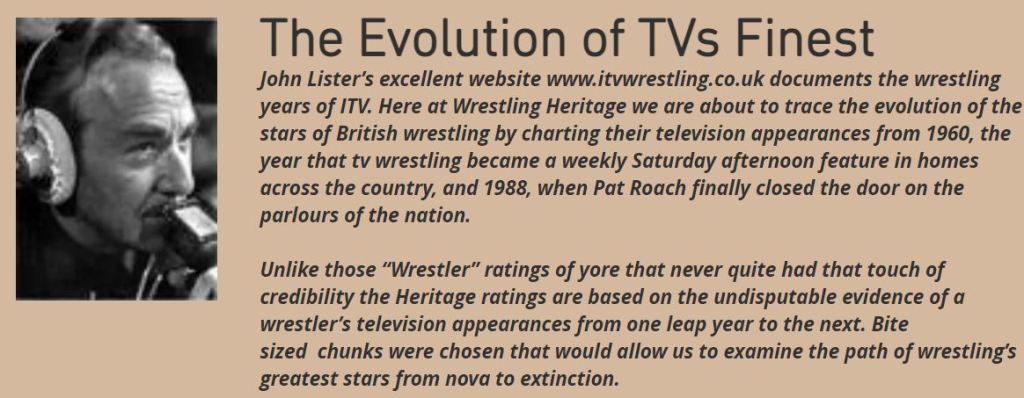
1960 – 1964
Our ratings begin with the period 1960-64. Already, it seems, the half decade of sporadic televised tournaments had brought about a sea change in the wrestling hierarchy. The heavyweights who had ruled the roost during the first sixty years of the century had now been nudged out by smaller men who looked just as big on the black and white television screens. We have no full blown heavyweights in our top ten, and seven are most definitely from the lower divisions.
9. Johnny Kwango and Alan Colbeck
Two contrasting characters tied for ninth position. Smiley and Grumpy; Johnny Kwango was serious about entertainment and Alan Colbeck was, well, just very, very serious. Jolly, acrobatic and colourful Kwango had a style quite distinctive from Colbeck who was dour, technical, and thoughtful. For those who couldn’t distinguish the West African from the Yorkshireman Kent Walton would, even in those pre political correctness days, delicately comment that the African could be identified by the white trunks.
The quality of Kwango’s opponents, including Steve Logan, Don Branch, and Vassilios Mantopolous demonstrates his standing amongst the stars of the day, and two victories over wrestlers’ wrestler Keith Williams along with a straight falls win over Ron Oakley showed that here was a wrestler with more to offer than an exceedingly hard head.
European champion Colbeck met an equally illustrious set of opponents, including World lightweight champion George Kidd. A surprise drawn decision against an inexperienced Welshman should have been enough to alert fans that the promoters had big plans for a youngster called Tony Charles. One of Colbeck’s appearances in this period was when he took part in the first televised tag team contest, partnering Ivan Penzecoff against the Royal Brothers.
8. Farmer Johnny Allan
One of a trio of heavier men makes his presence felt in position eight. Nobody could accuse the Yorkshireman of having an easy time as his opponents included Ernie Riley, Norman Walsh, Josef Zaranoff, Bill Howes, Kurt Stein, Billy Joyce and Matthius Rosges. In May, 1961 Allan lost to London’s Dazzler Joe Cornelius in the first FA Cup Special.
6. Bert Royal and Keith Williams
Two more Northerners tie for sixth position. Bert Royal had caused a sensation with fans for more than a decade with his fast, acrobatic and polished style that was to replace the slower technicians of the early post war years. He also had the distinction of being one of the wrestlers to have appeared on the first televised show way back in November, 1955. Although well established by 1960 the calibre (and weight) of opponents met by Royal during this four year period will surprise many; Bill Howes, Steve Logan, Vic Stewart, Eric Taylor, and Ernie Riley all stood in the opposite corner. As mentioned earlier Bert and younger brother Vic appeared in the first televised tag contest, in September 1963, against Colbeck and Penzecoff. Whilst the villainous pairing disappeared into thin air, Bert and Vic went on to popularise the four man version of our favourite sport. Within our four year period they went on to make a further four tag team appearances, including one against Mick McManus and Steve Logan.
Keith Williams, as stated earlier, was a wrestlers’ wrestler, respected by all those in the business but obviously considered by promoters to lack the vital ingredient to make him a star. Pallo, Dempsey and Kwango numbered amongst his opponents. His position at number six demonstrates his importance in creating the authentic image of professional wrestling.
4. Steve Logan and Bill Howes
Two heavier men occupy fourth equal position. Two of the hard men of wrestling, southerner Steve Logan, and the man that Northerners like to claim as one of their own, Bristol born Bill Howes. Logan met opponents from the middleweight to heavyweight division, including a win over a promising young wrestler by the name of Steve Veidor. Three appearances partnering Mick McManus against two teams that were not to last the course, and the one against the Royal brothers that was to set the scene for more than a decade of rivalry.
The wildness flickered in the eyes of Billy Howes when he lost his temper, which was often. Nothing could disguise the skill of the wrestler and he holds joint fourth position alongside Logan. Opponents were out of the top drawer; Norman Walsh, Ernie Riley, Tibor Szakacs, Josef Zaranoff, Joe Cornelius, Roy Bull Davis, and a classic 1962 Cup Final day spectacular in which he defeated Jacques Lageat to establish himself as European Mid Heavyweight Champion.
2. Jackie TV Pallo and Bob Steele
Two wrestlers also tie for second place. The colourful self styled Mr TV and the skilful technician from Manchester, Bob Steele. Pallo needs no introduction, of course, and by the start of 1962 he had coined the name Mr TV. In the Cup Final day spectacular of the following year he lost to Mick McManus in the bout that was to establish the two of them as the hottest names in wrestling for the following decade.
Bob Steele was everything that Pallo was not. A true technician, a craftsman, and highly respected by fellow professionals. In the early sixties he was expected to become one of the big names in wrestling, but it was not to be despite sufficient contests against top notch opponents to make him number two in our ratings.
1. Mick McManus
Only the boy at the back of the class who has not paid attention for the last fifty years will be surprised by our number one TV wrestler for the years 1960-64. Niggly Mick takes top honours by a mile, with ten appearances more than his closest rivals. He was to set the standard for years to come.
Maybe it’s our own prejudices, but Mick’s opponents that created his 100% record don’t seem quite as impressive as some of those lower in the ratings. Clearly apparent is the number of overseas stars that faced McManus on the samll screen to help establish his supremacy; Joachim La Barba, Gil Cesca, Inca Peruano, Jean Robert, Marcel Gobi, Fernand Bawin, Geuchi Moussa, and Michel Foulnier. Foreigners or Northerners ( and to Londoner Mick they were probably one and the same) helped make Mick McManus the top television wrsetler for 1960-64.
1965 – 1968
Our Heritage ratings of the top TV wrestlers moves to the years 1965-68. The social revolution of the mid sixties was reflected amongst the wrestling stars of the day. Harold Wilson’s “White heat of technology,” the musical and fashion revolution, and the long awaited discarding of the wartime legacy meant that some of the biggest names of wrestling now appeared unfashionable. It was time to move on. Only three of our previous top ten were able to stay in the rankings. Casualties were widespread, and some of them surprising. Billy Howes and Johnny Kwango escaped relatively unscathed, falling to twenty equal. Surprisingly, Bert Royal fell from the top ten to position 41. Others out of favour included Farmer Johnny Allan, Alan Colbeck, Bob Steele and Keith Williams.
So, who were the new fangled television superstars to take over from the old guard? Well, there were our first two fully blown heavyweights for a start, a Londoner who epitomised the new era and a Yorkshireman we were surprised to see here.
9. Mick McMichael and Jon Cortez
Doncaster’s Mick McMichael is the one we were surprised to see in our ratings. We have been known to gently make fun of his “Popular Mick” tag, but maybe we should start to reassess the situation. Well, maybe, but not yet Mick. Nevertheless, Mick McMichael makes it effortlessly into our top ten. George Kidd, Jackie Pallo, Jim Breaks, Mick McManus, Clayton Thomson….Mick lost to them all, but each time added to his appearance tally, aided by his tag team outings as part of the Yorkshire Terriers team, where we’d enjoy reporting more disappointments but cannot as Mick and Steve Clements were a great tag team.
Jon Cortez shares the number nine slot. He hadn’t even made it to our tv screens in the 1960-64 period and so the top ten position shows the rapid impact he had made on the nations television viewers. A victory over Bernard Murray gave the Dulwich wrestler the Golden Trophy. Other opponents included Mick McManus, Ted Hannon, Adrian Street and George Kidd. Jon Cortez’s tv tally was enhanced by his highly popular and very successful tag teaming with brother Peter.
6. Steve Logan, Al Miquet, Bill Robinson
We have to admit that as top tens go three equal at number six is hardly makes for the most exciting countdown. Nonetheless, the facts are that three wrestlers tied for position number six.
Steve Logan is one of the three survivors from our previous top ten, though despite two more appearances than in the previous period he has fallen from position four to six, not to mention the indignity of sharing the placing with a lightweight and a northerner.
Yorkshireman Al Miquet had only just missed a top ten position in the 1960-64 ratings, but this time half as many appearances again moved him from number 12 to joint 6th. One of the few to hold McManus to a draw on television showed how significant Miquet was becoming on the welterweight scene (he was later to drop to lightweight). Other opponents included Jack Dempsey, Zoltan Boscik, Bobby Barnes and Jon Cortez.
Our third contender at number six is heavyweight Billy Robinson. Heavyweights have been noticeably few on the ground in our ratings so far. Robinson more than doubled his appearances to take him from position thirty four to number six. Robinson met just about all the top heavyweights on our television screens of the time.
5.Jackie TV Pallo
The self proclaimed Mr TV, having come close to ousting rival McManus in our last ratings now took a sharp turn in the wrong direction and fell to number five, despite notching up a couple of extra appearances. Another cup final day clash with McManus drew viewers by the million.
4. Roy St Clair
The son of a man who appeared on the first ITV wrestling show way back in 1955 doubled his appearances to climb from 19 to number 4. A wide range of opponents stood in the opposite corner, from middleweight Bert Royal to super heavyweight Crusher Verdu, from newcomer Dave Larsen to experienced men such as Mike Marino and Les Kellett. In May, 1967 Roy introduced his kid brother to the viewing public in a tag match against the Black Diamonds in Rotherham. Things would never be the same again.
3. Tony Charles
Another youngster, Tony Charles, doubled his appearances to move up from 15 to number 3. Television fans saw the Welshman mature over the four year period, and in 1968 opponents included heavyweight greats Billy Joyce, Al Hayes, Roy Bull Davis and Steve Veidor.
2. Steve Veidor
We have to admit being as surprised as anyone by these tv ratings, and expected the Cheshire Golden Boy at number two no more than we expected a Welshman at number 3 and a Cornish man at number four. Veidor tripled his tv showings to move from number 39 to number 2. Opponents were top notch. Steve Veidor is a surprising, but worthy, holder of the runners up position.
1. Mick McManus
Well, you weren’t surprised were you? Niggly Mick’s victory was even more conclusive than in the 1960-64 period. Many opponents promised no match for Mick, and they weren’t. The one exception came in January, 1967. the time of the infamous disqualification loss against Peter Preston at Lime Grove Baths. According to www.itvwrestling.co.uk McManus got himself deliberately disqualified when the result didn’t go quite the way he planned.
1969-72
We reach the years 1969-72 in our Heritage review of televisions top wrestlers. By tracking those with the most appearances in bite sized four year chunks we are able to follow the trend of wrestling’s rising, and falling, stars.
Four of our previous top ten survive the passage of time from one leap year to the next, and we are now left with just two living to tell the tale from our 1960-64 original top ten. A solitary Bert Royal makes a comeback from the wilderness, returning to the top ten from which he had fallen four years earlier.
The big names consolidated their position as a smaller roster of wrestlers featured on our television screens making a top ten position more competitive than ever before.Most surprising casualty of them all was Highbury’s Mr TV, Jackie Pallo. Despite making four more appearances than in the previous four years Jackie tumbled out of the top ten to find himself at number thirteen.
Also falling into the bottom half of the top twenty were Jon Cortez, Tony Charles, and Roy St Clair. Falling even further (to 27) was Al Miquet, and Billy Robinson paid the price of travelling the globe by sinking to number 53.
Each was replaced by the modern stars of wrestling, and we even manage to squeeze eleven big names in to the top ten.
8. Zoltan Boscik, Steve Logan, Tibor Szakacs, Mike Marino
Four men tied for number eight position, all of them considerably increasing their tally of appearances. Old stalwart “Iron Man” Steve Logan was one of only two wrestlers to have appeared in all three of our top tens. He made more appearances in this period than at any other time, nine more than in 1965-8, but even this was not enough to avoid a fall from number 6. Logan had mixed fortunes, with wins over Johnny Kincaid, Lee Sharron, Ray Steel, Honey Boy Zimba, Ivan Penzecoff and a young Tony St Clair, and a handful of disqualification losses against Bill Howes, Masambula, Les Kellett, Tony Charles, and Bert Royal.
Logan found himself sharing honours with an Italian from London and two Hungarians from Hungary. Mike Marino doubled his appearances and entered the top ten for the first time following his exile to the independent ranks that had ended at the beginning of 1966. Marino met the best, as we would expect, but surprisingly often settled for a draw, which we did not expect. One such sharing of the honours was with Steve Veidor in the 1971 Cup Final Special.
The two Hungarians at number eight were the man with the iron chop and the man with steely scowl. Tibor Szakacs was revered throughout Southern England, where surprisingly he restricted his appearances. The miracle of television brought his not inconsiderable talent to the nation at large. Tibor had steadily increased his annual appearances since the early days of television wrestling to arrive at number eight.
Zoltan Boscik was an apprentice of the independent circuit, but by 1969 he was one of the country’s top lightweights. His opponents on television in this period included most of the leading lightweights and welterweights; no one could accuse Zolly of having an easy ride. Opponents included Jim Breaks, Jon Cortez, Al Miquet, Julien Morice, Alan Sergeant, Jackie Pallo, Johnny Saint, Brian Maxine, Bill Ross, John Naylor. He even managed a couple of tag matches, one of them partnering Andreas Svajik, a fast and clever lightweight for whom we had great hopes at one time.
7. Adrian Street
A wrestler who had made his presence felt for almost a decade Adrian Street had more than doubled his tally of appearances in each of our four year periods. By 1969 Street was ready to take the mantel from Mr TV Pallo as televisions most flamboyant character. Let’s face it Pallo was decidedly black and white in comparison with the multi-coloured Street on the new colour televisions that were leisurely entering the nations homes. Showings against Saint, Maxine, Zimba and others were supplemented by appearances of the increasingly popular (in the lesser used sense of the word) tag team pairing of Street and Bobby Barnes.
6. Bert Royal
Bert Royal’s kid brother had that really annoying trick of bouncing back up when he was knocked down and apparently out. Big brother Bert has done something similar, by rebounding back into the top ten from which he fell four years earlier. In this four year period Bert tripled his appearances to head towards number six. Fans still remember Jackie Pallo rolling across the ring to walk into a folding body press and go a fall down in the opening seconds. All very impressive. Except for those fans who had seen an identical opening at their local hall.
5. Vic Faulkner
Vic Faulkner nosed ahead of big brother with an additional two appearances on our small screens. Drawn decisions against Jackie Pallo and wins over Johnny Saint and Jim Breaks were highlights, not to mention a relentless stream of wins in partnership with brother Bert in tag team action.
3. Mick McMichael and Steve Veidor
We were surprised when Mick McMichael crept into our ratings last time at number nine. Well we were surprised again to find that he doubled his appearances and climbed to number three, albeit in partnership with Steve Veidor. His achievement is even more impressive when we note that with tag partner Steve Clements on his travels all of these appearances were in solo contests. We certainly remember Mick’s appearances but the facts have nevertheless taken us aback. Just how many wrestlers were there around to lose to? Sorry Mick, we all loved you really. That’s why you were “Popular Mick.”
Sharing the honours at number three was the heavyweight that Northern and Southern fans both claim as one of their own; and both reckon they know how to spell his name. Call him Veidor or Viedor (or just plain Steve Bell if you like), but he was certainly popular. Eleven more appearances than in 1965-8 were not enough to prevent him slipping from number two to number three.
2. Mick McManus
Like the rest of you we sat glued to our screens all those years ago waiting for the downfall of niggly Mick. He frustrated us then and so decades later we gain satisfaction in reporting that Mick McManus has slipped from the top spot. Four more appearances than in the 1965-8 period were not enough to keep him at the top.
1. Les Kellett
Notable by his absence from our top ten until now Bradford’s Les Kellett climbed from number 15 to the number one spot making an average of more than one appearance a month over the four year period. Opponents ranged in weight from Bobby Barnes to Lee Sharon, from angelic Bert Royal to dastardly Steve Logan, but Kellett was always the one that fans were there to see. A popular new entrant and number one in the Evolution of TVs Finest.
1973-76
Time marches on and we reach the years 1973-76 in our review of television’s top wrestlers. By 1973 many of the post war greats had hung up their boots, but three of our original top ten had survived into this second decade.
Eight of our previous ten survived the passage of time, but they were joined by four newcomers in a conundrum of a top ten that contained twelve wrestlers! The two casualties were both Hungarians, with Tibor Szakacs falling to number 18, and Zoltan Boscik plummeting to number 20. The reduction of mid week broadcasts, finally ending in the middle of 1976 meant a considerably lower number of appearances for those in the top ten.
10. Mick McMichael, Johnny Saint, Alan Dennison
Doncaster’s Mick McMichael maintained his top ten position, sharing the honours with Johnny Saint and Alan Dennison. We have been known to mock the way that the Doncaster wrestler was billed as “Popular Mick,” but considering the rule bending characteristics of his tv opponents it was hardly any surprise he was popular. He did meet some of the good guys admittedly, but amongst opponents in this period were first degree villains Brian Maxine, Peter Kaye, Alan Dennison, Adrian Street, Mark Rocco, Mick McManus, and Jim Breaks.
Johnny Saint didn’t need a villain in the opposite corner to make him shine. Saint had been a shining light on the independent circuit for a decade and the mystery is why it took until May 1969 for Joint Promotions to recognise the potential. Having just missed out on a top ten position in 1969-72 Saint now moved up from number 15 to number 10. For most wrestlers a televised straight falls win over Jim Breaks would have proved the ultimate success, but Saint bettered this in November, 1976 when he defeated Breaks again to take the World Lightweight title that had been relinquished by George Kidd.
Alan Dennison’s career swayed between dastardly villain and sickly-sweet good guy. Villain or hero he made his first appearance in television’s top ten although he had been a familiar figure to viewers for a decade. Appearances included a double knock out against Zoltan Boscik, No Contest results against John Naylor and Kung Fu, and a surprising win over Jon Guil Don.
8. Bert Royal and Steve Logan
You can’t keep a good man down, and that’s even more true when there are two of them. Bert Royal and Steve Logan were in our original 1960-64 top ten, and Steve has maintained his top ten presence ever since. Bert’s television credentials are no less impressive as he had appeared in that very first 1955 ITV show. Royal met the usual array of middleweights and heavy middles, but we were surprised to find him opposing some heavier opponents such as Johnny Yeasley and Roy St Clair. He also provided experienced opposition for some bright young stars going on to greater things, men like Ray Steele, Tony St Clair and Jackie Robinson. Both Royal and Logan’s tally was boosted, of course, by each of them being half of the top two tag teams in the country. In this period Logan and partner McManus lost to Kendo Nagasaki and George E. Gillette, a sure sign that the tectonic plates of the wrestling world were on the move.
7. John Naylor
A newcomer to our ranks, and what a newcomer! John Naylor was one of a handful of newcomers on to the scene in the early seventies that gave fans a glimmer of hope for the future. Here was someone with skill, style, speed, and a healthy amount of aggression. Having learnt the business at Riley’s gym he could certainly wrestle, and his early professional experiences came on weekend visits to France. John Naylor played a significant part in changing the style of 1970s wrestling, but often seems one of the forgotten men of the new breed. His television appearances illustrate his progress through the ranks. From outings against northern based mid carders Keith Martinelli, Peter Kaye and Mike Bennett he went on to face Jim Breaks, Vic Faulkner, win the World of Trophy and dutifully losing to Mick McManus.
4. Les Kellett, Vic Faulkner and Jim Breaks
Les Kellett and Jim Breaks remain in the top ten and are joined by Yorkshireman Jim Breaks, surprisingly absent until this point. Kellett fell from the number one spot with appearances slowing down towards the end of the period leading up to his departure from Joint Promotion rings. Vic Faulkner’s never ending popularity with fans ensured regular television appearances in both singles matches and tag team action with brother Bert.
3. Mike Marino
Not only did evergreen Mike Marino move up from number eight to number three he was the only one of our previous top ten to actually increase his number of appearances. Even more impressive than the number of appearances was the quality of Marino’s opponents at a time when he already had a quarter of a century of professional experience under his belt. During this period mid heavyweight Marino had televised wins over fully blown heavyweights that included Albert Wall, Prince Kumali, Wayne Bridges and Steve Veidor. He even came close to snatching the British Heavyweight Championship from Gwyn Davies in a bout that unfortunately ended with both men being counted out.
2. Steve Veidor
Moving up one place is the Cheshire golden boy Steve Veidor. We have continued to re-assess Veidor’s contribution to wrestling over the years and the passage of time has led us to conclude that we simply did not fully appreciate him at the time. Sorry Steve. Forgive us if we remind readers that during this period you had televised wins over Gwyn Davies, Wayne Bridges, Pat Roach, Bruno Elrington, Pete Roberts, Tibor Szakacs, Prince Kumali and Judo Al Hayes. Not bad.
1. Mick McManus
The man we loved to hate regains his position at number one despite eleven fewer appearances. We know you’re not surprised. The real surprise was how we all accepted Mick’s domination of the television screens for so many years, often against second rate opponents. As bad uns go though, there is no doubt about it, Mick was a good ‘un.
1977-80
With midweek wrestling now consigned to history and a three month strike removing wrestling from our screens there were fewer matches broadcast during this period than for many years.
Just four of our previous top ten survived the passage of time with the remaining six tumbling down our countdown. Times were definitely changing. Gone were Bert Royal, Vic Faulkner and John Naylor, just falling outside the top ten. Well and truly gone were Mick McMichael, Steve Veidor, Mike Marino and Les Kellett. TV wrestling would never be the same again. Just missing out on top ten places were a new, exciting breed that included Marty Jones, Mal sanders, Wayne Bridges, Dynamite Kid and Lee Bronson.
10. Johnny Saint and Alan Dennison
These two stars with contrasting styles from the lighter weights remained the anchors of our top ten for four more years, with poor old Mick McMichael drifting away. ITV wrestling celebrated a quarter of a century on our screens with a knock-out tournament that featured seven of our top ten. The runner-up of the tournament was Alan Dennison, who defeated Mal Sanders, Jim Breaks and Peter Kaye on the way to a final that he lost by the odd fall to Alan Kilby.
8. Peter Kaye and Chris Adams
The first two of our newcomers to the top ten. Call him Peter Kaye, Stubby Kaye or Tally-ho Kaye this man seemed to be everywhere, a big favourite of promoter Max Crabtree if not the fans. Kaye’s record was not an enviable one although he did make his way to the semi final of the 25th Anniversary tournament with wins over Pat Patton and Young David before losing against eventual winner Alan Kilby. Chris Adams was only two months old when ITV introduced wrestling to armchair fans. Twenty three years later he turned professional wrestler and very quickly proved a popular addition to the British wrestling scene. He was a former judo champion and wrestled initially as Judo Chris Adams. He was another losing semi finalist in the 25th Anniversary tournament. Within three years Chris was wrestling in the Mexico and had defeated Perro Aguayo to take the World light heavyweight title. He went on to have a successful career in the USA before shot and killed in Dallas in October, 2001.
7. Giant Haystacks
The big man himself makes his first appearance in our top ten by becoming a regular figure on our screens. Although not a skilful wrestler Haystacks did not evoke the emotions of other oversized heavyweights and most fans had a fondness, or at least a grudging respect for the giant. Unlike his famous oversized rival Haystacks was not open to the criticism of avoiding the hardest of opponents. In the opposite corner during this four year period were Kendo Nagasaki, Big Daddy, Count Bartelli, Wayne Bridges, Tony St Clair and Pete Roberts.
6. Steve Grey
The Peckham lightweight had previously just missed out on a top ten place. He now put things right and entered the top ten at number six. In April 1978 television fans saw him defeat Bobby Ryan at Blackburn to take the British lightweight title. Other opponents included Jim Breaks, Johnny Saint, Mick McManus, and Billy Torontos.
5. Tony St Clair
Tony St Clair was no doubt one of the youngsters of the fifties who watched the early ITV wrestling shows where his dad, Francis St Clair Gregory, was one of the big names. Twenty years later the younger of the St Clair brothers was one of the top wrestlers in Britain, and we find him entering our top ten for the first time.
4. Jim Breaks
Few could rile the fans quite in the same way as “Cry baby,” and fans loved to throw dummies into the ring which only served to magnify the Yorkshireman’s tantrum even more. Outside the ring we found him one of the nicest wrestlers we met, but we won’t tell anyone Jim. Breaks remains at number four in our top ten with thirty bouts against the best in Britain.
3. Mick McManus
Nearing thirty years as a professional Mick McManus was still at the top, though the tell tale signs of his demise were beginning to show. Mick fell to number three but remained a regular on our screens for the third successive decade.
2. Mark Rocco
Rollerball Rocco followed in his great father’s footsteps and became a household name throughout Britain. His explosive style brought a new list of adjectives to the lips of wrestling fans as he carved out a unique place in British wrestling history. A television favourite throughout the 1970s he smashed his way into the top ten at number two, missing the number one spot by just a couple of appearances.
1. Big Daddy
Well, none of you were surprised were you? The man who had been a powerful heavyweight of the fifties and sixties, and holder of a version of the British heavyweight title, finally found fame and fortune when he dominated television wrestling in the second half of the 1970s and the 1980s. The opponents may not always have been impressive, the tag matches may have disguised his limited ability, but no one can deny that Big Daddy was the keystone of British wrestling’s short lived 1970s renaissance. We’ll give him the credit he deserves. For now.
1981-84
As our countdown of the great and the good enters a new decade we find the speed of change gathering pace. All sorts of weird and not so wonderful characters were beginning to find a place on our screens, mercifully far away from our top ten contenders. Nevertheless, the times were a changing even amongst this compilation of wrestlings elite, with only three survivors from our previous top ten.
Gone was Chris Adams, to North America. Gone were Johnny Saint, Peter Kaye Mark Rollerball Rocco, and Tony St Clair, to the independents. Gone, to just outside the top ten, was Giant Haystacks. Gone, astonishingly, was Mick McManus, the man who had dominated the first twenty five years of British wrestling. In the end Mick bowed out gracefully, giving way to the new generation, most noticeably Mal Sanders. Gone in the most final of ways, was Alan Dennison, the Bradford wrestler who met an untimely death in June, 1984.
10. Vic Faulkner, Pat Roach, Tom Tyrone
We have three wrestlers anchoring our top ten. Tom Tyrone, the son in law of Tug Holton, enters our hit parade of hard hitters for the first time. Tyrone often gained the sympathy vote by opposing villains Mal Kirk, Banger Walsh, Butcher Bond and Bruiser Muir. Pat Roach was the subtlest of bad boys. Not really a villain at all, just someone the fans often turned against. Completing our trio was the ever youthful Vic Faulkner a Golden Gown winner and someone the fans would never turn against.
8. Ray Steele & Pete Roberts
Two junior sized heavyweights who many fans have now realised they under-rated at the time. Roberts took part in a couple of challenges for Wayne Bridges’ World title. Nothing quite so exotic for Yorkshireman Steele, but some good contests against the best on offer.
7. Sid Cooper
Having hovered around just outside our top ten for twenty years old “Hell In Boots” now made it inside as he entered the veteran stage of his career. Now a frequent tag partner of Bobby Barnes the Yorkshireman Cooper continued to do what he did best, losing whenever the situation required to one of the golden boys of the day.
6. Steve Grey
The lightweight wizard retained his number six position in our yellow brick road of tv favourites. Grappling fans will perhaps remember with most nostalgia the Steve Grey period when he regularly opposed the two top northern stars of the lighter weights. Blackpool’s World Lightweight Champion Johnny Saint was a wrestler in Grey’s own style and they gave beautiful precision displays of professional wrestling for purists up and down the land. It was a different matter when Grey’s opponent was Bradford’s Jim Breaks. Faced with Breaks’s blindside fouling and scurrilous tactics, Grey proved himself a worthy opponent on many occasions.
5. Big Daddy
Well, we’ll go t’ foot of our stairs, as they would say in Yorkshireman Big D’s county. No sooner had super heavyweight Shirley established himself in number one position he was dislodged much to our surprise. By now Crabtree was well and truly in tag mode and increasingly fans were experiencing that déjà vu feeling as the routine script was repeated time and again.
4. Marty Jones
Unlike Big Daddy in any way other than sharing a top ten position was the Lancashire lion, Marty Jones. In November, 1982 Jones snatched the vacant World Mid Heavyweight title with a win over Bobby Gaetano, later to lose it, and regain it from rival Dave Finlay.
2. Dave Finlay/Jim Breaks
One of Marty Jones’ main rivals over the years, and like Jones a man who kept wrestling’s life support machine working throughout the eighties was Belfast bruiser Dave Finlay (that “Fit” tag is just a bit too modern for these old men at Wrestling Heritage). Whilst wrestling was sinking in a sea of despair consider the quality of Finlay’s tv opponents to appreciate that it was not all doom and gloom: Chris Adams, Young David (Smith), Marty Jones, Alan Kilby, Jim Moser, Steve Logan, Clive Myers, Vic Faulkner and Mick McMichael.
Sharing number two position, and by now a top ten regular, was the mouth of Yorkshire, the great Jim Breaks. By the 1980s Breaks had been a television favourite, in the lesser used sense of the word, for over twenty years. As with Finlay we invite you to consider Breaks’ television opponents to remind yourself just how much talent was still around in the 1980s:Jon Cortez, Johnny Kidd, Steve Grey, Sammy Lee, Alan Dennison, Jackie Turpin, Mick McMichael, Danny Collins and Vic Faulkner.
1. Alan Kilby
Well, we have to admit it. No one was more surprised than us, and pleasantly surprised, to find Alan Kilby in the number one spot. We even went back and checked the records, and found Kilby a clear winner. Yes, he was boosted by a number of Big Daddy tag pairings, but less than a handful. Other opponents were top notch, veterans Tom Dowie, Bobby Barnes and Mike Marino, bright stars such as Ray Steele, Dave Finlay, and Mal Sanders. Well done Alan Kilby, you deserved it.
1985-88
We reach the end of our seemingly never ending story and the top ten tv wrestlers in the final quartet of years between 1985 and 1988, which ended in the demise of ITV wrestling. It seems so long ago that we celebrated that first top ten, which included the giants of post war wrestling, McManus, Pallo, Royal, Kwango and Kellett, alongside the wrestler’s wrestlers Steele, Howes, Williams, Allan and Colbeck. The best part of three decades later wrestling’s landscape was a very different place; one that many fans would prefer to forget, and yet one that still evokes fond memories all these years later.
Whatever the memories and prejudices older readers bring with them to the Wrestling Heritage site we will all, no doubt, celebrate that even in 1988 our top ten of TV Wrestlers included some names that will go down in history as true greats of the post war professional wrestling era.
10. Skull Murphy
Take for instance, Skull Murphy. A quick review of his opponents (and successes) during this period show how he had matured into a wrestler who equalled the exploits of his father, Roy Bull Davis. Not only was Skull now an equal of his famous dad, he even looked like him! As a long term fan of dad it was particularly pleasing to see the emergence of Skull and a new meaning to the term Plymouth Brethren.
9. Steve Grey
A child who watched his black and white wrestling heroes Peckham’s Steve Grey was by now something of a veteran, making the top ten for the third consecutive time. We’ll let you into a secret though. He had two fewer appearances than were needed to gain him only a top twenty place between the years 1973 and 1977.
7=. Alan Kilby and Pat Roach
Alan Kilby was the surprise number one position holder in the previous top ten. Eleven fewer appearances resulted in this fall to number seven, but the quality of opponents showed just how the Sheffield wrestlers had evolved into one of television’s finest. With the light heavyweight title belt fastened around his waist, or slung over his shoulder, Kilby beat just about all those placed before him – Steve Logan, Mel Stuart, Barry Douglas, John Elijah, Skull Murphy, Billy Joe Beck, Inca Peru, Ted Heath and others. Impressed?
Sharing seventh place was the Birmingham Bomber, Pat Roach. Oh, how satisfying to see Pat in this elevated position as tv wrestling reached its conclusion. With the shenanigans to which viewers were now subject to at times Roach epitomised so many things that were good about the great days of wrestling; a good honest grafter who could wrestle and arouse the emotion of fans without outrageous gimmicks and outlandish antics.
6. Dave Finlay
The Belfast bruiser continued to enrage fans, destined to become one of a handful of wrestlers destined to remain at the top for a further two decades. In retrospect we now consider the quality of his opponents to be variable (shades of McManus?) but having said that he did outclass some of the biggest names of the time, such as Cliver Myers, Johnny Saint, Johnny Kincaid, Alan Kilby, and Pete Roberts.
5. Big Daddy
The man who evoked conflicting emotions amongst fans remained one of the most prolific tv performers, now following the well rehearsed routine of a Big Daddy tag match.
4. Greg Valentine
Keeping it in the family promoter Max Crabtree’s son (and Big Daddy’s nephew) entered the top ten at number four. With greater skill and athleticism than Uncle Shirl Valentine was a wrestler and no one begrudged him his success. His televised appearances included a fairly even balance of singles matches and tag bouts.
3. Danny Collins
Middle aged fans may well read Wrestling Heritage and lament the passing of a Golden Age but The Evolution of TVs Finest does help us to appreciate just how much talent there was around even up to 1988 when the screens went blank. Even the Victor Meldrew’s of our readership would acknowledge that our top three would have been fully at home in the rings of the fifties, sixties and seventies.
At number three we have Danny Collins. Now sporting the Britiush and European welterweight title Collins was walking in the footsteps of Mick McManus, Jack Dempsey, Goldbelt Maxine and Alan Colbeck. Walking in their footsteps and holding his head high. True that they did not have to suffer the indignity of appearing in a Big Daddy tag match, but then we all have to earn a crust.
2. Ray Steele
At number two, moving up six places, we have Yorkshire heavyweight Ray Steele. Here we have another wrestler who could have been a success in any age, and at his best was comparable with Albert Wall, Geoff Portz and Gwyn Davies.
1. Marty Jones
Finally, we reach the conclusion of The Evolution of TVs Finest. Going in the footsteps of McManus, Kellett, Daddy, and Kilby. Ironically, in an age when we complained of falling standards Marty Jones was probably the best wrestler of the lot.
With the crowning of Jones we ended our celebration of the twentieth anniversary of the cessation of ITV wrestling. We chose the word celebration with care, because it is surely a moment of celebration that decades after the event wrestling fans remember the golden days of wrestling through the wonders of modern technology.
On 17th December, 1988, The Final Bell looked back at the great names of wrestling over the previous thirty three years. Twenty years later fans have access to records of thirty three years of television wrestling in the excellent website, www.itvwrestling.co.uk We thank John Lister and his team of researchers, and wrestling historian Ray Plunkett, for allowing us access to their records in the compilation of The Evolution of TVs Finest.
For one last time; “Happy Thursday, Friday, see you Saturday.”
 Wrestling Heritage