
Also known as The Farmer’s Boy, The Farmer
Wrestling Heritage welcomes memories, further information and corrections
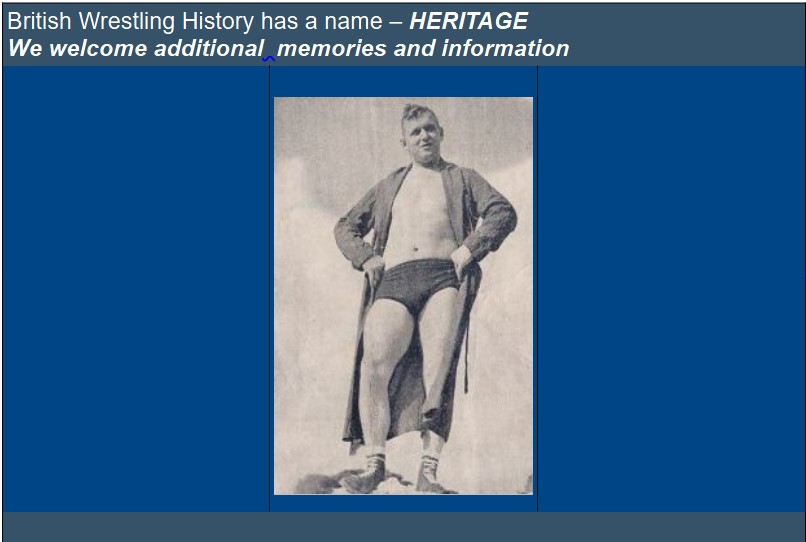
The roots of professional wrestling lay in the countryside; it was only during the “Golden Age” at the beginning of the twentieth century that the likes of Georges Hackenschmidt, Tom Cannon and Jack Carkeek made wrestling a fashionable night out for the city folk.
The nickname of the Farmer has been attached to many professional wrestlers, some with more legitimacy than others. When it comes to George and Harry Broadfield they were the genuine article, brought up working on the land to help their parents, Henry and Jessie Broadfield on their farms in Middlestown near Wakefield and Heybeck Lane, near Dewsbury.
George Washington Broadfield was born in the West Riding village of Thornhill on 20th August, 1919. The farming heritage went back generations and no doubt Agricultural work built up the power to execute a fearsome elbow slam that could knock out an opponent and earned him the title “KO King.”
Not that wrestling was his first love. As a youngster rugby was his favourite sport. In his mid teens George took up wrestling, and took to the sport like the proverbial fish to water.
George was certainly wrestling professionally by 1937, more than likely a year earlier. Uncertainty occurs because the Farmers Boy name was used from the beginning, but there were other Farmers Boys. Previous ones had worked in London and the south, in 1936 we find Farmers Boy working on northern programmes, so this was most likely George Broadfield. In 1937 George was described as “The new sensation” and boasted he drank sixteen pints of milk a day!
He received regular bookings from the outset and within a couple of years was facing the top names in the business. A powerful young man, no doubt aided by the farm work, the Farmer’s Boy tagline was dropped in the mid 1940s in favour of The Farmer. Bernard Hughes recalled “I saw George Broadfield, who was normally billed as The Farmer, at Newcastle. He was a very strong man, could be a bit rough, and won most of his matches by knockout.”
In 1946 the Daily Mirror reported that George was wrestling in France and had received a great ovation from 7,000 spectators at the Palais des Sports in Paris after dislocating his foot in a match with Charles Rigoulet. In July, 1947 we have found George advertised as World Junior Heavyweight champion, an honour he held for two years.
When George’s father died in 1951 he took over running of Heybeck Farm along with his own 162 acre Childswell Farm. Something had to give, and it was the wrestling. George retired in 1956 to concentrate on farming and convert from beef to dairy farming.
28/03/2021 Page addded
13/08/2021 Page reviewed
662GB
 Wrestling Heritage