
By Graeme Cameron
Wrestling Heritage welcomes memories, further information and corrections.
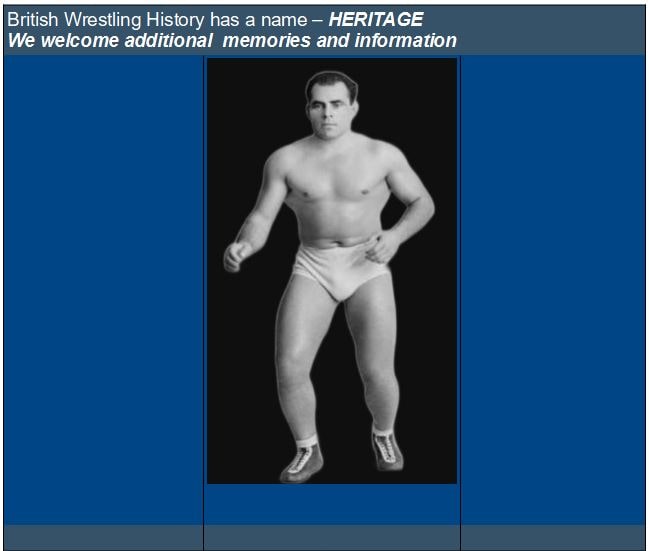
It was a long and illustrious career for George Pencheff, of Bulgarian birth. He moved to Australia as a child he wore his national credentials on his dressing gown in the shape of a kangaroo. Removing the gown revealed one of the finest physiques in wrestling.
George made his pro wrestling debut in 1929 and quickly established himself as one of the top three wrestlers in Australia. It was eight years later, in 1937, and with tours of California and Quebec under his belt, that he arrived in Britain.
Six thousand fans filled the Empress Stadium in London to watch George wrestle Jim Londos in a match advertised as “modernised Catch as Catch Can” style. Londos, considered by many as the best in the world at that time, came out winner with a reverse leg lock after 48 minutes.
During the 1930s George had numerous battles with Fred Atkins and Australian heavyweight champion Tom Lurich, the latter often for the title. After six years of trying, he finally garnered the title from Lurich in 1939 in Sydney. He retained this title for an amazing 17 years, finally losing it to Baron Von Heczey in 1957 in Adelaide. It would be fair to say he defended the title infrequently, in part because of the war and later, his penchant for globe trotting.
George continued to headline through the Forties against the likes of Atkins, Chief Little Wolf and Olympian Eddie Scarf. In 1950, the travel bug bit and Pencheff became something of a globe trotter appearing again in the UK, France, Germany, New Zealand, South Africa, Singapore and all over the USA and Canada. He featured in main events in many places, often as the foil for a bigger name but sometime in his own right.
He was known for his fast-paced style featuring rapid-fire dropkicks. The original Jack Claybourne named Pencheff as a favourite opponent. He worked with many big names that included Whipper Billy Watson , Dara Singh, Canada’s Earl McCready and Danny McShain to name a few.
His 35 year career ended in 1964 when he suffered a serious injury against Tarlock Singh in India. He made some appearances as a referee after that but perhaps his most enduring legacy is that he had a hand in founding Police Boys Clubs in Australia. Generations of amateur and pro wrestlers have got their start in these clubs and still do so today. What could be a greater legacy than that?
George Pencheff died on November 29, 1986.
A true legend of Australian pro wrestling.
Page added 29/11/2020
 Wrestling Heritage