
Wrestling Heritage welcomes memories, further information and corrections.
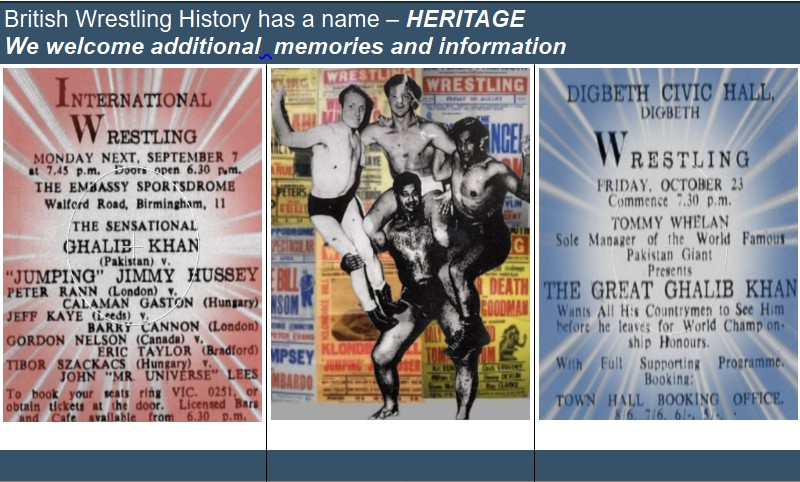
The Great Khan
We saw The Great Khan only once, an independent show in the 1960s when he defeated a bruiser (who we also never saw again) by the name of Killer John Dillinger.
Well the Killer just wasn’t, and we are pretty certain that it was yet another promotional fib that he was from the home of the original Chicago gangster, John Dillinger.
Ghalib, on the other hand, was the real deal. He was a muscular giant, standing 6 feet 5 inches tall, with an imposing presence in the ring. Sam Betts, who wrestled as Dwight J Ingleburgh, remembered Ghalib well, and told us that although he wasn’t the most skilled of technical wrestlers he always proved a difficult opponent due to his immense strength, “If Ghalib chose not to work with you then you had a real fight on your hands. With his physique it was natural his style relied heavily on strength holds; he was very strong.” Ghalib’s brother recalled, “He was so powerful. Once I needed to change a tyre on my car but didn’t have a jack. He just lifted it up with ease.”
Ghalib was born in a small village in the Khyber Pukhtoon Kwa of Pakistan, which in those days was known as the North West Frontier. He was the only son of Hakim Khan (from his first marriage), losing his mother at an early age. He had a number of step siblings. Farming was the main profession of the family in Pakistan, so Ghalib worked on the family farm, developing his strength which he put to good use in village competitions that included weight-lifting, wrestling and kabaadi (1) , which Ghalib’s son described as a sort of rugby without a ball.
Ghalib married in 1952, fathering seven children, five girls and two boys. In 1958 the family emigrated to Britain. Ghalib began work as a butcher, which he combined with his wrestling career
Ghalib had joined a local amateur wrestling club in the early 1960s. He was a natural for the professional ring and two or three years later made his professional debut. The name Great Khan was a perfect fit and he soon found popularity with all audiences, especially so amongst the Asian community. That was certainly the case the night we saw him in Preston, receiving a tremendous ovation from the large Asian community.
Most of Ghalib’s matches were in the north of England, though he did go to India where he was disappointed when a planned match with Dara Singh failed to materialise.
Ghalib continued wrestling for a number of years until a recurrent back injury caused him to retire. The origins of the back problem went back many years, to the days he was a young man in Pakistan and had carried 20 stones of flour for 3 miles as a bet.
Ghalib Khan died on 4th December, 2008, aged 84, following which his body was transported to Pakistan for burial.
(1) The objective of the game is for a single player knownas as a “raider”, to run into the opposing team’s half of the court, touch out as many of their players as possible, and return to their own half of the court without being tackled by the defenders in 30 seconds. Points are scored for each player tagged by the raider, while the opposing team earns a point for stopping the raider.
16233
 Wrestling Heritage