
Robby Baron v Al Nicol
Wrestling Heritage welcomes memories, further information and corrections.

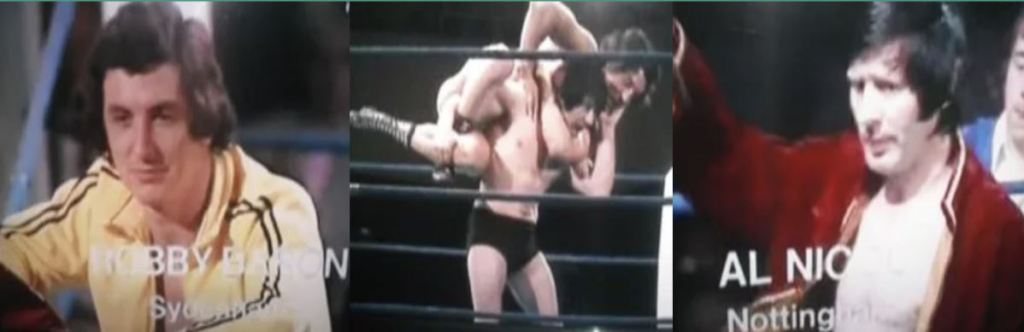
As we have described elsewhere, for instance in The Haunting within this very Armchair Corner section, Wrestling Heritage strives to apportion equal weight to wrestlers’ work in spite of how their prominence in terms of poster inches may have varied.
So we once again here embark upon a review of one of those typical and, yes, even classical opening bouts that were the lifeblood of professional wrestling down the decades; sporting and technical combat over a good 4 or 5 rounds, leaving the door open for rule-benders in subsequent bouts to enrage the audience with unruly tactics quite at odds with this, their own skilful technique.
The introductions were noticeable for a couple of slips of the tongue, with MC Mike Judd having to correct himself to announcing that only one fall was required for victory. Soon after, when repeating the perfectly clear introductions from the Master of Ceremonies, Kent Walton summarised the bout as being “Baron versus Nottingham” – it vaguely sounded like a scene from Robin Hood!
This was in fact the third and final of the two wrestlers’ annual televised bouts from 1971 to 1973. Each would have the very same outcome.
Kent Walton informed us that Baron, at 12 stone 1lb, was giving away 7lbs to his opponent. Then he harped on for rather too long about the experience advantage held by Nicol. It is true that Nicol had first wrestled on television in the fifties, but Baron was now in his sixth year of very regular televised appearances – and he had been active through the mid-sixties prior to that début small screen knockout at the hands of Jon Cortez, often wrestling as Young Robby. But most tellingly of all, the commentator chose not to mention either of the pair’s earlier televised match-ups – thereby omitting the fact that the “inexperienced” Robby Baron had triumphed on both occasions. In truth, broad-shouldered Baron was much taller than Nicol, and looked up to a stone heavier.
At no time did Walton put any value on this Nicol experience and it rather sounded like a euphemism for “old age”. This Midlander was perfectly located to have locked in combat with all the lighter weighted stars down the years, from Jack Dempsey and George Kidd through to Adrian Street Esq. and Jackie Pallo. Indeed he was probably the most frequent opponent Mick McManus ever faced on television. And he featured in many a championship bout. Why on earth did Walton not mention anything of any substance like this?
Equally, the commentator insisted that Baron was lacking in experience, this veteran of 5 nights a week over 10 years. He even displayed dismay at Baron’s increased weight from the welterweight division, and laughably suggested he should lose weight by training down. After three rounds he told us that Nicol would think he’d find things easy against this “up-and-coming youngster”.

The action was varied but marked by the paucity of throws. That notwithstanding, we never felt that there was too much back-to-canvas interaction because the pair rang the changes nicely. They carved out little stories in each round, mostly centred around the weakening of Baron’s shoulder. This allowed them to lock up for protracted periods, but Nicol varied things beautifully by executing a rolling throw in the armlock and, later, an arm wrench and lift.
This was wince-inducing stuff and Baron took revenge by performing a high base of the spine drop, from seated position, to close the second round and Nicol, in great discomfort as a result, refused the handshake afterwards. The commentator failed for the most part to identify this sequence of related manoeuvres.
Other set pieces included Baron doing a George Kidd roll up from which we could not be attacked, though his lanky legs protruded in a way the Scot’s had never done.
At one point we noticed Baron’s shoulders down for a count of at least 6, referee Tony Mancelli clearly aware he didn’t need to be in count-mode as early as round three, and oblivious to the premature ending he should have reeled off.
When Baron finally gained the hat-trick winning fall in round four, with a folding press Walton underlined his surprise by stating he would have lost his money if he had had a bet – he clearly wasn’t a student of form after their earlier encounters!
The commentator’s annoying distractions may have caused this review so far to seem negative. What we actually witnessed was a believable set-to, with a great variety of moves and matcraft. Unsmiling, serious-looking business, to keep the Essex audience engaged and attentive.
Baron’s career is even more intriguing. Walton’s words seemed to underscore that the sixties welterweight should be kept in his box and not outgrow his weight limit. He should be happy with his lot and go on for another decade as an “up-and-coming” youngster, active 99% of the time in very similar opening bouts. Our intrigue centres around the following question: were Robby Baron and many other of a similar status to him happy continually to play this very supporting role? Oh, he did once top the bill at the Royal Albert Hall in tag action alongside Steve Viedor when the promoters finally realised that he weighed over 14 stones. But this high point was a flash in the pan.
It may be that the Al Nicols and Robby Barons of the wrestling world were perfectly happy to build these low-profile careers around technical expertise, and perhaps they were unwilling to develop villainous or comedic sides to their repertoires.
Or it may be that thick glass ceilings were in place to prevent all but a very few worthy and skilled matmen such as these from developing their full potential. If Kent Walton’s words and attitude in this bout are anything to go by, he sounded like the mouthpiece of a promoters’ office reluctant to let out any detail of interest about the wrestlers and their careers, and firmly keeping them in support roles when their actual ability merited much more.
Wrestling Heritage dedicates this review to Robby Baron for the many hours of entertainment he gave us unstintingly over a 15 year career.
 Wrestling Heritage