
Wrestling Heritage welcomes memories, further information and corrections
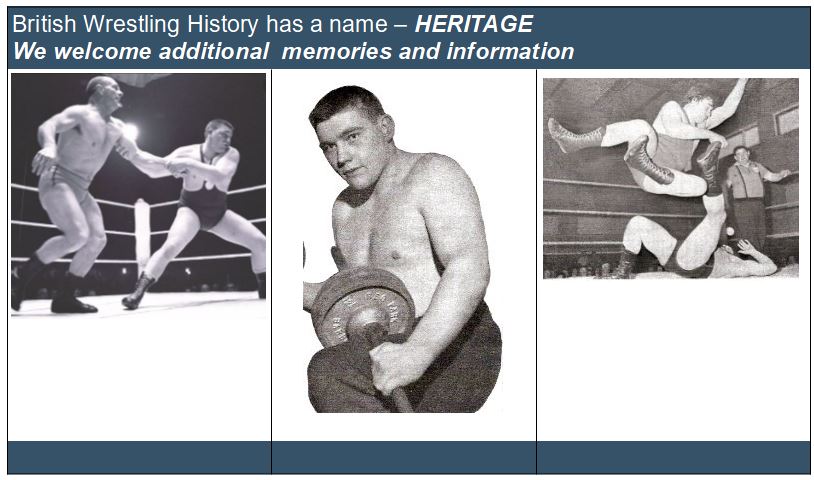

Mighty by name, mighty by strength, and mighty by his generosity and kindness to others. That was Mighty John Cox. John was one of those most receptive to fans seeking a few minutes of his time or his autograph, and it was just the same attitude years later when he would spend many hours recalling his wrestling days with the fans at the Kent Reunion.
Dave Sutherland, the snacks seller at the St James Hall in Newcastle, told us, “I first saw John in one of his early bouts January 1964 and I was immediately impressed.Later I was to find that he was probably the most friendly and approachable wrestler on the go at that time especially during the years that I was working at St James’ Hall, Newcastle. He was always ready for a few words or to tell us about the venues and audiences from his tours abroad.Quite an honour to have two such rewarding careers as both a wrestler and a paramedic and seemingly he excelled at both.“
Two careers because whilst one of the top heavyweight wrestlers in the country John also served as a paramedic for forty years. If that wasn’t enough to keep him busy he was also a member of East Riding of Yorkshire Council, Barmby Moor Parish Council , Pocklington Town Council, Mayor of Pocklington and served on Humberside Fire Authority.
We guess that medical training would come in useful should an inury occur on one pf the programmes that featured John. John’s interest in wrestling began when he served as a first aid volunteer at the SS Empire shows in York. After getting involved in martial arts through judo he trained as an amateur wrestler at the Tingley Amateur Wrestling Club as an apprentice of former heavyweight champion, Ernie Baldwin.
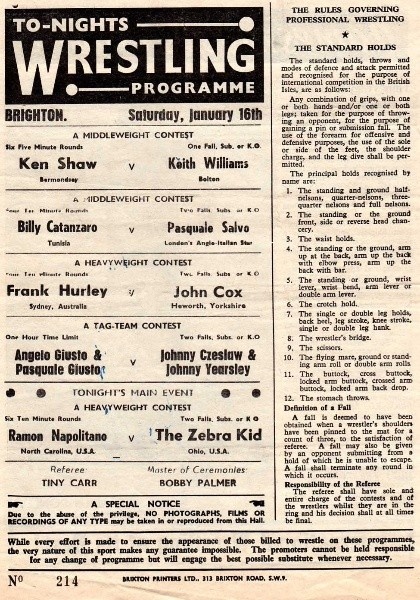
Now the accepted wisdom (if there is such a thing in wrestling history) is that John made his debut in October, 1962 at Grantham against Jim Armstrong. Well that’s what The Wrestler magazine told us all those years ago. Who should question it? Well, this is wrestling, so all of us, of course. Then came a surprise, we found one of those pieces of jigsaw under the wrestling history table that moves all the other pieces of the jigsaw . Ray Plunkett listed a match for John Cox against Frank Hurley at Brighton on 16th January 1960. Our initial thought was this was a mistake. Hold the front page! We were then uncovered a copy of the actual programme from the event. What was John Cox doing deep in Dale Martin land in 1960? Assuming the programme took place as advertised this is now our earliest documented appearance of his wrestling, but we doubt if this was his debut and there had been earlier appearances nearer home.
Wrestling went mostly in tandem with his medical work with each taking priority at different times. In 1964 things began to move up a gear for John and his wrestling career. The first of thirty televised wrestling appearances (source: itvwrestling.co.uk) with a loss against Billy Robinson – talk about a tough start. Time for a decision about the future. Wrestling needed to become a priority for a while, and for five years or so during the second half of the 1960s John put his ambulance work on pause and concentrated on his wrestling career.
Nineteen stones, surprisingly nimble, forever hovering around the division one names of Wall, Davies and Nagasaki, and certainly giving them a fright on many occasions and a defeat on a few. Even Nagasaki, the invincible one, was felled, literally by Big John. Many fans were seceptical of the internet rumours that John had beaten the undefeated Kendo Nagasaki. We managed to find the proof that not only had John beaten Nagasaki but that it was at the near peak of his career, and was no planned inconclusive result. The Haliax Evening Courier reported that John had beaten Nagasaki by a knock out in the third round at the Victoria Hall in Halifax.
One of Nagasaki’s most knowledgeable fans, David Icke, told us that John was quite a threat to Nagasaki in the mid 1960s. In 1966 he had results of the two meeting on more than a dozen occasions with Kendo winning the majority but including several draws and that win.
In November 1965 Dale Martin Promotions called on John to appear at the prestigious Royal Albert Hall, with their programme predicting him to go on to British and world honours. His opponent was the visiting American Catalina George Drake; another hard day at the office. Another international star, South African Jan Wilko was in the opposite corner when John was invited back to the Albert Hall in January 1966, followed by the Japanese star Shozo Kobayashi in October 1968. This man was given no breaks! A fourth, and final Albert Hall outing came in September 1971, opponent Scottish champion Ian Campbell.
By that time John had returned to his medical work in parallel with his wrestling commitments. As a Paramedic he was called upon to deal with some serious incidents. The 21st December, 1988, was a dark day in Britain’s recent history. A transatlantic flight, PAN AM Flight 103, was destroyed by a bomb whilst flying over the Scottish town of Lockerbie. It was Britain’s deadliest terrorist attack, taking 270 lives. Medical staff were rushed to the scene to deal with the incident. John was among three paramedics air-lifted by the RAF in a Sea King helicopter from their base in Pocklington, Yorkshire to Lockerbie. He was one of seven ambulancemen combing the area where Flight 103 had hit the ground. Rubble from the destroyed houses was spread over a wide area. The search party found many body parts but no one alive.
In the early 1980s John began to cut back on his wrestling commitments, but life was not much quieter with his ambulance work, political involvement, and an increasing number of bookings as an after dinner visitor. This man was never short of energy inside or outside the ring.
We end with comments by his wrestling colleague Paul Mitchell, “John was a true gentleman, a great ambassador for the game and a true asset to his community. The last time I chatted to John and his wife I was staying in Skipton on a break and he was engaging and funny as always; not a bad word for anyone in the game and that being a rarity. John got a massive push in 1964 but his love for helping others reduced opportunities later. John had no ego and respected the fans and earned the respect of his fellow workers.”
John Edward Cox, born 31st May, 1939, died 26th April, 2026.
Page added 02/05/2026
844

