
Also known as The Golden Ace
Wrestling Heritage welcomes memories, further information and corrections.
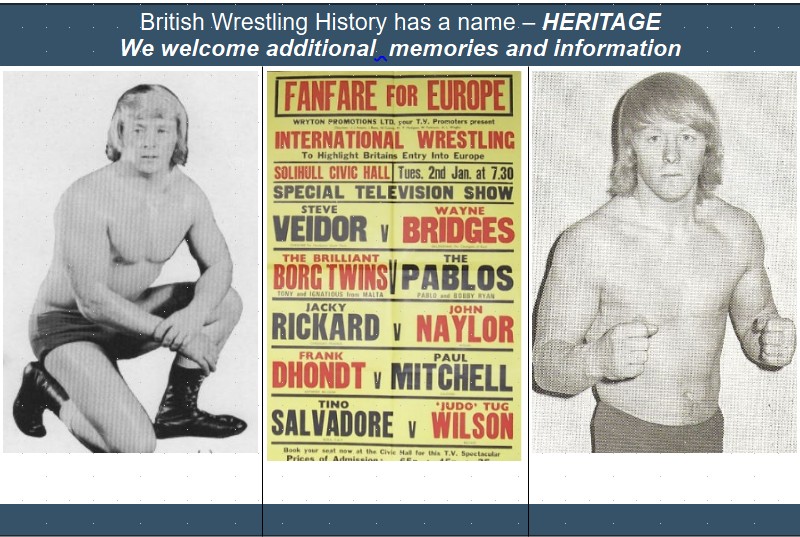
A Man Who Could Make Us All Believe
Standing on the top rope facing the audience, a backwards summersault on to his astonished opponent and the most likely result was a pinfall for John Naylor.
Such moves were to become almost commonplace thirty years later, but in the early 1970s they helped make “The Golden Ace” John Naylor one of the new breed of wrestling stars. Wigan’s John Naylor brought a breath of fresh air to the northern wrestling scene when he appeared in 1970.
In 1970 wrestling was still attracting sizeable audiences, admittedly well down on a few years earlier, but enough to provide a good living for the best wrestlers. In the lighter weights this included Johnny Saint, Jim Breaks, Jon Cortez, Vic Faulkner. Competition was fierce amongst the light and welterweight division and it would take a wrestler of outstanding ability to break through.
Step forward John Naylor. John could match the speed of the fastest men in the ring, but he brought something else. He was one of that breed known as shooters, the legitimate catch-as-catch-can wrestlers who could hold their own with anyone. In other words John Naylor combined the best of two worlds – the speed of Saint and Cortez, and the grit of the hard men Dempsey and Riss. Skill, style, speed, and a healthy amount of aggression; an appealing combination.
The speed and agility should not disguise the hardness of John Naylor. Wrestler Tony Francis recalled to Wrestling Heritage “Many Moons ago I was billed to wrestle Ray Steele, on the pier at Morecambe. When I arrived at the venue I felt quite ill, and even more so when I saw the poster; Ray was never known for his gentleness! Anyway I had to cry off, and as it was too late to get a substitute it was down to Steve Fury to appear twice. Steve did his best, and took the bout to round five, and left the ring absolutely exhausted. Now, the plot thickens. Steves’ original opponent, The Little Prince, had also cried off, but this time a sub had been found….John Naylor!! Well, if Steve thought his match with Ray was hard, John took him to a different plane. Strangely enough, after a large whisky in the bar I was able to enjoy both bouts in comfort. I don’t think Steve Fury has ever forgiven me!”
Born in Wigan in 1944 John grew up in good wrestling company. Having learnt the business at Riley’s gym he could certainly wrestle, and his early professional experience was supplemented with weekend visits to France. Along with contemporaries Steve Wright, Dynamite Kid and Mark Rocco, John Naylor played a significant part in changing the style of 1970s wrestling, but often seems one of the forgotten men of the new breed.
In January 1973 John was one of a team of British wrestlers facing French opposition to celebrate Britain’s entry to the European Community. On that occasion John didn’t sell the Frenchman’s few offensives and literally ran rings around him. There were no handshakes, just protests from Naylor to the referee at occasional and very mild instances of French frustration.
A 1975 ITV Trophy Winner established John as one of the most popular wrestlers on television at the time. In all he made twenty-eight wrestling appearances between 1972 and 1985, with opponents that included Marty Jones, Brian Maxine, Vic Faulkner and Mick McManus.
Ironically it is a match on the BBC for which he is most often remembered. The Big Time was a television programme that allowed members of the public fulfil their dreams. A Burnley school teacher, Keith Rawlinson, trained for around three months before facing a selected wrestler at the Royal Albert Hall. The selected wrestler was John Naylor. The result of the match was as inevitable as it was predictable with John turning Keith’s dream into a nightmare. Just what happened on that night has been open to speculation, with the most frequently offered explanation offered by John’s colleagues being that Max Crabtree wanted John to make it look like more of a match whilst John was keen to protect the reputation of professional wrestling. This was one of four Albert Hall appearances, with the other opponents being Zoltan Boscik, Ted Heath and Alan Sarjeant.
In the mid 1970s promoter Max Crabtree re-named John as the Golden Ace, a name lifted from a wrestler of the 1930s. We frowned upon this nonsense at the time, still do, and hope that John Naylor did also. He was above this nonsense.
The years of training at Riley’s shone throughout his career as John Naylor was, without doubt, one of the finest welterweights of the 1970s. A true professional who defended the integrity of the business. A man who could make us all believe.

Page added 18/10/2026
28587

