
Wrestling Heritage welcomes memories, further information and corrections.
The Top Twenty Ladies of the Wrestling Heritage Years.
Hollywood glamour combines with English aristocracy, battleaxes with business brains, as Wrestling Heritage counts down the 20 (non wrestling) women to have made the greatest impact during the Heritage years. Add the indispensable touches of Heritage mystery and controversy, and a whiff of intrigue that only a femme fatale can arouse, and we present you with an extremely varied and surprising listing.
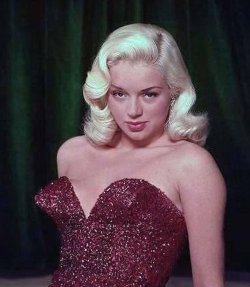
20. Diana Dors
Diana Dors was an English actress who was portrayed in the sex symbol role through the fifties and often described as the “British Marilyn Monroe.” Later she would develop to, as they say, a full-blown heavyweight, but she was seen at her middleweight best in Carol Reed’s 1955 film centred around the British wrestling scene, “A Kid For Two Farthings”. Her co-stars included Primo Carnera, Francis P. Blake, Lou Marco, Olympic wrestler Ken Richmond, and Tiger Joe Robinson. From this springboard of respectability, Diana Dors went on to be a prominent celebrity over the next twenty years.

19. Vera Wilkinson
After Count Bartelli’s final bout against Tarantula, he made a speech officially proclaiming Vera Wilkinson as his Number One Fan. He then stunned the audience by giving to Vera the famous red dressing gown that we had all come to know and love. Apart from being the Count’s Number One fan, Vera must also rate as one of the most privileged fans of all time.

18. Googie Withers
Better known as Googie, Georgette Withers was big British box office before, during and after World War Two, co-starring with greats such as George Formby. Her career peaked in the 1950 film noir “The Night And The City”, centred around crooked dealings in the London wrestling business.The leading pair may have officially been Hollywood’s Richard Widmark and Gene Tierney, but for us Googie and Heritage favourite heavyweight villain Alan Garfield steal the show. The key wrestling scenes feature Mike Mazurki and Stanislaus Zbyszko.The whole film has recently been removed from You Tube, so look out for it when it next airs on television.. Garfield is to be seen lifting weights, and then holds centre screen for a short while.

17. Pam Edwards
Easily identifiable by the letter P she always wore on her lapel, Pam Edwards was commissioned for a brief spell in 1971 by The Wrestler magazine to write her own series of articles entitled “A Bird’s Eye View of wrestling.” This all might seem fairly innocuous stuff forty years on, but her interview with Kendo Nagasaki was unwittingly revealing as the masked man had hitherto always been billed as being from Japan and fans had no reason to believe otherwise. Yet in the interview Nagasaki clearly was quite forthcoming in a way only an English native speaker could be. Around the same time, Pam Edwards co-authored “The Who’s Who of Wrestling” with Joe D’Orazio. Quite how the division of labour went we may never know, but until proven wrong we at Wrestling Heritage will assume Pam compiled the birthdays and Joe did the rest.

16. Princess Paula
Princess Paula (in a managerial role) scrapes in time-wise at the very end of the Heritage Year period but quality-wise her contribution was magnificent. Here we had a formidable woman dressed up in a red Indian head-dress. Definitely all chief, no squaw.She accompanied her man, Dave Fit Finlay, to the ring and played a very full role before, during, and after proceedings. Managers had been few and far between in British wrestling, but Princess Paula’s impact was outstanding. She took her role to even greater creative heights by also openly criticizing and blaming Finlay every time he lost a fall or went wrong. And boy did she go for it, a fearsome sight when fired up and angry – even fellow Riot Squad member Skull Murphy quivered in his boots. Yes Princess Paula was an accomplished wrestler, but it is solely for her role as a manager par excellence that we include the very entertaining Princess Paula. In wrestling rules are made for bending

15. Hilda Ogden
The Ogdens were a new family in Coronation Street in 1964. And wrestling was a new inclusion in World of Sport the same year. National interest was great and Coronation Street moved swiftly to dedicate a whole episode to a bill featuring Chic Purvey versus Terry Nylands, and Wild Ian Campbell opposing, as a substitute for Prince Umpala, Ogden the Terrible, being Coronation Street newcomer Stan Ogden. His wife Hilda did not approve at all and was just as awesome as Wild Ian Campbell in her protests. The episode actually showed a fair amount of wrestling and grimacing and actor Bernard Youens, Stan Ogden, did indeed get to grips with Campbell before being knocked out via an aeroplane spin and ending up draped over an angry Hilda at ringside. Wrestlers hobnobbed it with many another Coronation Street star, including Pat Phoenix, but it is Hilda Ogden, as played by Jean Alexander, who makes the listing here for maximum involvement.

14. Gwen Elrington
Big Bruno’s second wife, Gwenda, also turned her hand to promoting and, by arrangement with Dale Martin Promotions, staged weekly presentations on the South Parade Pier in Southsea, Hampshire.The pair opened a poodle parlour together in the ground floor of their Portsmouth house, but soon transformed this into a regular hairdressing salon, where Gwen dyed Bruno’s hair for the various film parts he took in the late sixties. See her doing her stuff, right.

13. Diana Rigg
Wrestling had an ongoing relationship with the ratings success ITV show The Avengers throughout the sixties.In 1967 the female lead of Emma Peel was taken by actress Diana Rigg and she followed in the footsteps of her predecessor by being invited to star in a James Bond movie.In the 1968 movie “On Her Majesty’s Secret Service”, Diana Rigg played Tracy Di Vicenzo and became the one and only Bond girl to marry James Bond.However, she also got to grips with evil Russian heavyweight Yuri Borienko, who played Gunther in the movie.As a result of this entanglement with a top wrestler, Diana Rigg later became Dame Diana Rigg, and is placed ahead of more passive glamour girls already mentioned above.

12. Kendo Nagasaki’s Auntie
Far more mysterious than her hooded nephew, we see this Blackpool landowner’s legacy in the ever more opulent surroundings used for publicity film of Kendo Nagasaki over the last twenty years. Everyone in wrestling was told that Nagasaki had inherited a substantial sum of money, and we can only wonder how much influence his benefactress had in securing the arrangement for the prized scalp of the great Count Bartelli to be ceded to youngster Nagasaki in March 1966. And perhaps even in setting him up with expensve sword and gown a couple of years beforehand? In the absence of any substantial evidence to the contrary, Wrestling Heritage proceeds with this theory. Could this be her, left?

11. Marion Hughes
In 1963 Marion Hughes became the first non-male journalist to write regularly in The Wrestler magazine. At the time this was a significant breakthrough for the feminist movement. In openly appearing photographed and glamorously dressed, Marion sent a loud and clear message that wrestling was for everyone and the politically correct move worked in everyone’s favour. However, we can only surmise now what obstacles she had faced, but a telling sign was contained in a poem she wrote for inclusion in that year’s December edition in which she thanked her colleagues for her “acceptance” over the course of the year.

10. Klondyke Bill’s Girlfriend
Yet another who can justifiably be described as formidable, Gordon Lythe’s girlfriend featured in the 1972 BBC television documentary about The Klondyke Brothers, from the Philpott File series. We see the 32-stone heavyweight at the supermarket checkout where his paramour works. A battleaxe before her years and before her nuptials, this feisty northern lass confronts her fiancé about why he has failed yet again to insert their forthcoming marriage announcement in the local newspaper. Klondyke Bill certainly loses this encounter by straight falls and trudges off to face a milder opponent in Orig Williams.

9. Betty Addison
Boy oh boy did Goldbelt Brian Maxine land on his feet when Betty Addison appeared on the scene in 1972 to run his Fan Club!There had been many other fan clubs down the internet-less years as fans found a route to find out what was happening in other parts of the country, and of course mostly centred around the clean-cut wrestlers. Indefatiguable Betty had that magnificent marketing edge that knew how to make her club and her man seem appealing. One by one knowledgeable fans signed up, many of them nearly 40 years later occasional or regular contributors to the Wrestling Heritage site. From her Penkridge, near Wolverhampton, base her output of materials, news and friendship was immeasurable. She also found time to correspond on other areas including her beloved racehorse, Red Rum. If Betty were around today, be sure she’d be involved in this Wrestling Heritage site in a big and useful way.

8. Raquel Welch
The American film actress famously appeared in this Royal Albert Hall programme in December 1972. She was in England again to film Bluebeard alongside Richard Burton, and Mick McManus unsurprisingly appointed himself to be the wrestler to meet her on set. Even Raquel’s glamorous support was not enough to save McManus as he succumbed on this bill for the first and only time to arch-rival, Jackie Mr TV Pallo.
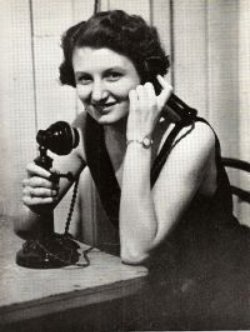
7. Kathleen Look
“Beauty, brains and glamour” allowed Kathleen Look to penetrate the male-dominated area of wrestling promotion in the middle part of the twentieth century.Feminine wiles enabled her to claim the promotional rights at one of the country’s main venues, Belle Vue in Manchester, and she was instrumental in establishing presentations at London’s Royal Albert Hall.In her shimmering dresses she made in-ring announcements proclaiming her annual “Open to All Tournament” and attracted some of the world’s greatest wrestlers with her generous pay-days. Jack Sherry, right, appeared frequently on her shows.
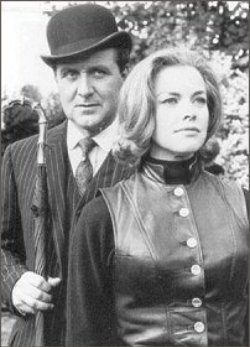
6. Honor Blackman
Jackie Mr TV Pallo’s two main televison appearances of the early sixties were in Emergency Ward 10, and then alongside Patrick McNee and Honor Blackman in The Avengers. Playing villainous gravedigger Scott Sexton in the episode Mandrake, screened in January 1964 and also featuring John Le Mesurier, Pallo was scripted to have a fight scene with glamorous agent Cathy Gale.The actress unfortunately got a bit carried away and Jack finished up in a real-life Emergency Ward after a blow to the head when Honor accidentally let go of the spade they were fighting over. This was big news in the national press at the time.As a direct result, a judo-jacketed Honor Blackman appeared on ITN News explaining the importance of self-defence for women. Her reputation and publicity boomed.All was well by spring of 1964 as the actress, who had now developed worldwide fame as recently-cast Pussy Galore in the Bond masterpiece “Goldfinger” alongside heavyweight wrestler The Great Togo, was introduced from the ring to the Royal Albert Hall crowd by Mr TV himself. In the 1970s, Big Bruno Elrington appeared in two New Avengers episodes alongside Joanna Lumley. Of the various screen actresses we have mentioned, Honor Blackman ranks highest for really getting to grips with a wrestler and scoring a knockout victory!

5. Jennifer Faulkner
Ex-Bluebell dancer Jennifer scores as perhaps the most reported woman in our listing. As early as 1967 she featured prominently in the Granada tv documentary The Wrestlers, in her ballet school where she also had husband Vic stretching as you can see. Coverage in The Wrestler magazine and in the 1970 Mick McManus Wrestling Book followed. As late as 1978 Jennifer was even penning an article herself for the TV Stars Wrestling Annual entitled “The Wrestler and The Showgirl.” In 2010 Jennifer defeated all the Heritage Members as nobody correctly identified her photo from the News page to publicise this Heritage Feature.
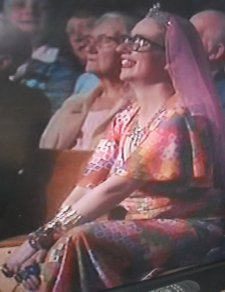
4. Duchess Pandora Verrukalian
Fanpower strikes for the second time in this Wrestling Heritage countdown. The unmistakable Duchess Pandora Verrukalian was a regular ringside-seater at many south London venues from Erith to Croydon through the seventies. Her regal chiffon veils and gowns were topped off by a magnificent tiara, but it was the predatory come hither of a twinkle in her eye that had all the blue eyes in her sights. Wayne Bridges, Lee Bronson but most particularly of all Steve Viedor, as well as many others, all found her lure momentarily irresistible.Later in the decade The Duchess would famously declare how the publication of Wrestling Scene had “fulfilled a long felt want”.A few more fans with The Duchess’s clout and wrestling may have survived a bit longer in the national spotlight. Duchess Pandora was a true visionary who entered into each show American-style and added to everybody’s enjoyment.
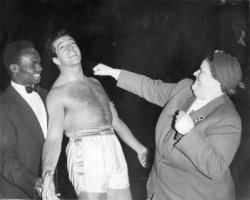
3. Bessie Braddock
Battling Bessie was a Liverpool Labour MP and socialist firebrand in the post-war years.She rose to senior positions within the ruling Labour party of the sixties but it is as a high-profile fan of wrestling that we salute her, though it is clear her interests were shared with boxing. Prior to becoming such a prominent M.P., Bessie had been a regular ringsider at Liverpool Stadium and listed Jack Pye and Dai Sullivan amongst her favourite wrestlers.Bessie Braddock died in 1970 and grunt ‘n groan was denied the support of a potentially powerful ally through its difficult years to come.
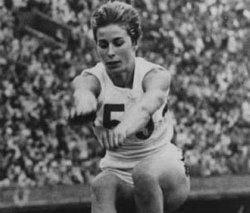
2. Mary Rand
The original Golden Girl of British sport.Long jump gold medallist at the Tokyo Olympic games in 1964, this dashing blonde was successful, it should be remembered, at a time when only a limited number of track and field events were open to women. She was honoured by her peers and the nation when she became the BBC’s Sports Personality of the Year that December, but was strangely overlooked at the highest level of the official honours list. Many other winners were knighted. See Mary making her acceptance speech bottom left.The pinnacle of Mary Rand’s sporting career was when she appeared in-ring on World of Sport’s Saturday wrestling presentation from Bolton in January the following year to present the Television Trophy to Mike Bennett. Wrestling, in time-honoured fashion, nabbed a successful name from another sport: the BBC had enjoyed success at the time with a major Greyhound Racing knockout event, and the 16-entrant welterweight series had followed similar lines since November.Not aired from that presentation was the part of a supporting bout in which Mary Rand enthusiastically performed seconding duties on Colin Joynson. However, with Colin’s wife ringside, the heat intensified and Mary reluctantly withdrew from a role she had clearly been relishing.Mary Rand was a true wrestling fan, however, and Peter Szakacs claimed that the highlight of his own career was receiving from her his trophy for winning an eight-man knockout tournament in Reading. In retrospect we can confidently state that Mary Rand’s involvement with, and unconcealed enthusiasm for professional wrestling, within the body of a multi-sports show, served to cement the idea in the public eye that wrestling was nothing more than one of a number of mainstream sports, perhaps a little more colourful, and with a few eyebrow raising antics.
…………but just before you see the First Lady……………..
We had a great number of guesses at the start of this countdown as to who would be crowned First Lady. Some of those guesses did indeed make the top twenty, so we were pleased members shared our appreciation of the likes of Kathleen Look and Honor Blackman. Others did not and we mention here for completion’s sake Klondyke Kate, Miss Linda (Blackfoot Sioux) and Mitzi Mueller. Remember we had stated clearly that we would exclude women wrestlers, and of course Ladies involved outside the Heritage years.
We do make special mention of one who was overlooked. Tony Francis made a strong case for Anne DeRelwyskow, and we would retrospectively agree with him. Ann took on the reigns of Relwyskow & Green Promotions, enduring to the very end of Joint promotions.
1. Trixie Pallo is The First Lady of Heritage Wrestling.
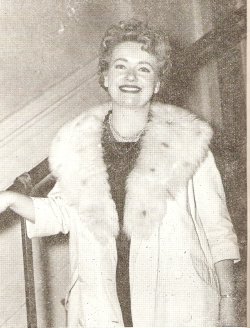
Georgina “Trixie” Pallo was wife of Jackie Mr TV and mother of Jackie Pallo Junior.
We place Trixie at the top of the pack for her contribution to the wrestling spectacle over many years, both by making the ever more outlandish gowns of her boys, and principally through her ongoing ringside presence during many bouts featuring her husband.
Trixie was in fact the central touchpaper that sparked the early flames of wrestling’s greatest ever feud between Jackie Pallo and New Cross’s Mick McManus: in the pair’s third television match-up, to celebrate his pin-fall, Pallo got out of the ring to kiss wife Trixie on Cup Final Day in 1963.
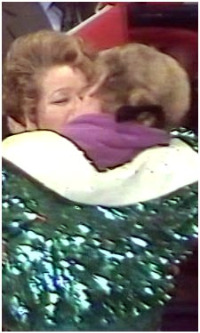
Hard to imagine now that such an innocuous show of affection could have been perceived so sensationally, but it was, in this year of the Profumo affair. So much so, in fact, that versions of The Kiss have become mangled in wrestling folklore down the years: some say it was McManus who exited the ring to plant a kiss on Trixie, others that McManus’s wife was involved.

What is in no doubt is that the prize jewel and the centre of the controversy was mink-coated Trixie Pallo.
The Pallo-McManus feud lasted for 11 years in the ring … and many more outside it.
Trixie was pivotal to Pallo family life. The saying of an even greater woman being behind a great man never rang more true, as she told Eamonn Andrews “My two boys, they are my whole life.” Discretion was another of Trixie’s virtues as she kept Jackie “in the dark” during the months leading up to Eamonn presenting him with the famous red book of “This Is Your Life”
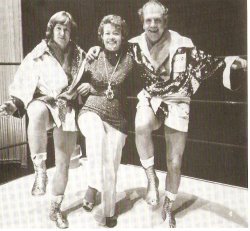
Trixie was also to be seen getting involved in Jackie’s other out-of-ring activities, and the Pallo family even recorded songs together.
In a Christmas 1962 interview in The Wrestler magazine, Trixie had nominated Wimbledon’s Eddie Capelli as her favourite wrestler other than her husband. In the 141 editions of this magazine, she was the only woman to be interviewed and have a whole double-page spread dedicated to her.
A visionary in a realm beyond wrestling, Trixie was arranging her own karaoke sessions many years before the Japanese trend arrived in Britain.
Wrestling Heritage salutes the Pallo family for allowing fans over the fence of privacy for added enjoyment and spectacle all round. We leave the final word with The First Lady herself, as quoted in the Daily Telegraph obituary of her husband in 2002:
“I’ve watched him hundreds of times, but as soon as I see him walk out of that dressing-room door my tummy gets in a knot, I’m ever so proud of him.”
16438
 Wrestling Heritage