
Also known as Raoul Ravelle
Wrestling Heritage welcomes memories, further information and corrections.
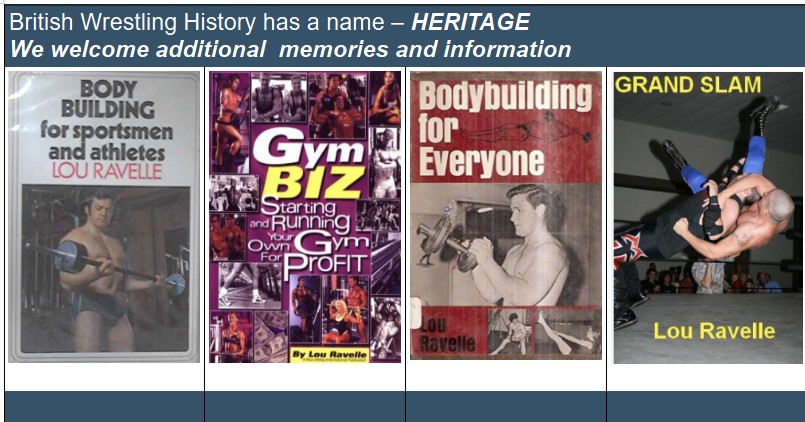
Here’s a man who was at the centre of things. Lou Ravelle was not just a pro wrestler of the 1950s and 1960s, he was a man near to the heart of Paul Lincoln Management, editor of the Wrestling World and Mr Universe and Muscle Power magazines, owner of one of London’s first fitness gymnasiums, a bookshop owner in Bloomsbury, and in later life a hypnotherapist in Majorca.
It was Lou that planned that familiar photo of Dr Death and The White Angel signing the “contract” for their Tooting match, persuaded a famous Hungarian Joint Promotion heavyweight to take the photo, and he told us it was all enacted one afternoon after an enjoyable liquid lunch. Lou was an honorary member of wrestling’s great haunt, the Mandrake Club where the whole industry, Joint and opposition alike, were one big boys club. He told us that most of the London wrestlers would go along to the club after a night’s wrestling. Lou knew them all – Atholl Oakeley, Jack Dale, Les Martin, Paul Lincoln, Ray Hunter, Joe D’Orazio, Bill Benny, and the list goes on.
None of which, or maybe because of which, stopped Lou becoming a fierce critic of professional wrestling in later life and in 2013 authoring a novel that exposed the sport.
Lou took up amateur wrestling at the Manchester YMCA, where he met a young Frenchman who had just entered the country following the end of World War 2. The Frenchman, his name was Jean Morandi, was earning a bit of money by wrestling on fairground booths. It’s the usual story. Lou went along with no more intention than watching his friend and was then persuaded that this would be a good way for him to earn money too. In the fairground booths he learned many of the techniques that would prove essential in the professional ring, and the money was good, “We were paid 15/- for the match. If it was a good match fans would be invited to throw money into the ring, ‘nobbins,’ and from those we could make another 30/- each.”
By the end of the 1940s Lou was working in the smaller halls around south Lancashire. With greater aspirations he made his way to London, living in Notting Hill. In those pre Joint Promotion days he found work with both Atholl Oakeley and Dale Martin Promotions.
A momentous moment, that still played on Lou’s mind when we talked to him in 2012 was the night he wrestled Harry Rabin in June, 1953. It was an occasion that would have an impact on anyone. Lou and Harry wrestled each other at Peterborough in a show in celebration of the coronation of Queen Elizabeth II. The referee for the match was George DeRelwyskow. Harry took a fall. Lou went to shake his opponent’s hand and Harry collapsed at his feet. He was carried to the dressing room where he died. The following Saturday Al Hayes drove Lou to the inquest where a judgement of death by natural causes was declared.
In the mid 1950s Lou befriended a young Australian named Paul Lincoln. His opinion of his friend was, “Paul Lincoln was just another run of the mill worker until he decided to put a mask on and he became a great success. As a promoter he had a rather plush office, in contrast to Dale Martin. He took to smoking cigars, I think he liked the image.”
Lou’s editorship of the Wrestling World magazine proved valuable to Lincoln as he established himself as a promoter. The magazine covered covered both independent and Joint Promotion wrestlers, much to the consternation of Joint Promotions, who refused to co-operate. Lou laughed as he told us “The full face and headdress of Billy Two Rivers on the cover must have made Jack Dale sick.” Lou was adamant when he spoke to us fifty years later that whilst the magazine was supportive of Joint Promotions they “Squashed us and after two years we were forced to fold up.”
Lou’s interest was always more in physical culture and health than professional wrestling. In 1957, and now wrestling for independent promoters, he opened a gym in Sloane Square. A financial backer, Lord Colwyn, who Lou had taught weight-lifting, said the object of the gym was to teach unarmed combat to the sons of aristocrats! Twenty years later he was running three fitness centres. Forget the aristocrats, these were known for providing value for money services available to everyone. He told us the secret was to get results without being expensive. In 1959 the first of his many books, “Body Building For Sportsmen and Athletes” was published.
There was a wider audience for Lou in 1961 when he appeared on the BBC television quiz (they called it a Parlour Game at the time) “Play Your Haunch.” The question posed to the panel was “Who is the All-In Wrestler?” The panel were bamboozled and the wrestler was the most unlikely of the three possibilities, Lou Ravelle.
By now you will have gathered that Lou Ravelle, not the most celebrated of wrestlers, is a man worthy of celebration. If that’s not enough to convince you, in 2004 Lou received the Oscar Heidenstam award for his lifetime contribution to sport. Oscar was named President of the World Amateur Body Building Association (WABBA) in 1977, President of the National Amateur Bodybuilders Association (NABBA) in 1980, and President of NABBA International in 1984.
Amongst all this what was the highlight of his career? A surprise maybe in view of what has gone before. He told us it was the time he interviewed George Hackenschmidt.
In 2012 Wrestling Heritage maintained contact for a few months with Lou. He gave us many insights into the professional wrestling business, which you will find scattered around our site, including his opinion of Bert Assirati, “”Bert was a law unto himself. He did not play the professional game by the professional insiders rules at all. So he did what he wanted, which is why he smashed various people up. It all gave credibility to the game which is something it could well use I suppose.”
Looking back on his wrestling days Lou said that he had a wonderful time and that he, and other wrestlers, often received special treatment. As he was born in 1924 we can only assume he is no longer with us.
Page added 02/03/2025
17437
 Wrestling Heritage