
By Ron Historyo
Cinemas
For sure I have a couple of my own observations about my research of the Manchester Wrestling scene. The first is that you will remember I highlighted the sheer number of cinemas that were rescued to turn into clubs and wrestling halls. Many of them short lived ventures, but nevertheless memorable. For every success like the Wryton in Bolton that lasted about 24 years, there was the brief Bolton Palace Stadium, The Globe at Cornbrook in Old Trafford, the Windsor in Salford, The Palladium at Collyhurst, and many more that I mentioned in the series; all short lived wrestling stadiums.
These single screen cinemas were not put out of business by the later big multiplexes, the biggest reason was the growing popularity of T.V. Even if you could not afford a set in the late 1950’s or early sixties it was popular to rent a set. You could now watch a western on your TV set. Of course some picture houses got a reputation as fleapits, and remember those grubby old half moon ash trays as well.
Simple maths though, if you could not make money seven shows a week then one wrestling show might be struggling. So a good all round club was a chance, with cabaret and bingo, the man on the organ, food as well as a bar, wrestling fitted in.
Music
Right at the end of the 1950’s music was changing and a Teddy Boy era was beginning. Mid sixties we had Mods and Rockers.
Dancing was popular and we had the growth of not old time dancing but modern disco type dancing. It was in this era that I began to find wrestling in clubs being advertised.
Wrestlers were cheap and gave variety to an evenings entertainment. Everything knitted together well. When the Beatles came along, the popularity of this sensational new style grew many times over. Although dwarfing all other groups by their sheer fame, we also saw the growth of other groups that history now records as big in their own right. In the North West we had the Mersey Beat scene and the Manchester beat. Manchester had people like Wayne Fontana, Peter Noone Freddie Garritty and bigger still The Hollies. Graham Nash was a Salford lad.
As we witnessed from the club bills in the series there was room for all of it for a while. My own impression is that by 1965, the main thing in demand was either a famous soloist or a group. Bingo, Comedians and wrestling probably went down the pecking order. There were so many groups that a support group became the norm instead of a support act. There was so much demand and growth of new groups that I get the impression that wrestling was pushed out.
The old formula was still o.k. For Butlins, the Labour Club, the British Legion, but just maybe the really big clubs no longer needed the wrestling. It is an opinion based on what I saw trawling the papers for adverts. Consequently, the nightclub wrestling scene was before my time, a nostalgic era with perhaps a five year peak.
Frustrations
The really tough thing about trying to recapture a glimpse of the history of wrestling around Manchester is that you can nowhere near get enough evidence of the sheer number of clubs that had wrestling on. For every success there are many failures.
For every unusual club that I did find there were probably another four or more that I never found.
Like I found just the one bill for Unique Promotions at the Rainbow Rooms in Patricroft when I wrote part 3 (Salford) you have to regard it as a vital find just to get the one souvenir.
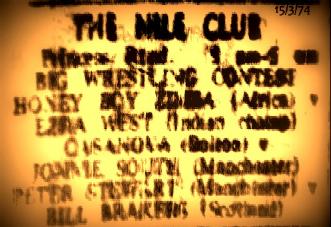
You can also be up against some awful images that just bring a tantalizing glimpse of what you wanted. I have an example here of one of the most rundown clubs you could imagine, The Nile Club in Moss Side mentioned by Eddie Rose in his book.
There was no glass in the windows which were covered with large pieces of carpet nailed to the frames with a drop outside below. Some wrestlers would not work there. The promoter was Ezra Francis. This was essentially wrestling after midnight for a West Indian audience.
This poor image I managed to capture of one night. As a researcher, you convince yourself that the find is worthwhile. After all this is archiving.
Honey Boy Zimba tasted Posh Alderley Edge (part 6) and then The Nile Club, what a contrast.
Also you cannot expect for all events to be documented, if it was good enough for Pontins to advertise wrestling today at 3.00 PM in the ballroom on a chalkboard and have no programmes, then it was probably good enough for a members only club to just make it known that Thursday nights was wrestling night.
Quality
In the 1960’s a golden age continued, there had always been stars and plenty of them, and television had brought wrestlers to our living rooms at four o,clock on a Saturday.
The wrestling schools were churning out lots of new stars and the Russell Club showed us how Wryton were getting these men used to a live audience. Eddie Rose visited the Russell Club as a reporter and confirms the experience school idea.
I did not know when Pallo was fighting McManus on TV circa 1963 that in Hulme people like Ginsburg, Cutler, Roy StClair, Johnny Eagles, Joynson, Keith Willaimson, Herman Veidor were probably fighting in front of a couple of hundred people.
At the the end of the sixties we had Bill Robinson and George Gordienko, and Portz, Davies, Wall, Ian Campbell and worthy tough guys like Elrington, Wild Angus and Mal Kirk. And of course Bartelli and Nagasaki. And in the lower weights just as rich a crop.
Most of us over 60 years old probably feel that by 1970 we had maybe peaked, losing people overseas. There was a slow down in shows, Belle Vue was only weekly in the 1970’s and no more Bank Holiday extravaganzas. Still fullish in 1970, the Kings Hall was half empty at the end of the decade. Despite a rich crop of new people like Dynamite Kid, Rocco, Jones, Kung Fu, Iron Fist, many of us feel that just maybe the best years had gone, and by the time we got Regal and Finlay and Davey Smith there was too much damage to keep them.
So as a young man, I had probably missed the very best myself, but they do say, that what you never have you never miss and maybe at the time I was not aware of any deterioration.
Re-balancing history
Wigan and it’s Snake Pit offered an experience and grounding that was allegedly second to none. Consequently it takes it’s place as a vital feeder to the wrestling game.
But in writing Manchester I have grown to appreciate that there were groups of wrestlers based in Moss Side, Salford, Stockport, and very significantly Bolton. All over north Manchester there were wrestlers and others who lived in the inner city suburbs.
Greater Manchester had been a Mecca. From December 15th 1930 when Oakeley had fought Assirati at Belle Vue there had been a long golden age. Ask the people who are left that are over 80 years of age and they will tell you about a packed Kings Hall. They will recall Jack Pye and Bill Benny, Bomber Bates and Assirati. People settled in Manchester like Carl Van Wurden. Many like Jack Atherton and Martin Conroy lived in central Manchester.
BelleVue
The sixties was a magnificent era bringing in great stars.
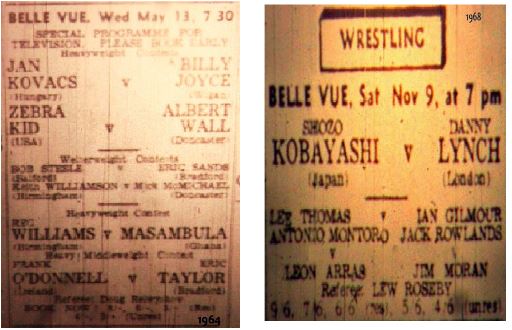
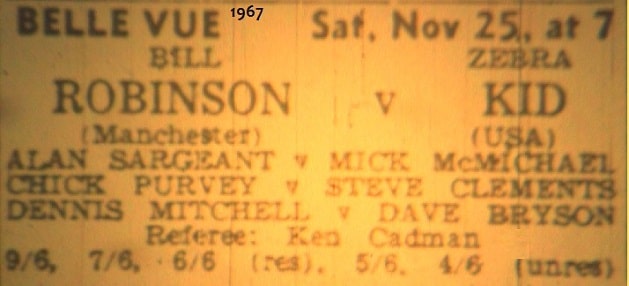
Just unbelievable the array of overseas visitors of high repute, like Gordienko, Starr, Two Rivers, Togo , Maivia, Zebra Kid and a young Andre the Giant.
All that and you also have to unravel the deceptions like Kendo Nagasaki of Japan having an early workout with Geoff Portz, something they went on to do many times over in Canada.
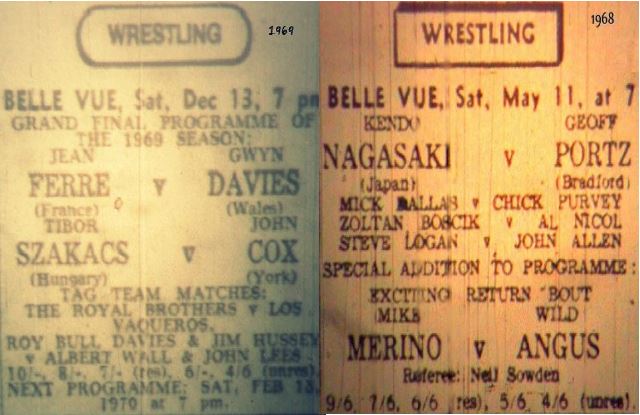
And while many young stars were starting out in the Russell Club in Hulme, Belle Vue was packing in the crowds to see the greatest bouts one could imagine.
Bouts between Billy Joyce and Billy Robinson were well spaced out to not get stale, but became a long running saga. Britain was rich in top class wrestlers. It was much rarer to see men of very different weights matched together because the Joint Promotion roster was huge.
Kings Hall held over 6000, but if you were lucky you might still catch very similar bouts at the Wryton Stadium in Bolton, or other smaller halls than that. These guys had to work.
Originally when I started the series I was not going to write about Belle Vue, but I had done a feature on Altrincham and also Bolton in my Grappling Series. Belle Vue has been done in many ways, many times. But this Manchester series would not be complete without demonstrating the sheer magnificence and presence of Belle Vue in Manchester’s History.
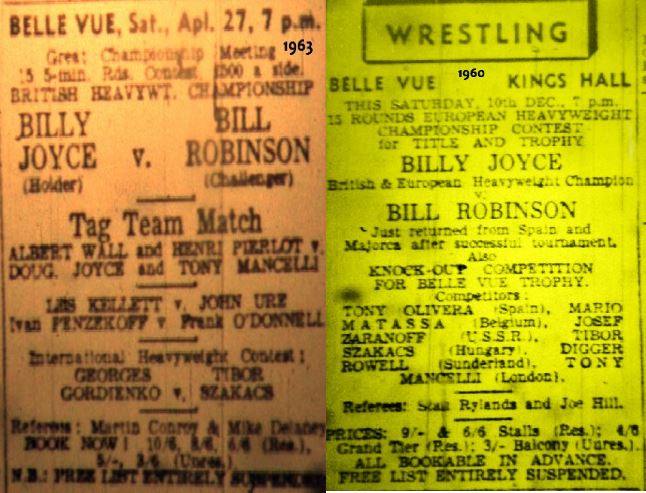
It’s a simple fact that the big stars needed big wages and big wages needed the biggest audiences. Legendary bouts from TV were prime to be repeated at Belle Vue.
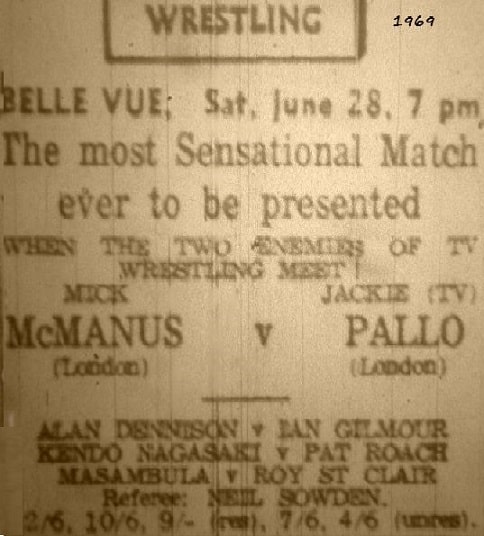
Such was the pulling power of this stadium that in 1969 Mick McManus and Jackie Pallo came north twice to pack out the Hall.
This was a good handful of years after their early TV bouts and in fact they had been meeting since the early 1950’s.
Never the best of friends, I don’t read too much into the rumours of real animosity, they were colleagues who had a great recipe for making money with their well rehearsed act.
You would be hard pressed from all the bills I have displayed to choose only one to go to. The McManus/Pallo match below ended up in a double disqualification. And a pre TV Kendo Nagasaki knocked out a pre TV Bomber Pat. Roach.
As we all know, wrestling in this country did not die, not even when it lost it’s TV slot, and many Heritage members had the time of their lives with 80’s wrestling.
Over this series though in Manchester I have shown the club scene boom and tail away. The many short term ventures of converted cinema’s.
Round about 1972/73 the Stamford Hall in Altrincham was pulled down and in another ten years Manchester Wrestling had to face a future without Kings Hall and Wryton Stadium. Wryton had also doubled as a weekend wrestling school.
If Belle Vue had been Wrestlemania then Jack Cassidy shows had been Stampede Wrestling.
As John Lister pointed out in the Talk Wrestling forum, the Monaco Ballroom in Hindley is still doing shows today, and across the country some of the old places are still going.
It has to be doubtful that wrestling could ever again be as strong round Manchester as these Golden years.
Historyo
 Wrestling Heritage