
Wrestling Heritage welcomes memories, further information and corrections
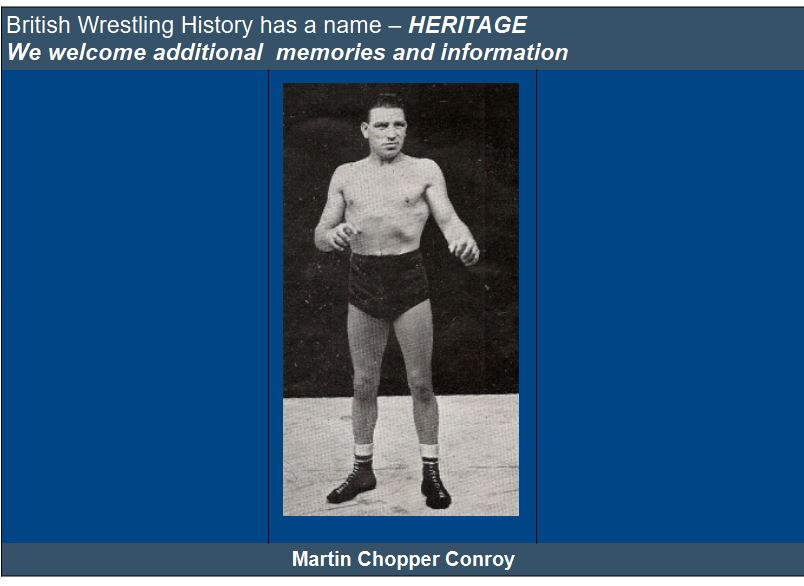
The Conroy Brothers
Piecing together wrestling’s undocumented history can be likened to trying to complete a jigsaw without a picture of the end result. Sometimes we are sure the pieces are in place only to find another one that results in the need to shuffle them all around. Our search began with the familiar, a man we watched in the 1960s and 1970s, Martin “Chopper” Conroy. We knew he had a wrestling career going back to the 1930s with the name Cordite Conroy appearing on wrestling programmes around the country.
Then we discovered a missing piece, or at least Ruslan Pashayev did. There was not one, but two Cordite Conroys. Ruslan told us of his new piece of the jigsaw, “There were two wrestlers who used the name of ‘Cordite Conroy.’ One whose name was Jack Cordite Conroy was a 15 stone wrestler usually billed from London, his earliest results are from 1931 and another called Martin Cordite Conroy, usually billed from Rusholme/Manchester and both sometimes were billed from Wigan.” Ron Historyo was able to confirm Ruslan’s findings. The Martin “Chopper” Conroy we all remember was Martin Conroy, born in 1913. The Jack Cordite referred to by Ruslan was his older brother John Conroy, born in 1903. Their father, worked underground in the coal mines, both father and mother Winifred born in Pemberton, Lancashire. Grandparents had been born in Ireland
Let’s begin with the familiar. Fans of the 1960s and 1970s have fond memories of Martin “Chopper” Conroy. Not so much as a wrestler, those days were long gone, but as a referee, Master of Ceremonies, matchmaker and Director of Wryton Promotions and Director of Joint Promotions. He had a reassuring presence that made us know everything was alright. As a referee he controlled matches efficiently and with authority, but always with a gentle nature that made him a favourite with the mums and nans. As a Master of Ceremonies he projected the image of a legitimate sport suitable for the whole family and on the management side he brought new energy to bills by bringing the likes of Johnny Saint, Al Marquette and Paul Mitchell across from the independents.
Ron Historyo recalled: “When I started going to Belle Vue he was the MC and a very credible one at that. I thought he was always on the side of the fans. He was stiffening up and used to shuffle about a bit and threaten to chop stroppy wrestlers. It got the crowd going. There were clearly people in the audience that had seen him wrestle shouting don’t get Martin at it.”
Graham Brook found Martin genuinely friendly, “I remember Martin Conroy being very personable. I had attended the Stamford Hall in Altrincham one night and was surprised to see him turn up at the bus stop. We chatted about the show for a while and he seemed very concerned to make sure that I got on the right bus.“
More memories, this time from wrestler Paul Mitchell, “Martin was an old school protector of the game and I echo the comments of Graham regarding the time he had for the fans. He had a huge effect on me and he was a gentleman in the true sense of the word. His whisky voice introductions I can still hear in my head after all those years. I remember his great sense of humour and his love of toffees all brought in by regulars which were lined near the timekeeper‘s bell.“
Yet Martin was a wrestling pioneer going back to the all-in days of the 1930s. The name Conroy had been on the posters since 1931, but this was not Martin this was Viper or Cordite Conroy, that is Martin’s older brother John.
Cordite Conroy was an exceptionally strong heavyweight, and one of the best around in the early 1930s. In 1931 he defeated Frenchman Marcel Douvinet and wrestled Atholl Oakeley for the British heavyweight title. In July, 1932 he travelled on the Carnarvon Castle to wrestle in South Africa. He returned to Britain to appear in rings again in January 1933, with reports of a much improved wrestler.
Younger brother Martin began to appear in the rings in 1936. Weighing around 12 stones at the time Martin was considerably lighter than his older brother Cordite John (sometimes Jack), who was still knocking around the heavyweights.
With the outbreak of war both of the Conroy brothers had more pressing matters on their mind than wrestling. When the war ended the name Cordite Conroy reappeared on the posters, but this time with a difference, it was now Martin Cordite Conroy. Martin’s nephew confirmed for us that his uncle Martin assumed his brother’s name after John had retired. For some reason the new Cordite Conroy was no longer a Londoner (where John had lived for some time) but a more exotic Australian!
In 1951 Martin added another name to his repertoire, dropping his Australian identity he was now Martin Chopper Conroy, the name that most readers will find familiar. In the fifteen years that followed Martin wrestled regularly around the country. In the early 1960s he stopped wrestling other than the occasional bout but remained centre ring every night as a referee for Wryton Promotions, later moving to Master of Ceremonies.
Following retirement from wrestling and up to the time of his death Martin worked in the kitchens at St Mary’s Hospital in Manchester.
John Cordite Conroy lived in Wigan until his death in 1976. Martin Chopper Conroy died In Majorca in April, 1980.
A final comment from Paul Mitchell testifying to the ultimate professionalism of Martin Conroy. “He had the knack of knowing just how much showbiz was needed and respected the intelligence of fans.”
Page added 23/06/2023
811
 Wrestling Heritage