
By Asha Grave
Wrestling Heritage welcomes memories, further information and corrections.
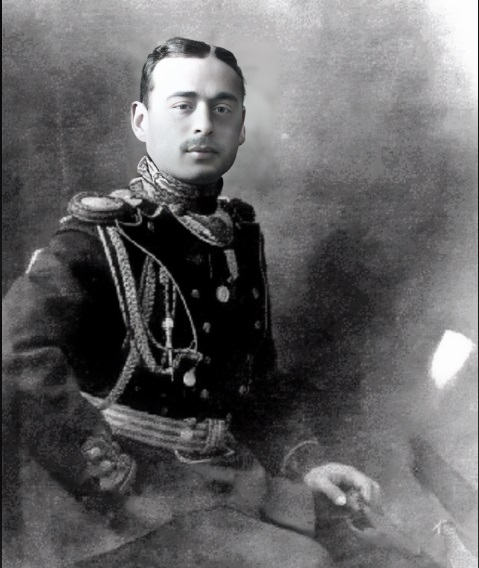
This is a short story of my grandfather Nikolai Grave, a young officer in the Russian army. Nikolai was a nobleman born in Kazan in 1884 and a First Lieutenant (Poruchik) of the Life-Guard Preobrazhensky Regiment.
Following the October Revolution of 1917, the Russian Imperial Army disintegrated. Many officers from the Kazan region fled eastward to escape the Bolshevik “Red Terror.”
My grandfather fled east too. As a captain under the leadership of General Kappel the White Army retreated across the vast expanse of Siberia. In September 1919, Nikolai became commander of the armoured war train Karatel (Каратель = Punisher) belonging to Cossack Governor Semyonov. Nikolai travelled to Vladivostok in January 1920 and landed in Japan by ship, en-route to the Dutch East Indies, consequently losing his Russian citizenship and becoming stateless.
Upon arriving in Batavia (Dutch East Indies) he competed in several cities, including Bandung and Semarang. Nikolai tried his luck by immediately challenging the reigning wrestling champion, Limutkin (1).
Limutkin performed at various venues, such as Pasar Baru in Batavia (now: Jakarta), and Bandung City Square, and he always won.
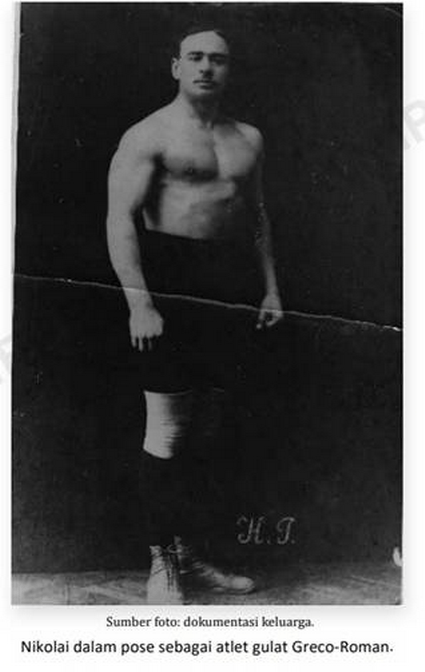
Nikolai posing as a Greco-Roman wrestler.
Photo source: family documentation.
Limutkin boasted that if his opponent could last 10 minutes in the ring, he would be awarded a gold medal. Nikolai tried to take advantage of this opportunity. It is possible that he had no other income besides being a Greco-Roman wrestler and professional wrestler, so he needed to be a winner. Nikolai hid his identity and used an alias, Masque Noire (Black Mask). He was embarrassed if people knew he was making money through wrestling. Admission to the Preobrazhensky Regiment was a marker of extreme social and political standing. Officers were almost exclusively drawn from the high nobility. This matters, because he, as a nobleman was ashamed, wrestling for money. That’s why he hid his face.
Nikolai won the match and received a gold medal. Limutkin wanted revenge and performed a wrestling “show” with ‘Black Mask’ six times. According to the Bataviaasche Nieuwsblad newspaper, dated March 14, 1922, during a match on February 27, 1922 Nikolai suffered an accident after Limutkin jumped and landed on his leg. This incident caused Nikolai to be rushed to the hospital and since then he has been unable to wrestle again.
Because this incident was reported in the newspaper, help and donations for Nikolai poured in and a considerable amount of money was collected. With the money from the donations and contributions, Nikolai decided to buy a plantation concession on the outskirts of Kabupaten Bandung from the Dutch East Indies government.
The Second World War was immediately followed by the Indonesian War of Independence (1945-9) during which Nikolai had his leg amputated. Nikolai and his Japanese wife parented nine children, all of whom left Indonesia and set up homes in the Netherlands, Italy, USA and Japan. Nikolai lived out the rest of his life and died in Indonesia where he is buried.
Asha Grave
(1) Peter Limutkin was a very strong and successful heavyweight wrestler, often described as a giant from Poland or Finland. He travelled extensively in the 1920s and 1930s, active in Australia, the Far East and Europe.
Page added 04/01/2026
22565
 Wrestling Heritage