
Wrestling Heritage welcomes memories, further information and corrections.
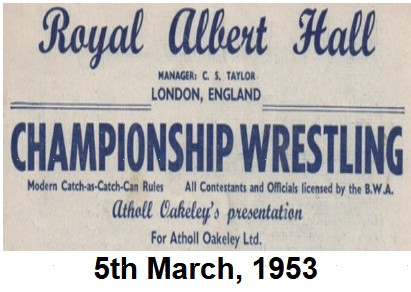
5th March, 1953
Oakeley Marches On
Joint Promotions had formed in March 1952 with southern England promoters Dale Martin joining in January, 1953. They were making headway in establishing themselves as the dominant force in British wrestling having carved the country into exclusive territories and signing up wrestlers under their exclusive control.
None of this stopped Atholl Oakeley continuing a relentless crusade to re-establish his own “Modern Catch-As-Catch-Can” style of wrestling. Give Oakeley his dues, he knew the meaning of the word promoter. He would present lavish star-studded programmes, often with big name overseas visitors.
In October 1952 the Royal Albert Hall agreed to present professional wrestling on a regular basis. The promoter involved was not Dale Martin Promotions as might have been expected but the aforementioned Atholl Oakeley the ex British heavyweight champion and veteran promoter of the 1930s.
On 5th March, 1953, he presented his fifth show at the Royal Albert Hall. The evening before HM Queen Elizabeth and the HRH the Duke of Edinburgh had been in attendance for a charity concert. We like to think they had got their dates mixed up and were disappointed to miss the wrestling.
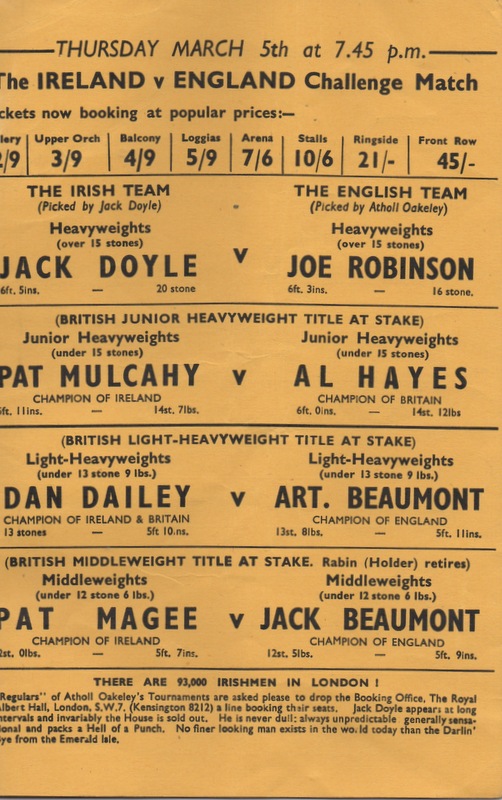
It was Ireland versus England. The Irish team, we were led to believe, was selected by Jack Doyle against an English team, selected by Oakeley himself. Supporting the heavyweights were three Ireland v England championship matches, those being his own British Wrestling Association champions of course, and not the recently formed Joint Promotion Lord Mountevans champions.
Oakeley’s favourite, the former boxer Jack Doyle was matched with Newcastle’s Tiger Joe Robinson. In the event the match did not take place and Gerry Hoggarth came in as substitute for Robinson. Oakeley announced that Robinson had turned up at 7.30pm on the night of the match with a medical certificate saying he was unfit to wrestle. The medical certificate was dated 25th February. Consequently Robinson was stripped of his European heavyweight title, which would now be decided between Doyle and Hoggarth. Gerry Hoggarth stepped in as a last minute substitute and knocked out Jack Doyle The more sceptical may well wonder why Hoggarth, who lived some 250 miles away, just happened to be so conveniently placed. We could not possibly comment.
Doyle entered the ring first. He was said to look dejected and uninterested, failing to acknowledge the crowd when introduced. The round began. Hoggarth was the more energetic of the two, moving around the ring and bouncing off the ropes. When the round ended Doyle had failed to impress and the crowd began to boo.
Round two and an opportunity for Hoggarth when Doyle developed an inexplicable interest in the crowd. Hoggarth attacked from behind tossed the Irishman over and took the first fall.
The action continued. Both men fell from the ring. The referee began the long count to twenty (as required by Oakeley’s rules). Both men tussled and continued to fight outside the ring. With the count at fifteen Hoggarth escaped from Doyle’s grasp and climbed back into the ring. The count continued. Doyle seemed entangled half under the ring. He got to his feet and began to climb back into the ring just in time. Except, would you believe it, he slipped. “Twenty,” exclaimed the referee and it was all over.
A match for the vacant British middleweight championship took place between Pat Magee and Jack Beaumont, billed as Irish and English champions respectively. The scene had been set at the previous show on 5th February. On that night at the Royal Albert Hall the B.W.A’s middleweight champion Harry Rabin had successfully defended his title against Guido Ronga. Oakeley had announced in advance that irrespective of the result this would be Rabin’s final match. The last match working for Oakeley maybe, but Rabin continued wrestling until June when he died in the ring. Following the contest it was announced that Magee and Beaumont would compete the following month for the vacated crown. Beaumont defeated Magee to be announced as the new champion.
A young Judo Al Hayes was being given a “push” by Oakeley, who had already bestowed upon him a British title and booked him three times previously at the Royal Albert Hall. On this occasion he defeated Pat Mulcahy in a match billed as the British Junior Heavyweight Championship.
Wigan’s Arthur Beaumont and Ireland’s Dan Dailey made their Royal Albert Hall debut, Beaumont the winner to take the vacant British light heavyweight championship.
Page added 01/03/2026
25765
 Wrestling Heritage