
Wrestling Heritage welcomes memories, further information and corrections.
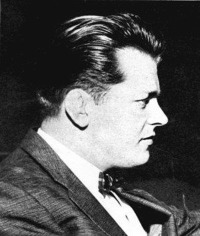
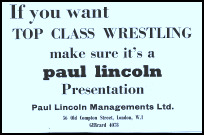

Paul Lincoln Management
Whilst Paul Lincoln was making headlines as a musical promoter wrestling was still very much on his mind.
At the time his music ventures were going from strength to strength there was growing disillusionment in the world of wrestling. Wrestling was booming throughout the country and a number of wrestlers felt that the promoters were making good profits without paying the wrestlers their fair dues.
Within a short time of leaving Joint Promotions Paul Lincoln was staging his own wrestling tournaments. Precisely when he started his promoting we cannot be certain, but we do have evidence of Paul Lincoln tournaments in 1959. He gave up a regular income from Dale Martin to gamble on the unknown.
This low key wrestler of the Dale Martin stable was to demonstrate that outside of the ring he was a man of courage and vision. Courage and vision because Lincoln set out on a mission to change wrestling in a hostile climate. Joint Promotions were beginning to feel more secure in the confidence they now had a television contract, and Dale Martin Promotions were overwhelmingly dominant in the staging of wrestling shows in southern England. Even Atholl Oakeley had packed his bags and gone home.
Nothing stood in the way of Dale Martin in the south and their Joint Promotions partners around the country.
Then came Lincoln.
Marketing, business acumen, known contacts in wrestling and the world of entertainment, add to that the courage of youth; it was a forceful combination that was to challenge Britain’s wrestling establishment.
If he was going to go into competition with Dale Martin Lincoln was determined to do things differently. His friend and editor of Wrestling World Lou Ravelle told us he set up a swanky new office, in contrast to the more basic Dale Martin headquarters, and took to smoking large cigars.
An early success came in 1959 when Ivan Morgan, the manager of the Granada Cinema in Woolwich agreed to allow Paul Lincoln stage a wrestling show in his cinema. The experiment was a success and a turning point for the fledgling company when a contract was offered to promote wrestling in the largest Granada Cinemas around the country.
Within a couple of years Lincoln overcame seemingly insurmountable odds to become a serious rival of the established Dale Martin Promotions. That he promoted with such success was no accident. A shrewd business brain, creativity, innovation and a gift for publicity combined together to bring new life into the professional wrestling formula.
The Paul Lincoln Managements wrestling product was basically the same as that of Joint Promotion shows, but Lincoln’s flair and ability to create a publicity machine that was second to none attracted new fans to the sport. Loyal fans. In 1965 The People sunday newspaper reported of one family that travelled to live wrestling shows five nights a week, but would only attend Paul Lincoln shows.
When Lincoln started his own promotion he was in urgent need of wrestlers. Veterans Bert Assirati, George Kidd and Black Butcher Johnson were working for the independent promoters and were available. But he knew the name Paul Lincoln on the posters would hardly entice the fans. Paul credited George Kidd with the idea of creating a new masked persona, Dr Death. The move was inspired. The supporting role Aussie became one of the biggest crowd pullers in the country and featured on Paul Lincoln shows most evenings. Many of Dr Death’s early matches were on programmes promoted by George Kidd.
Dale Martin Promotions were dismissive of their new competitor, and scathing of some of Lincoln’s business practices. It was those practices that bring us to the vision. Paul Lincoln shows oozed colour and excitement. An array of talent was vividly described on the posters, usually with accompanying photos. Lincoln’s marketing skills shone through. An until now run of the mill Sikh wrestler was transformed into The Wild Man of Borneo, a Glaswegian became the Mighty Chang, and then there was the bowler hatted Society Boy. They were joined by colourful overseas stars Ski Hi Lee, Quasimodo, Ricky Starr and more disenchanted Joint Promotion men Al Hayes, Mike Marino. Don Stedman. Innovation was not superficial as Lincoln nurtured his own talent to fill out the bills – Roger Green, Bob Kirkwood, Dave Larsen, Kim Kendo amongst them.
The roster of wrestlers working for Paul Lincoln at any one time was small, no more than a couple of dozen regulars at the most. Yet his permutations of those men was magical, drawing back the crowds week after week.
Fifty plus years after the event former Paul Lincoln wrestler Bob Kirkwood remains loyal and fond of his late friend. He explained to us why he thought Lincoln was the greatest wrestling promoter of them all. The innovation and the ingenuity were essential but Paul Lincoln had another quality that Bob had not seen in any other promoter. He explained that every wrestler on a Paul Lincoln show was made to feel important. A couple of youngsters opening the show in a run of the mill opener would be told that their calm preliminary match was essential for creating anticipation for the excitement to follow. “Everyone was made to feel like a star,” said Bob, “We were all part of the Paul Lincoln family.”
Lincoln’s promotional skills were perhaps seen at their finest in the rivalry of the masked men Dr Death and The White Angel. Lincoln created a rival for his own evil Dr Death. It was a carefully crafted feud of good and evil that became known to most people in the land, wrestling fans or not. Remarkably all of this was achieved without the aid of television because as a rival to the Joint Promotions organisation there was no chance whatsoever of Dr Death or the White Angel ever wrestling on television.
The quality of the shows plus Lincoln’s flair for publicity gained him a reputation that not only attracted the paying public but also the eye of the television executives. In the Autumn of 1963 Lincoln was in serious talks with ITV to promote the soon to be introduced Wednesday evening tv shows, but negotiations fell through at the last minute and the contract went to Joint Promotions. Lincoln’s business colleague and friend Bob Anthoay told us that the poaching of Ricky Starr by Joint Promotions was the deciding factor in Joint Promotions retaining the contract. There was further disappointment in 1965 when it seemed likely that the BBC were going to present regular wrestling shows but again it came to nothing.
See also British Wrestling Federation
See also Wrestling Federation of Great Britain
Paul Lincoln Promotions
At the end of 1965 an arrangement was reached with Hurst Park Syndicate, the parent company of Dale Martin Promotions, that established a new company, Paul Lincoln Promotions, as a subsidiary of Hurst Park. Lincoln, Ray Hunter and Al Hayes were Directors of the new company. To all intents and purposes the rivalry with Dale Martin was over and the two companies worked in harmony. Although the days of his greatest influence were now behind him, Paul Lincoln was to be remembered, and will continue to be so, as one of the most influential figures in British wrestling. He may not have broken the tv monopoly, but Paul Lincoln changed the face of British wrestling. A man of courage and vision.
Lincoln-Alexander Promotions
We have come across early 1960s programmes presented by Paul Lincoln and Bob Alexander. Who was Bob Alexander? Even Paul Lincoln stalwarts like Bob Anthony and Bob Kirkwood were unable to shed any light on the mystery. Get in touch if you can help.
20965
 Wrestling Heritage