
Wrestling Heritage welcomes memories, further information and corrections.
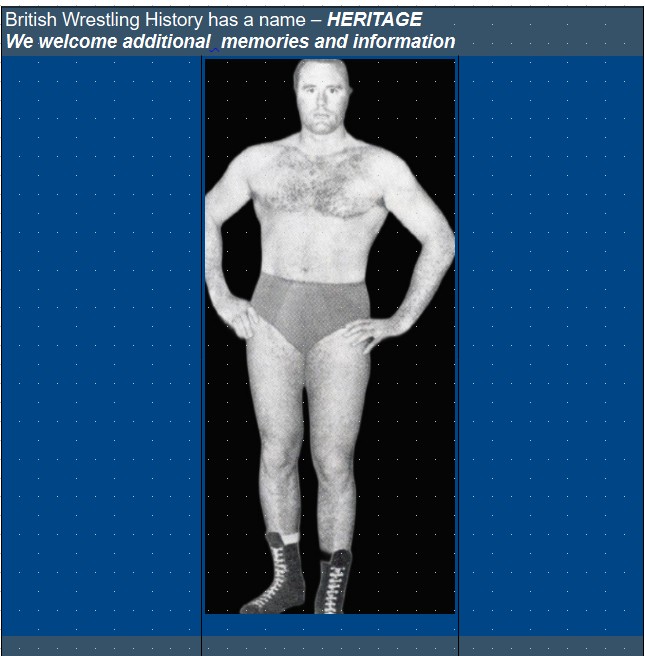
A Rebel Without A Cause
Ray Hunter was a leading light on the Paul Lincoln Management presentations of the early 1960s. Hardly surprising as he and Lincoln were business partners in wrestling management and ownership of the 2I’s coffee bar, the haunt of Tommy Steele and Cliff Richard that played a leading role in the emergence of British skiffle and rock and roll. Lincoln and Hunter bought the coffee bar from two brothers, surname Irani, and re-named it after them. It was a case of coffee on the ground floor, rock and roll in the basement and accommodation for visiting wrestlers on the first floor. There were more Paul Lincoln business connections with ownership of the Cromwellian Club along with wrestlers Al Hayes, Bob Anthony and the original owner, Tony Mitchell.
But we are interested in the wrestling world. It was in 1950 that teenager Ray left his native Australia, heading for Singapore en-route to Europe. We find him in Singapore in November, 1950, for a nine month stay, wrestling Baron Von Heczey, King Kong Emile Czaja and the many locals. His journey continued on 9th August, 1951 when he boarded the The Canton, destination England. His friend Paul Lincoln would arrive in Singapore a month after he had left.
In October we have found him advertised in Britain, possessor of the acclaimed “Alligator Lock” specialist. Don’t ask us, we’ve no idea what an Alligator Lock was. He weighed around fourteen stones at the time, a good three stones lighter than the fans of a decade or more later remember. He formed a good friendship with Irishman Pat Kloke, who took him under his wing and schooled him the necessities for British success. A successful German trip in 1952, South Africa in 1954 and Ray was well on the way to establishing himself in British rings, though with Bert Assirati as a fairly frequent opponent he must have learned the hard way.
October 1953 and Ray made a Royal Albert Hall debut against Abdul The Turk. It was the first of twenty appearances at the country’s premier venue. ten of them before the breakaway to join Lincoln and fellow rebels in opposition to the main promoters, and ten on his return in 1966. Amongst notable Royal Albert Hall successes we can include a win over British heavyweight champion Ernest Baldwin, overseas visitors Jack Laski, Yves Amor, Crusher Verdu and draws against Mike Marino, Paul Berger and Kendo Nagasaki.
Four times Ray appeared in the prestigious Royal Albert Hall International Heavyweight Tournament, 1958, 1960, 1969 and 1970. In 1958 Ray defeated Yves Amor in the quarter finals before losing in the semi finals to the eventual winner, Tibor Szakacs. Szakacs was to prove Ray’s nemesis in the International Tournament. In 1960 wins against John Lees and Jack Bence were followed by a loss to Szakacs in the final; 1969 it was a draw against Szakacs until referee gave a points decision in favour of Tibor, and deja vu in 1970 with a quarter final loss against you’ve guessed it.
When it comes to nationwide appearances on television Ray was in there more or less right from the start, a sure sign that here was a man promoters could rely upon. He appeared on the second ITV wrestling presentation, 27th December, 1955, opponent Dennis Mitchell, and around a dozen times each time of his independent sojourn, until August 1970.
Despite all his success Ray made a surprising (well, surprising to us innocent fans) in March, 1961. He joined his friend Paul Lincoln working in opposition to the dominant Dale Martin Promotions. Lincoln had set up his opposition promotional business a few years earlier and was having some success with aspirations for a share in the lucrative television contract.
Until that move we can find no reference to the Rebel tag, so conclude it was then that plain old Ray became Rebel Ray. Maybe he did consider himself a rebel, but more likely it was because wrestlers on Lincoln promotions were always a little bit larger than life. Whilst at it Lincoln threw in a Commonwealth heavyweight belt, courtesy of a win on 6th June 1961 over Prince Kumali at Southampton.
Whatever the reason there are fans that felt Ray could only benefit from this makeover. That’s because although he looked the part, was valued by promoters and possessed considerable skill he has been criticised for lacking colour.
Palaisfan told Wrestling Heritage: “He clearly got around a bit and must have been respected enough within wrestling to be in the ring with the likes of Gordienko. My memories of him are that he was tall, well built and strong, but not very charismatic or particularly exciting to watch.” Wrestlefan said: “Ray Hunter was a classic case of the wrestler who looked right, but had a nervous little man lurking within.”
Djg4jan disagreed:“He had great bouts with Dr. Death, Don Steadman, Ski Hi Lee and the numerous foreign villains who came to our shores. Excellent tag matches with Al Hayes.”
For four year Rebel Ray did indeed headline programmes for Paul Lincoln Management and other independent promoters. In 1966 Lincoln merged with Dale Martin and he returned to the Joint Promotions circuit, albeit with his feet well and truly rooted in southern England. Within the Joint Promotion group a new company, Paul Lincoln Promotions, was formed on 30th December, 1965, with Ray Hunter now one of it’s Directors. Not bad for a rebel.
The return to Joint Promotions brought regular bookings, more Royal Albert Hall shows, more television appearances and a place on one of post-war wrestling’s most prestigious events. It was Wednesday June 8th, 1966. It’s hard to believe with 5,000 fans inside the Royal Albert Hall, and thousands more viewing live on cinema screens around the country, there were still an estimated 3,000 disappointed ticketless fans left standing outside with an unexpected night on their hands. To say this was the night of the year would be an under-estimation. Mick McManus and Ricky Starr topped the bill, also present was Dr Death, Mike Marino and Jackie Pallo. The sole heavyweight offering was Rebel Ray Hunter against the American Samoan Peter Maivia.
Putting that glorious moment in context our impression is that after 1966 Ray Hunter settled into a prosaic, routine workrate, leading David Franklin to comment, “he did not seem interested in doing any more than turning up and doing as little as possible…. perhaps by the time Joint Promotions took over he had simply lost interest.”
Ray Hunter left our rings in 1971. SaxonWolf has told us he met up with his friend Al Hayes in the USA the following year, “He re-connected with his old pal, Judo Al Hayes (now Lord Alfred Hayes) and spent five weeks touring around Texas and New Mexico in singles and tag matches, often teaming with Al Hayes, as you would imagine.”
Post 1966 appearances may well have led to negative comments from fans, but here was a man with his moments who by the end had become a rebel without a cause.
26115
 Wrestling Heritage