
Wrestling Heritage welcomes memories, further information and corrections.
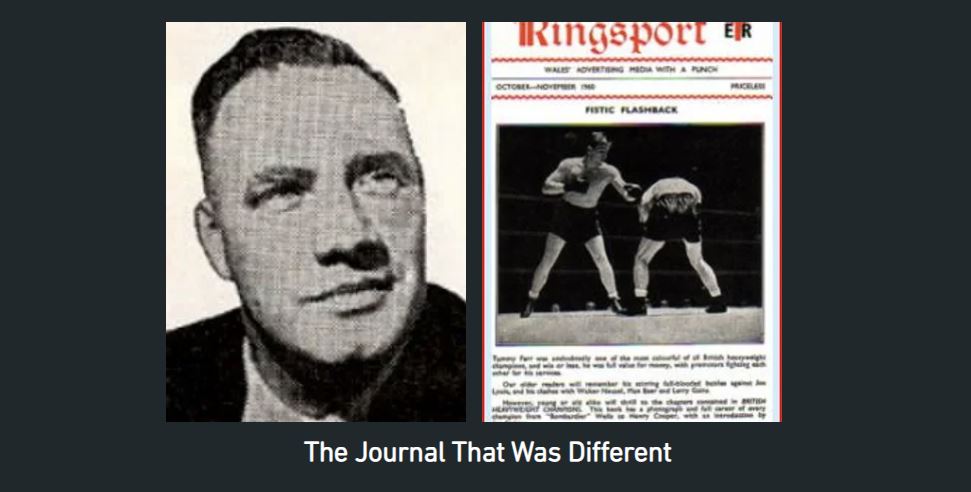
We celebrate today a part of wrestling’s heritage that seems to have been forgotten or too easily overlooked by fans of the post war wrestling era.
Fans recall The Wrestler magazine, but long before the Wrestler appeared on the news stands, and long after it had ceased trading, there existed a lesser known magazine, Ringsport. Fifty years or five decades; say it how you like but it’s pretty amazing to take note we are nearing half a century since Ringsport magazine was launched.
Ringsport is fondly remembered by those who read it, but circulation difficulties always meant that this magazine which proclaimed itself “The Journal That is Different,” would always remain in the shadows of its more illustrious counterpart.
Forty years ago Evan told us that he had underestimated the overheads of publishing his first magazine, with most of the profits going to printers, distributors and newsagents. With his new venture Evan was determined that things would be different.
Ringsport was different.
For starters it began life as a boxing magazine. Boxing was the first love of proprietor Evan R Treharne. Evan’s early journalistic experience had been as a boxing reporter in south Wales, and he was employed as programme writer by some of the better known boxing promoters. In the 1940s he became a published author of books about boxing, including “Among the Heavyweights,” “Famous Heavyweight Fights,” “The Fighting Guardsman” and later “British heavyweight Champions.”
He both boxed and wrestled as an amateur. These interests were apparent when Ringsport was launched in August, 1959.
The balance of the magazine soon changed to a mixture of contemporary wrestling and boxing heritage, largely because Evan’s home in the South Wales town of Caerphilly made it difficult for him to keep in touch with the modern boxing scene.
Ringsport also differed because it could not be bought in the news agents.
Distribution costs had played a significant part in the failure of Evan’s previous magazine, Combat. These costs were slashed by selling Ringsport directly to the public either by post or in the halls. Evan was a familiar figure in the halls of South Wales, selling copies of his magazine. An army of volunteers formed the sales force in halls around the country. They were paid little, or even nothing for their endeavours, but this was the sort of loyalty that resulted from Evan’s enthusiasm and warmth.
The biggest difference was the price.
The magazine was free, in its early years anyway. By giving the magazine away circulation figures could rise dramatically, doubling and then quadrupling with the first three issues. All the overheads, and a small profit, were covered by the sale of advertising. In later years, when a cover price was introduced to meet rising costs and worldwide circulation, Ringsport continued to produce a Welsh issue filled with advertisers, many of whom had been associated with the magazine from the early days.
Costs were kept to a minimum in every aspect of production. Wherever possible the printing and distribution costs were slashed by Evan doing much of the work himself. There were no plush offices or fancy trappings. The headquarters of Ringsport Publications was a small terraced house, front door opening directly on to the footpath, in Stockland Street, Caerphilly, a small town in South Wales.
The magazine was also unusual in that the breadth of its coverage was much greater than that of The Wrestler. It covered the whole wrestling scene, the independent promoters as well as Joint Promotions. Ringsport was the only place to read about the early careers of Johnny Saint, Al Marquette, Johnny Kincaid, Klondyke Bill and other stars of the independent circuit. “A lot of wrestlers owed a great deal to Evan,” said Eddie Rose, “and promoters too. Ringsport was the only magazine to publicise many wrestlers. Evan was very generous too. He would happily publicise one of our tournaments, often a double page spread, and take no money at all.”
Amongst contributors to the magazine were wrestler and promoter Jack Taylor and the great heavyweight, Bulldog Bill Garnon, the Fishguard heavyweight and erstwhile champion. Bill Garnon and Evan Treharne were lifelong friends, and late into his life Garnon would travel regularly to the Sophia Gardens, Cardiff, to watch the wrestling, write a report and meet up with his good friend. Evan himself was the main contributor, using a variety of names.
The magazine was very much a family affair run by Evan and his son, Edward. Contributors considered themselves friends of the family. Indeed, many readers considered themselves part of the family, and it’s a wonder how Evan found time to publish the magazine as he seemed to spend so much of his time in correspondence with readers of the magazine.
One such fan was John Shelvey, a reader who lived in Torquay at the time, but is now resident in Australia: “When I was living in Torquay I would ‘phone him now and again and he was always a delight to listen to. I tried once to get him to fill in a little questionnaire I had prepared. He was brief and to the point with all his replies along the lines of ”(what school did you attend) ”THE SCHOOL OF HARD KNOCKS”. He appeared to idolise Bill Garnon and wrote about him frequently. Very old school. I’m sure Evan corresponded with many fans and equally sure they would all recall an anecdote or two. I’ve got quite a few of his mags. including some of those larger books where he would cobble together several issues into one thick tome. Some of them have travelled over 24,000 miles with me!!!!!!!!!!!!!!!”
John pulled out of his filing cabinet, at random, two of Evan’s “journals” as he sub titled them. One heralded the ”19th Year of Publication ” No. 176 with a photo. of Tony St.Clair carrying the British Heavyweight Belt over his shoulder. Inside was an Historical piece on Jack Sherry and boxer Jack Peterson along with an article by Evan’s best friend Bill Garnon titled ‘A POWERFUL NECK’. Inside were pictures of the likes of Rocco, Marino, Roach, Gillette and Nagasaki as well as a back page of LADY WRESTLING IN JAPAN. There were also a few ads, one by G.I.Taylor selling his promotions including the gem ”T.V. Stars available – subject to availability!
John’s random selection illustrates the fall of the magazine. A boxing orientated magazine that increasingly featured wrestling, became a small but significant part of the wrestling scene but by the late 1970s was showing signs of decline. John’s sample contained articles and photos that had previously been published, and an editorial content that had had begun to lack direction and attention to detail. By the end of it’s life the magazine was a shadow of its former self.
The challenges facing the magazine were immense. The high inflation rate of the early 1970s combined with production stoppages by electricity, coal and postage strikes were all difficulties that Evan endured but managed to overcome.
The late seventies was a difficult time for all those involved in the wrestling business, and many have told us of those who failed to support Evan at this time. Promoters, some of whom had been greatly helped by Evan in the early days, now refused to allow the sale of Ringsport in their halls. Almost entirely dependent upon postal subscriptions the magazine became increasingly prey to rising postage costs.
Evan became increasingly desolate the magazine began to suffer, with John Shelvey recalling one of his handwritten notes to Evan appearing in the middle of one of his published articles.
The demise left many feeling sad at the loss, and now a quarter of a century later there are those who have regrets. Dennis Lord ponder whether he could have done more to help a good friend, John Shelvey regrets never getting round to visiting Evan, he was about to make the journey from Torquay to South Wales a couple of days after Evan died
In retrospect the demise of Ringsport was inevitable. Fans were staying away from the halls, and within a few years there would have been nothing to report. The loss of Ringsport for manyt was more tragic than the loss of The Wrestler.
The closure of The Wrestler meant the loss of a magazine. The closure of Ringsport was the loss of a friend.
 Wrestling Heritage