
By Ron Historyo
Wrestling Heritage welcomes memories, further information and corrections

Sam Moores
I have an affinity with Salford.
Dad was brought up there and we go back three or four generations on his side, right back to those ancestors who came in from rural parts during the industrial revolution. Many people in the 1800’s made it their home and never went back. The pull for my own ancestors was work on the railways and in the warehouses.
Sam Moores was born in 1862 and grew up in Salford. Over the years the city of Salford was to expand into a Metropolis stretching to Little Hulton, down the A6 and Cadishead down the A57. Even before this there were suburbs, the main demarcations were Pendleton and Broughton and Salford itself. Once here Sam Moores was of Pendleton.
But there is the thing, Sam was born in Mill Lane Passage, Sutton, Macclesfield on 7th October 1862 and was the youngest of several siblings. His sister and two brothers it would seem had been born in Leek, indicating a family moving about.
In 1869 dad Sam, born Macclesfield, a Mason, had died in Prestwich Lunatic Asylum and mother Martha was left with the family in Pendleton. It all fits really. Macclesfield was a silk weaving town and widow Martha became a silk weaver in Salford. In 1873 mother also died and I assume that the older siblings were able to bring Sam up. Thankfully the girl Christina was a young adult (assumed role) It would not have been long before Sam was working, possibly as early as 12 years of age and probably as a Pit Boy.

Just shy of his nineteenth birthday Sam Moores married Elizabeth Tongue in Salford and was by then a collier.
By 1882 Sam Moores can be found in the newspapers wrestling. He was living at William Street in Pendleton . Such was his stock that by 1890 he was often referee at some contests. In these far back times Wigan did not dominate Lancashire Wrestling.
Although born Wigan, the famous Tom Connors was also adopted by Salford and had the Cattle Market Tavern. I had thought that Lauritz Neilson, the migrant from Denmark was the first famous Salford Wrestler. But Sam Moores is also in the mix. Oldham and Ashton -Under-Lyne were also centres of wrestling in those days.
Strange now to look back on the BBC wrestling documentary that Heritage took part in. The wrestling was traced from the Music Halls, featuring Hackenschmidt, but you won’t learn much about Lancashire wrestling studying Hackenschmidt.
London was the place to show Greco Roman Wrestling. Lancashire style was that fierce dog fight that at that time was unknown in the south.
When I wrote about the Hindley wrestler Joe Carroll I explained that the man who changed all this was known as Jolly Jumbo when in 1899 he put on a festival of sports at Easter at Kensal Rise in London.
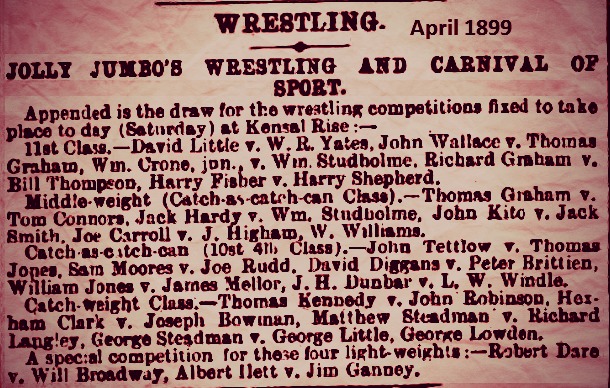
Jumbo (William T Ecclestone) was offering train fares to Lancashire wrestlers and championship belts and putting Catch Wrestling on an equal footing with all other wrestling styles. Indeed, within ten years it virtually saw off Greco Roman.
Joe Carroll had won the middleweights but I have not told the story of the light weights.
Sam Moores had been Lancashire Champion for many years and now this was officially open to all England with a belt at stake it was a turning point for Catch Wrestling.
In the first round Sam Moores beat Joe Rudd, the Wigan wrestler. The crowd was over 1000.


By the finish three men had tied at lightweight. Jim Mellor of Stalybridge, Tom Jones of Wigan sometimes known as Burgy Ben, and Sam Moores. Jolly Jumbo had an opportunity here to promote another contest in May in Manchester at the Free Trade Hall. It is not quite clear what happened, but Jim Mellor dropped out and Moores was to fight Jones, with the bout reaching a time limit it was drawn.
A final attempt was made to get Jones and Moores together again in Manchester. Moores had put down a stake and Jones had failed to turn up and match it. It may be that Jones objected to the bout, if drawn, being decided on points.
Moores and Jones had previously argued in 1898 about venues, Moores preferring a hall and Jones a field. Jolly Jumbo had presented Moores with the belt certainly by August of 1899 and whatever the disagreement was about the facts are that from that day forward Moores agreed to defend against any man in the world at that weight.
By this time Sam Moores had his own beer House on Laundry Street in Pendleton. His days in the mines were over.

Whilst there may have been friction between Moores and Jones the third man in the Kensal Rise Trilogy Jim Mellor proved to be a regular opponent of Sam Moores. I can actually find five occasions in the papers when they fought. Mellor was by eight years the younger man.
They met in 1897 at the free Trade Hall and fought a drew. I have them fighting at The Snipe Inn Grounds in Audenshaw in 1898 and again a draw, but how different fighting for an hour in the mud. It had rained heavy that morning. Great to hear though that the draw was agreed with a hand shake.
In February 1900 they fought again at the Free Trade Hall with Moores the winner, and so popular was this bout that they put it on again at the Drill Hall in Stalybridge in April.
Both men were injured that day and Moores was struggling. As it was in those days Moores paid Mellor £10 to buy a draw and it was agreed. Very late in Moores career, in 1905, these two men were perfect for a display at Broughton Rangers Football ground. By now Salford had a school of wrestling, the well known Lauritz Neilson and Tom Connors with his public house and Sammy Moores now with a Beer House at 38 Broughton Road Pendleton.
For those attracted to this sport in Edwardian times, this part of Salford must have been buzzing with enthusiasm with all that was going on. Indeed at that time it could stand shoulder to shoulder with Wigan. Moores, who had been well respected won this match, now in the twilight of his career.
In 1908 Moores lost his wife Elizabeth and was left a widower. Over the years they had ten children, three of whom had died. In 1911 at the Pub Sam Jr was barman and daughter Lilly was House Maid.
Also in 1908 what may have been Sam Moores last match, maybe more of an exhibition against Peter Gotz at the Hippodrome In Westbar Sheffield.
On the basis that few left Salford and I have the right man, in the right town and the right age, I would say Sam Moores lived until 1936, but this could do with being substantiated.
Unlike the other Pioneers that I have written about I cannot say that Sam Moores was of the Alhambra Age. He was not really a Music Hall Wrestler and takes Heritage reader’s back on a journey in time to wrestling in fields.

Lancashire wrestling was not a national sport but a local one. Sometimes covered by the newspapers but one must understand that back in the 1880’s many of the fan base would be unable to read or write. Wrestling was not a Saturday night out as we would later know it. It was a cloth cap audience with bets and side stakes in any sort of weather with matches sometimes concluded on another day at another venue.
What really fascinates me are some of the venues and the alias’s of some of the wrestlers. For instance, if Sam Moores fought at The Larkhill grounds in Farnworth his opponent might have been “Bulldog”. At the Snipe Inn mentioned it could have been “Tea Pot,” a guy called Joe Newton. Think of Failsworth and you might think of Johnny Saint, but how about John Street known as Lack Leech at the Moorfield grounds?
There was Troot of Oldham, R Winstanley of Wigan known as Cisley. William Winstanley was known as “Soap”. Even Tom Connors was known as “Little Pompey”. In 1883 Moores fought “Wash” who was James Faulkner of Tyldesley, at the Higginshaw grounds in Oldham.
One more name is Burgy Ben, the man mentioned as Tom Jones of Aspull, Wigan. This takes me back to that famous day at Kensal Rise in 1899 when Lancashire went to London and the first belts were fought for.
My co researcher Ruslan Pashayev has donated a photo to Wrestling Heritage as well as some considerable expertise. Look at that history below.
This takes me onto another problem.
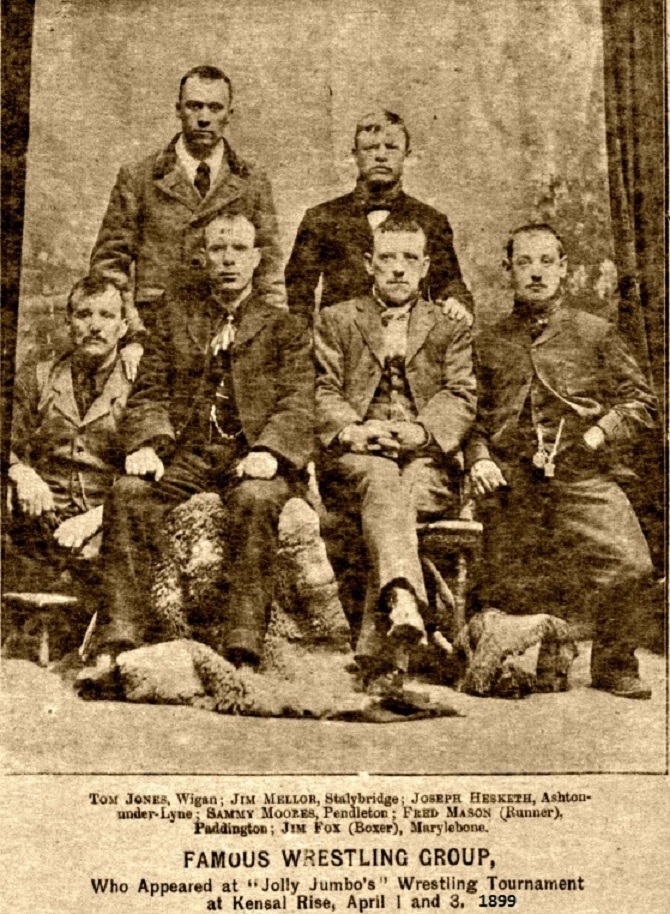
Not long ago I wrote an article On The Trail Of Mysteries and how difficult it can be to be conclusive. In that photo we have a boxer, a runner and four wrestlers who took part. I have shown a sketch of Sammy Moores in 1898 and I favour front left seated as a real image of this man.
I would have thought seated middle left. Also photo of Tom Jones (Burgy Ben).
Is it seated left to right, Moores, Mellor, Jones?. (The lightweights.). Or am I wrong?
I do not think the sportsmen have been named in a logical order. But it is another mystery, you the reader are entitled to form a conclusion. What you are looking at is quite a piece of history from an age that we will never see again. We have had a trip back in time before the Music Halls into the fields and paid tribute to a great light weight champion, the first to hold a belt like we have known our champions wear.
For me a man who Salfordians can be proud of.
Ron Historyo
Postscript
In March, 2025 we were pleased to hear from Sam’s Great Granddaughter, Lee-Ann. She confirmed that Sam died in 1936 and was buried in Agecroft Cemetery, Pendleton.
17899
 Wrestling Heritage