
Wrestling Heritage welcomes memories, further information and corrections
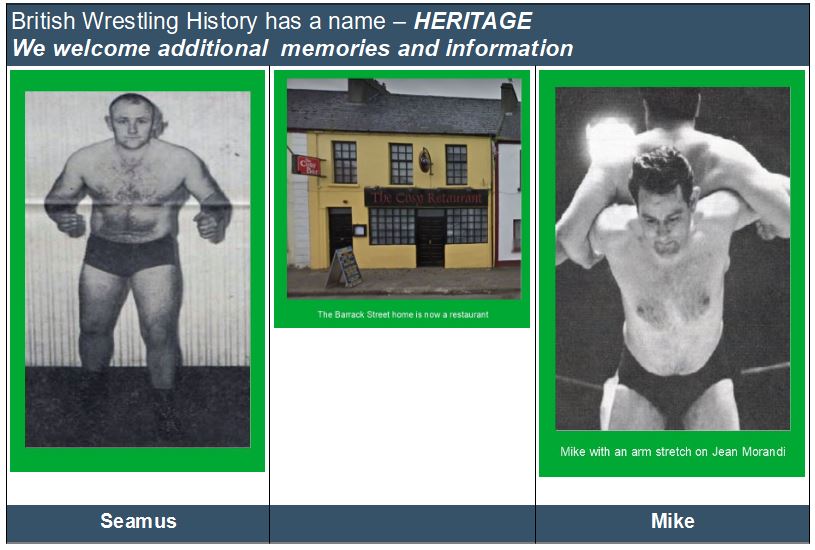
Charlestown, a town of around a thousand inhabitants is sometimes referred to as one of those places that time forgot. In the “Death of an Irish Town” it was used as an example of the repercussions when Government policies failed to support rural areas. It was in this small town, just inside County Mayo bordering with County Sligo, that were born two fighting Irishmen of 1960s British wrestling, the Donlevy brothers.
It was in 1932 and 1934 respectively that carpenter Michael Dunleavy and his wife, Mary Kate, parented Michael and Seamus. The boys were born in Barrack Street, part of a family of nine children. More than a century later we can only imagine the hardship of the family, eleven of them crammed into a three bedroomed terraced house, surviving on the earnings of a carpenter and meagre takings of a tiny shop that doubled up as the village bar. No one in the town had lots of cash to spend. At the time of writing (January 2021) the house in Barrack Street is still in commercial use, as the Cosy Restaurant.
Work sometimes took father away from home, to other parts of the country and further afield. The route from Ireland to northern England had been a well trodden path since the mid 19th century when around a million people fled the country during the Potato Famine (1845 – 1852) many of them heading for Liverpool where they dispersed to seek agricultural work in the north and midlands of England.
The journey to Liverpool was the one taken by Michael Senior around 1940, finding work as a carpenter in Liverpool docks. As the years went by many of the children made the same journey, the takings from the shop insufficient for a family of four girls and five boys. This was the journey made by Seamus, and later Michael, some years later, not long after leaving Lowpark National School, now converted into a shop.
Born on 28th November, 1934, James Dunleavy was the birth name but he was always Seamus at home. Seamus followed family members and made the journey to England in 1952. The plans had been taking shape in his mind for years – he was going to England to become a famous boxer and earn lots of money to send home to his mother. As it turned out Seamus found work as a general labourer and did pursue his boxing interest. He joined Duffy’s Boxing Club, which shared premises with the Pegasus Wrestling Club. It didn’t take too long before Seamus decided he was better suited for wrestling than boxing.
As runner up in the Northern Counties Championships in 1954 Seamus qualified for the All England Championship, held in the Empress Hall in Haringey. Seamus made his way through to the final, where he lost out to Harry Kendall, a man who he would meet again years later in the professional ring.
Seamus didn’t turn professional straight away. He continued hard grafting with occasional visits back to Ireland. Seamus and brother Mickey moved to Birmingham where they thought there would be more work opportunities, which there was. A friend was a relative of Billy Riley and introduced Seamus to Billy. This resulted in regular trips from Birmingham to Riley’s gym, learning the business alongside Billy Joyce, Bill Robinson, Jack Dempsey and the other Wigan lads. Seamus started wrestling professionally following a stint on Matt Moran’s wrestling booth. Billy Riley was keen for his proteges to learn the skills necessary for the professional ring in the booths taking on challengers. His first professional match, on 6th November, 1958, for Billy Riley and Jack Atherton, was at Colne Municipal Hall against Alec Bray.
Seamus and Mickey developed their own business interests in Birmingham, buying houses and renting out rooms. They continued to train at Handsworth Gym and by 1960 Seamus was a busy worker for Joint Promotions. Weighing around 14 stones he was well placed to work with a wide range of opponents, often finding himself against heavier men such as Ray Apollon, Tibor Szakacs and Ian Campbell.
A hard man who had been taught to “shoot” in Wigan Seamus’s style was a contrast to brother Mike. Mike was the more methodical and technical whilst Seamus was the bruiser. Seamus’ rugged features alerted fans straight away that they were about to witness a ring villain, and they were rarely disappointed.
Seamus appeared on television between 1961 and 1965, eight times in all, with opponents including Tibor Szakacs, Les Kellett and Masambula. Also highlights of his career were two appearances at the Royal Albert Hall, a draw against Doug Joyce and a win over visiting Chilean heavyweight El Grande Apache. We know little about the credentials of El Grande Apache but do know other opponents during his short tour included Billy Joyce, Josef Zaranoff and Dazzler Joe Cornelius.
With business interests taking up more time and travelling becoming more tedious Seamus and Mike cut back on their travelling in the second half of the 1960s. Seamus wrestled mostly in the midlands until the early 1970s, our last sighting being against Bobo Matu at Kirby in Ashfield in September, 1972.
Seamus’ intriguing life story, which includes an attempt on his life when bullets were fired into his car, and management of various midland night clubs, can be read in his auto biography, “Finally Meeting Princess Maud.”
Seamus Dunleavy died peacefully at home on 4th January, 2023.
Page added 24/01/2021
14582
 Wrestling Heritage