

Part 5:
Catch as Catch Can
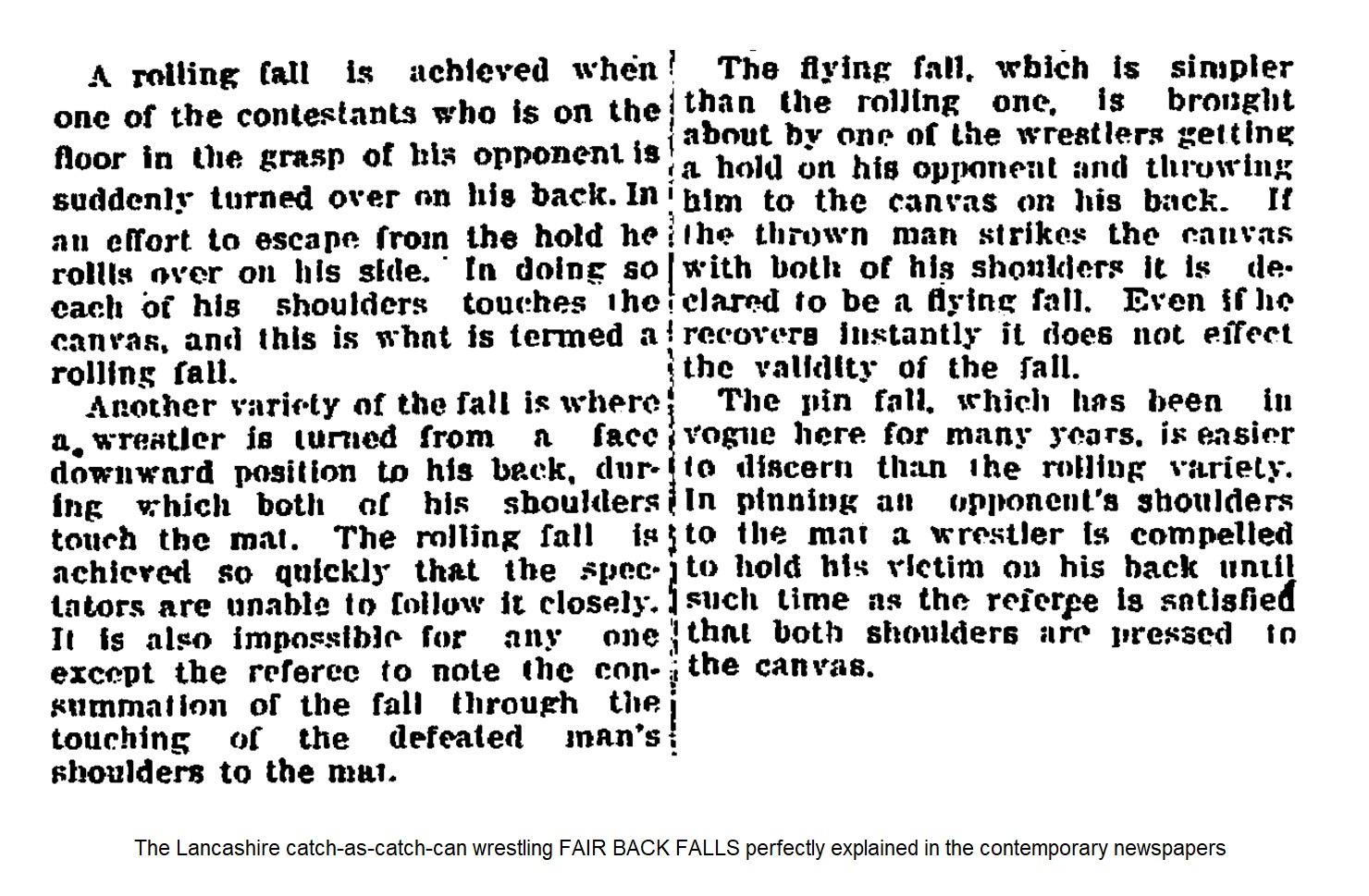
The style of wrestling they (the bosses of the game) chose to become official Lancashire prize wrestling was a catch-hold of any part of the body above and under the waist line, a freestyle wrestling. The definition of fall, they used, or a fair back fall, was taken from the contemporary Cornish-Devon sources which were available through major English sporting publications, “two shoulders should strike the ground together”. But they ignored the other part of that rule which clearly states “and before any other part of the body, so to say the original reading of the rule suggests the Cornish-Devonian fair back fall to be directly onto shoulders. They, Lankies, instead, didn’t care much for that detail. Giving adversary a foil, first, and then not letting go the hold of him trying to turn him onto his back became a common scenario of most of early Lancs wrestling matches, and as a matter of fact this exhibition did look funny to most of the observants of this new kind of wrestling, especially when the attacker grabbing his opponent by the legs felled them onto their hands, or bellies, and then tries to overturn them by twisting their legs, and them walking on their hands or standing on their heads, whole thing did look somewhat comical, strange, foreign to a trained eye of a common English wrestling practitioner or to a fan who saw wrestling at the big Cornish-Devon or Cumberland wrestling gatherings.
Another important detail was that at that early stage of Lancashire wrestling history there was no agreement to whether actual prolonged struggle on the ground, on “all fours” as they say should be allowed or not. Some said that wrestling contests should not be conducted under the up and down system which dominated local prize fighting for centuries. Those wanted it to be a fair or upright style for the most part. But as a matter of fact most of the pro wrestlers of that very first generation were employed from the former up and down fighters and they simply weren’t willing to learn to wrestle on their feet and basically dictated the fashions, what the new style of wrestling should be like. Those obviously chose familiar to them the up and down variation of catch as catch can wrestling. Bottom-line is that the wrestling vocabulary of the early Lancashire catch as catch can was based on the type of wrestling which was part of up and down fighting culture, so to say it was not a normal, generally accepted idea of what English wrestling is.
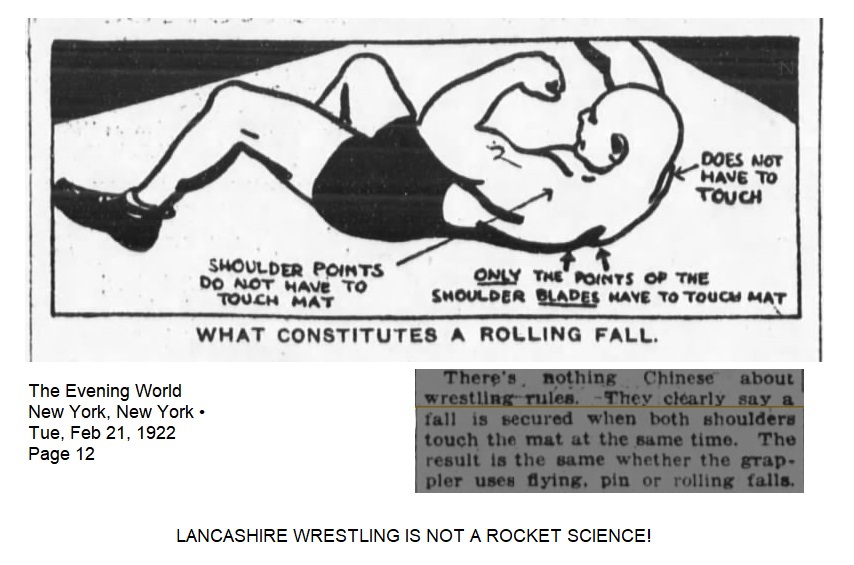
The adopted in Lancashire definition of fair back fall meant an instant touching or striking of two shoulders together, a touch-fall speaking the modern wrestling terminology, and that of course also included the so called rolling falls, when wrestler rolled from one shoulder to the other.
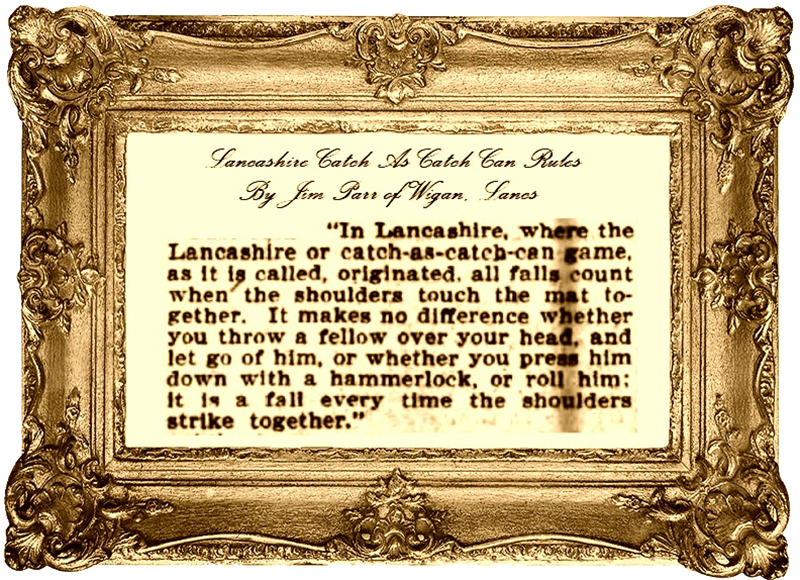
Jim Parr of Wigan, Lancs a popular champion wrestler from the early 1900s thus explained the basics of catch wrestling: “In Lancashire, where the Lancashire or catch-as-catch-can-game, as it is called, originated, all falls count when the shoulders touch the mat together. It makes no difference whether you throw a fellow over your head, and let go of him, or whether you press him down with a hammerlock, or roll him: It is a fall every time the shoulders strike together.”
Bell’s Life in London and Sporting Chronicle – Sunday, 09 July 1843; Page 2.
“RIDINGS AND CLOUGH.-A vast concourse of spectators assembled on the bowling-green of the Humphrey Chetham, near the Manchester Water Works, on Monday, to witness a trial of strength and skill in the Lancashire fashion, between Adam Ridings alias Dockem, of Bury, and George Clough, the Black Diamond, of Clifton, the best of three fair back falls for £10 a-side. About half-past three the magnets of the day came forth in wrestling trim, and two fine young men they appeared. Clough had the advantage in weight, but the odds ran as high as 2 to 1 against him.
They were not long in commencing operations, when Adam caught his man in his arms, and gave him one of the cleverest cross buttocks ever seen, which Jack M’Grath designated a Catherine wheel; the round only lasted two minutes.
The next bout was undecided, although in the opinion of many it was a fair fall in favour of Adam, as Clough was certainly on one shoulder when quitted, and turned over on the other instead of his breast.
The third was an easy fall in favour of Clough, through Adam outstriding himself, 4 to 1 on Adam, who went in and completed his job in a masterly manner.”
As a matter of fact Adam Ridings of Bury, Lancs aka “Dockum” won most of his matches on cross-buttock throws given from the standing position, he was locally known as a “cross-buttocker” and that his skill allowed him to successfully compete in the Cumberland Back-hold wrestling events as well.
Although the organized prize wrestling was not known locally, this fact does not speak for the game of wrestling being unknown to the native residents of that region prior the 1828 Ashton event. The pub-wrestle, the wrestling challenges in local pubs for a drink, or for a little wager with few pence, or a shilling aside being at stake, or a wrestle out of pure curiosity as to find out “who is a better man”, or simply for fun, happened quite often. All these and similar events along with all the other facts related to the birth, evolution and the early history of Lancashire catch as catch can wrestling are well documented in my book THE STORY OF CATCH (2019).


18048
Made with WordPress
 Wrestling Heritage