

Part 6:
More Lancashire Styles
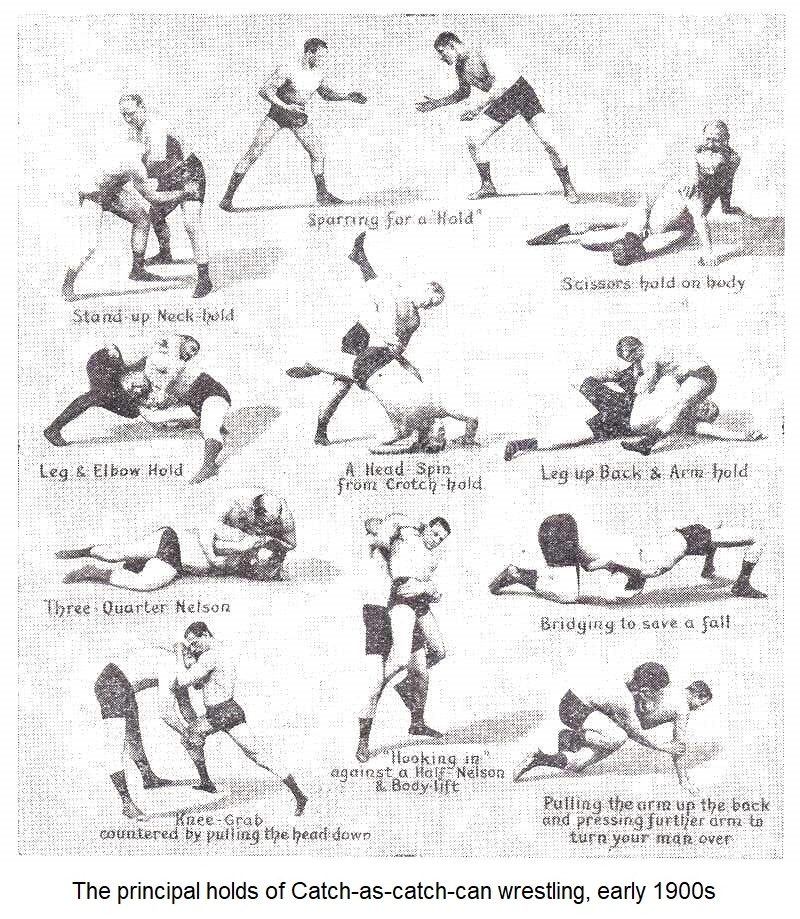
As it appears to me the game of wrestling was understood by the local people as a skill of felling a person to the ground (in local dialect is was known as a thrut, wrestle for a thrut) without resorting to kicks, blows and etc unfair actions. It seems like local wrestlers weren’t familiar with the “noble art of tripping” which formed an essence of English jacket-style wrestling, they mostly wrestled with their hands, arms and widely utilized the physical strength of their bodies, instead of using their feet and legs for throwing their adversaries to the ground. Catching advantageous hold or struggling for such hold was the main focus of local gamesters. Taking holds of any part of the person’s body was allowed (even below the waist), as well as very likely was the instant felling opponent from his knees after either of the two or both were down on their knees (at that time though the actual struggle on the ground was not allowed), even though in the City of Manchester these were not considered a fair wrestling strategy.
Local wrestling practitioners only had a very few legit holds in their dictionary; the variations of chancery hold, single leg, double leg, crotch and of course their ultimate favourites the Nelsons. And it was from these holds that they would attempt to send their opponents straight onto their backs. Just like in other regions of England the fair-fall, or the fall was on one’s back, a horizontal flat back fall, and any other kind of fall was seen as a half-fall, or a foil.
Lancashire wrestlers were very proficient in their traditional mode of wrestling. It is a known fact that the Manchester’s Chetham School youngsters favorite pastime was that of wrestling. Despite all that there were no wrestling gatherings in Lancashire let’s say similar to those which were held elsewhere in England, in such places as West Country, North Country or in Berkshire, counties of Norfolk and Lincolnshire.
Wrestling for a throw (or the “thrut”) was original local Lancashire wrestling, but it wasn’t the only wrestling game practiced locally. There also was another kind of wrestling in which both men could simply start contest on the ground, one being on his knees (advantage for his opponent) and the other trying to either keep him in this position for as long as possible, restraining his moves, or to try and turn him onto his back and then immobilize him, depending on what they actually agreed on.
Wrestling skills, or the skill of felling and dominating opponent, also played a very important role in the up and down Lancashire style of fighting, the only professional combative sport of Lancashire men. That sport wasn’t a fair upright fighting, the object of this kind of fighting was to take down, to throw your opponent on the ground first, and then deliver them all kinds of punishment, make them quit and say “I yield!”, it was even allowed to kick a helpless person, who were previously thrown.
OWD LANKISHIR WROSLER.
In point of fact the old-fashioned rough-and-ready Lancashire wrestler combined the Devonian kicking with his own knowledge of holds, his clogs being good substitutes for the horrific “kicking shoes,” with a plate of iron between the plies of leather, worn by Abraham Cann in his historic match with Polkinghorne, the Cornish champion. A sound “puncing” followed by the application of a Half-Nelson was the whole history of many a casual fight under the Red Roset).
The Times. London, Greater London, England Wed, Feb 16, 1910- Page 20.
LANCASHIRE WRESTLERS.
“There’s Thistle Jack; there’s limber Joe,-He’ll wrostle aught i’th town an’ fo’; Come cut an’ long tail, he licks o’, An’ lays ’em o’ their backs, mon!” From Heigh Jone Owd Brid by E. Waugh.
This short paragraph from the 19c press links together the two Lancashire sports, the newborn catch wrestling and the old up and down fighting. Interestingly, the author does mention the full-Nelson hold, a hold which likely was the most common “wrestling” finisher in the fights after the Lanky fashion.
“Among the other wrestling fashions which prevail in our own land, there is that of Lancashire, the most brutal and repulsive of them all. Under its rules almost unlimited action is permitted, and in days not far remote, when “purring” was a favorite sport, among the lower order -a “game,” if such it can be called, played by two wearing metal-tipped clogs, with which they kick each other on the shins and legs until pain and exhaustion led one or other to give way-hardly any device was prohibited. Now it is forbidden to scratch, throttle, bite, or deliberately injure an adversary, and the “full-Nelson” is not practiced. This dreadful hold was obtained by thrusting both arms under the arm-pits of the opponent, bringing the hands round in a lock on the back of the neck, whereby such leverage could be exerted that the vertebra might be fractured or dislocated unless the man surrendered. But, in spite of its amendment, the Lancashire style is not pleasant to look upon, though it has thousands of followers, and many exponents who wrestle frequently for large stakes in the presence of excited crowds.”
Frankly, the full-Nelson or a Pillory Hold as it was commonly known in England since probably early 18c, or even before that time, was not exclusive to Lancashire wrestling traditions, it was mentioned under this name in the famous Yorkshires’ Z. Wylde treatise on manly arts of self-defense. Another important detail is that it was not referred to as a legit hold in the game of wrestling, but rather as a way to overcome your adversary using wrestling skill and thus give them a lesson, punish their arrogance.
There has been a great deal of discussion of why nelson hold is being called the nelson. My explanation of that is actually pretty simple and sure is based on logic and common sense. Whether you call it a pillory, which was a medieval instrument of public punishment, or a nelson, what you mean is that the arms (or an arm in the case with half-nelson) of a person are locked in a specific way, and thus are disengaged, he simply cannot use them. Interesting coincident, but the famous admiral Lord Horatio Nelson lost his right arm in the battle of Santa Cruz de Tenerife in 1797, so obviously after that happened he couldn’t use it anymore, he didn’t have an arm.
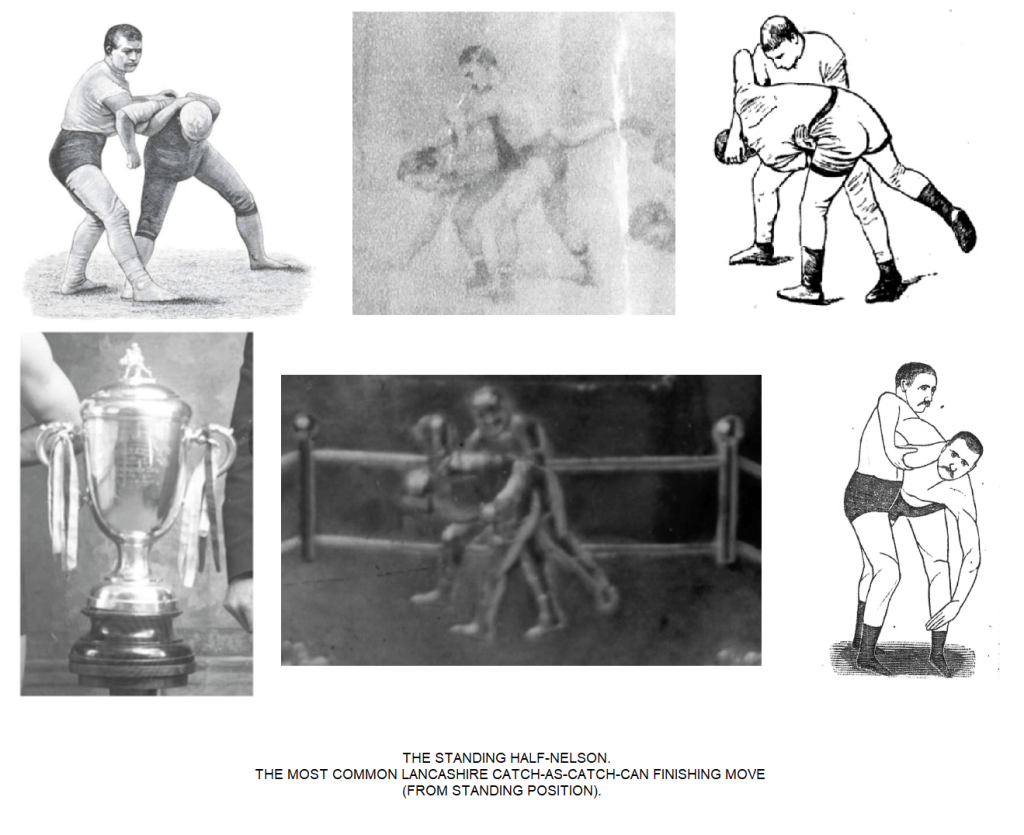
So to say, it is very likely, and quite logical to guess that the idea of original “Nelson” was actually that of half-nelson (and not a full-nelson), which still is the most popular catch wrestling throwing and rolling technique, that is locking person’s arm in that peculiar “pillory” way and thus disengaging it, causing a person problems with mobility or resistance, locking them, then giving pressure on the back of his neck usually combined with the crotch or leg/foot holds flipping or rolling him right onto his both shoulders.
And finally, the vast majority (if not all) of those Lancashire catch wrestling “matches of old” were the prize-wrestling events, which is another, a fancier word for pro wrestling exhibition. Taking that under consideration we should understand that this “game”, the professional Lancashire Catch as catch can, never was about “who is the best wrestler of the two”, but was a predetermined finish affair in which “wrestlers” (wrestling entertainers) who work like partners in ring (it does take two to tango) were both employees of an organizer of the event, and the ultimate goal of such enterprise was to make a good show that could attract large crowds and to get the maximum turnover off it (including the control and manipulation of the betting money of course because only a very limited group of people knew that it was not a genuine sport)…and then after that, repeat that the same show again, and again, and again to make even more money.

18050

Made with WordPress
 Wrestling Heritage