
By Ruslan C. Pashayev
Wrestling Heritage welcomes memories, further information and corrections.

The Evolution Of The Species 3
Based on the above, it became obvious to me that whatever kind of catch as catch can wrestling the early Lancastrians brought to America in the 1850s it didn’t attract the crowds. Yet for some reason a kind of catch wrestling that was imported here in the early 1880s by Bibby and Acton made such a huge impact on local fans that by conquering their devoted hearts it once and forever changed the pro wrestling history of America. Again we have to understand, and this is important, catch wrestling in Lancashire had evolved and changed a lot from the 1850s to 1880s, almost to the point of being unrecognizable, and becoming a completely new, another kind of sport, or to be more accurate a new form of athletic entertainment.
With all honesty the wrestlers of the 1840s and 50s didn’t have much to offer to their fans. They only knew a couple of standing throws such as the Lankie-throw (pro wrestling’s back body drop), a basic headlock followed by a cross-buttock, a flying mare (a shoulder-throw) and of course the popular crotch body-slam (performed usually from the wrist and crotch hold or from back of the neck and crotch hold), and that was pretty much it. At that time, in the 1840s, the ground wrestling in Lancashire was very basic. Occasionally two men fell on their sides and the stronger guy turned his opponent on his back, that was pretty much it.
The contemporary American pro wrestling which the local fans faithfully admired was absolutely different. It was all the way collar and elbow, the most popular local wrestling fashion, and a side hold with their intricate tripping and crossing legs (hooking) techniques that were very similar to those applied by the Cornish wrestlers in England. American Collar and Elbow featured a great variety of slamming standing throws, and that is exactly what the masses wanted to see the most!
As I previously mentioned the art of ground wrestling in the 1840s in Lancashire wasn’t yet fully developed, there really was no vocabulary for that part of catch wrestling. It was in the late 1850s, and decisively in the 1860s, during the Golden Era of Lancashire catch in the City of Manchester and neighbouring mill-towns (Ashton-under-Lyne the Home of Catch, Oldham, Rochdale, Middleton, Bury and Bolton) when ground wrestling was finally established and became the most recognisable feature of this style of wrestling.
Notably the ground wrestling holds and positions from the Golden Era were all exclusively related to the so-called Nelson family of holds combined with either crotch or feet or legs holds to use a human body like a natural lever for turning an opponent right onto his back so that both his shoulders get in direct contact with the ground. We also have to remember that in original Lancashire catch wrestling pinning or slow force wasn’t necessary, regardless how quick two shoulders touched if the referee saw it the match was over. That is why all kinds of back falls such as flying falls or slams, rolling falls and of course the pins all equally counted!
To summarise, the American wrestling audience of the 1850s wasn’t ready at all to watch the catch wrestling shows. They weren’t a draw here! Also the continuing wrestling on the ground part was a huge turn-off for local fans! There is no way the walking on the hands, a most common Lankies’ escape from being turned onto their backs was approved by Americans in the 1850s! They needed to be exposed to the French Greco-Roman style first, and that is what happened in the 1870s, when French wrestling pioneers came and conquered the States, slowly replacing old style with their new European wrestling fashions, and that made local fans get used to seeing men rolling and not freak out – what kind of wrestling is this? But that took a whole decade, before the new wave of Lankies were welcomed here and their athletic shows were feasible to impress anyone!
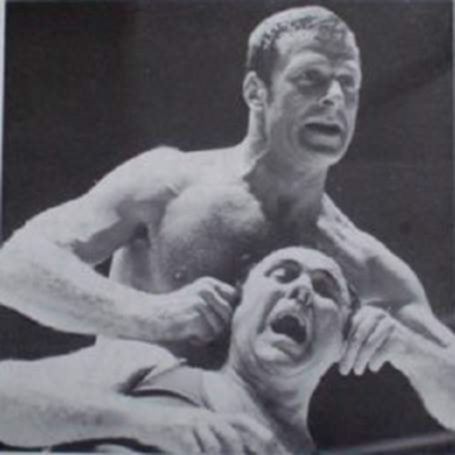
Yes, catch changed and evolved and what Bibby and Acton brought to America in the late 1870s early 1880s was very different from what early Lancastrians exhibited here in the 1850s. On top of that over these two decades catch wrestling in Lancashire developed a theatrical aspect, which was completely unrelated to any kind of wrestling whatsoever! A perfect example of this would be a so-called double-ear hold, when a person is grabbed by their ears and thrown all over the ring. That I suppose was an earliest form of CATCH, as we like it. This most historical catch’s submission hold to be immortalised by Mick McManus’ “NOT THE EARS”!
Page added 20/09/2026
26604

