
Wrestling Heritage welcomes memories, further information and corrections.
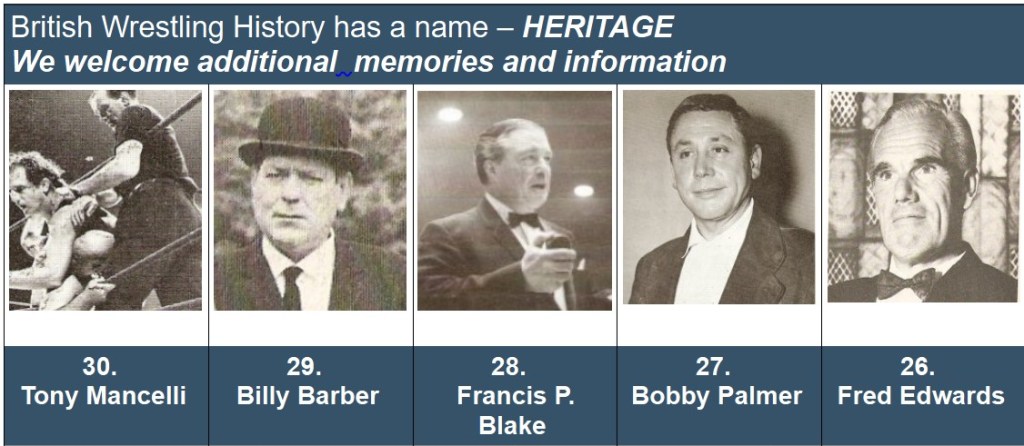
30. Tony Mancelli
Tony Mancelli was a teenage wrestling prodigy before the war who developed to National and Regional heavyweight champion. Through the early sixties he gradually phased out of a wrestling role and became a full-time referee, also becoming resident at the Royal Albert Hall.
It is hard for any referee to make a mark if they are not to interfere with the wrestlers’ work. Indeed, some have been excluded from this list for being decidedly obtrusive!
But this “Blackfriars Thunderbolt” scrapes in at 30 and no higher for his virtually total anonymity. We’re not sure whether this was a good or bad thing….
29. Billy Barber
In his white tee-shirt and trousers, Billy Barber looked the part, and his alliterative name made us feel we were witnessing one of the main referees at work.
For all that, his time at Dale Martin’s was in reality rather brief, no more than a few years, and we are left with the realistic impression of a journeyman pro.
28. Francis P. Blake
Frankie Blake was ring announcer through the 1930s at the famed “Ring” in Blackfriars, and also officiated once at Madison Square Garden, New York. He joined Dale Martin Promotions as Master of Ceremonies in 1948 and remained the Number One official until 1972 when he went into semi-retirement and presented the promoter’s programmes at the Esplanade Pavilion, Weymouth. He still popped up on the occasional television wrestling presentation through the seventies, but his lazy lack of detail makes us consider him over-rated.
We give him the benefit of the doubt by including him here and hope his work in his prime did more justice to the top-line wrestlers he was privileged to introduce over 20 years at the Royal Albert Hall.
27. Bobby Palmer
Brighton’s Bobby Palmer was the son a famous boxer, Pedlar Palmer, the young “Box of Tricks” world champion back in 1895.
Pre-war, Bobby was a teenage lightweight wrestling sensation and in the late forties he challenged for European and world honours at welterweight. Injury curtailed his wrestling and he moved into refereeing in the 1950s. In 1963 he drew plaudits for his Royal Albert Hall disciplining of heavyweight villains Johnny Yearsley and Bruno Elrington. He announced his retirement from refereeing in 1968 and became a senior southern Master of Ceremonies for the ensuing decade. It is clear to us that Bobby was one of the boys, and very well liked by the wrestling fraternity. Objectively, however, his work rate was based on minimums, announcing clearly obvious falls with distant disinterest and in a repetitive manner. He developed one of those exaggeratedly clipped accents, but little rapport with the spectators. Another whose end of term report has to read “Could do much better.”
Bobby Palmer resurfaced in the national press in 1993 when his father’s diamond-encrusted world belt popped up in a bank vault owned by somebody else, and Bobby laid claim to it. He died in 1999 aged 84.
26. Fred Edwards
A rarity in that he was a master of ceremonies not only in wrestling but also stock car racing and boxing, we remember Reading’s Fred Edwards’ precise style and dapper ring presence.
An all-round sportsman himself it was when wrestlers Eddie Capelli and Tony Mancelli were involved as racers at a stock car rally that they met Fred and encouraged him to get involved as a wrestling official.
Fred looked and sounded right, appeared on televised wrestling, and did the job required satisfactorily.
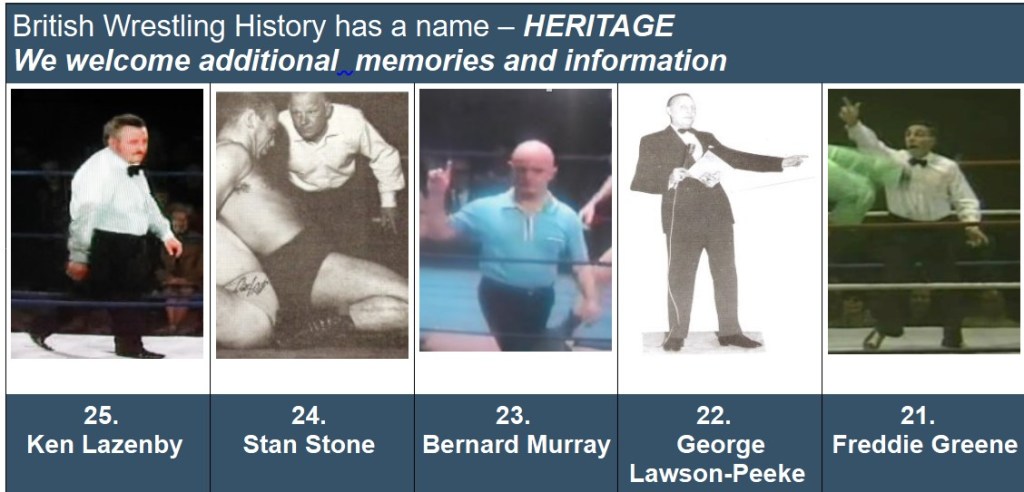
25. Ken Lazenby
A television regular, Ken Lazenby was a mainstay of Relwyskow & Green Promotions. Portly Ken kept a firm grip on proceedings, and was ever eyeing the audience for their reaction. Ken Lazenby refereed the sensational 1971 televised bout in which Kendo Nagasaki was unmasked for the first time, by Billy Howes. We could do with more detail on this authoritative figure and invite contributions.
24. Stan Stone
Stan Stone was a leading southern referee of the fifties and early sixties. Possibly at the top of his game in 1962; in that year he refereed two high profile television grudge matches: Jackie Pallo versus Mick McManus and, a few months later, the controversial and bloody episode in the Clayton Thomson versus Les Kellett feud. He refereed regularly at the Royal Albert Hall.
23. Bernard Murray
Bradford’s Bernard Murray was a lithe lightweight wrestler of the fifties and sixties and it is occasionally alleged that Les Kellett lifted much of his comedy routine into his own work. Having been a successful amateur, Bernard was instrumental in then encouraging John Cox and Jim Breaks to turn professional. Bernard Murray was then involved in training wrestlers and by the early seventies his bald pate appeared regularly on Dale Martin presentations as a referee. Clearly reluctant to steal the limelight from any wrestlers, Bernard Murray’s refereeing therefore remained unobtrusive, with occasional animated flurries.
22. George Lawson-Peeke
A charismatic and gregarious master of ceremonies whose career spanned from the immediate post-war years and well into the nineteen seventies. Rather like Frankie Blake George had been involved in the entertainment business during the war years, but he had also been a wrestling master of ceremonies before the war and was the first MC to appear on a televised wrestling presentation in 1938. Another notable role was presenting the sensational heavyweight clash live before 12,000 fans at the White Hart Lane football stadium, between Bert Assirati and the French Angel, Maurice Tillet. Assirati rated alongside Spencer Churchill as one of George’s favourite wrestlers. His sociable style, always ready to exchange anecdotes over a drink after a show, means that George Lawson-Peeke, though sadly no longer with us, remains one official we do have plenty of detail on.
21. Freddie Greene
Freddie Green was originally a boxer and had hoped that his son would follow him into the noble art. But his son took on the wrestling ring name of Steve Grey and it was dad who followed, assuming a role as a popular referee for Joint Promotions through the seventies.
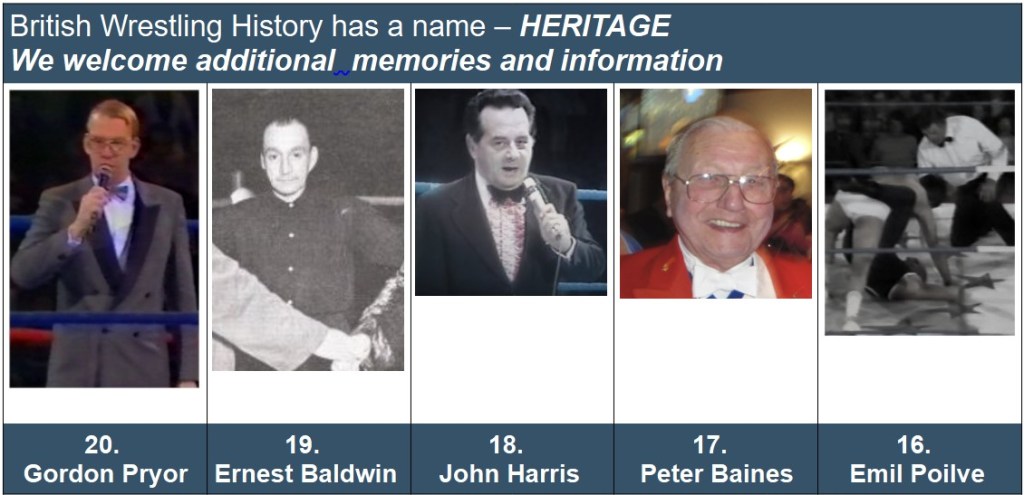
20. Gordon Pryor
Tangible records are hard to come by in the world of professional wrestling. One man with a place in the record books is Chesterfield referee and MC Gordon Pryor. Gordon was the last ever MC on ITV’s televised wrestling, introducing the contests on that fateful December day in 1988. For almost twenty years Gordon had been a popular referee and MC in the rings of the north and Scotland. He was another of those officials who epitomised all that was good about wrestling and boosted the credibility of the sport through his high professional standards. Gordon’s involvement in wrestling began following a letter he wrote to promoter Ted Beresford asking for a job at his shows in the Goldwelll Rooms, Chesterfield. Ted offered him work as a steward, and later as a second and then timekeeper at various venues around the north and midlands. When Max Crabtree took over northern halls in the early 1970s he employed Gordon as an MC, and later referee. Asked what he considered were the most important qualities of a referee Gordon told us the referee had to do his job without becoming a “feature” of the contest, an enabler who would allow the match to develop in the way the wrestlers wanted.
19. Ernest Baldwin
Looks were deceiving. Ernest Baldwin appeared much too unassuming and (dare we say) gentle to be not only a top referee and MC, but also a three times British heavyweight champion who wrestled world champion Lou Thesz in 1957. Recurring injuries led to premature retirement in 1961 and a move to refereeing duties. We wouldn’t accuse Ernest of always being immaculately dressed. He looked the part but always had something of an unkempt look that took nothing away from his authority in the ring. As a referee he moved around the ring with a speed that belied his stature, and as an MC he had all the looks of a man we knew we could trust. Outside the ring Ernest was an influential figure as mentor of numerous young hopefuls taking tentative steps to wrestling success through his gymnasium at Tingley.
18. John Harris
Captain John Harris was involved in the training of wrestlers in the 1950s and later a leading referee, first for Paul Lincoln Promotions and later for Dale Martins. He quickly developed into a skilled Master of Ceremonies and by the late seventies and early eighties he had assumed the mantle of the main man in the south. John Harris successfully addressed and redressed a number of the accusations of disinterest we have levelled at his aged peers: he gave absorbingly lengthy introductions and made us feel that every bout mattered. Had he peaked a few years earlier, he would certainly feature higher up this Heritage Years listing.
17. Peter Baines
The magisterial Pater Baines was a long serving referee and Master of Ceremonies who dated back to Scottish promoter Alex Bannerman before going on to work for Joint Promotions throughout Scotland and Northern England until he broke away in protest against JP 1970s management procedures to work for Brian Dixon and Orig Williams. Always immaculately presented Peter brought an air of authority, respectability and authenticity. Until the time of his death Peter was a regular attendee at the Reunions in Ayr, Leeds and Kent, travelling around the country in his campervan. He was Honorary President of the Wrestlers Reunion Scotland.
16. Emil Poilve
Cheshire’s Emil Poilve was a man often mentioned by professional wrestlers when asked to name the top referees. Rex Strong told us that a referee could make or break a match, and Emil had the inate skill of knowing precisely when to intervene. He took to counting ’em out after retiring from a twenty year career as a wrestler in the midlands and north of England. Emil was a gentleman of the ring amongst an assortment of characters that he commanded quietly yet firmly. The confidence with which he commanded every aspect of the bout re-assured fans they were watching a competitive contest between two skilled competitors.
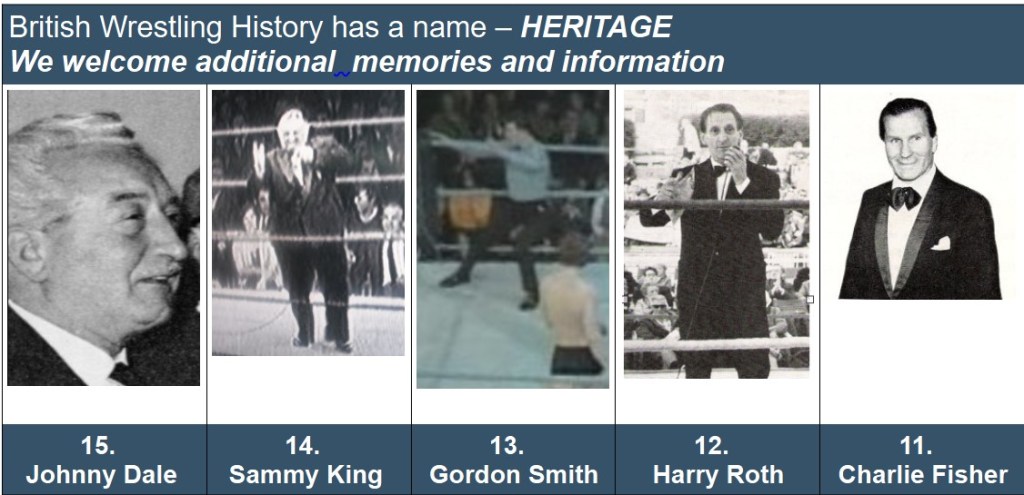
15. Johnny Dale
The bearer of a big surname in wrestling circles, Johnny was the brother of Joint Promotions founding father and British Middleweight Champion, Jack. Johnny had worked regularly as an announcer in the fifties and resurfaced in-ring in the seventies. His style was very clipped, very pre-war, but he had a certain imposing aura about him that made us value his work. He had a trait of whirling around on one heel to present the wrestler in the opposite corner. When HRH The Duke of Edinburgh attended a wrestling tournament for the first time in 1963, he spent a full ten minutes going over the rules with Johnny, who was then Managing Director of the largest promotion at the time; they were presenting around 12 shows nightly.
14. Sammy King
Portly and chatty southern MC who endeared himself to fans in some part thanks to his way of bouncing and bundling out of the ring off the apron. In the 1930s he was a professional toastmaster and boxing compere, before dabbling in wrestling promotion in north London and then, post war, becoming a senior Dale Martin emcee and making frequent television appearances, including officiating on the first of the great McManus v Pallo grudge matches in 1962.
13. Gordon Smith
Confidence to control without a desire to dominate a match was an essential quality for anyone who made it into our listings. One man with that quality in abundance was Gordon Smith, who refereed many of Derek Collins matches. When we asked wrestlers themselves who they considered the best of the third men Derek was quick to speak up for Gordon Smith. Derek explained that he nominated Gordon because of his ring presence that allowed him to exert authority without detracting from the work of the wrestlers. That’s the quality of a top class referee – a star who allows the two other stars to shine. A northern referee for Morell and Beresford Promotions the tall, slim figure of Gordon Smith moved niftily around the ring at a speed uncommon amongst many of his colleagues.
Heritage member Dave Sutherland remembers Gordon: “Everyone agreed how smart Gordon Smith looked in the ring and he always had time for a word with the crowd outside the hall prior to the evening’s matches, usually to discuss the day’s football scores. Unfortunately the last time I saw Gordon he was carried from the ring having been knocked over by an aerial challenge by two top heavyweights, it might have been Albert Wall and John Lees or two fellows of similar stature, who landed on top of him and the bout having to be abandoned as no contest and Ernie Baldwin having to step in to referee the rest of the night in his civies which included suede shoes and braces. Smith still looked in extreme pain as he left the hall and we never saw him again while I worked there.”
12. Harry Roth
Harry Roth was a slight figure of a man whom we never recall seeing on television, though he did appear in various photos in the sixties and seventies showing him clearly active in the Dale Martin offices in Brixton. What we especially appreciated about Harry’s work, and what justifies his position in this ranking, was the way he remained ringside throughout each bout. This may seem a peculiar compliment, but so many of his peers fled the scene whenever they could, clearly aware of the match outcome ahead. So we value his clear enthusiasm for the game in that respect, and also from the serious and informed choice of words he used in his introductions. Outside the ring, Harry Roth’s chats with the fans were telling: he wanted our opinions, he wanted feedback. In so many respects television work was the stamp of a professional’s acceptance. In the case of Harry Roth, its absence makes only a positive impact as those of us who saw him in action can feel we have a special privilege. We have no record of his ever having refereed. In 2014, Lou Ravelle reminisces: “Harry Rothchild of Wimbledon ran Rothchild Promotions with his associate Syd Finlay. In Dorchester they had an arrangement to hire the ring and ring crew from the local army base. One evening they arrived at the venue, the seating was all laid out, but there was no ring. The show had to be cancelled and Rothchild Promotions was ruined. Dale Martins had got to the soldiers. Nevertheless, Harry went on to work as a trusted employee of Dale Martins for many years thereafter.”
11. Charlie Fisher
Eltham’s Charlie Fisher wrestled on well into his sixties and, apart from occasional refereeing stints, then moved directly to the master of ceremonies role. He was a creature of habit and numerous shows witnessed reveal his nightly procedure. Moving around the hall every ten minutes in the hour before the start, no doubt checking the likely attendance. His set patter as described in Wrestling’s Words of Wisdom. His enthusiastic drumming up of interest in the next presentation. His disappointing lack of interest in the bouts, forever fleeing to the dressing room as if to avoid watching any wrestling at all costs. Then occasionally announcing falls to the wrong wrestler. He came into his own, however, whenever a villain was playing up at the end of a bout, always ready to get involved regardless of his best bib and tucker. Unsmiling but lovable, Charlie Fisher was a ubiquitous Dale Martin Master of ceremonies throughout the seventies.

10. Joe D’Orazio
Joe D’Orazio was a cousin of fellow Anglo Italian Mike Marino, a great friend of Steve Logan, and wrestled at welterweight for Dale Martin Promotions in the early fifties. He took his wife’s maiden name as his ring surname. Later in the decade, with talks of wrestlers going on strike, Joe was at the centre of the controversy and was exiled from the promotion for some while. He worked at this time as a stuntman and filled in in the movies as Charlie Chan, also promoting in opposition to his former employees. He returned to the fold and succeeded Charles Mascall in writing the programme notes under the name Bob Scala. Joe became a very unobtrusive referee, usually dressed in a black t-shirt but occasionally spruced up as at the Royal Albert Hall where he became resident referee from 1968 and throughout the seventies. In 1971 Joe co-authored The Who’s Who of Wrestling, still an excellent read to this day. In the 1980s Joe turned his hand to emceeing, but it is as referee that we remember him most. He was scarcely noticeable, preferring to let the wrestlers hold centre stage. On several occasions we spotted him diving head first between the two top ropes, to straighten up with his legs in the air whilst his eyes were at canvas level and he counted off an invariably winning fall.
9. Martin “Chopper” Conroy
When Chopper Conroy retired from wrestling and slid comfortably into the role of referee, then MC and Director of Wryton Promotions, it was apparent that wrestling was in safe hands. Martin was a man greeted warmly by fans and he would smile and exchange a few words on his way into the ring. As a referee he controlled matches efficiently and with authority, but always with a gentle nature that made him a favourite with the mums and nans. Martin was an influential figure in post war British wrestling, training countless young professionals at the Wryton Stadium, and in latter years as a Wryton Promotions Director tempting the likes of Johnny Saint, Al Marquette and Paul Mitchell across from the independents.
8. Lou Marco
Lou Marco was famed for his grinding gravel voice and energetic ring presence. After a brief spell as a lightweight wrestler he quickly turned to refereeing and by 1935 was in control of a World Heavyweight title match at the Whitechapel pavilion, featuring famed Alaskan Jack Sherry. He was the Number One Dale Martin referee throughout the fifties and up until 1966 when he was seriously injured after officiating at the Royal Albert Hall for the final time. Read our Year of Wrestling 1966 for more on that. Lou Marco appeared in the two wrestling-based films we mention most on this site, “The Night And The City” and “A Kid For Two Farthings”, in which he was credited as Lew Marco. The classically sized referee: small to make the wrestlers look even bigger than they were.
7. Mike Judd
Possibly one of the most enigmatic and controversial names on our list, and in whichever position we place him there will be many fans who disagree strongly. Mike Judd was a lanky Master of Ceremonies who cut his teeth working within Paul Lincoln Promotions. After the merger in 1966 he became a regular MC on the Dale Martin circuit, seemingly making the Fairfield Hall in Croydon his own, and eventually rising to wrestling’s top job, resident Master of Ceremonies at Kensington’s Royal Albert Hall. There is no doubt he was a great announcer and could beef up a storyline and controversy at the end of bouts very well, and used his full range of vocal options to create heat. To unwitting fans at the time his only crime was perhaps being a bit young to be the top MC. Years later we would discover that he was an accountant, even a Director within Dale Martin Promotions, but ultimately dismissed for the marvellously named “financial irregularities”. (Nice to know other more serious fields than wrestling have equally ridiculous terminology!!!). More intriguingly for fans, we know he was quite unpopular with many within the business and stories of him taking high-handed directional approach with his elders, such as Jackie Pallo and Les Kellett, are legion.
6. Stan Rylands
Popular 1960s referee for Wryton Promotions the Potteries Stan Rylands could usually be found on a Saturday night officiating at the Victoria Hall, Hanley.At other times he officiated in the north and midlands, and was a regular television referee, but it was the local Saturday night job that led him to be the man in charge on the night that Kendo Nagasaki unmasked Count Bartelli.
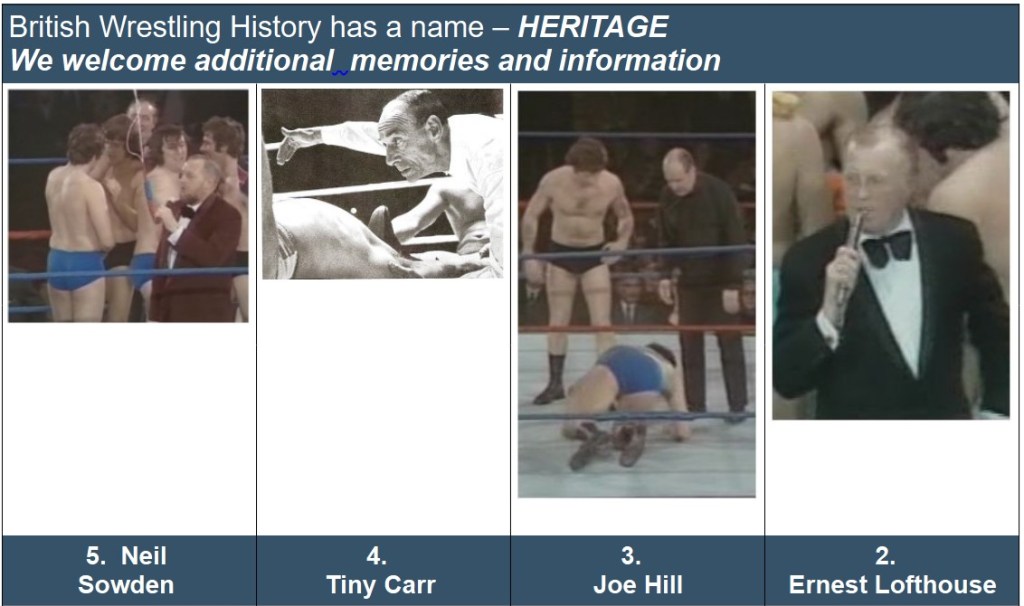
5. Neil Sowden
A touch more northern sophistication in the shape of Neil Sowden, the bearded smartly-dressed and well-spoken Master of Ceremonies in Morrell Beresford land. Came second only to Ernie Lofthouse in his ability to accurately describe the events leading up to a fall in the finest detail. Prior to officiating in the ring, Neil Sowden had a short-lived wrestling career, ending abruptly due to injury.
4. Tiny Carr
Albert “Tiny” Carr from Bow in London’s East End was the first referee to make a name for himself on the small screen in the early sixties, though he had officiated on the first ever televised wrestling in 1938, and was already a regular at the Royal Albert Hall, but his darting around and unflinching admonishment of villainous heavyweights more than twice his size captured the viewing public’s imagination, and his catchy name caught on. On FA Cup Final Day 1963, it was Tiny Carr who refereed the big televised needle match between Jackie Pallo and Mick McManus. In January 1964 Tiny Carr officiated in the first ever televised tag match to feature the then unbeaten team of Mick McManus and Steve Logan, their opponents in Kingston being locals Spender Churchill and Eddie Capelli. Tiny Carr disappeared from the scene, unheralded, in about 1969.
3. Joe Hill
Bradford’s Joe Hill was another of those former wrestlers who turned his attention to refereeing contests when he retired from combat. We remember a portly, thinly haired man who appeared an elder statesman of the ring but could only have been in his early fifties. Credited as the man who introduced Les Kellett to professional wrestling. The two of them had been friends as amateurs before the second world war, and although Kellett had wrestled a few professional bouts prior to 1939 he had given up all thoughts of a career following his war service. Joe Hill developed quite a feud with Mick McManus. We can gauge some measure of his status by the fact that he seems to have been the only referee to cross over promotions, coming south to officiate at the Royal Albert Hall and even disqualifying Mick McManus in a title bout there, the British Middleweight Championship decider of January 1968, in which Clayton Thomson retained his belt. From then on, McManus and Hill were forever embroiled in arguments and, at the Nottingham Ice Rink on one occasion, McManus famously refused to wrestle if Hill was the referee, and Gordon Smith duly stepped in. The heat eased off and, in 1971, it was Joe Hill who refereed both Nottingham bouts between Vic Faulkner and Mick McManus, with McManus winning both, in the second claiming the European Middleweight Championship.
2. Ernest Lofthouse
In the days when wrestling marketed itself on par with professional boxing the presentation of the officials was of huge importance. In this respect the credentials of Ernie Lofthouse were immaculate. Dinner jacketed Ernie, with his authorative voice precisely describing the action leading to the scoring of a fall or submission, commanded respect from fans and wrestlers alike. We can imagine no other Master of Ceremonies intricately announcing “…a pinfall with a double reverse arm lever to shoulder press.” Ernie was never caught off-guard in the moments leading up to a score. To the fans Ernie was a calm voice of reason and authority, but behind the scenes, as Norman Morrell’s right hand man, he controlled the dressing room with a rod of iron.
15231
 Wrestling Heritage