
Wrestling Heritage welcomes memories, further information and corrections.


The greatest wrestling feud ever, anywhere, started in April 1962 at Wembley. As Mick McManus stood in his corner for the preliminaries in his welterweight bout against Chelmsford’s Bob Anthony, a dapper Jackie Pallo in suit, tie and pigtail, jumped up to the ring apron to lay down a challenge for the Dulwich Destroyer’s Southern Area Welterweight title. Immediately we enjoy this poignant aspect that the bitterness should have centred around a regional title. But these were the times of the Kray Twins, and rivalries for local “turf” outweighed any importance a national or even world title might bring.
McManus had been a two-time British Welterweight Champion in the fifties, before relinquishing the belt to Wigan’s Jack Dempsey. Pallo’s competitive peak had been a challenge to Dempsey in May 1961 with the British title at stake, the first time Mr TV had ever topped the bill at the Royal Albert Hall, and on the famous night that Billy Robinson defeated Alan Garfield, Joe Cornelius and Gordon Nelson

In the gloriously unclear world of professional wrestling history we are left to dissect the real from the staged, but it does seem on the one hand that Pallo’s intervention was unscripted and caught McManus by surprise. However, the alacrity with which the challenge bout was set up makes us think otherwise.

Just a fortnight later at lunchtime on FA Cup Final Day, once again and appropriately at Wembley, McManus and Pallo finally opposed each other for the first time on television. The Highbury wrestler, with a few inches height advantage over his south London nemesis, wrestled hard and in a focused way we would subsequently have found strange. McManus was his usual determined self and audaciously took the lead by means of Pallo’s own speciality, the piledriver. In Round 5, Pallo equalized thanks to a Boston crab submission.
So, as the bell rang for the start of the sixth and final round, the score was one fall apiece. Drop-kicks ensued from both men, in the peak of their pro wrestling careers, but time was eventually the victor and the match ended with referee Stan Stone raising both men’s hands to signify a draw.
The energy and enmity displayed by both wrestlers, in a completely believable display of competitive wrestling, served not merely to pave the way for the feud that ensued over the following eleven years, but cast a template for the legitimacy and excitement of professional wrestling as a whole. These can truly to be said to have been career-defining moments.
Good news for 2012 Heritage Members was that the BBC, duly guided by Wrestling Heritage, unearthed the footage of the entire 1962 bout and, acting on Wrestling Heritage advice, aired part of it, albeit without one choice Waltonism: “This £100 pound-a-side bout is for the London Welterweight Championship, even though the title isn’t at stake.”

Talk nationwide was of nothing other than this explosive match-up. Dale Martin Promotions quickly set up a £200-a-side return bout at the Royal Albert Hall on 6th June 1962, the one-fall-apiece draw repeating itself inconclusively.
We have at times queried the watershed moment for the wrestling business when lighter weighted wrestlers could take over top-of-the-bill spots from the heavyweights whose bags they had hitherto at times even been asked to carry. This June 1962 bout marks the point where the two London welterweights topped the bill even above the nation’s principal 8-Man heavyweight knockout tournament, the Royal Albert Hall Trophy.
In the Mick McManus Wrestling Book it was described as “a rip-roaring affair.”
Apart from this non-title rematch, Dale Martin Promotions carefully nurtured the rivalry, astutely choosing to create two huge names rather than arranging other rematches which might cause one of the pair to diminish in status and value – a third inconclusive result might not have seemed plausible. This typified the wisdom and marketing skills of those founding fathers of Joint Promotions.
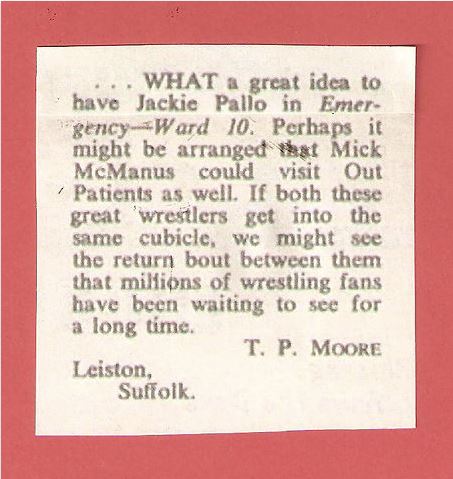

Historians from other walks of life outside wrestling and Wrestling Heritage Members alike may well be wondering what took us so long to chart the events and consequences in this most epic of feuds. At this stage in the story everything may seem perfectly clear, and the reader may be expecting a logical sequence of follow-up activity.
Think again. The McManus-Pallo feud is riddled with anomalies and red herrings.
How bizarre is it that the only remaining film of the pair in action should be of the oldest and first match described above! None of what follows can be seen on film and leaves Wrestling Heritage Historians with a head-scratching jigsaw to piece together.
The obstacles don’t stop there. Some listings of televised British wrestling introduce a 1965 Cup Final Day match between the pair. No such bout ever took place.
More misreporting and misremembering has ensued and even snowballed down the years. Take the Kiss that we will describe shortly. The Kiss has been attributed and mangled as having been exchanged between McManus and Pallo and either or both of their wives. Wrestling Heritage now sets the record straight.
Furthermore, McManus and Pallo did subsequently wrestle each other a dozen or more times in non-televised bouts outside the capital. Well away from detailed press coverage, the pair played out their rivalry for provincial audiences in Cardiff, Nottingham, Paisley, Leicester, Halifax and elsewhere, sometimes with return bouts involved, as in each of these five named venues. In fact Leicester and Halifax saw the only two victories Pallo would claim over McManus throughout the entire decade. Whilst undoubtedly intriguing matches, the total absence of any recollections combines with their relatively lower profile to lead us to exclude these from the mainstream bouts that did, indeed, constitute the Pallo v McManus feud. This is a position that could change given the right evidence.
So we take up the story once again with McManus v Pallo I & II in 1962 each having finished as an exciting draw.
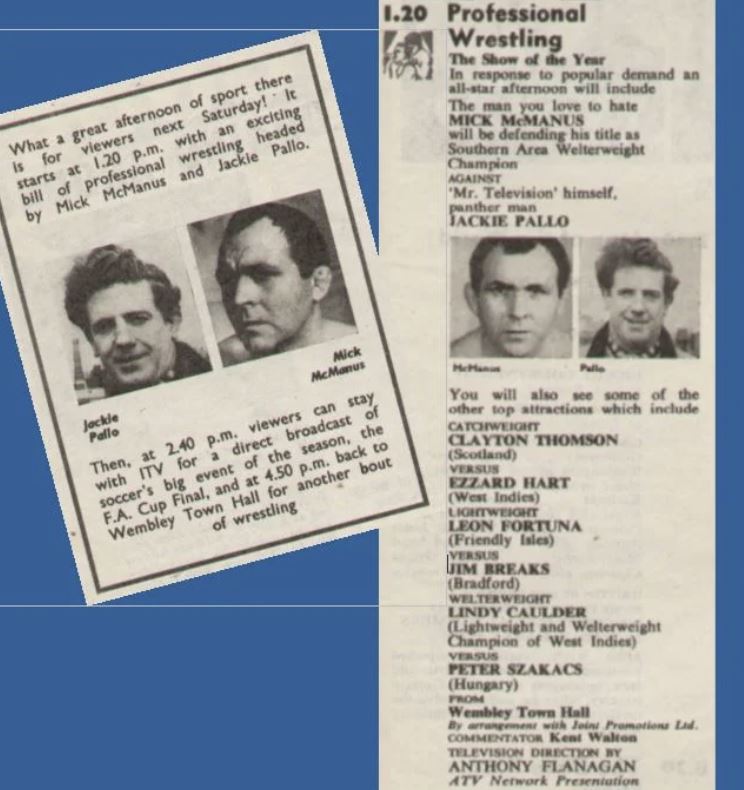
A year later and High Noon just had to arrive. Once again the pair shared FA Cup Final day billing with the soccer stars, but this time it was wrestling’s day. 16 million viewers watched their needle rematch and then 4 million switched off to leave only 12 million watching the Cup Final itself.
Once again, Pallo and McManus served up a humdinger, with the 1962 televised match being described as a “vicarage tea-party” by comparison.
The Southern Area title was at stake in 1963, this time with a match made over 10 rounds. Still riled by being hoist with his own petard in 1962, Pallo, decided in Round Two to use McManus’s patented forearm jab to purposeful effect. The crowd went wild.
The action remained fast and furious until Pallo was thrown from the ring twice in Round four, on the second occasion injuring his shoulder and struggling back only to be pinned at once by a gleeful McManus. But Pallo regained his composure and scored an aggressive equalizer in the sixth.
It was at this point that Pallo memorably jumped down to ringside and kissed in celebration wife Trixie, who was there as ever alongside Jackie Junior.
The action slowed understandably in Round Seven and then, in the eighth, Pallo took the upper hand. McManus was groggy. He lifted the champion to his favoured piledriver position, only for McManus to push him backwards and reverse the manoeuvre. McManus followed down immediately for the simplest of top presses to have his arm raised in victory by Tiny Carr, and to retain his belt. Once again Pallo had come unstuck as a result of his own speciality manoeuvre.
Mick McManus and Jackie Mr TV Pallo succeeded through these heroics in raising professional wrestling not only to the status of an exciting and accepted sport, but to being one of the most important sports in the land. But it wasn’t all about them in 1963. In parallel, Clayton Thomson and Les Kellett were embroiled in a bloody televised feud at the same time.
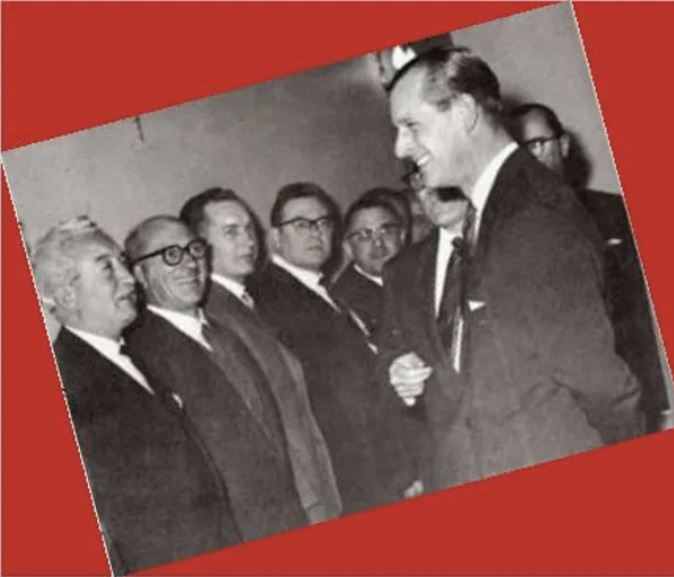
And just a week before McManus v Pallo III, His Royal Highness the Duke of Edinburgh had attended a televised live Royal Albert Hall wrestling presentation for the first time. And as if all this wrestling excitement weren’t enough, Joint Promotions had the upwardly mobile Paul Lincoln Promotions snapping at their heels, with exotically appealing stars such as Quasimodo, the Wild Man of Borneo, Ski Hi Lee, and their own feud between the White Angel and Doctor Death.
Their influence was even greater within wrestling itself. That McManus v Pallo I bout with which we started was added on to a major television presentation in which Billy Howes relieved France’s Jacques Lageat of the European Mid-Heavyweight Championship. A great bout in itself but it emerged virtually unnoticed as talk nationwide was only of the two London welterweights.
McManus v Pallo III therefore set the seal on under 12-stoners being able to top the bill around the country and on televised wrestling presentations, whereas such glory had hitherto been reserved exclusively for the heavyweights. Whole bills without a single heavyweight present would soon become commonplace. McManus, particularly, had a stocky screen-filling frame and televiewers slipped passively into the assumption that he must have been far bigger than a welterweight.
It will be difficult for fans of the internet age to comprehend what happened next, and just how McManus and Pallo rose to become the cherry on the top of the cream of this very sixties knickerbocker glory.
 Wrestling Heritage