
Wrestling Heritage welcomes memories, further information and corrections.


The seventies dawned with Mick McManus at the very height of his pomp and power. He had gracefully relinquished all interest in the British Middleweight Championship, secure in the knowledge that it would become the long-term property of his protégé, Brian Maxine.
Whilst still appearing on the prestigious television and Royal Albert Hall bills more than any of his contemporaries, he also continued to determine wrestlers’ fate from his matchmaker’s office in Brixton. Don’t get us wrong, the game needed a strong central figure, and McManus fitted the bill perfectly. His dedication to wrestling’s secrecies and integrity was second to none, and there exist many signs of him bringing new talent along. He just continued to ensure his name outshone all others.

The 1970 publication of The Mick McManus Wrestling Book was a prime example. Written by Charles Arnold, it didn’t even carry McManus’s thoughts, but just bore his name. It was an entertaining series of unrelated chapters about some of the wrestling names of the day, but McManus laid his status on thick.
He then cast an acquisitive in-ring eye around the championship scene, and, as he approached 50, decided that there would be no more fitting European Middleweight Champion than himself. Vic Faulkner was provided with an acceptable replacement belt and seventies McManus was on his way.
To McManus, the feud with Pallo was history, he now had new peaks to climb. Any of those twenty-first century fans, who limit their historical research to lists of bills and results, will no doubt concur.
The whole thrust of Wrestling Heritage, however, as stated in our editorial at our birth, is based on memory and impact.
Yes, Pallo and McManus IV may have been way back in 1967, but 1972 fans were still buzzing with their rivalry. Kent Walton played his own role in keeping a lid on it, but the fizz in the bottle couldn’t be kept in. The rivalry between McManus and Pallo was box office magic, and, if anything, it intensified in and out of the ring during the seventies.
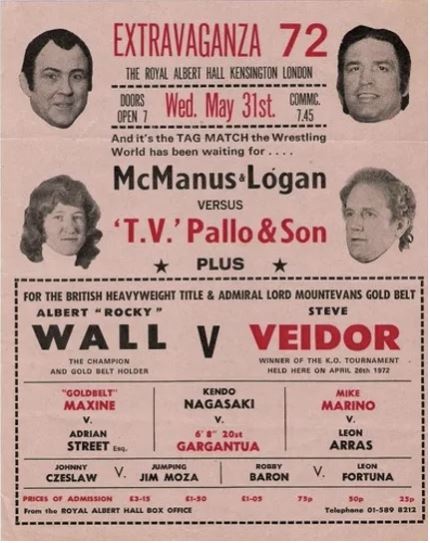
The May 1972 end of season spectacular at the Royal Albert Hall saw an eagerly awaited tag clash featuring Jackie Pallo Junior on the other end of his dad’s tag rope. Logan and McManus claimed victory, but intensity of the singles feud between McManus and Pallo would not go away.
Matchmaker McManus finally realised the fact in the autumn of 1972 and rekindled the sixties rivalry at the Royal Albert Hall in December with a Challenge Match between the pair.
Tellingly, the match took place just a couple of months after the demise of The Wrestler magazine and the outcome was therefore withheld from the wrestling public at large. It was not reported in wrestling programmes either.

Finally Jackie Pallo scored his first and last decisive victory over McManus. We cannot in all honesty say that the nation sighed a sigh of collective relief, because this became one of the most suppressed pieces of information ever. Fans were unaware, and McManus seemed still to be overtrumping his nemesis by appearing in that night’s programme alongside the greatest Hollywood screen siren of the times, Raquel Welch. In spite of, or possibly even because of his Raquel Welch flirtation, McManus’s eye was off the ball and Pallo went into Christmas as a genuine contender, defeating McManus by two falls to one in Kensington.

Whereas it had been promoter McManus who, in true Captain Mainwaring style, had decided he was the most suitable wrestler to appear, alongside Robby Baron, on the BBC’s ratings hit, The Generation Game, Pallo now came into his 1973 own and appeared alongside Bruce Forsyth on the Christmas special of the same show. He was also the featured star of This Is Your Life – with McManus making a grudging contribution.
But it was the February 1973 rematch with the European title now at stake that interested Pallo and his fans. Once again he scored a victory over McManus – only to be disqualified just seconds later for failing to release the submission hold.
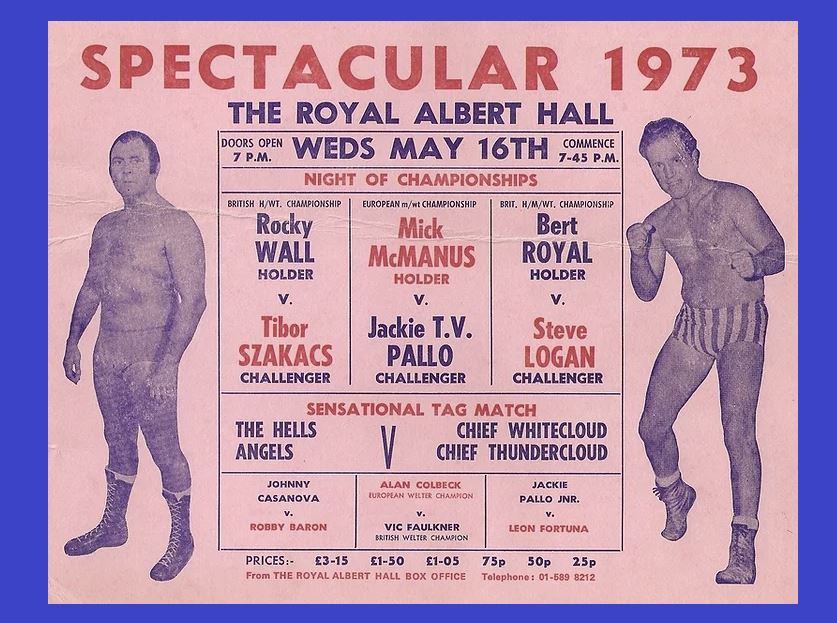
This was neat planning to extract maximum effect and the scene was now set for the deciding McManus v Pallo VII which would once again be the highlight of the Royal Albert Hall end-of-season spectacular in May 1973, once again with McManus’s European Middleweight Championship on the line. Seemingly unwilling to split their respective seventies merits, the pair wrestled to a double-knockout verdict, and this was the last time they would share the same ring.

Pallo had been a hive of wrestling industry through the early seventies and continued on the same track for the rest of the year. A new feud with Steve Logan didn’t quite take off, but Pallo continued to teach his boy the ropes in readiness for their big push for freedom and independence as described in The Heritage Years of wrestling.
The two drop-kicking athletes from their early encounters were now fifty somethings living, albeit quite deservedly, off the fat of their careers.
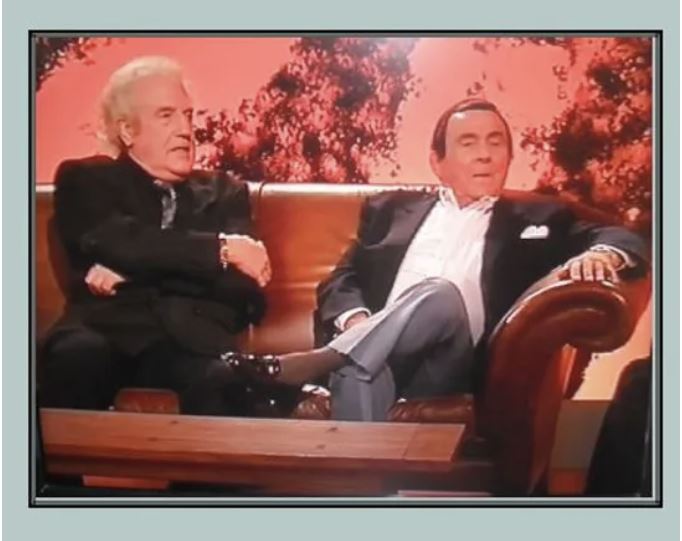
Twenty years later, the pair would finally share the sofa that Eamonn Andrews had been unable to engage them upon. Pallo had by now published his own book and paid, in an equivalently grudging manner, respect to his old New Cross foe.
In conclusion, it seems certain that both Pallo and McManus worked magnificently together inside the ring, but that all manner of factors outside the squared circle created obstacles to any great friendship or close professional collaboration.
We have done our best to piece together a true historical record of the Greatest Feud in Wrestling, and have boldly confronted those red herrings and obstacles that we discussed near the start.
Let this painstaking research now be history, while we await additional snippets of detail and reminiscences from fans and friends that will allow us to edit and embellish our story so far.
 Wrestling Heritage