
Wrestling Heritage welcomes memories, further information and corrections.
100
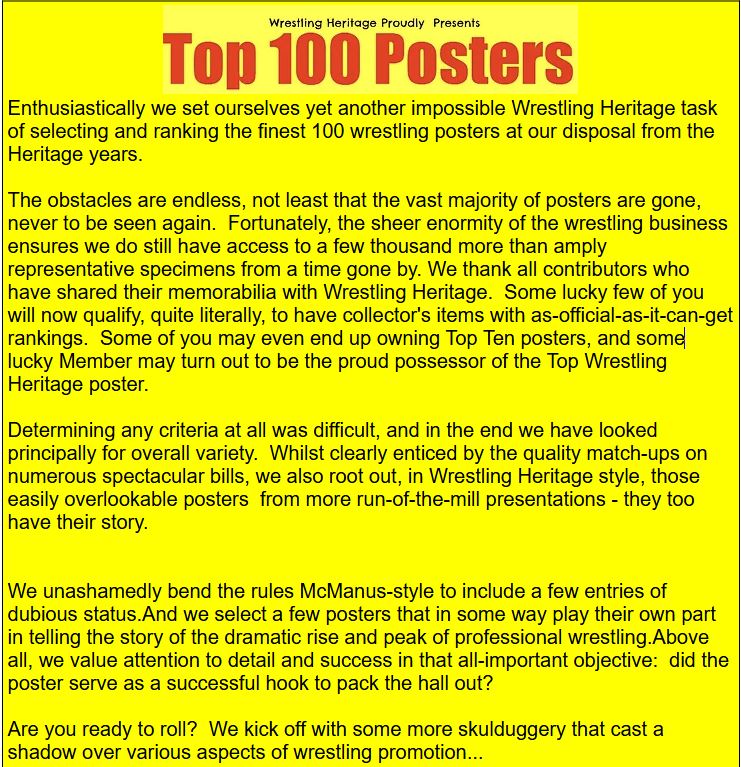
Naughty, naughty. As can be read on this site, by 1970 the McManus v Pallo Rivalry was decidedly on ice. But promoters knew what would fill halls and here Doctor Death applied all his mischief to lead the casual maybe hurried reader to believe they would see the two Londoners in action against each other. The words DEMANDED RETURN really do invite the misunderstanding. But we mustn’t be too harsh, it’s a great bill in itself, and Young Robby must just have passed his driving test!
99
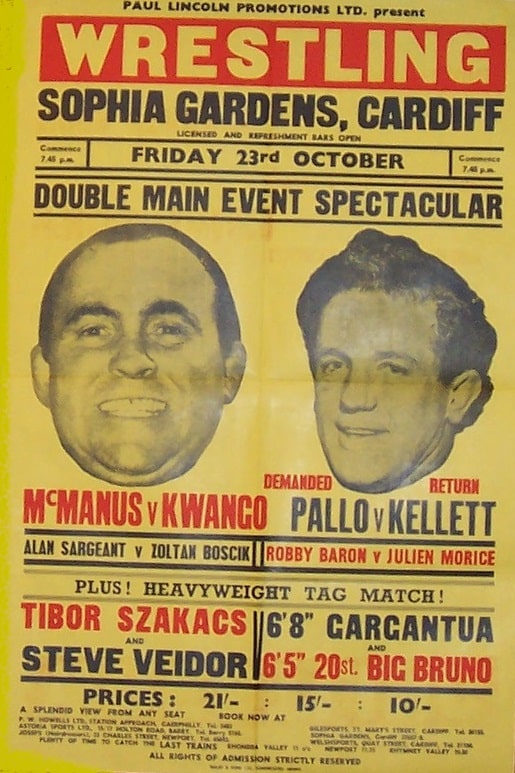
A simple example of what constituted a good poster in the seventies, even if it is dumbed down by comparison with preceding decades. Up to date photos and an appropriate layout. Admittedly we’d prefer not to see two neighbours so blatantly billed against each other – but why didn’t they bill it as a Manchester grudge match? They could have been fighting over the cost of petrol driving down together! But we will overlook such irritations in this rundown if it means we can include posters featuring Heritage favourites – and it’s good to see Eddie’s font that tiny bit bigger than the others’.
98
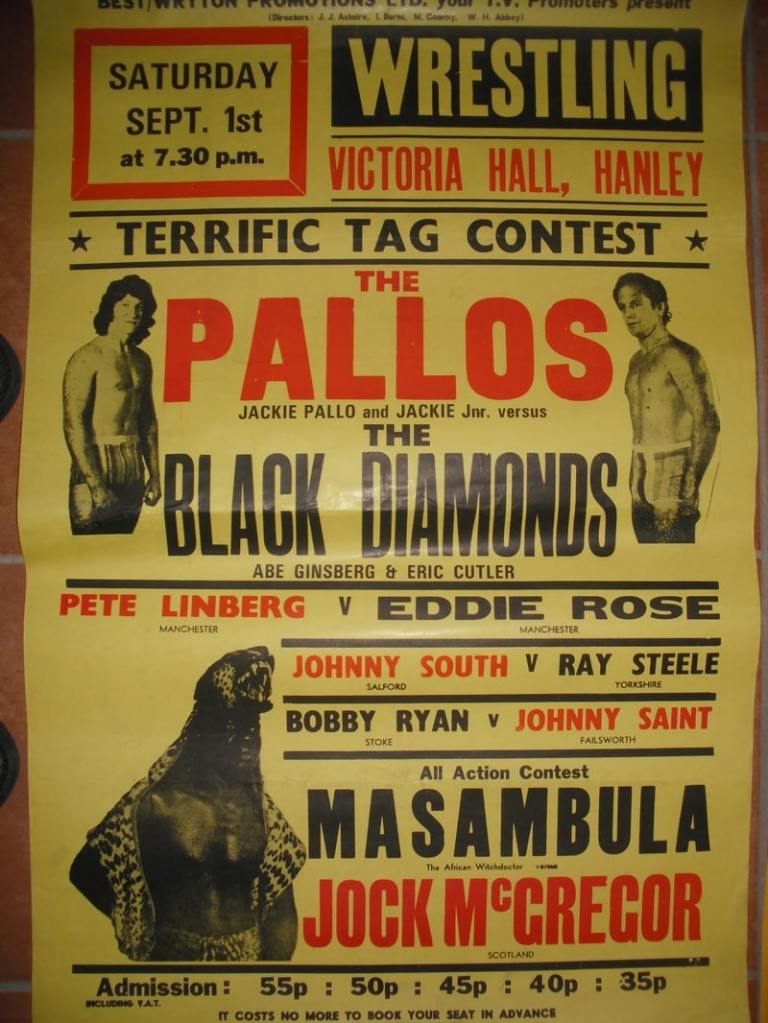
It’s a strong 5-bout bill to be sure, laid out with care. But it is extraordinary to see the bill topped by the sole non-bill topper in single combat. And he has his photo too. It is probably decades too late for us to have any chance of understanding what precisely was going on here, but this poster does seem to do its best not to hook the audience through the biggest names on the bill.
97
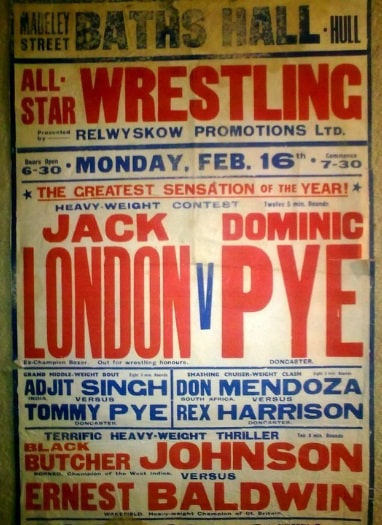
Borneo! What on earth is going on here with Black Butcher Johnson being billed from the land of the orangutan? Whilst being Champion of the West Indies! Never mind the detail, this was an exciting bill with boxer turned wrestler Jack London facing up to the man who recently featured in Wrestling Heritage’s second greatest Photo. Most intriguingly of all, look at this first sighting of the name Relwyskow in this context…
96
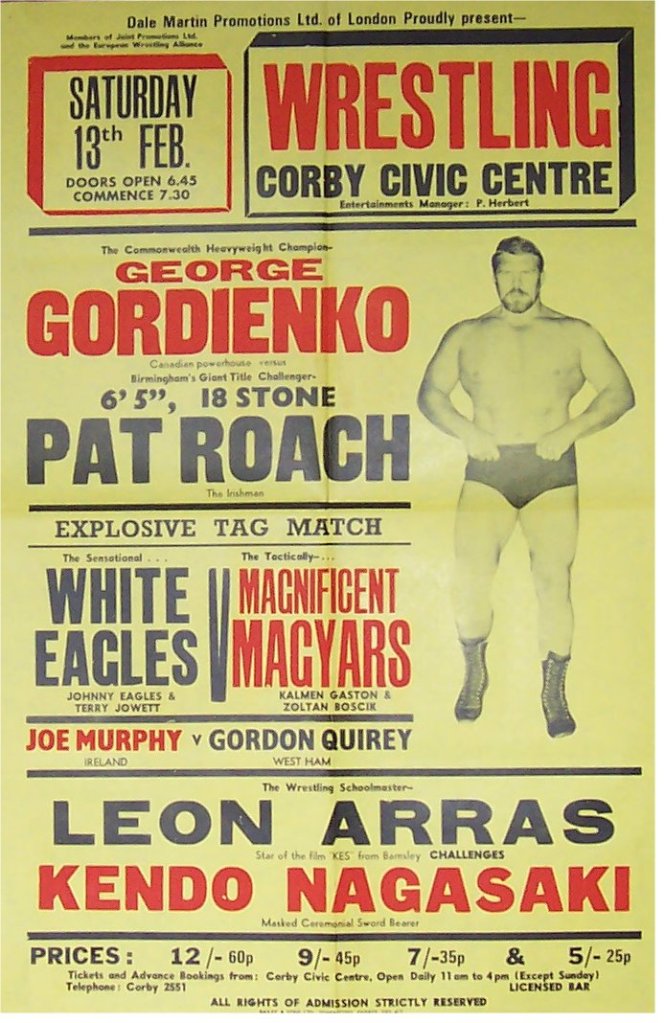
The same Georges Gordienko who will be seen bill-topping 10 years earlier in the next entry, here commanding prime billing and full-length photo. Gordienko remains woefully under-covered and under-discussed on this site but this poster shows his true status. This poster claims currency also as showing shillings taking priority for one last time over new pence – just a few hours after the heat from the tag match had cooled down, decimal coinage would officially replace LSD, consigning, in its turn, shillings to minor billing and, ultimately, oblivion. The catchy style of having a description both before and after the wrestlers’ names would become all too much bother just five years later, but for now diligence and creativity prevailed, and the magnificent mystery of the ephemeral and flexible Commonwealth Heavyweight Championship belt flutters beguilingly once again.
95
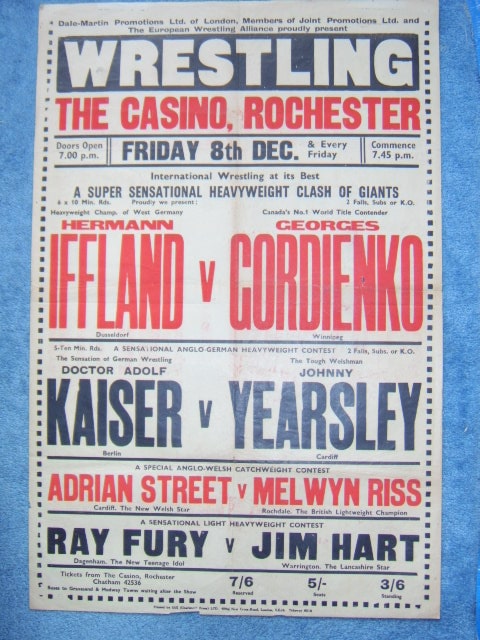
Wrestling was on the verge of its early sixties peak and it was truly international 1961 presentations like this that brought the success. Two outstanding German visitors on the one bill leaving us wondering whether Johnny Yearsley had to wrestle clean that evening. A British champion on the undercard in the only bout not described as “sensational”!

94
Meanwhile, the previous night……possibly the world’s first ever “globular” bill. Jackie Pallo in one of his early billings by his nickname against an up and coming 18-year-old northerner. Even tag was still very novel in 1961 and billed still as American. The only American citizen on the bill was actually Harold Sakata and we can only imagine that it was his in-ring performances as the villainous Great Togo that captured the imagination of a film producer at this time who, a couple of years later, would shoot him to international stardom as Oddjob in the James Bond film, Goldfinger. And we are left to wonder in all respects about Steve Sipos, one half of the all-Hungarian affair.
93
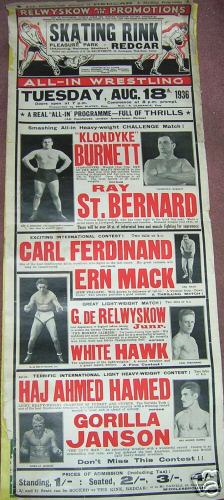
Just look at the detailed presentation of this 1936 bill!
Appealingly meticulous language to make this presentation at a Yorkshire holiday resort really seem of international importance.Language that would go on to be used almost unchanged over the next 40 years as wrestling boomed.7 of the 8 wrestlers are photographed. And there’s even space for George Junior on the undercard. They don’t mak’em like this any more.
92
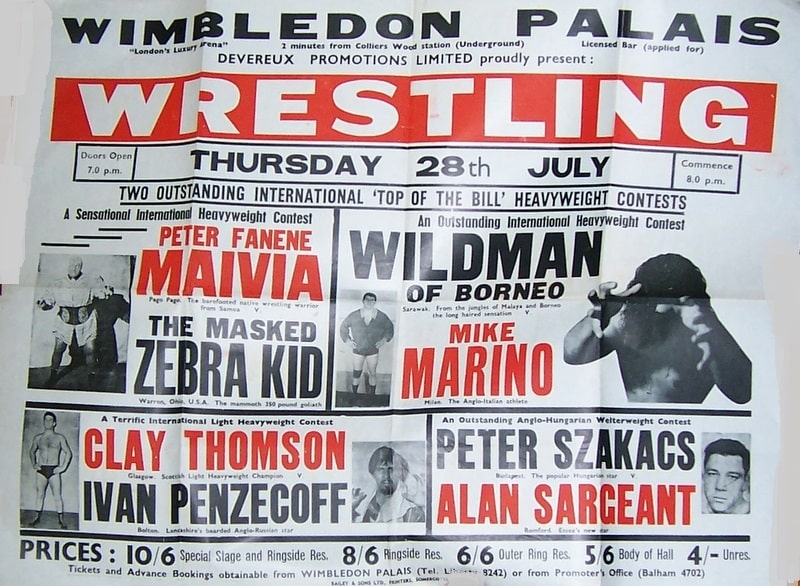
Here’s the original Wild Man of Borneo presented in a sure-fire way to fill halls. And the first entry for one of the South’s leading venues, still much venerated today on this site. Herbert Devereux’s personal touch and generously large poster makes a fairly standard 4-bout bill really stand out. A perfect matchmaking balance of the surreal and the plausible. The fetish for Anglo-Hungarian, Anglo-Italian and Anglo-Russian descriptions abounded in wrestling as in no other sport. See The India Rubber Man actually described in our A-Z as an Anglo-Latvian.

91
Far and away the most recent entry on our countdown, this BBC-made poster dates from December 2012. A designer’s eye has successfully captured the essence of the posters from years gone by as glorified in our listing.
90
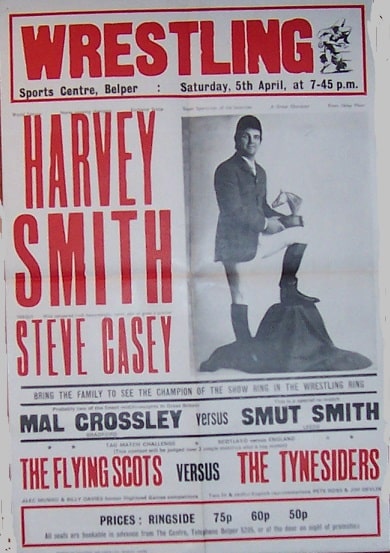
Harvey Smith was a Big Name entry to the Joint Promotions wrestling ranks in 1975. He was not merely from the top-of-his-game in another sport, he also brought with him a genuine reputation for rule-bending, aggression and Yorkshire grit. His dislike of authority was legendary. Number 90, therefore, shows just how very quickly and well he acclimatized. Here’s a disaffiliated Harvey doing just what Kellett, Pallo, Garfield, Wall, Street, Nagasaki and the rest were doing in 1975
89
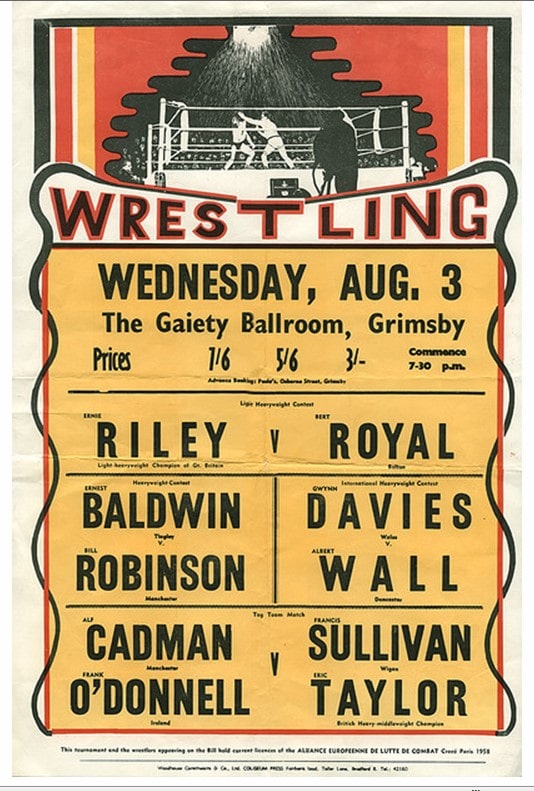
No attempt whatsoever to make this an international bill, just ten very solid home-bred wrestlers featuring on a poster presented with a flair that is commensurate with the venue’s name. A golden chance to see seven British champions and a tag match for three bob.
88
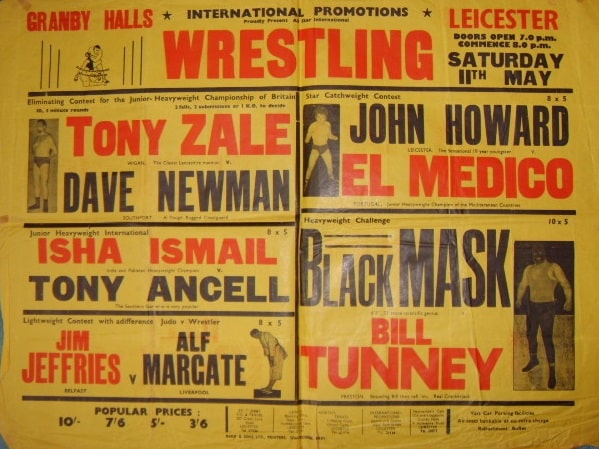
The variable quality of the contribution to the wrestling scene of independent promoters, whom we call “The Independents”, is an ongoing area of discussion and at times dispute on Wrestling Heritage.
A magnificent full-spread poster in the style of the very best Belle Vue, Paul Lincoln and The Royal Albert Hall could offer shows The Independents at their very best. The promoter respects the fans’ intelligence by limiting his claims as to the title at stake in the eliminator. An early sighting of dear Al Marquette under something more akin to his real name catches the eye.
87
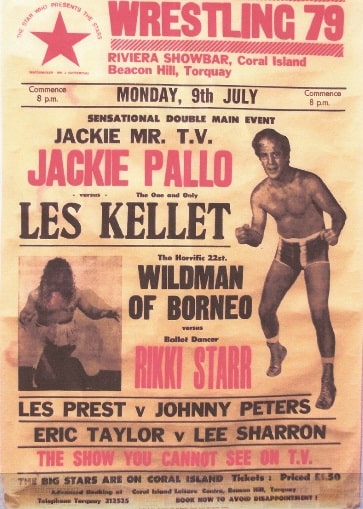
Full marks to Jackie Pallo for not trying to imitate the tv promoters or hoodwink the audience. His commercial eye made him proud to boast that his was the show you couldn’t see on television. This was top-notch ballsy stuff at the time. And he backed it all up with 4 top names, not to mention the self-same heavy-middleweight champion from above and three very solid others. really appealing bill with only Mr TV’s own prominence casting the faintest of shadows.
86
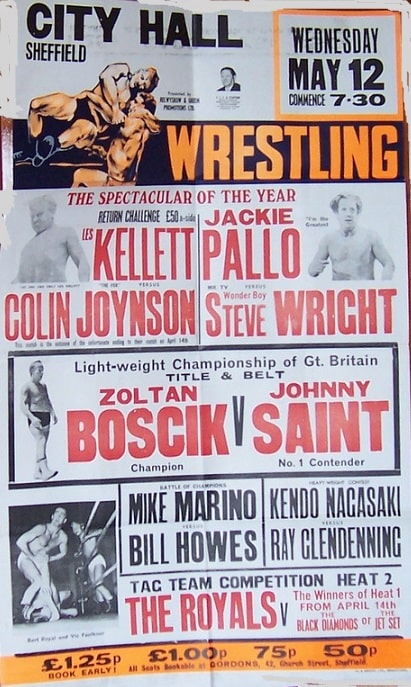
We go back to the same two bill toppers eight years previously. The promoter who promotes his own face once again conjures up an outstanding and original mix of established headliners and hard-hitting value-for-money pros. All on a magnificently laid out poster, with the framed title bout rightly holding centre stage – if not top billing. Even the tag match was meaningful! Our only concern, which of these bouts came on as the curtain-raiser?
85
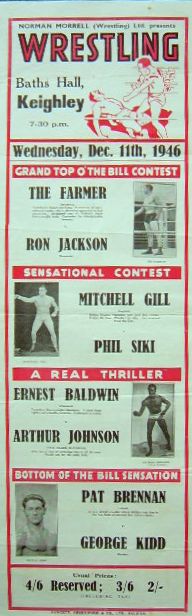
Meanwhile, 25 years earlier in newly peace-time Britain, the founding father of Joint Promotions was experimenting with serious and attractive presentation. Even Black Butcher was presented under his rather more mundane real name. We notice how Norman strives to apportion equal prominence to each wrestler, and have only two misgivings:
– could he be one of the very first to be accused, quite literally, of over-sensationalisation?
– weren’t these prices a bit stiff for ration-book Britain? Nothing less than a florin for entry.
84
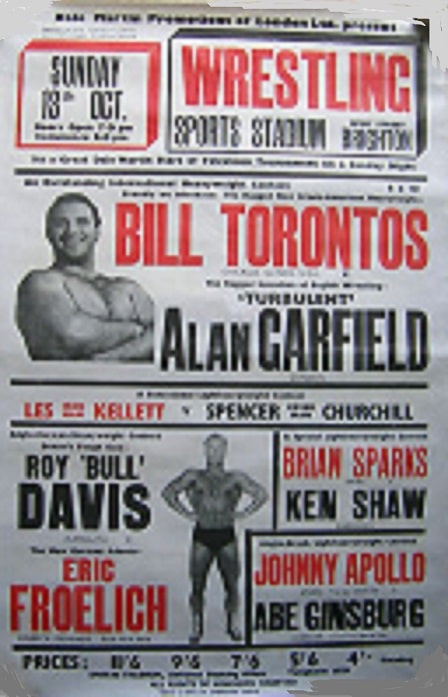
We return to a recurring theme at Wrestling Heritage which makes this a truly prized poster. In the autumn of 1963, on the back of imposing publicity photos, sent from Chicago, a rugged new heavyweight took instant bill-topping status with established home-grown stars all nudging down the poster to accommodate his arrival. When the diminutive cigar-chewing Tornado Torontos finally appeared, a number of mis-matches ensued against formidable heavyweight opposition such as Big Bill Verna, the Outlaw and, here, the Lord of the Manor himself. The Chicago Express quickly slid down future posters to appear in closing comedy bouts over the following 17 years. An interesting brownie point is that, in view of his comedy style, Billy Torontos hardly ever shared a bill with even greater clown, Les Kellett – the promoters wisely decided that would be overkill.
83
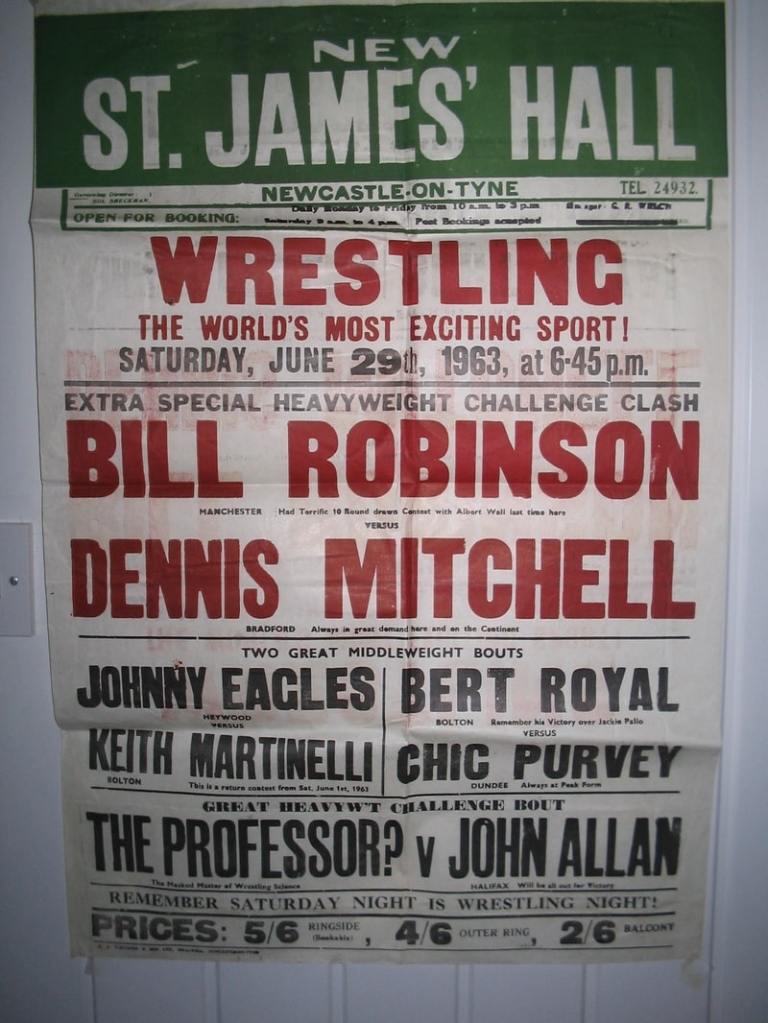
Wrestling Heritage is proud to have amongst its Members so many fans (and hot dog vendors!) based in Newcastle and the North-East. So we are especially pleased to include a poster from their beloved St James’s Hall from the same heyday year and with the early Geordie start striking southerners as rather weird, particularly at the height of summer.
82
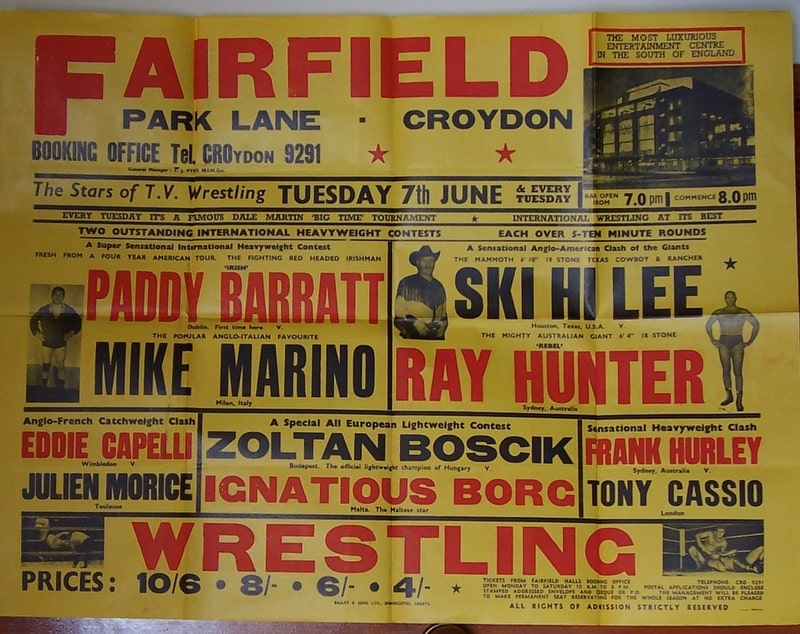
A Dale Martin promotion from one of the country’s premier wrestling venues, in 1966.
A magnificently laid out poster, exploiting its double width to the full and making every square inch of interest. Norman Morrell’s influence from 20 years earlier, and above, is evident as three of the five bouts are described as “sensational”. But dig deeper and this poster is an enigma wrapped up in a mystery. To all the world this poster bears all the hallmarks of a Paul Lincoln presentation, even with loyal Rebel Ray running proceedings. We have explored the needle rivalry between the two promoters and then also the cosy merger and ring invasion six months earlier.
So what on earth was such segregation doing here, on a Dale Martin presentation? Could it be that ten Lincoln boys were celebrating one of Ski Hi Lee’s final UK appearances?
81
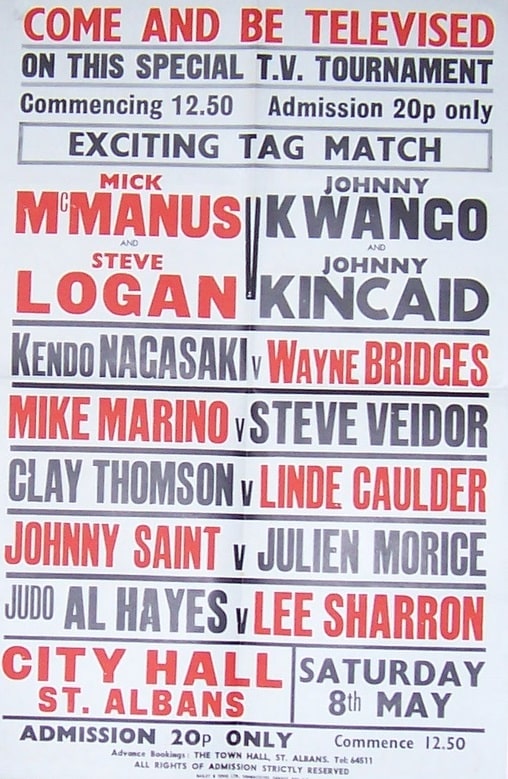
Not a great poster by any stretch of the imagination, but it claims its place at 81 by virtue of it not merely being a televised show, but a Cup Final Day Spectacular, featuring the television debut of Kendo Nagasaki to boot. Note the start time. And check out the entry charge, cheap even by 1971 standards. They just had to be sure of getting a full house and could take no risks. They knew hardened fans would see the value and didn’t bother with any superfluous poster detail or photos. They probably expected to sell out well before the Big Day. A novelty item indeed.
80
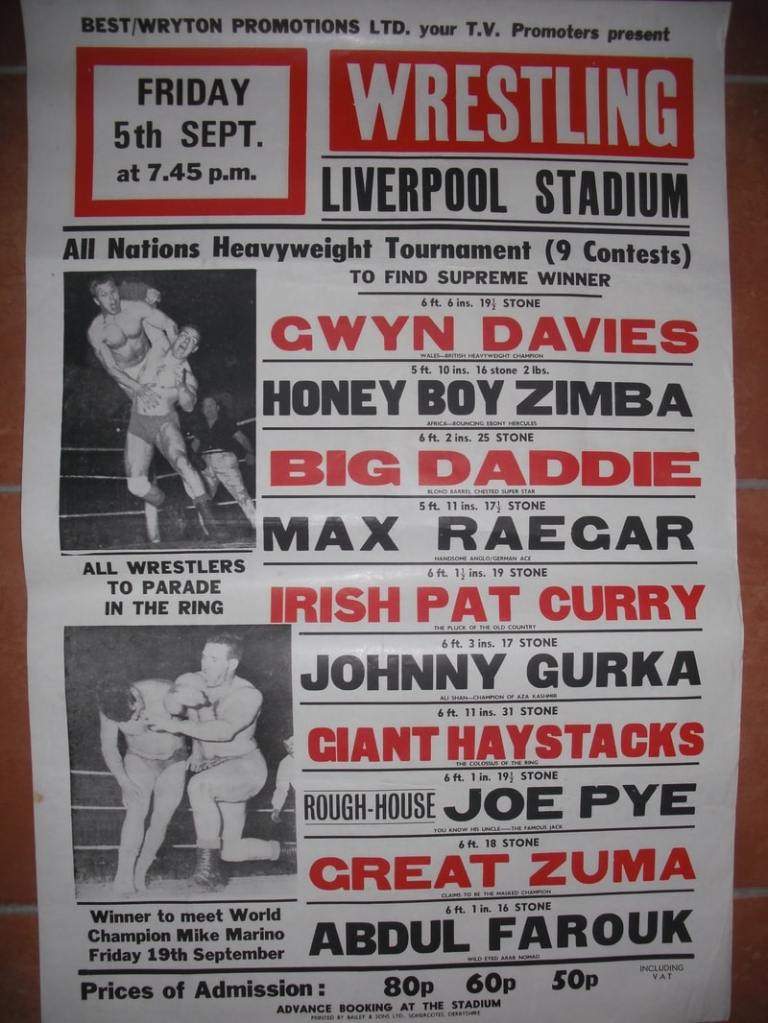
Admittedly this poster enters the Top 100 more thanks to the bill itself than the poster presentation, but it is quite novel as a result. Features we like are the meaningfulness of the tournament with the winner to meet a World Champion; the parade of wrestlers; the imposing listing with each wrestler’s height and weight given. In fact, this poster could have featured much higher in the listing only for a few nasty niggles: lazy insertion of photos of wrestlers who are not billed; no mention of any kind of trophy for an All Nations affair; and for these super-heavies to be rewarded with a bout against a far lighter opponent doesn’t quite make sense. As for how they managed to extract 9 bouts from this awkward number of ten wrestlers we shall leave to your own tree diagrams … but we can be sure there was some underhanded bye-system to ensure Haystacks progressed without actually wrestling much.
79
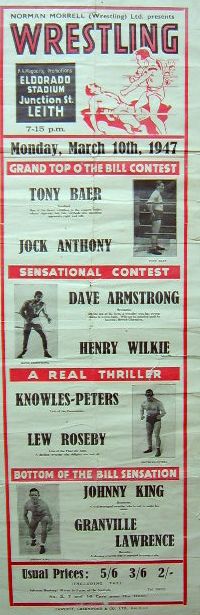
A fascinating historical record from Scotland of wrestling promotion before the formation of Joint Promotions. An enthusiastic and diligent Norman Morrell experiments with language and a presentation style that would form the template for his peers and the business as a whole over the following 30 years. What a treat to have the year clearly stated – they must have known this would serve us so well sixty-six years later!
78
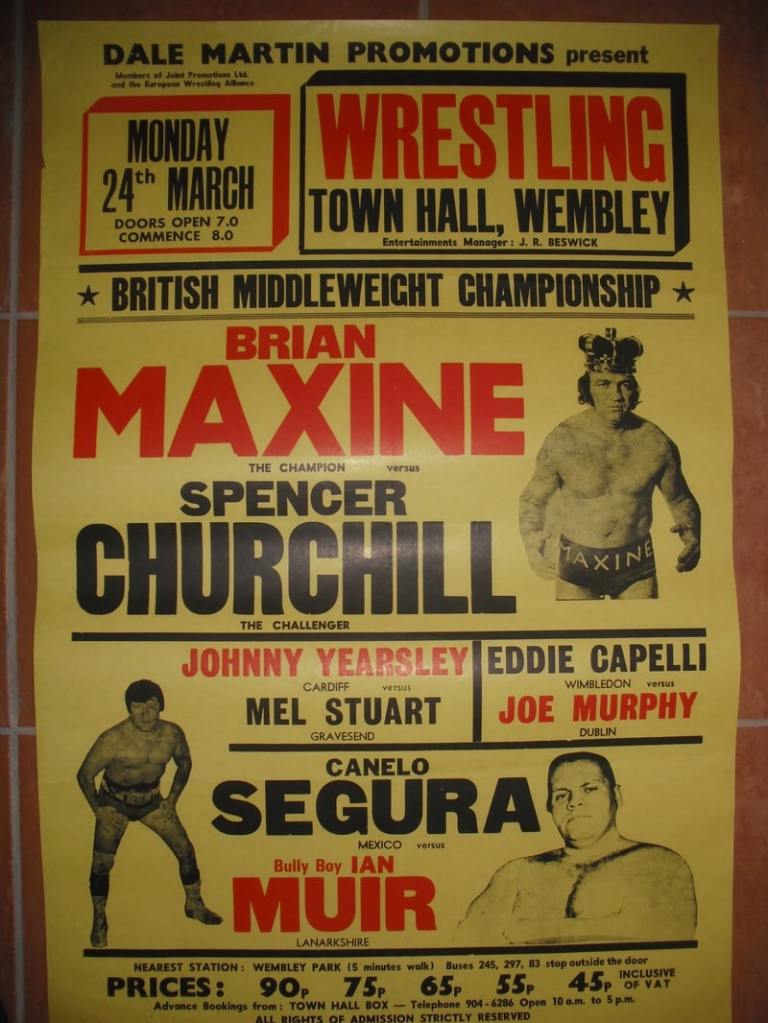
A rather run of the mill bill that stands out by virtue of having a title contest as its main event. Promoting around twenty shows every evening at this time, Joint Promotions had about 20 “official” title holders at their disposal, but title contests were used very sparingly, especially in the south of England. Even the Championship of Kent was hardly ever contested.
Casual fans and outsiders may be surprised that greater use wasn’t made of this attractive feature, so we should explain a couple of facts about wrestling titles. In many cases the belt itself had been made by an individual who was reluctant to relinquish it to any promoter or other wrestler even when he was past his sell-by date. And there was always the fear of a double-cross, with the challenger claiming the title against the pre-arranged plan. So we’ll turn a blind eye to our concern as to whether the Cover Man could have made the upper middleweight weight limit and congratulate Goldbelt Maxine on his mission to show his belt wherever he wrestled.

Sixes & Sevens
Same venue. Same twins.
But the stark contrast here shows how the aggressive independent promoters tried to pick off prestigious Dale Martin venues in the mid-seventies. Here they decided to reduce the price of ringside seats by 10% just 10 months after the 1974 pink poster. The booking of halls and the financial arrangements between promoters and local venue managers remain a subject we have discussed but have little authoritative access to, or records of. How fascinating it would have been to have seen the three-way negotiations between existing promoter, theatre management and new kid muscling in. So, which style of wrestling poster is best? You decide.
75
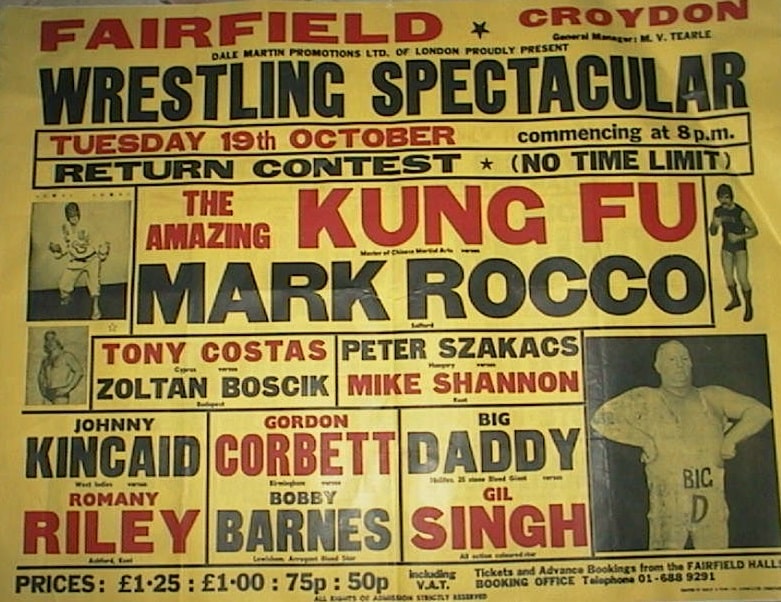
Like most of this set of ten posters, another from one of the country’s top 20 venues. We can imagine the excitement these two risk-taking bill-toppers generated. But mostly it’s the Return element that catches the Heritage eye. With at the time fortnightly Croydon spectaculars, considerable planning was required to ensure variety, as each bill had at least a dozen wrestlers and the Dale Martin pot of pros wasn’t bottomless. In retrospect, it is also interesting to recall how the words NO TIME LIMIT elevated the bout to even greater prominence. In hindsight, rounds were essential for so many reasons: the wrestlers needed a break to wrestle to their best; fans needed a break for all manner of needs; and the ringing of the bell allowed for all kinds of villainy and controversy. The enigmatic and skilful Gordon Corbett features at the bottom of the bill during that brief year or so when he dedicated himself to work in Joint Promotions rings – rather than his own.
74
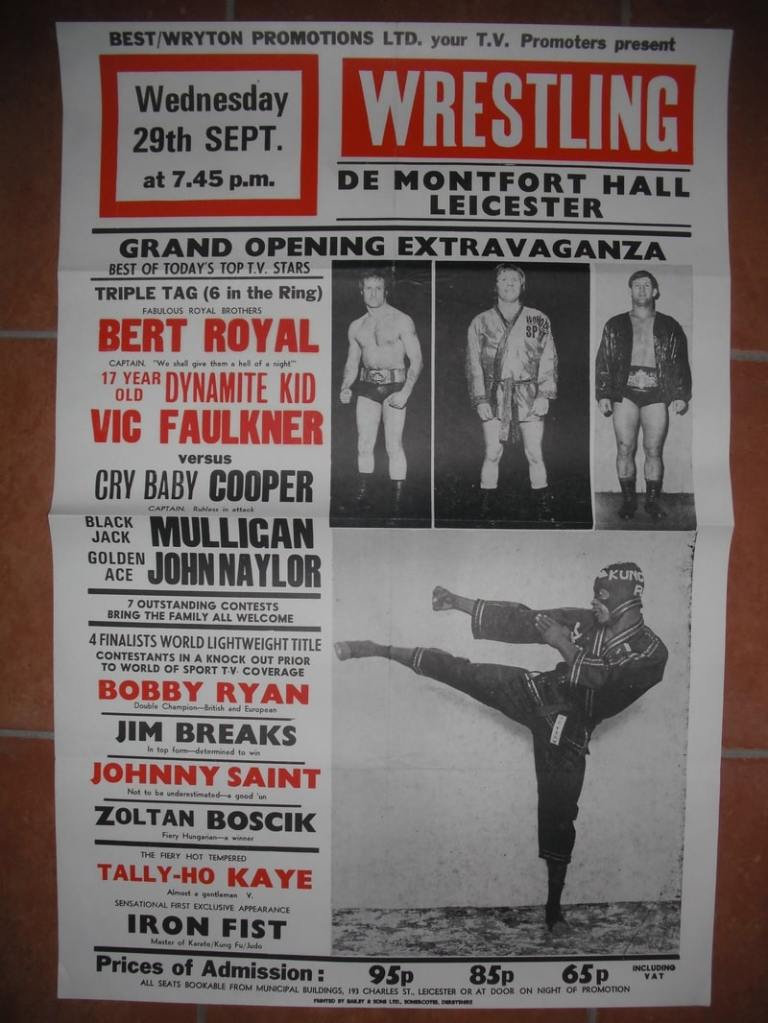
No fifties fans or promoters would have imagined that one of the nation’s major venues would be presenting an “extravaganza” just twenty years later where not a single heavyweight would appear. The lighter wrestlers had previously even been expected to carry the big boys’ bags outside the ring! The use of language to describe the KO tournament is fascinating; is it deliberately misleading to make it appear the world title will be decided this evening; or is this in fairness as clear as they could be? You decide. Most prominence is given to Iron Fist in his short-lived masked period. This poster provides an interesting historical record, but for once it leaves us crying out for a change of pace with a heavyweight contest.
73
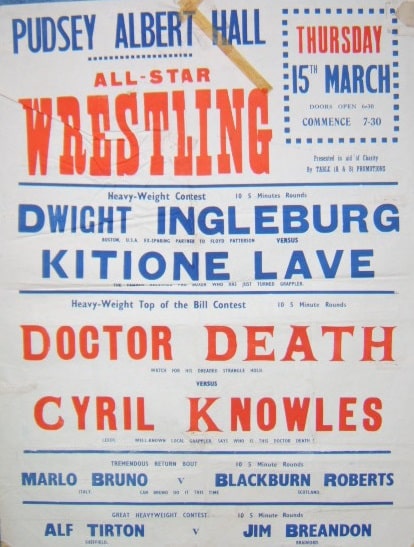
Notable first-time attendee at the 2013 Southern Wrestlers’ Reunion, Dwight J. Ingleburgh, tops the bill alongside fellow Barnsley-trained boxer, Blackburn Roberts, Heritage favourites both. A multi-fonted poster that works well and the essential ingredient of an independent bill, a Doctor Death, leads us immediately to wonder mischievously which of the other six wrestlers may have donned the hood this evening. Most of all, this fine rare poster features the great Kitione Lave, and the Tongan Torpedo is added to the A-Z listings at this time.
72
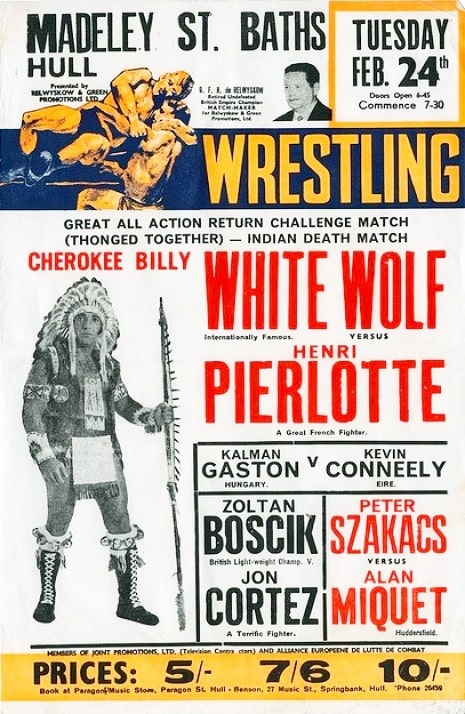
Heritage member Recky from Australia supplies this Del Relwyskow poster and comments: “I have a liking for this poster due to the simple fact that a bloke who had a helluva run in Australia and was probably one of my first favourites is advertised on it (Chief Billy White Wolf).” Meanwhile, Wrestling Heritage wonders what precisely “thonged together” might have actually meant.
Surely the promoter who promotes his own face has missed a trick here, with three Magyars on the bill some kind of meaningful team match would have added edge. And without it, on the contrary, the thought of one trotting out after the other leaves the bill in danger of being repetitive.
71
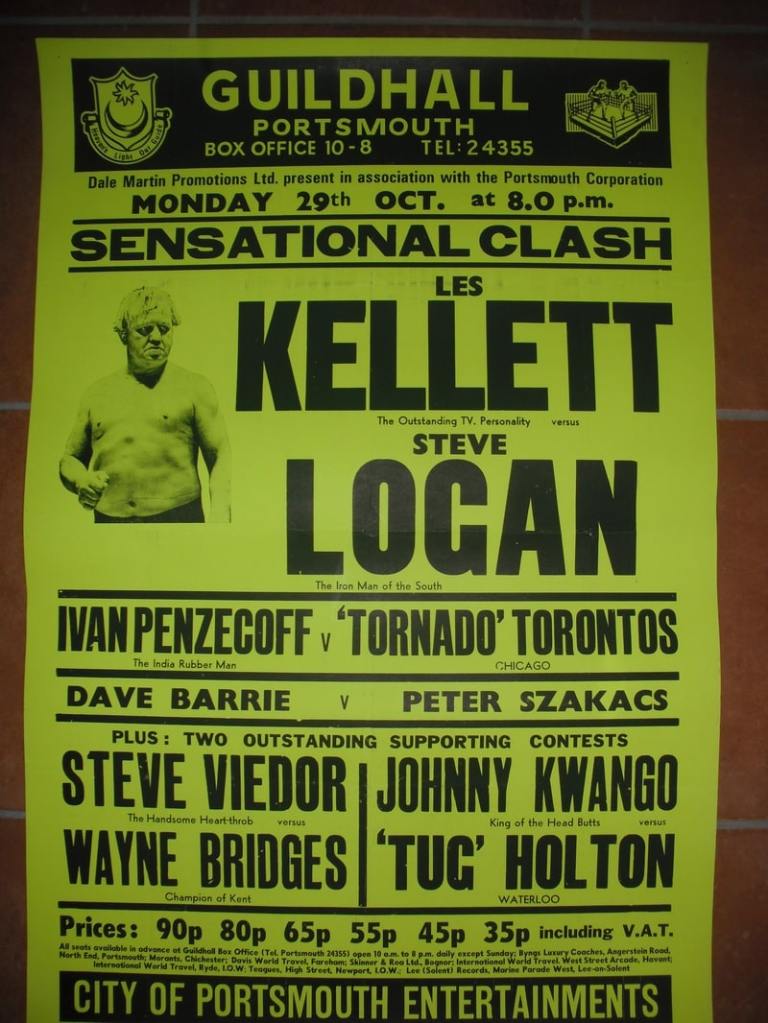
If Geo Del Rel really was the master match-maker, Portsmouth can lay claim to having the classiest posters in the south of England. Pompey weighs in to our countdown with this unusual luminous poster. It’s one of those rare venues where the venue itself was also featured. Gwen Elrington, wife of Big Bruno, was also promoter in Portsmouth, but her shows were on Southsea Pier – how we’d love one of her posters! She managed to attain a degree of autonomy within the Dale Martin network.
So Dale Martin’s knew they had to promote decent fare at the The Guildhall and promoted to the best of their abilities. Here, there’s not a local wrestler in sight with all those Hampshire heavies to choose from.
70
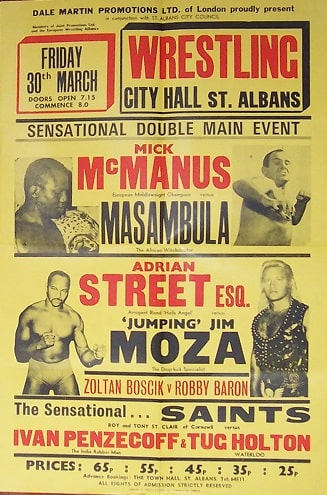
Blink and you miss it. Dale Martin Promoters were just starting to twig that Adrian Street was top-of-the bill material, but, by the time they truly did, he had become disenchanted and moved off to rival promoters and, subsequently pastures far afield. So this poster records him sharing top billing with the great Mick McManus. The Welsh welterweight would go on to astound us as he faced the biggest America had to offer, but here Jumping Jim provided enough of a weight difference for us to question the catchweight contest. But a great night out assured for the fans.
The photo of Jim Moser is well sourced; the tag match pairings are ideal in terms of weights and styles.
For the uninitiated reading this countdown, and you are most welcome, here’s an involving teaser. Try to work out from the posters featured which other wrestler was invariably on the same bill as Mick McManus. That wrestler doubled up as McManus’s driver.
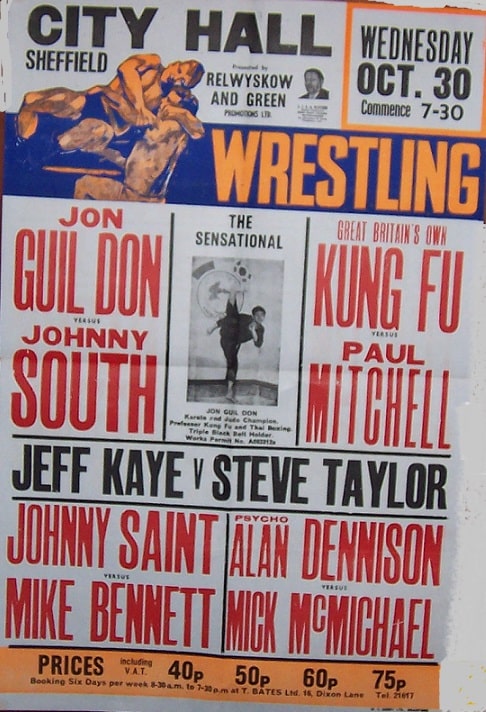
69
Another poster that underscores the deep impact that Jon Guil Don made during his six-month UK stint, an impact often addressed on this site if not readily called to mind by the majority of wrestling fans. Guil Don’s lightning fast moves lent themselves readily to catchweight bouts and an ideal opponent has been selected here. How strange the poster-maker felt the need to remove the mystique of the masked man sharing top billing. Just as we all thought he was from the Orient, the beans are spilled and here he is as British. Let’s hope Ireland’s Eddie Hamill didn’t notice his nationality being wiped out! Heritage Member Paul Mitchell crossed the Snake Pass to be an equally ideal opponent and would apply all his versatility to allow Kung Fu to sparkle.
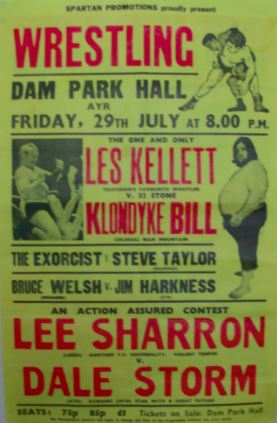
68
A thoroughly professional independent poster with appropriate photos of the main event wrestlers. One of the most prominent Scottish wrestlers of the seventies, Dale Storm fulfils the local hero role against the reliable Yorkshire villain. Hard to know which Exorcist this might have been in 1977 (surely not Dale…?), and perhaps even harder to know which Steve Taylor it was this time.
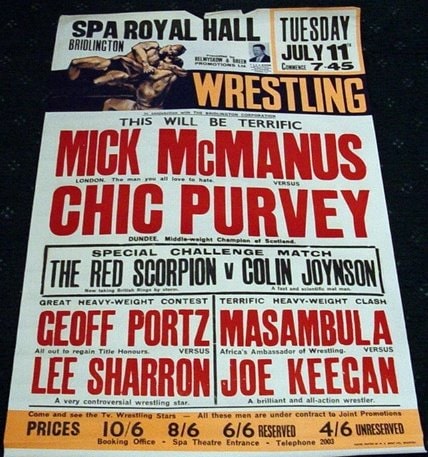
67
The same Yorkshire villain ten years earlier against a Yorkshire hero on the Yorkshire coast. We can say with some authority that this Red Scorpion would have been Ted Heath. But the main event stands out with Dale’s predecessor as one of the top lighter Scottish wrestlers of the sixties – not to mention star of Coronation Street – opposing the wrestler who was hated in the south and absolutely despised anywhere north of Watford. But boy did he travel. Colour is used most eye catchingly on this fine specimen.
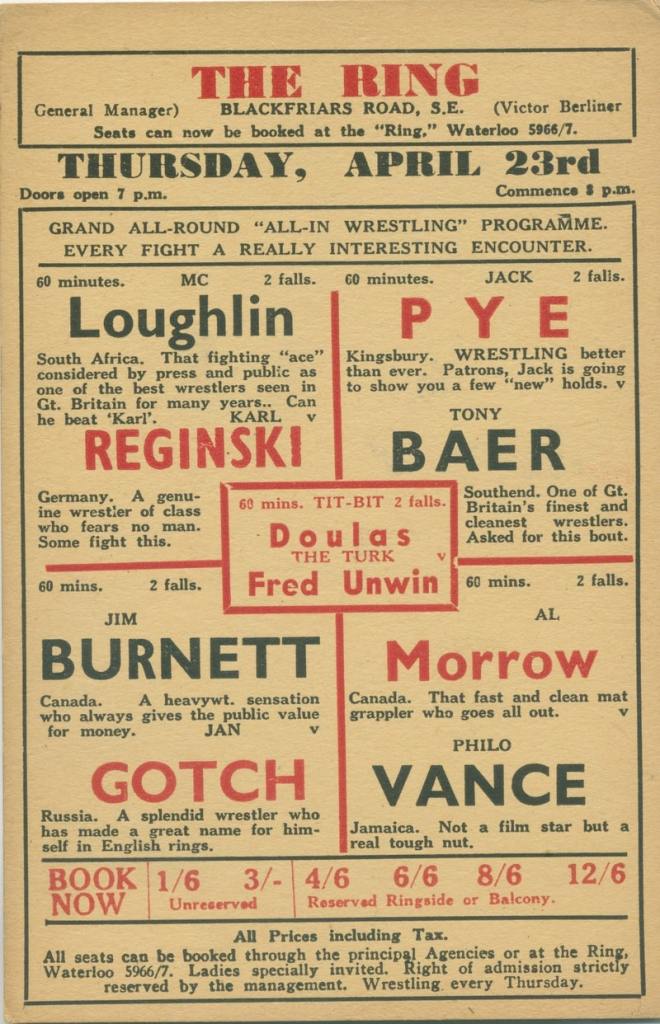
66
An absolute gem for St George’s Day at one of the country’s very top venues of the thirties and forties, The Blackfriars Ring. The writing reaches out and speaks to us even now, with Dirty Jack and his “new holds”, and the programme described as “interesting” – hardly hype, was it? Some tit-bit over a one hour duration! Most of all we note the appearance of Gotch, recognised as one of the all-time greats.
And we shall just have to wonder just how unsightly poor Philo Vance must have been…
65
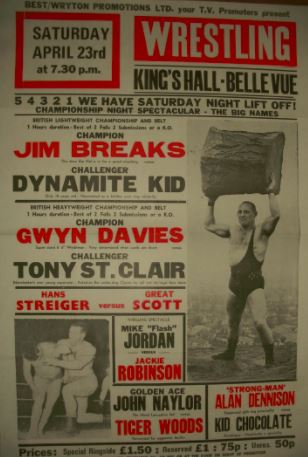
Meanwhile, St George’s Day a quarter of a century later at one of the nation’s premier venues. A poster that scores negative points for its choice of photos – how could they show the embarrassingly vanished champion Rocky Wall when two completely different heavyweights were wrestling for the title? And what’s with the log when it would have been better to see at least a couple of the bill toppers? But with two British championships at stake, this poster was a must inclusion in our listing for historical reasons. It’s a strong undercard, too, which leaves us in little doubt that Hans Streiger would have left as great an impact as any on the fans.
64
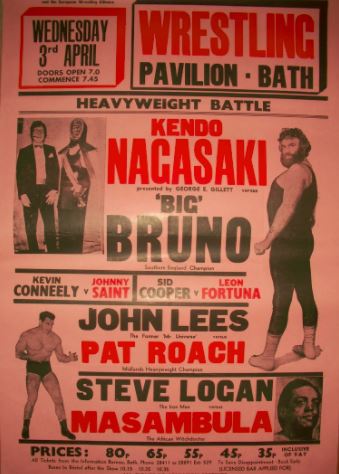
It all seems so sober as we revert to a Dale Martin presentation, but it was this serious style of poster that made wrestling seem a legitimate sport for so long, devoid of outrageous antics and claims, and providing balance and great value for money over the five bouts. Layout, photo selection and use of colour make this a representative example of thousands others like it.
63
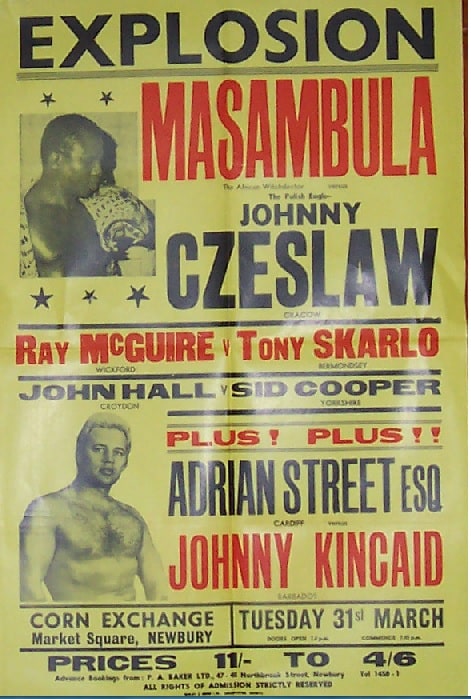
Thinking outside the box. Even the venue is reduced to the bottom of the bill as a creative poster-maker really goes for it and succeeds in creating excitement and anticipation. But why oh why did they persist with that modest photo of Masambula? With all his showmanship and exotic trappings, surely a more appealing shot of an African witchdoctor could have been inserted.
62
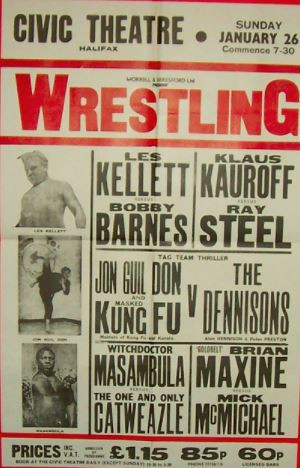
A rare outing for Peter Preston as one of the Dennisons on a bill which ensures there are Yorkshiremen in each and every bout – but no whiff of a team match here with Masambula possibly the only sure fire Yorkshire winner on the card! This Morrell & Beresford poster quite simply has a different presentation style from most others on the countdown, hence its inclusion. This countdown is actually focusing on design and each poster had a designer who sat and planned out the the layout and photos.
61
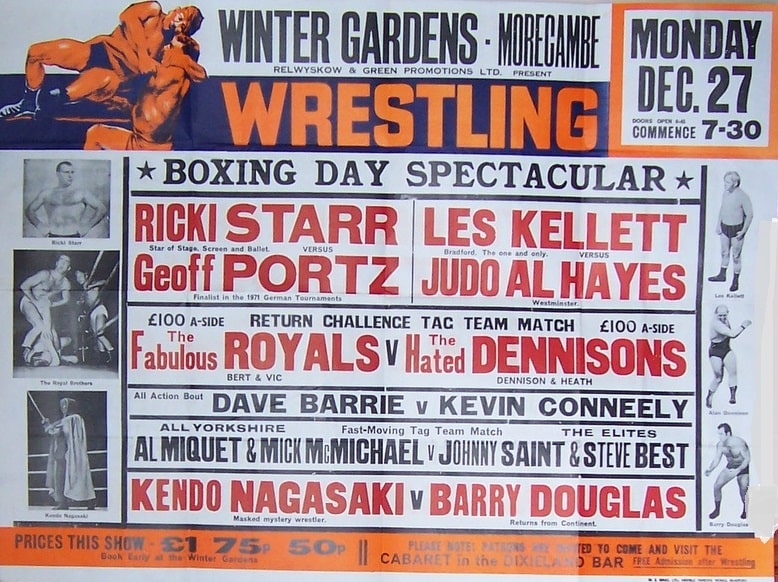
Geo Del Rel’s third entry alone in this fourth set of ten posters, with nephew Barry Douglas no doubt working hard to ensure everyone woke up sober after their weekend festivities to make the trip all the way up the west coast – the promoter even rescheduling Boxing Day to the 27th and making us wonder how many fans had turned up on the Sunday evening! What a great bill, with each bill-topping clown up against a formidable opponent, the third paradoxically opposing Kellett Junior, two tag matches, and, on this occasion, the poster actually informing fans of how the bouts would go: not much doubt with the delightfully unequivocal billing of the “Hated” Dennisons and it is the billing of that tag bout that really whets the appetite. Happy days!

60
Could they really afford to risk making the draw from the ring and having the two villainous pairs face each other in the first round? In our experience of one-night tournaments, draws were made in the ring by the MC fumbling unsatisfactorily with some bits of paper or, worse, stating “the draw was made earlier in the promoter’s office.” Members of the audience were invited to the ring strictly to pick raffle tickets only. But it’s a rip-roaring bill and the poster’s symmetry somehow bestows importance on the proceedings. The revived seventies pairing of Cooper and Dennison casts doubt on the belief held in some quarters that they had genuinely fallen out when splitting ten years earlier.
59
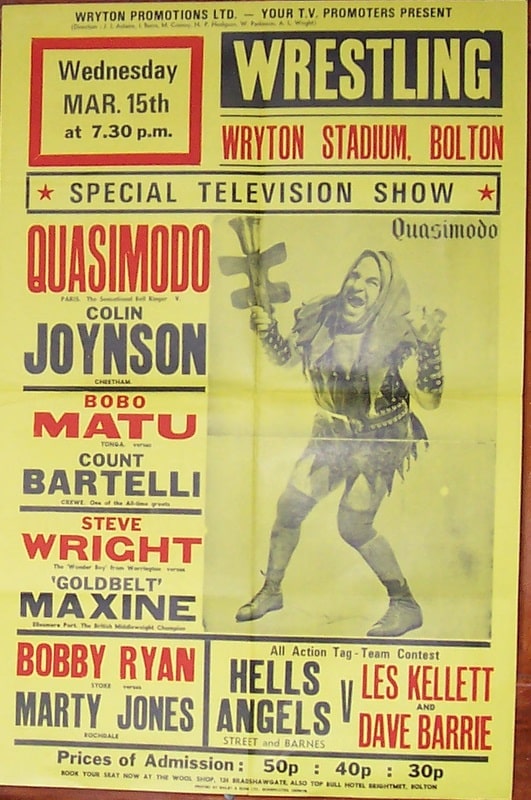
We embark now in true Wrestling Heritage style on a mini-run focusing on the guys who made the big names shine brightly. In Colin Joynson’s case this was only one of his many talents, as he could hit hard with the Pat Roaches of the ring, too. Joynson had been the man selected for N’Boa the Snakeman’s tv debut and would also go on to feature generously in a rare televised outing for the unmasked Kendo Nagasaki. Here he is entrusted with ensuring the ever-photogenic bell-ringer made an impact on his sole tv appearance, a match deemed too grotesque for Saturday tea-time and consigned to the mid-week witching hour slot. We like the gothic caption of the poster just in case any reader was in doubt as to which of the billed wrestlers this was! By the way, this bill also saw a rare televised loss for Count Bartelli.
58
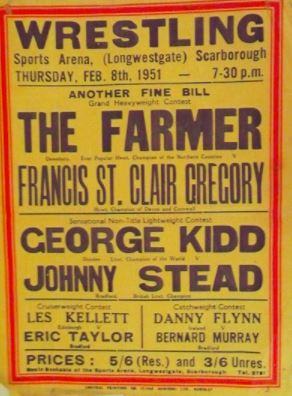
In the days when Les Kellett was billed from Edinburgh and heavyweights topped bills as a matter of course even over world champions, diminutive Bernard Murray was propping up the bill. During the lifespan of Wrestling Heritage many aspects of Bernard’s work have come to greater prominence, including his training of so many wrestlers and the fact he was a real tough shooter. This Scarborough poster is elegantly laid out and the promoter does not shirk from showing that half the wrestlers were from Bradford.
57
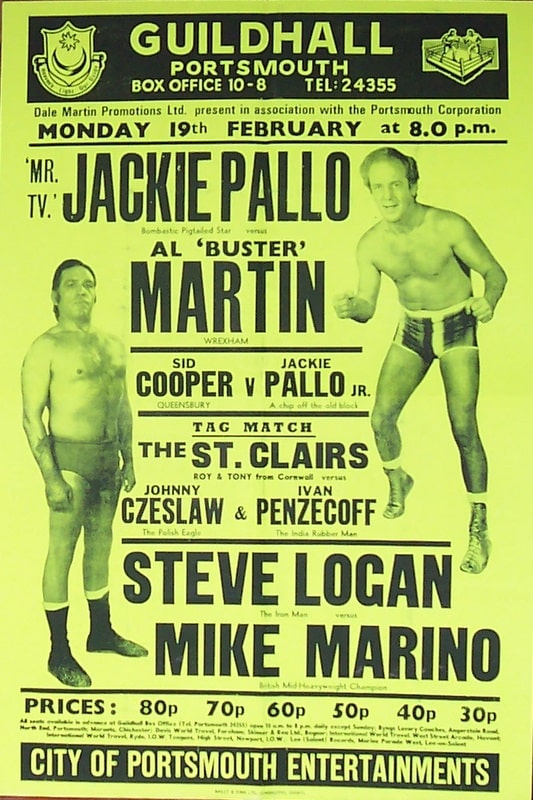
That’s the hallmark of a good poster! Equal-sized photos of the principals face to face, and here slightly off-set to show that Logan is bottom of the bill. But in this second dose of Portsmouth luminosity on our listing it is Wrexham’s Jack Martin who catches the eye in the middle of his 3-year stint working for Dale Martin Promotions in the 1970s. Rough-house Buster Martin was usually opposing other heavyweights in support bouts, but here his work is valued enough to go top-of-the-bill and ensure Mr TV would have to wrestle clean. Toned down for tv on his few small-screen appearances, this Worzel-Gummidge look-alike threw all rule-books aside in his nightly wrestling and, without ever becoming a household name, ensured tremendous excitement and horror with his rip-roaring style.
56
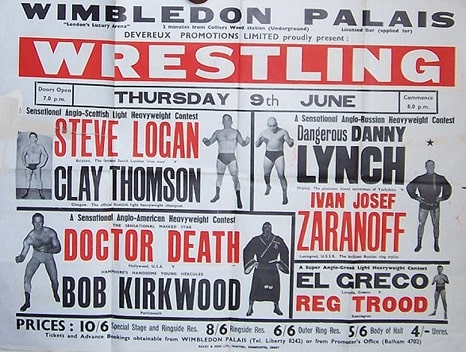
How could we compile this listing without having the Number One Wrestling Heritage masked man peering down imperiously upon us! It’s Anglo-time gone mad with the four bouts billed as Anglo-Greek, Anglo-Russian, Anglo-American and Anglo-Scottish. Yet not a whiff of a team match element. Carefully selected photos – even if Danny Lynch was looking a bit anorexic. Most of all we notice, to complete our mini-run, Doctor Death’s opponent, who made a living out of suffering magnificently at the hands of these hooded villains, the Portsmouth Hercules Bob Kirkwood. His work is summarised in Shining Stars.
55
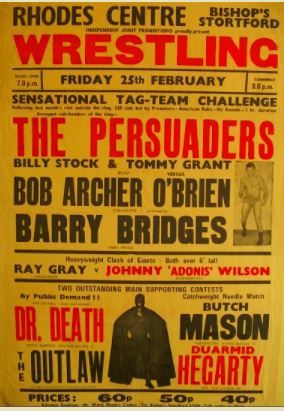
Compare that with the Doctor Death photo on this independent programme from 1972. We can surmise that Chelmsford’s Archer O’Brien, now well outside Joint Promotions, had something to do with this presentation at nearby Stortford. Let’s face it: if the original Doctor Death and the original Outlaw (cunningly billed here from Canada) really were to have met in a loser-to-unmask match, it would not have been in a supporting contest! But we award top marks to “Independent Joint Promotions” for making each bout important: one’s a needle match; another by Public Demand; and the tag is a Challenge Match “following last week’s riot outside the ring.” How on earth did they print the posters up so quickly…?
54
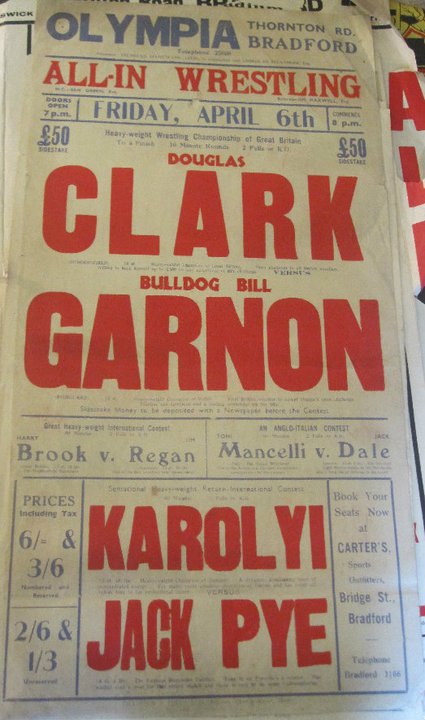
Unbridled nostalgia as we leave you to pick out those great names of the immediately post-war years on a bill topped by a contest for the Heavyweight Championship of Great Britain. Jumping out at us is Jack Dale who ventured far and wide over more than a decade, laying cornerstones for his own London-based promotion and the cartel that would form officially in 1952, heralding in 25 years of national-scale and televised professional wrestling.
53
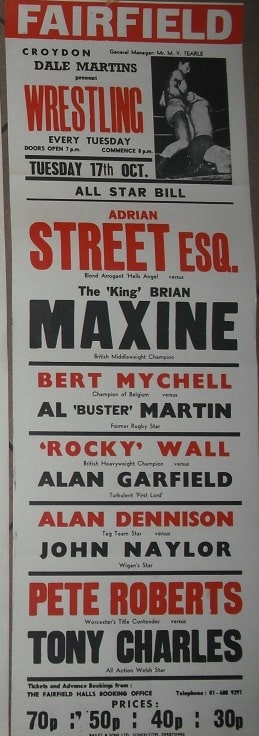
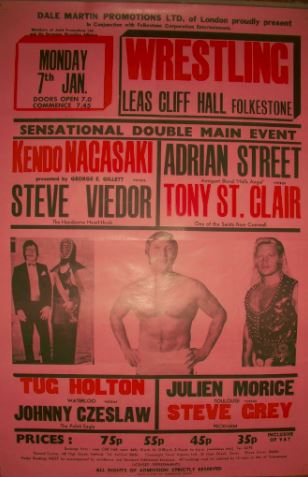
These narrow posters, still used sparingly in the early seventies, are a throwback to the war years as we have seen. t’s a great 1972 bill with so many Heritage favourites appearing including, once again, Buster Martin, Albert Wall, Golden Ace and the Flemish Master. The main mid-heavyweight supporting bout would balance in a stylish way some of the antics of the rule-benders shown above them.But the strength of Adrian Street’s controversial new image now peaks and sees him take top billing with even the British Heavyweight Champion relegated to support status.
52
15 months later and there’s room for more effeminateness as, belying his dapper photo, George E. Gillette was now starting to appear in what can only be described as drag. So was Adrian, so unsuspecting spectators who believed these two photos were in for quite a double-eyeful when the show started! From having seen their work so many times, we just know that Tony St Clair and Steve Viedor were the absolute ideal blue eyes to bring about maximum reaction to the controversial villains they opposed here.

51
The promoter who promotes his own face strikes again with this masterpiece from 1971 featuring 16 top quality wrestlers on an attractively laid out poster – he manages to squeeze so much info in clearly and even finds space for photos of seven of them. Four of the finest mid-heavyweights of them all are featured.
Headlining is a repeat of the still-fresh-in-the-memory controversial 1965 Cup Final Day bout in which Mick McManus had acted as second – to no avail.
Our only criticism would be that the four tag teams all wrestled clean and clean tag wrestling could only be deployed in small doses.
 Wrestling Heritage