
Wrestling Heritage welcomes memories, further information and corrections.
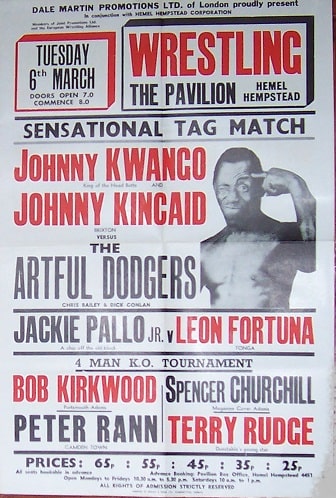
50
As we re-enter the earth’s atmosphere and hurtle towards our Number One poster in this second half of the countdown, we pay tribute to one of the most used and effective poster photos. What pressure did this then put on Johnny Kwango to use his gimmick wisely and well?
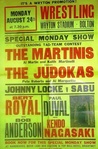
49
What marvellous marketing to call this a Monday spectacular! It wasn’t even the Bank Holiday that followed a week later. But the tag bout between two great tag teams, who each were active for less than a couple of years, makes us think that the hype was perhaps well-founded. Above all we include this poster as a memorial to Paul Duval who passed away during the launch of this poster countdown in 2013.
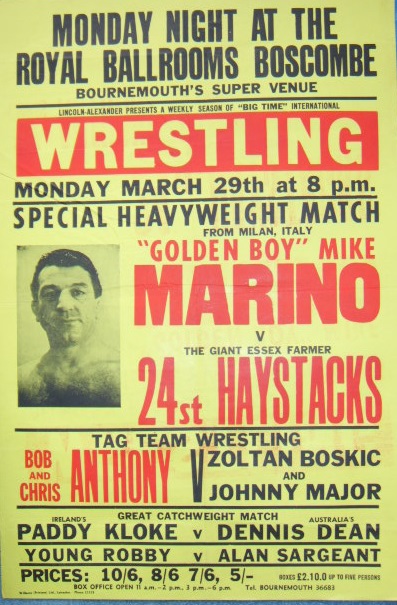
48
The promoters’ name “Lincoln-Alexander” catches the eye at once. And then, this very emotive name of “Haystacks.” We can name at least four wrestlers who made good careers out of the name and are left to wonder whether this was Farmer Bright in very late action here.
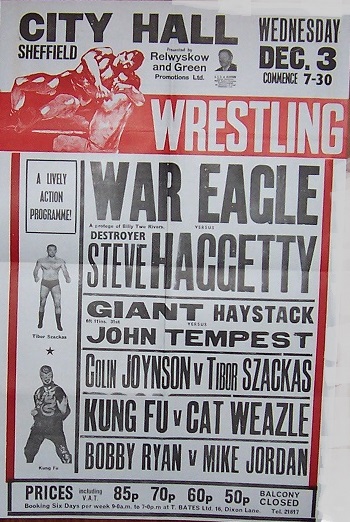
47
A decade later and a new “Haystack” creeps into a supporting contest, probably not quite unnoticed. A well balanced bill with Heritage favourites sharing the main event. Steve Haggetty was in great demand as a main event villain engaged to let the headline star shine, but we just wonder here whether, heavily outweighed by no-nonsense scowling War Eagle, he was able to put up enough of an offensive to allow the bout to merit top-of-the-bill status.
46
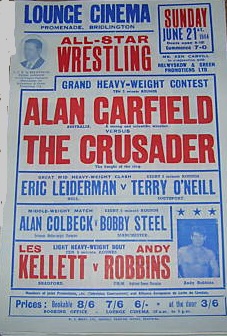
In 1964 Andy Robin was an up-and-coming light-heavyweight and Les Kellett was just putting the finishing touches to a comedy routine that would make him a household name. Their bout is intriguing through 2013 eyes. But in 1964 we were at the tail end of the period, being all of pre-history, where heavyweights ruled the roost and here Dave Armstrong and The Turbulent One were sure to turn on a great show for the holidaymakers. See how Geo Del Rel frames each bout to give it importance and acknowledges the intelligence of a possibly casual tourist audience: all details that helped build up professional wrestling before his successors ten and fifteen years later would decide they couldn’t really be bothered with such hard work.
45
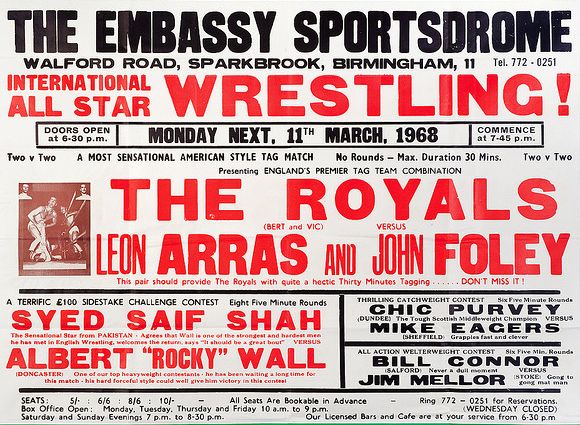
A poster that talks about “Monday next”. Such was the depth of talent in sixties wrestling we can state that this was at once both a super card and also quite normal. To elevate his 4 bout bill to spectacular status, the anonymous promoter applies many of the best features of poster design that we have described so far.
44
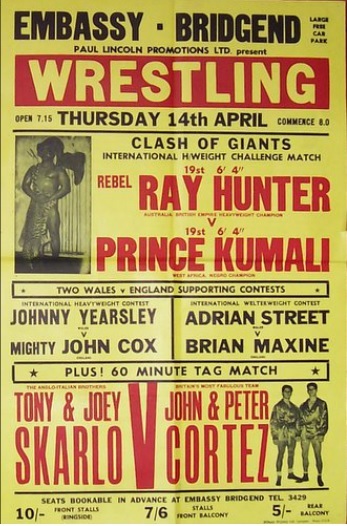
Balance in every bout, with the main eventers appearing to provide the perfect match-up. And both were famously reluctant to get heavily stuck in! The Welsh angle is deployed quite superbly in Bridgend to ensure meaningfulness and a great atmosphere for sure – but would they have cheered the master villain Yearsley?
43
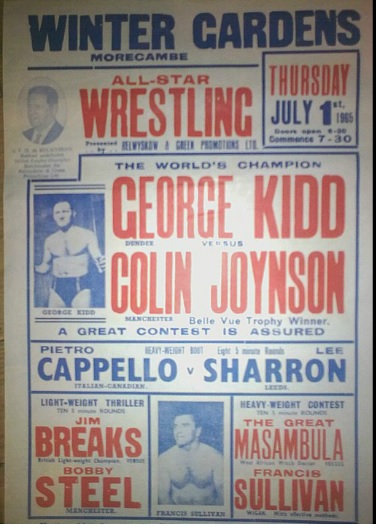
It’s 1965, wrestling has just become a part of the legitimate sports compendium “World of Sport”. Masambula is on the verge of an illness that would cause him to tumble down the weight scale – and see him happily facing all the other big name middleweights of the early seventies. Meanwhile the promoter’s pen doesn’t mention that the world champion is a lightweight taking on a skilful up-and-coming middleweight. Since Jim Breaks was also giving away a stone or two, hindsight makes us wish that the pairings had been rejigged in some way.
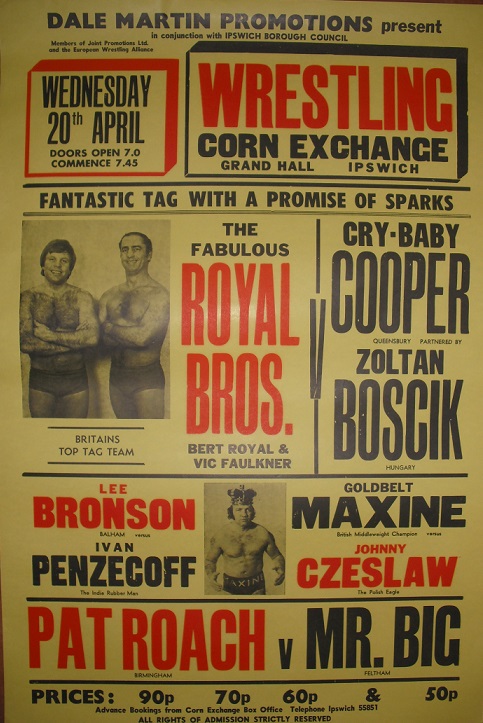
42
There are just so many Dale Martin posters at our disposal. They all do their job at least adequately, but, in view of the sheer quantity, there is inevitably a degree of sameness about them all, purely with the benefit of twenty-first century rear-view mirrors, of course. So we’ll overlook the detail that Mr Big would have been overshadowed by his taller opponent and note the involving byline here for the main event tag.
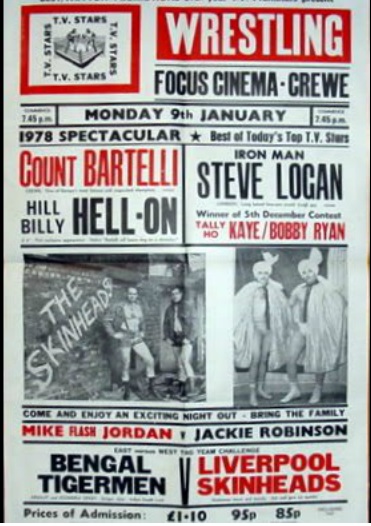
41
Count Bartelli on home turf! Did the notoriously frugal heavyweight cycle to the venue to save on petrol? It’s a run-of-the-mill card but the poster-maker successfully makes this particular programme explode to life with enthusiastic language and lay-out.
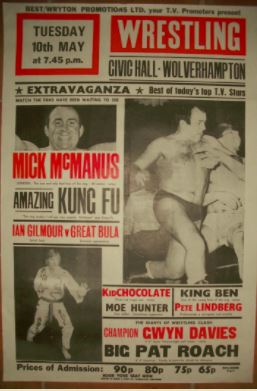
40
Kung Fu had burst onto the scene as a mysterious masked wrestler a couple of years earlier but quickly became well-known maskless. He seemed to share the glory for his unmaskings believably with Kendo Nagasaki – an insurmountable weight difference – and less plausibly with Mick McManus. But the two lighter men did the rounds and were able to top bills nationwide with their routines. Southern fans can notice again the overwhelming importance of Mick McManus when wrestling outside Dale Martin promotions – he is even accorded two photos when the national and local heavyweight champions are also on the bill.
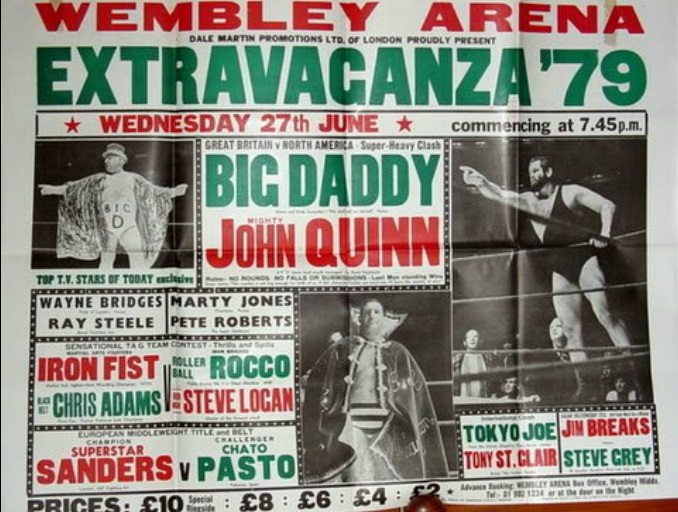
39
By the summer of ’79 the repetitiveness of Big Daddy bouts was wearing decidedly thin. The Mighty Quinn’s introduction to the mix breathed new life into the hope that the promoters might have some clever, well-thought out plot twists as they built up to this most exciting of evenings at a major venue still new to wrestling, with the national press watching professional wrestling closely as in no way since the Pallo & McManus feud of the sixties. The limit of their inventiveness, however, was to bill the Canadian as North American in the hope of inciting anti-US feeling that might not otherwise have been aroused by a benignly fluttering maple leaf. The outcome and fall-out are addressed in our editorial. Quinn did his job as instructed in under a hundred seconds, counted his megabucks, and left serious fans wondering how the game could have descended to this.
The poster performs at a far higher level, and the simple use of green is literally outstanding. It really did do the job of making prospective spectators feel a tenner was worth the money and that they would perhaps witness a momentous bill. Perhaps.
38
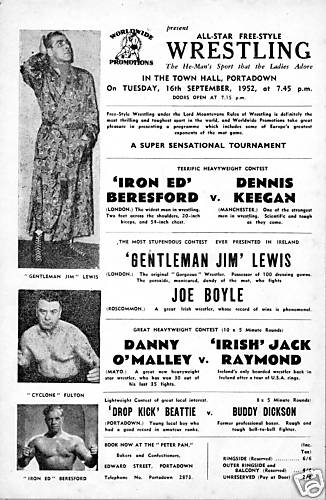
In 1952 the travelling roadshow even reached as far as Portadown. Just 20 years later, trips to that border territory would be out of the question. Here, promoter “Iron Ed” presents a card in great detail and puts on the token Irishmen, disappointingly against each other. In a 1952 way, Gentleman Jim’s photo was sensational and this entry in our listing serves therefore as an interesting relic from the year of the foundation of Joint Promotions.
37
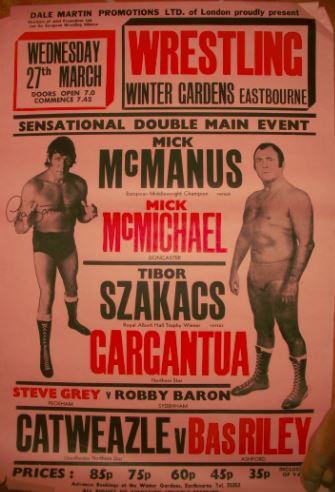
Number 37 enters the listing by virtue of being that most prized of possessions: the autographed poster, courtesy of Gargantua. It was never easy to secure both poster and autograph on the same night, and the endless curtaining at the Eastbourne Winter Gardens provided an obstacle to most autograph collecting of any kind. So we look back with great satisfaction on emerging forty years later with the pristine poster intact and diligently signed by another of those very literate villains.
36
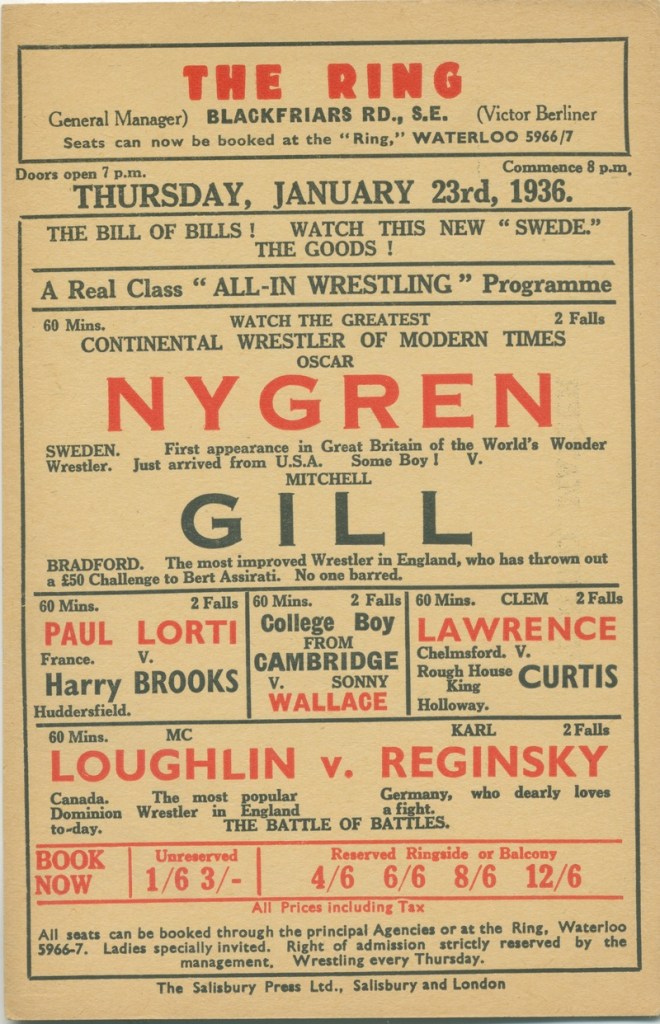
The oldest specimen on our countdown so far, promising 5 hours of wrestling. Just hear the saaf London accent of the promoter calling out to us to see his prized Swedish acquisition – “The Goods”. See how Canada was considered a “Dominion”. And we must just wonder about Ladies being especially invited. Mouth-watering indeed.
35
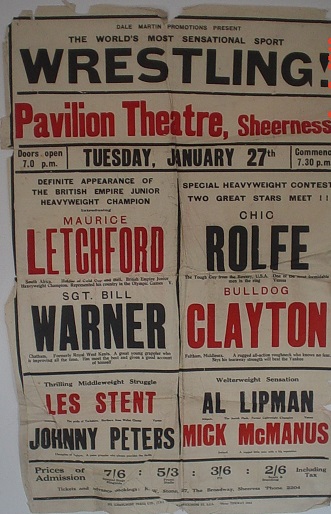
See our Speciality Manoeuvres feature for the contribution to wrestling made by South African Maurice Letchford. But this 1948 gem from the Isle of Sheppey makes the Top 40 most importantly by carrying the first poster sighting of the legendary Mick McManus who passed away just six months before our Poster Parade started, in 2013.
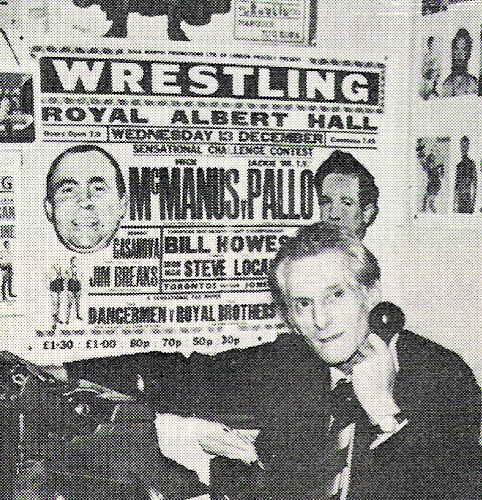
34
The poster we all wanted?
Oh, how we longed in those pre-internet days to sit in Harry Roth’s chair at 313 Brixton Road!
This poster portrays the sole high-profile bout from wrestling’s greatest feud where the Highbury wrestler would gain victory, thereby paving the way for two exciting rematches in 1973.Nestling beneath the champion is John Casanova, who received the Big Push in 1972 but failed to fire and disappeared from the scene within twelve months.
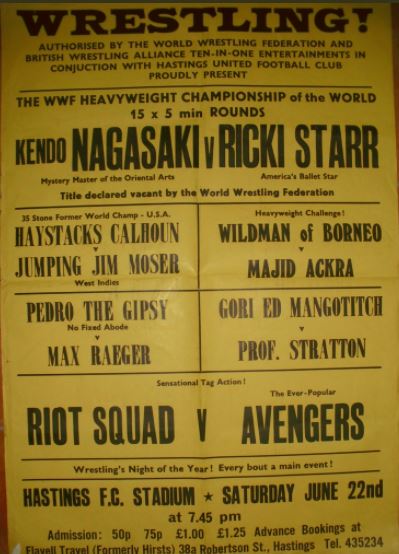
33
The very poster as seen on the BBC TV Timeshift wrestling documentary, first aired in December 2012. Neither of the town’s established wrestling venues, but a midsummer outdoor presentation on The Pilot Field. And this is one of the shows we remember most vividly, with the original Wild Man in one of his final appearances and signing a sadly now lost magnificent autograph. Professor Eddie Stratton did his karate thing on some tiles and those of us fed hitherto solely on a Joint Promotions diet were astonished to see goody-goody middleweight Johnny Kincaid pumped up to explosively fearsome heavyweight as he stepped into the main event moonlight to replace Ricki Starr, who was present but with his arm in a plaster cast.
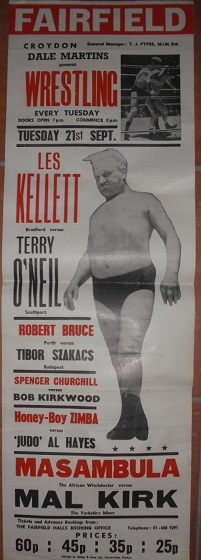
32
Once again it’s the three supporting bouts on this Croydon narrow poster that catch the eye.
Robert Bruce looked destined for great things, alongside his not dissimilar contemporary Mark Anthony, in 1972. Both upped stumps after making their names and were never sighted again. How the Southern England Heavyweight Champion could lurk in a supporting bout remains a mystery but perhaps he too had hit the ceiling dominated by fifty-something middleweights and this poster can in some way explain his departure stateside soon after. But it’s this photo of barnstorming Les Kellett that ensured a full house at the time and the poster’s place in the Top 40 half a century later.
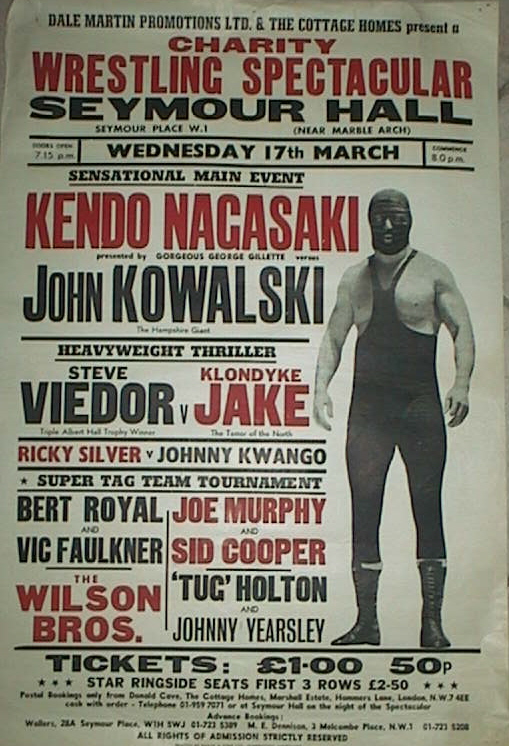
31
Another prestigious London venue and this quite simply looks great! Dale Martin Promotions always put in great effort at Marble Arch.
Just a slight concern at the thought of diminutive Dubliner, Iron Jaw, ending up being dwarfed by Tarzan Johnny on St Patrick’s Day, but it’s a fair bet the villainous pairings would have been eliminated to leave the way clear for a crowd-pleasing handshakes-all-round finale. This must be one of the very best photos of Kendo Nagasaki.
30
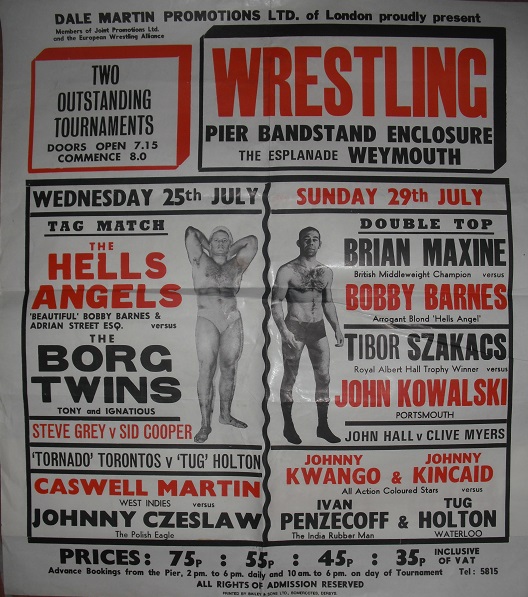
What lucky people in Dorset! Twice-weekly bills and now retired MC Francis P. Blake doing the honours. There was inevitably some repetition and here Tug and Beautiful Bobby appear twice within a few days. But this particular poster is one of the best among many from Weymouth and manages to cram so much into a small space.
29
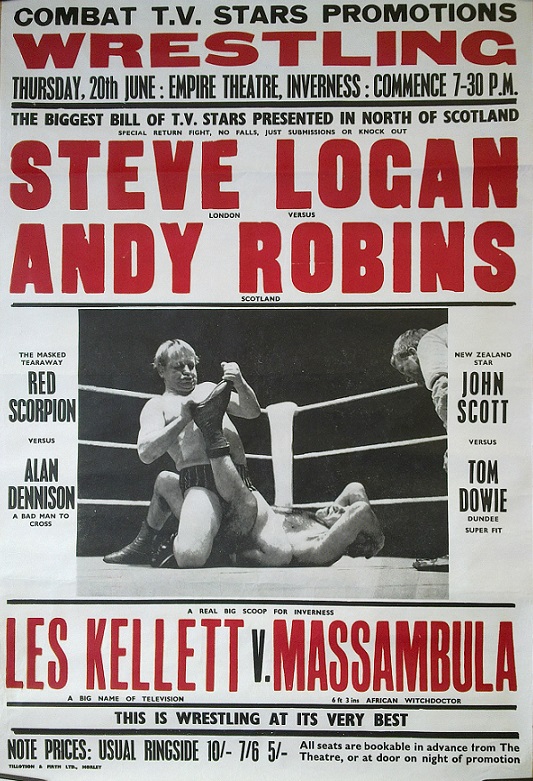
The pulling power, initially literal, of Les Kellett in a mini-run of three posters. Heritage Member Axos takes us into the twenties with this poster that justifiably places a return bout as top of the bill over the two great clowns of the day. Just seven weeks before, Robin and Logan had squared off at this venue, which Axos proudly points out is the most northerly now featured on Wrestling Heritage. The layout with support bouts either side of the central photo is rather original. The photo itself is unusual and it all just goes to show that individual promoters each had their own ideas. The Red Scorpion was at his peak and doing the rounds against his erstwhile tag partner.
28
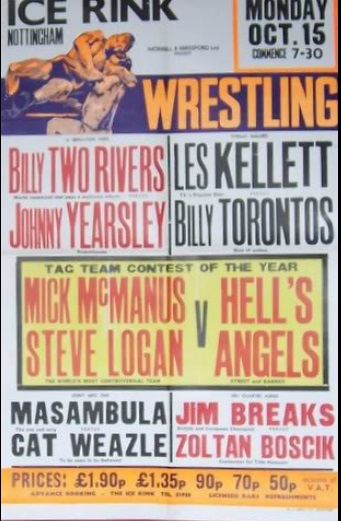
A poster that specifically refutes our assertion in Poster 84 and shows now not one but two bouts featuring crowd-pleasing clowns in opposite corners – these were just about the four main comedy wrestlers in the country at the time.
Once again we are lured by George De Relwyskow Jr’s framing within posters and attractive use of colour. He lifts pretty much the entire crew of Dale Martin bill-toppers and thrusts them onto a single programme in a way fans at southern venues could only dream of.
27
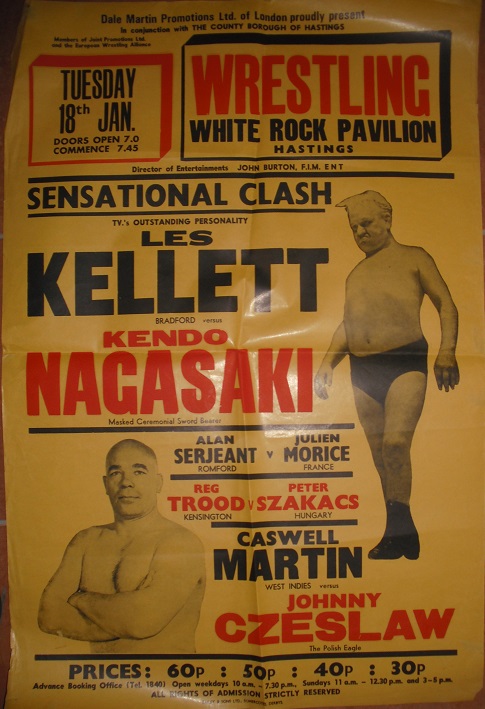
What kind of compromising was necessary to make two notoriously tetchy top-liners oppose each other in a headline bout that could work whilst allowing each persona to shine?
26
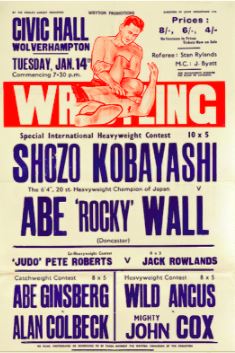
The “World’s largest promoters” claims number 26. We are less interested in size and more in 1968 quality as we examine this magnificent specimen, all in blue, with the only photo boldly obliterating the key tag word.
A pulsating catchweight bout was in store, for sure. So many catchweight bouts were just lazy bottom-of-the-bag leftovers. But here we have the tough and unrelenting European welterweight champion taking on the hard-hitting mid-heavyweight with his leather helmet. The other three bouts see perfect match-making, too, in one of the final posters where the rounds were specified. Here we can see 40s extravagance obliterated with no claims that even a single bout would last an hour.
25
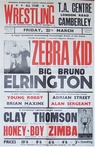
Evocative sixties entrapment in Surrey. An irresistible matching of super-heavies promoted in most eyecatching manner.
Four up-and-coming future favourites in the supporting contests and Clayton Thomson of the famously fluctuating weight taking on a full-blown heavyweight at a time when he was still British Middleweight champion. Years later, when the gaining the weight was easier than shedding it, he’d don a mask and regularly face heavyweights as The Exorcist.
24
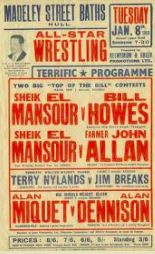
On the left, a very rare poster naming only seven wrestlers.
The bill lacks the extravagance of Relwyskow’s many other entries in this countdown, several of which are contained here in the twenties alone. But it’s an object lesson in design and photoless appeal.
23
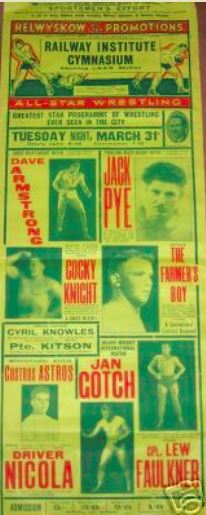
Compare that 1963 offering with the same promoter’s 5-bout spectacular eleven years earlier. Each bout has its own prominence and note the use of army ranks in the wrestlers’ billing to underscore that this must be the most legitimate of combat sports. Delightful.
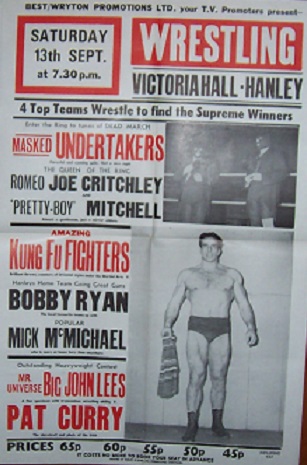
22
Heritage favourites abound on poster 22, which presents the tag team tournament appealingly and well, though we are a little concerned at Romeo Joe Critchley being billed as “The Queen of the Ring.” The largest photo is reserved for Mr Universe John Lees, a stalwart of nearly twenty years’ in-ring action. He looked the part and had an impressive title that played its full role in attracting the crowds. Like most of the bodybuilders in pro wrestling, John Lees didn’t have that same amateur or shoot background as many a lifelong grappler, but developed into an essential team player in allowing the bigger name heavyweights to shine against an ostensibly threatening adversary.
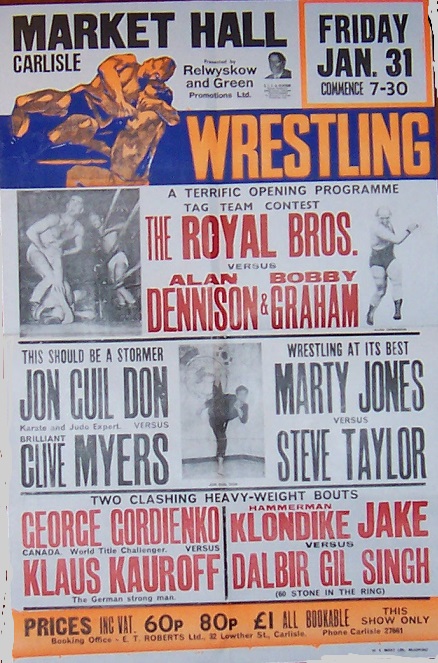
21
A venue that has hardly ever, if ever at all, had a mention in the life of Wrestling Heritage. Once again the promoter has done his homework and conjured up five interesting pairings. Only one concern regarding the sixty stone promised in the ring for the Hammerman’s match – this was probably under 40 stone in reality. Kauroff and Gordienko both liked to do things the hard way, and the word “clashing” surely did apply to their encounter. An unusual but perfectly valid pairing face the Royals and we are just left to consider once again, as questioned in Originality & Ignorance, whether these few martial arts specialists really did work best when facing each other. As historical evidence, however, do note how Jon Guil Don was rated the central figure on whichever 1975 poster he appeared. His skills were quite breath-taking and we must use this evidence to cement his place in British wrestling history for the enormous impact he made throughout his extended UK tour.
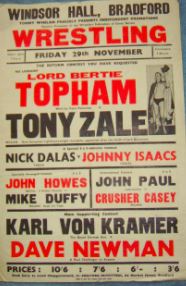
20
Tommy Whelan proudly and justifiably proclaims this an independent promotion, and applies all the professionalism of his Joint Promotions contemporaries in his poster-making. It’s impossible not to be fascinated by Lord Bertie Topham who left an indelible impression on those who saw him wrestle, including television comedian Frank Skinner. The independent promoters leave us a fine legacy of top-notch wrestlers like Lord Bertie who never wrestled on television – Doctor Death, Cowboy Cassidy and Dwight J Ingleburgh being just a few more for the list.
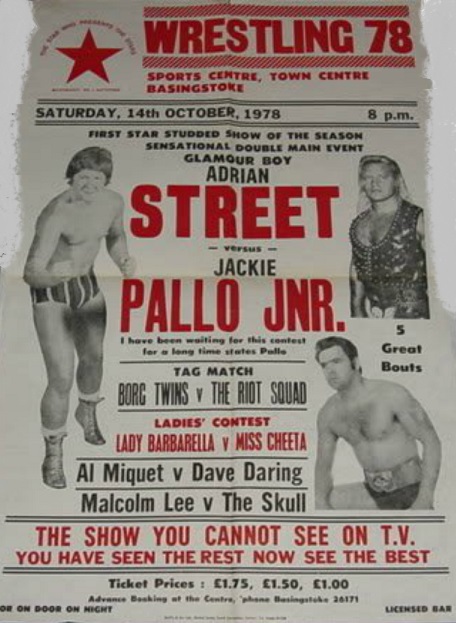
19
Immediately yet another independent bill that oozes class. Numerous disaffiliated ex-champions found satisfying twilight careers on the independent circuit and here Al Miquet ensured tremendous value on the undercard. By now, Adrian Street looked nothing like the photo they persisted in printing of him from 8 years earlier. The poster layout is great!
18
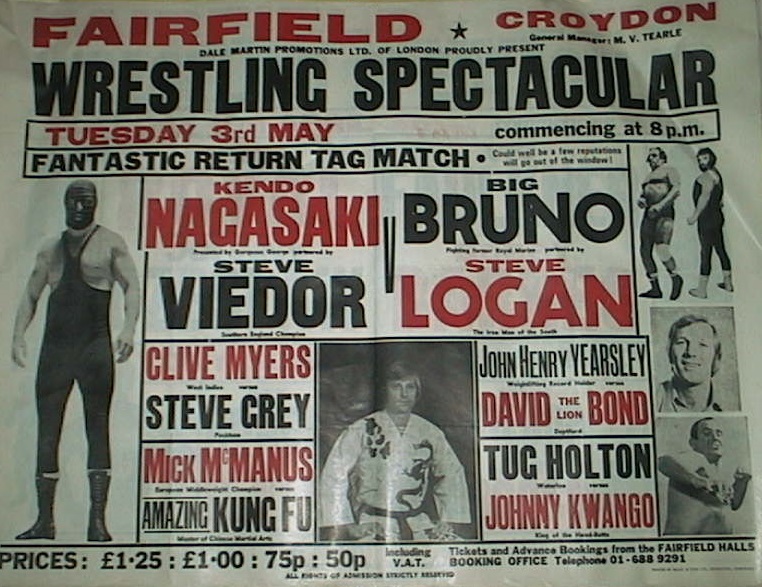
A landmark poster from the Heritage collection. With Croydon running fortnightly spectaculars, Bruno Elrington and Steve Viedor had an ongoing feud that lasted well over a year with every possible type of match up centred around challenges for and losses and regains of the Southern Area Heavyweight Championship. So it was that inspired variety was added to the mix with the unlikely pairing of Steve Viedor alongside his opponent in countless clashes over the previous ten years, Kendo Nagasaki. Nagasaki’s manager famously dubbed the pairing “a strange and unholy alliance.” So unlikely, indeed that the poster maker seems to think Viedor is on the side of Logan and Bruno, judging by the photo layout. Fed up with being copied, Kung Fu was now obliged to show his face to ensure the public knew they were seeing the true originator of a spectacular gimmick.
17
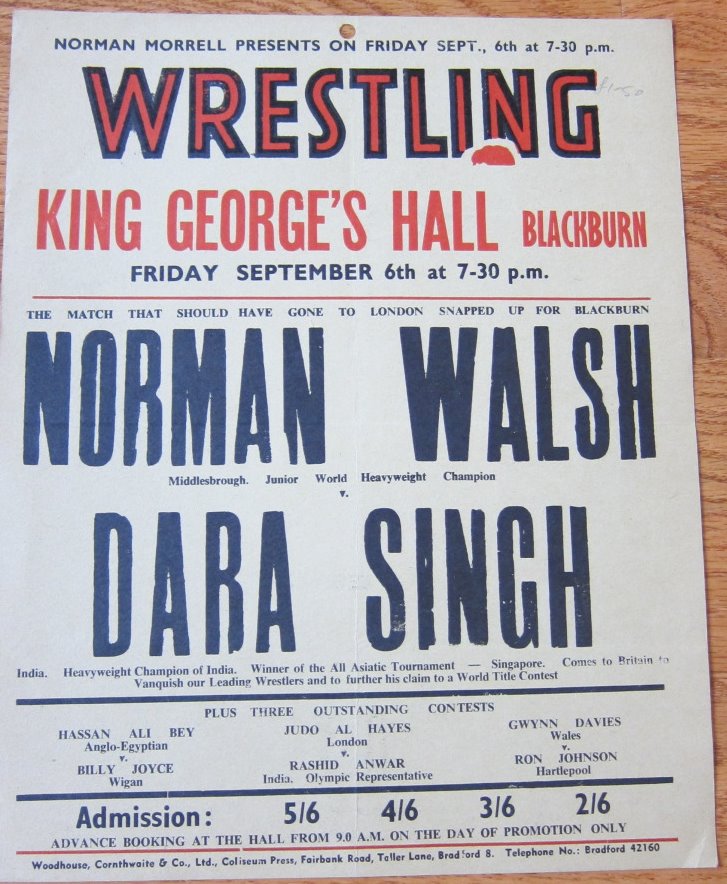
Dara Singh was a truly international drawcard, but to see three British Heavyweight champions reduced to tiny type is quite remarkable. There is probably some truth in Yorkshireman Morrell’s gleeful claim that this bout should have gone to London, and he was so excited that he went over the top in neglecting home-grown talent. Prominent Heritage Member Bernard Hughes is an avid fan of Norman Walsh and will not be surprised that the British Mid-heavyweight champion was placed at the very top of the bill, but others of us may wonder why Singh wasn’t matched with one of the afore-mentioned full-blown heavyweight champions.
16
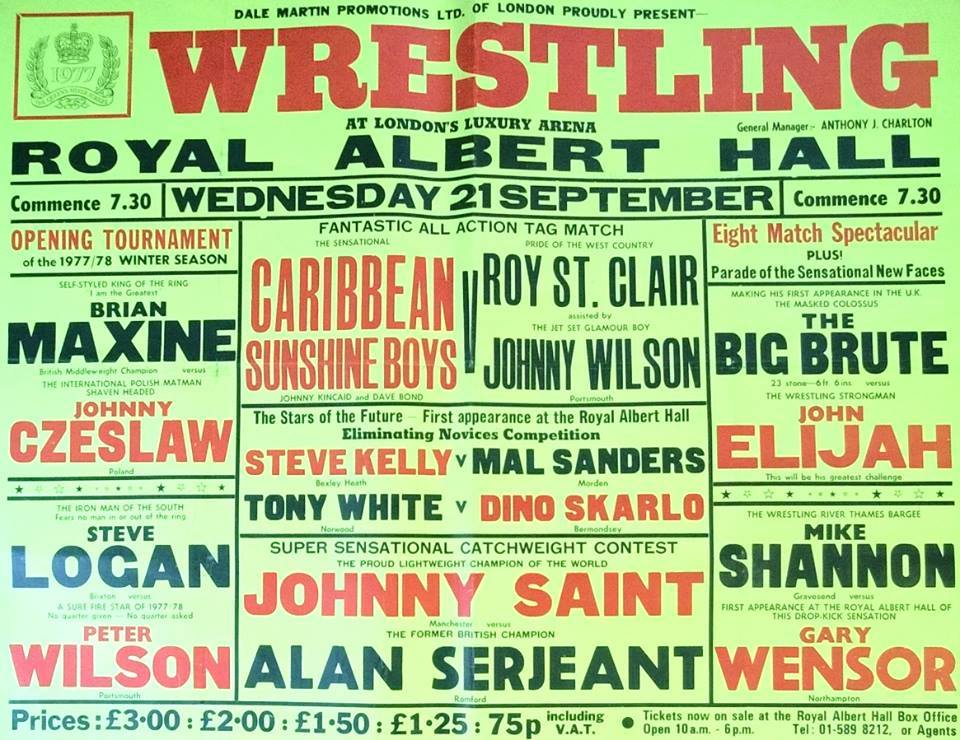
We won’t comment on the quality of the matchmaking but the poster is laid out thoughtfully, methodically, lovingly, respectfully. It’s a throwback to the thirties, showing that, forty years later, someone had survived who could produce work of this quality. But who was responsible for this anachronistic masterpiece? We shall never know.
This was merely a flash in the seventies poster pan for wrestling’s night of the year.
15
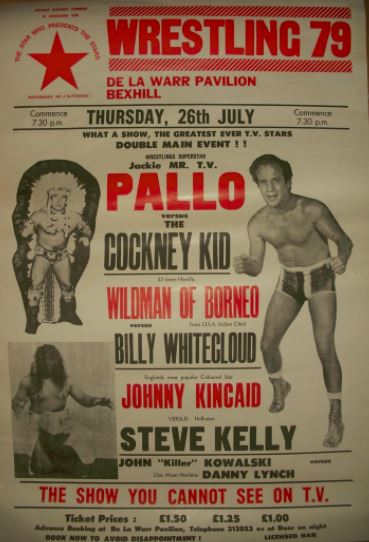
By 1979 Jackie Pallo really had attracted a basketful of former Joint Promotions headliners and here, just as he claims, he provides tremendous value. We are imagining that the Cockney Kid in question is the original Tony Scarlo. We are sure that this Wild Man of Borneo is not the original but the much larger latter day version. And we are left amazed at the quality of the support bout at the bottom of the bill with two notable super-heavyweights in opposition.
14
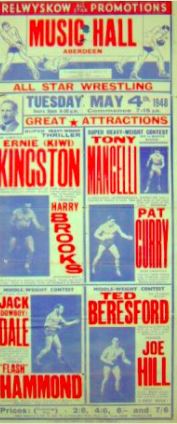
It was on post-war bills like this that the likes of Ted Beresford, Joe Hill and Jack Dale had dressing room discussions with promoter George Relwyskow that would lead to the formation of Joint Promotions four years later.
How on earth did they do all that travelling in the pre-motorway era? In a sense we could ask “Why did they bother?” These admittedly first-rate wrestlers had no television coverage to make themselves household names, so surely a few local Scots would have been just as suitable in far flung Aberdeen rather than bringing all these southerners up.
But no, a founding precept of Joint Promotions was that talent had to travel the length and breadth of the land.
As has been evident in our countdown so far, we can see Relwyskow leading the way in poster presentation in the immediate post-war years.
Once again, he seeks here to apportion equal prominence to the four bouts. We will be delighted to hear from any Member who can shed light on why Jack Dale should have been billed as “Dowboy”.
13
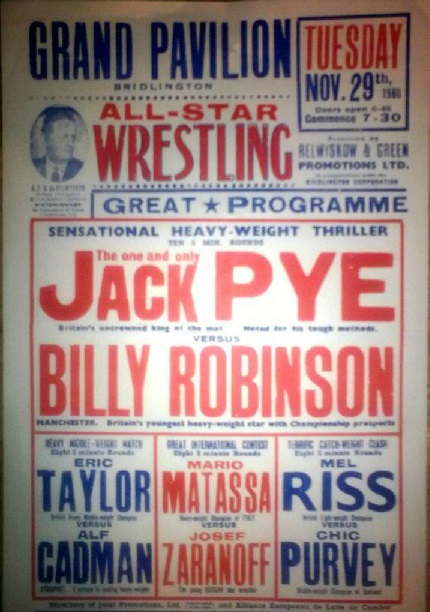
Perfect 1960 poster presentation once again with a mouthwatering top-of-the-bill clash. Every bout has importance bestowed on it.
12
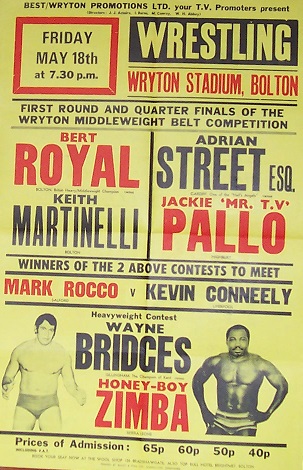
An ongoing tournament format is most attractive and lends meaning where none exists in the majority of wrestling programmes.
Once again we invite member contributions in the forum as to how this Wryton Middleweight Belt tournament developed and concluded.
11
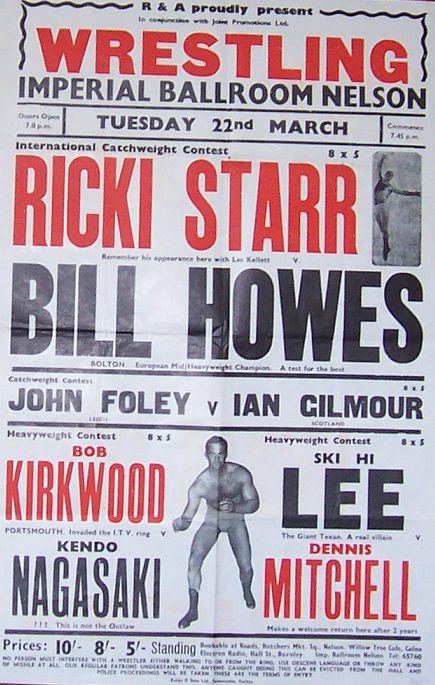
The only poster in our line up from R & A Promotions. A tremendous bill with the photographed Bob Kirkwood being remembered for his ring invasion and Ricki Starr for his previous appearance with Les Kellett. But the strangest byline of all goes to Kendo Nagasaki: “??? This is not The Outlaw.” It just goes to show what an impact The Outlaw had had on his tv debut just three months earlier in December 1965.
10
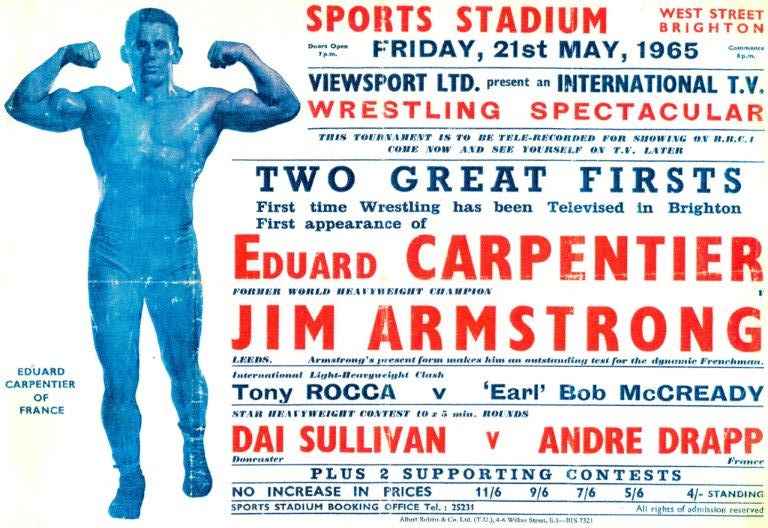
Historical value alone assures the BBC’s second entry in our Top 100 Posters. Wrestling was riding the crest of a 1965 wave and BBC1 wanted a piece of the action. An appetizing six-bout bill with a genuine world-rated headliner brought in to set wrestling to rival ITV’s off with a bang. The trouble was, without the ensemble cast and disciplined organisation of Joint Promotions, no appreciable impetus could be built up and the project flopped.
9
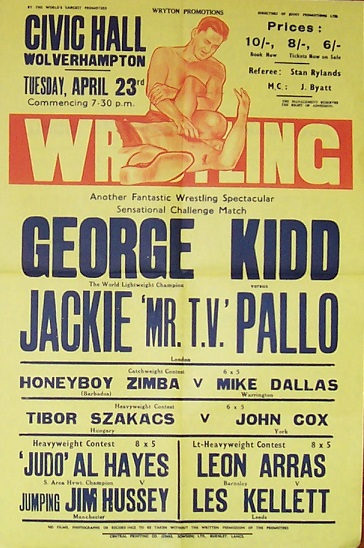
The third St.George’s Day bill in the top 100 posters has George Kidd taking 1968 top billing over some of the finest heavyweights of the day with even Kellett and Arras demoted to a supporting role. It will be hard for any American viewers of this poster to understand how a Scottish lightweight could regularly have top billing over so much other heavier talent – but he did.
8
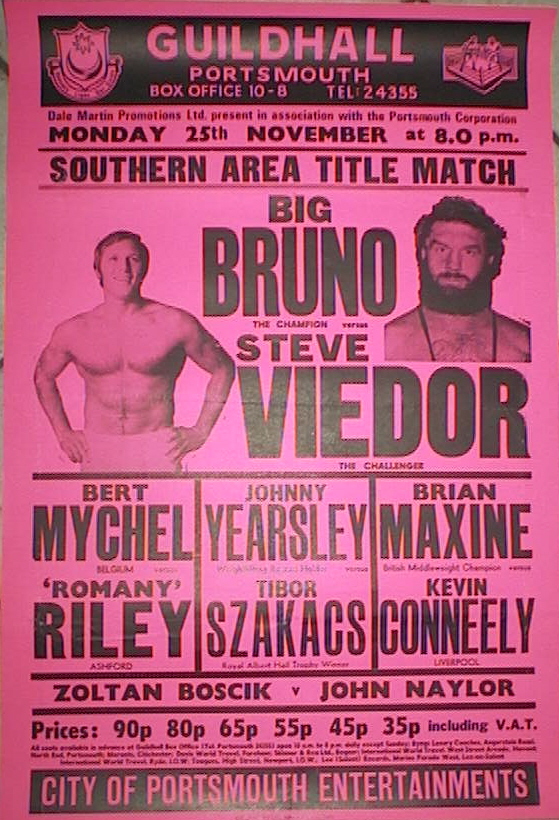
You’ve seen us rank Portsmouth highly through this countdown. Here Pompey peaks with local champion Bruno defending his title and sash on an all-star bill, portrayed most stylishly. Every bout is a winner, with Romany Riley sure to extract the very best from the Belgian great. But our Heritage eye even wanders to the curtain-raiser between two dour and uncompromising lightweights in a bout that would surely have been a treat.
7
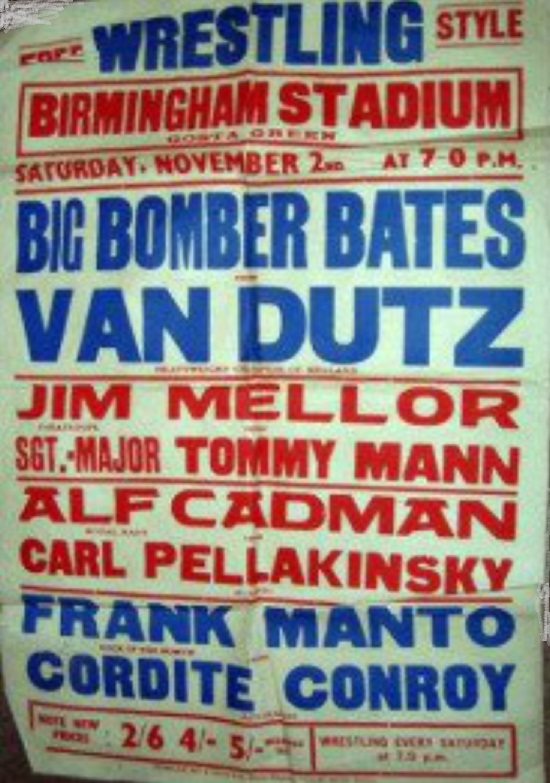
Wrestling seen in transition just 15 months after the end of the war, with wrestlers still proudly billed by rank, as we have noted before. Evocative names from the mid-twentieth century whose ring performances were such that few by-lines were necessary – the sparks would surely fly in the ring and ensure repeat business. Our headliner is seen in one of his final outings under his real name, as soon he would don the hood to create havoc nationwide as…
6
…..!
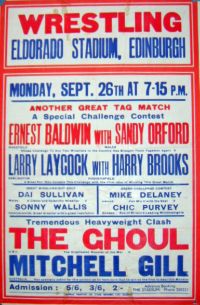
Back to Scotland for another perfectly balanced bill with unusual early promotional style for the still novel tag match, seemingly nominating the first-named wrestlers as team captains. See how tag was so sensational that even the legendary Ghoul was nudged down the bill. The support bouts in themselves were mouth-watering and once again the poster design is a winner.
5
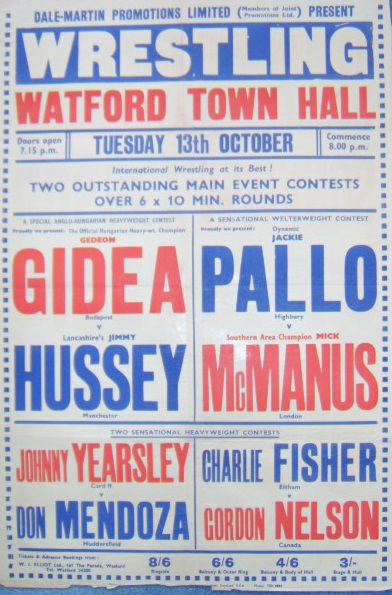
Six hard-hitting heavyweights as entry prices rise in the final year of the fifties. But it’s transition time again as the two London welterweights square up for the first recorded time on Wrestling Heritage, three years before their legendary feud would ignite national interest. See how it’s the dynamic Pallo who is billed above the Southern Area Champion. In these 21st century days of uncontrolled and misplaced hype, just see here how every superlative is worth its poster inches.
4
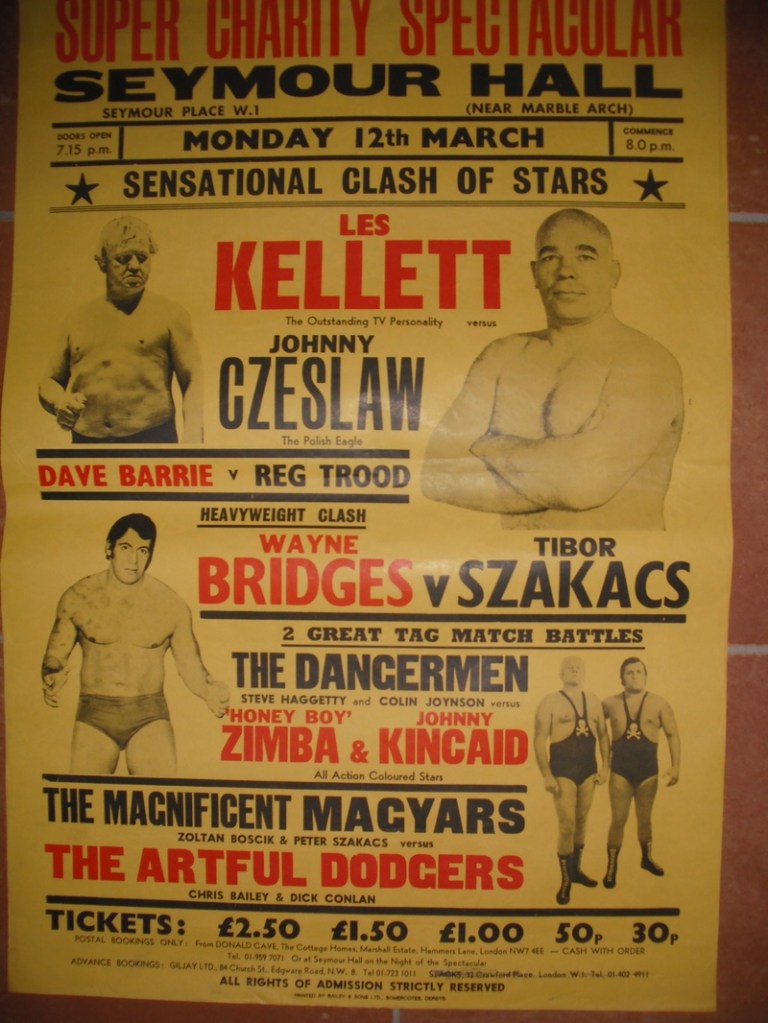
Sheer skill on the part of the poster designer here. The photographs are well selected and displayed with balance, and a quality night of entertainment seems assured, albeit at elevated West End prices.
3
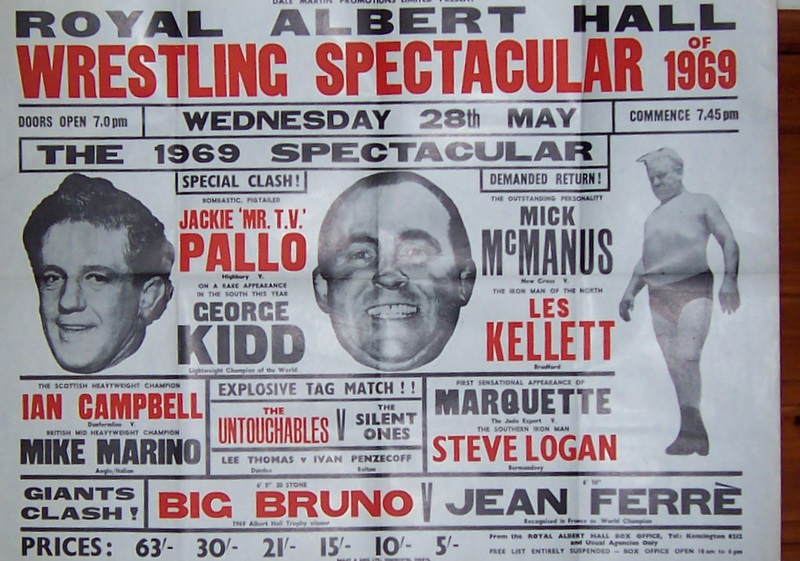
The same two portraits that set us on our merry way in Cardiff on Number 100 eyeball us here once again as our antepenultimate entry on the finest Royal Albert Hall poster at our disposal. Did professional wrestling ever again attain the giddy peak of excitement that this bill invited…and delivered? We see the self-same bout featured as at Number 9 above; we see Kellett and McManus trying to replicate the Pallo-McManus feud; we see the soon to become André the Giant facing that year’s Tournament Trophy winner; and most of all we see the oft recounted bout where Stockport’s Judo Al Marquette delighted London fans for the first time with his outwitting of the Iron Man. All this washed down by a famous tag match featuring the charismatic deaf and dumb stars and recorded now for posterity on an elegant double-sized wrestling poster.
2
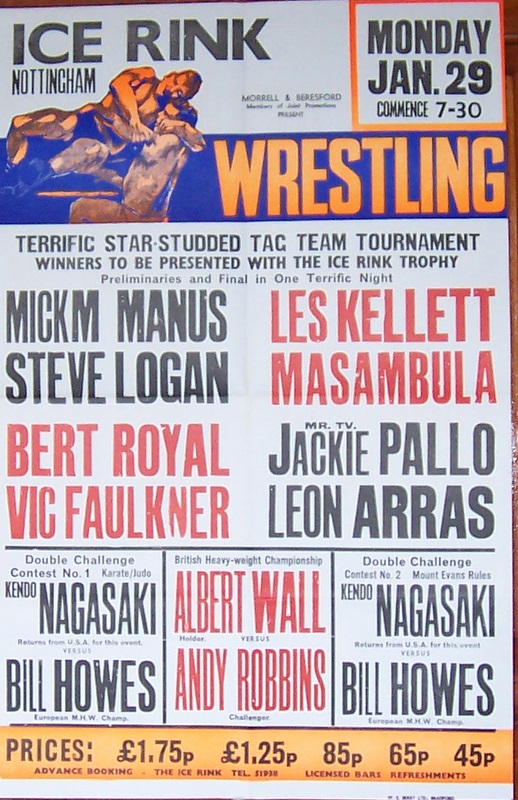
We have elevated George de Relwyskow to the heights of master poster-maker in our countdown and weigh out now with his finest, if financially excessive, promotion. Who needs photos when you have this wealth of British talent all gathered on the same bill? We can even overlook Mick’s missing “c”. It’s a surprise to see Jackie Pallo Junior absent from this 1973 tourney, and we can only wonder now how the explosive pairing of his father alongside Leon Arras may have gone.
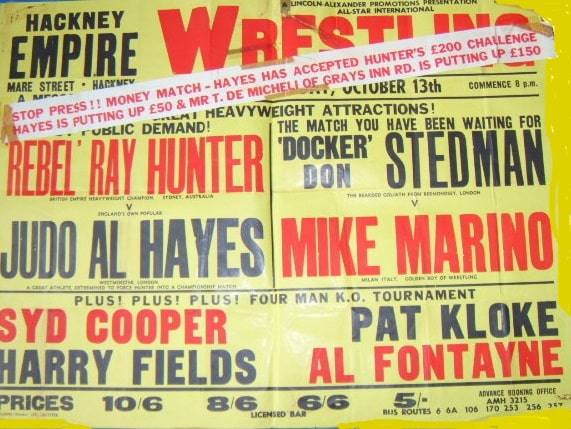
It’s this sheer enthusiasm of involvement of Mr T De Micheli that underlines once again just how real and important professional wrestling was to so many people nationwide in the years under discussion here at Wrestling Heritage.
The sixties poster and bill were already of top quality but the addition of the STOP PRESS announcement added further edge and interest.
Paul Lincoln Promotions had fewer wrestlers at their disposal and had to keep coming up with various pairings of the same ten or so bill-topping heavyweights. A feud has clearly been built up most successfully here between Hayes and Hunter – not bad considering both were blue eyes.
Thanks to forum member Ray for pointing out: “No. 1 is a classic and my old habit of looking at every detail revealed there, right down at the bottom, the buses that served the venue. Lovely stuff!”
We can be sure that the intimacy of the wrestlers involved on this bill ensured rip-roaring entertainment for well over two hours.
 Wrestling Heritage