
Wrestling Heritage welcomes memories, further information and corrections.

A Pure Wrestling Talent
Few were held in higher esteem than Tibor Szakacs. A classically trained purist he was a man who commanded admiration and respect rather than the adoration of fans. His dour, unsmiling approach failed to rouse their emotions, but when it came to wrestling ability no one had a bad word to say, and rightly so. Wrestling enthusiast Ballymoss said: “Tibor was a very skilled wrestler but somewhat lacking in that much needed ingredient to success in wrestling – charisma. No doubt his formidable skills were learned in a tough school in pre revolution days in Hungary.”
Dave Sutherland was fortunate enough to get a little closer to Tibor. “Tibor Szakacs was a regular at St James’ Hall, Newcastle in the early sixties, and very popular too. I did get to meet him once when he returned to Newcastle along with Steve Bell. Both were very jocular and mixed with the hall workers right from their arrival; Tibor in particular regaling us with his description of a recent Spurs match in which Jimmy Greaves had excelled. He asked could I get him that night’s Football Pink so I borrowed the Hall Manager’s copy from his office for him, whereupon he promptly dropped six 1d pieces into my hand and with a ‘Gracias’ disappeared into the dressing room with it, leaving me to scour the back streets of Newcastle for a paper seller to replace the manager’s copy so that he would be able to check his pools coupon. Without a doubt one of my top ten!”
Szakacs Tibor Laszla was born in Hungary on 22nd June, 1927. He arrived in the United Kingdom in December 1956, leaving his native country following the Hungarian Uprising (23 October 1956 – 11 November 1956). On arrival in Britain Tibor was put up in lodgings in Westgate on Sea in Kent, and given five shillings (25p) a week spending money. On 11th January all the Hungarian refugees living in Westgate were invited to the wrestling show at the Coronation Hall, Ramsgate. This was the night Tibor made his move and issued a challenge the top British wrestlers, specifying he was not interested in less experienced wrestlers. This unknown man had been in the country only a month!
Persuasive words must have been matched with an impressive try-out for Dale Martin Promotions as on 8th February he was back at the Coronation Hall, making his professional debut against Billy Joyce. A large ringside contingent of Hungarians were in attendance to cheer on their boy. The match was contested over five ten minute rounds and went the distance, resulting in a draw. Reports said that Tibor’s lack of experience was evident and he needed to master a more orthodox style.
He must have impressed the men paying the wages as later that month he was on the bills for Dale Martin Promotions against the likes of Arthur Beaumont, Mike Marino and Eric Taylor. This instant recognition confirms reports that Tibor was an experienced amateur in his home country before coming to Britain, and there is a reference to a silver medal in an international competition in Budapest that may be accurate.
However, claims that he had won a silver medal in the 1952 Helsinki Olympic Games do not appear to be true, we can find no record of a Tibor or Laszlo Szakacs in the 1952 or 1956 Olympics. By May he was travelling north and working for all the Joint Promotion members. At the time Tibor was considerably lighter than in his later years, usually described as a light heavyweight. In September he was booked for the Harringay Arena, opponent Eric Taylor, and two months later Dale Martin Promotions gave him his first experience of their wrestling mecca, opponent Tony Mancelli at the Royal Albert Hall. He was back at the Albert Hall in December to defeat Francis St Clair Gregory. There is no doubt that Tibor was an immediate success.
1958 was a milestone year for Tibor. In May he was the winner of the Royal Albert Hall Trophy, an annual eight man knock out competition. Tibor defeated Iska Khan, Ray Hunter and Bill Verna in the final.
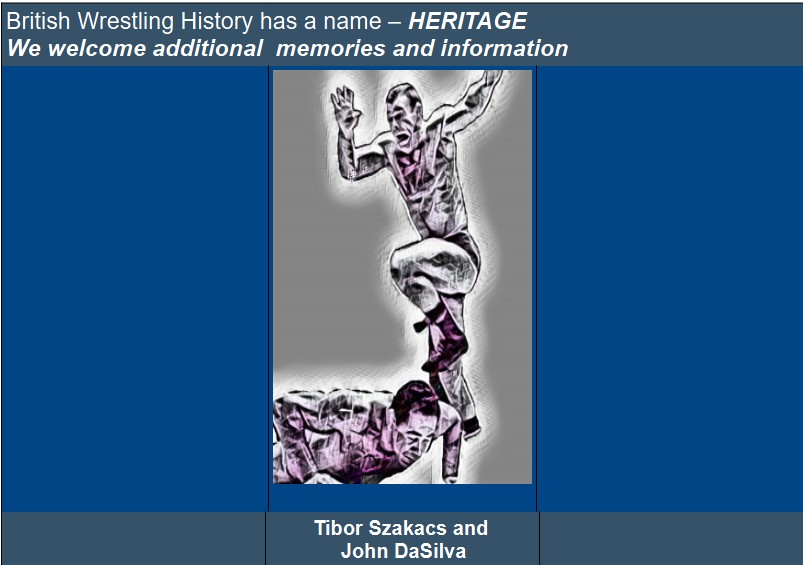
He was to cement his hold on the trophy with a further win in 1959, and a third consecutive win in 1960, a record that was to remain for all time. In total Tibor won the annual trophy on five occasions, that’s more than anyone else, later adding 1962 and 1966. 1963 was an exceptional year. Tibor was omitted from the annual tournament, which was brought forward to April. The following month he and John DaSilva were selected to wrestle for the grandly names All-Nations Trophy in the presence of His Royal Highness Prince Philip, the Duke of Edinburgh. The bout was over five minute rounds rather than the ten minute duration usually favoured by Dale Martin Promotions. It was round three before either man could edge into the lead, and it was Da Silva who took the opening fall. Tibor levelled the score in the fifth, leaving the way open for him to take the winner in round six following no less than three of his ubiquitous chops.
This ending brings us to an often commented upon criticism of Tibor’s style. Everything about his work in the ring was believable with the exception of his most frequent finisher, a back handed chop to his opponents throat, or more accurately, his chest. What was that about? Some misguided attempt to add a bit of excitement to Tibor’s orthodox style maybe. His counter holds were a pleasure to behold, he was the master of suplexes, flying tackles and other more scientific manoeuvres. All the more incongruous that his speciality should have been a back-handed chop.
On 29th November, 1962, Tibor became a British citizen. British fans had accepted him as one of their own long before then, an unvanquished Union Jack-flying defender in the face of visiting heavyweights, whether technicians or rule benders. The Liverpool Echo reported, “Few wrestlers have ever been given the spontaneous ovation that was handed to Tibor Szakacs last week at Belle Vue when at the end of his terrific bout with John Allen (sic) the crowd of over 5,000 stood up and clapped and cheered Szakacs long after he was back in the dressing room.”
Tag team appearances were limited for Tibor, who did occasionally partner brother Peter. One tag match of note, however, was his 1966 pairing with Henri Pierrot in the match that led to Nagasaki and Bartelli falling out and The Count subsequently being unmasked.
Tibor continued wrestling until 1978, and by then in his early fifties signs of ageing were beginning to show. He remained in the public eye as landlord of the Lord Palmerston in King’s Road Chelsea.
Tibor Szakacs died on 5th October, 1981.
Page added 20/06/2021
Reviewed 16/03/2022
2048
 Wrestling Heritage