
Wrestling Heritage welcomes memories, further information and corrections.
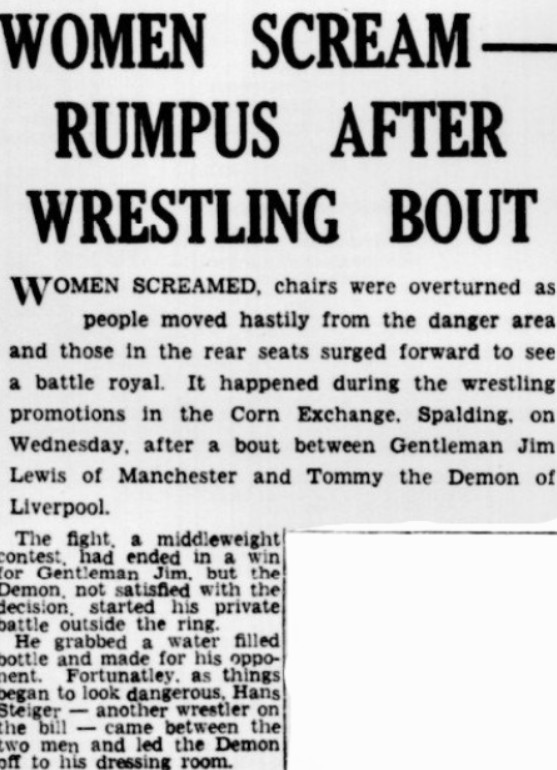
A man who gave so much to wrestling throughout his life and finally made the tragic ultimate sacrifice, that was Bob Hooton, known by a variety of names to the wrestling public.
In September, 1949 a new masked man emerged on the wrestling scene, seen for the first time at the Drill Hall in Crewe. Danny Flynn, Grant Foderingham, and Alf Cadman were amongst those that went down to the masked man. He was to continue his rampage, mainly in the rings of Wryton Promotions, for seven months.
Who was the Blue Flash?
We have no report of the Blue Flash’s match with the Black Panther on Easter Monday, 10th April, 1950, but less than two weeks later in the same hall there is a surprise on the advertisement. On 22nd April there is no Blue Flash, but we have Tommy the Demon described as the “ex Blue Flash.”
Who was Tommy the Demon?
Tommy The Demon was another masked man who had made his appearance in the early years of the Second World War. Concealing his identity under a red woollen mask, red trunks and red boots this demon certainly lived up to his name.
Navigating our way around web based misinformation we turned to one of his children to find his birth name was actually Robert Hooton, born in Wigan on 11th October, 1919.
A Lancashire childhood in the 1920s and entering the workforce in the 1930s was not easy. In Wigan opportunities for most young lads at that time were limited to working down tone of the local coal mines. That was the life mapped out for Bob Hooton until the outbreak of World War Two. You may have heard the Lancashire saying of “Put your hand down the pit and you’ll pull out a rugby player or a wrestler.” Well, Bob’s sporting interest was wrestling, no doubt inspired by the many other local men taking advantage of the pre war wrestling revival. So Bob Hooton joined Pop Charnock’s gym. Charnock was a veteran wrestler who had trained many Wigan greats, amongst them the legendary Billy Riley.
So Bob Hooton was Tommy The Demon, and he was also the Blue Flash (unsurprisingly for wrestling he had continued in that guise following his unmasking).
Are you with us so far?
In September 1951 a new masked man appeared on the wrestling scene, The Black Knight, described on the posters as "the notorious hooded terror." The masked man defeated all before him, and promoters even partnered him in tag matches  with the established northern masked wrestler Count Bartelli.

Bartelli was something of a rarity amongst masked man because he was a "clean" wrestler and popular with the fans. A goodie and a baddie together, it was a partnership sure to end in tears. A creation of Wryton Promotions it was most likely planned from the start that the two would eventually fall out and meet in combat with the Black Knight going down to enhance the reputation of their established star Count Bartelli. This was a blueprint for the same scenario taking place years later and the unmasking of Bartelli by Kendo Nagasaki in 1966.

The match eventually took place on 13th December, 1952, the venue was the Tower at New Brighton. Well, that's what we have evidence of, but we can tell you that according to Ray Plunkett's unofficial listings this was a repeat of a match that had taken place at Warrington three days earlier. It was a match over an unlimited number of rounds with the first fall or knock out to win, loser to unmask. The loser, of course, was the Black Knight, and the mask was removed.

Who was the Black Knight?

By now you've gathered how this story is unfolding. The Black Knight was Bob Hooton, also known as Tommy The Demon, formerly Blue Flash.

End of story? Of course not, this is professional wrestling. The mask was quickly pulled back on and at the Drill Hall in Chester the whole thing was repeated all over again. We  have evidence of that one, and another in Birmingham, but goodness knows how many other times the match was repeated.

In January 1953 it was announced that the ex Black Knight, Tommy Hooton, would continue to wrestle as Tommy the Demon.  It wasn't a clean break but at  some time during 1953 Hooton did eventually relinquish the mask. The name on the posters was now Tommy the Demon, Tommy Hooton or Bob Hooton.

Tommy Hooton was not a nationally known wrestler but was highly respected amongst his colleagues, "He beat Jack Alker, which took some doing," said Jimmy Lewis. Other opponents included more well known names Johnny Kwango, Henri Pierlot and Masambula.

Our records of Tommy The Demon end in 1953, only to resurface again in 1958. Initially we thought it unlikely this was Bob Hooton, but in view of his connection with the likes of Lewis, Black Panther, Flynn and Woolley who were starting out as promoters and on the look-out for reliable workers it remained a possibility.
Fortunately one of Bob’s sons was able to confirm that this was his father. Tommy The Demon continued to wrestle, referee and erect rings up and down the country until 1962.
Bob Hooton died on 22nd June, 1963, aged just 44. Newspapers reported that two months before his death he had been asked to wrestle, was thrown from the ring, taken to hospital where two kidney operations were carried out but failed to save his life. We can tell you that this information is false. Reality is that he was taking down the wrestling ring at a club in Bolton when the corner post fell on his leg, leaving a serious wound. The wound became infected and the infection went to his kidneys and Tommy The Demon died of sepsis.
Bob Hooton was buried in Philips Park Cemetry in Manchester. Bob’s widow could not afford a headstone, but one was finally installed by Bob’s sons in 2025.
Jim Lewis organised a charity show for the benefit of Tommy’s widow and three children. Jim Lewis said that although he had retired from wrestling and taken up refereeing duties some years ago Tommy was always willing to help out.
9023
Page added 21/06/2026

