
Wrestling Heritage welcomes memories, further information and corrections.

A Man Who Never Got
Too Big For His ‘at
Bamber Bridge is a small town about three miles south east of Preston in Lancashire. Not a lot of note has happened there over the years and the town is probably best known for what locals call the Battle of Bamber Bridge. During the Second World War the town was home to an American regiment. Local residents sided with black American soldiers in a violent rebellion against the white American military police in protest against racial segregation and discrimination. A black soldier, Private William Crossland, was shot and killed. A memorial garden and annual event now commemorates the battle outside the Ye Old Hob Inn where the battle started.
Noteworthy Briggers, as the locals are called, are also in short supply. 1960s Trades Unionist George Woodcock, he of bushy eyebrows fame, is now hardly remembered.
Yet there is one Brigger who is still remembered fondly, not just by those eighty plus year olds who knew him, but by later generations who were told stories of one of the towns colourful characters; boxer, wrestler, poultry farmer, and publican Tommy Tucker.
Tommy Tucker could hardly be his actual name. No, it wasn’t but it was the name by which Thomas Fletcher was universally known from childhood when he was made to repeatedly recite the nursery rhyme in an attempt to cure a stammer.
Thomas was born in Bamber Bridge on 1st April, 1902, the son of an Irish orphan, Jane Chambers. By the age of nine Jane was in England attending school in Liverpool.
His fame came as a boxer, a very successful one who travelled extensively around the country. We find him for the first time in May, 1918, beating Nipper Walsh of Chorley on points in Preston. This wasn’t his debut as he had boxed for the first time the year before as a literally last minute substitute for a frantic promoter in Preston. Five more last minute substitutions followed in the same hall, so Tommy must be unique in having his first six professional matches without his name on the programme.
In those days boxers were much more active than in the late twentieth century, it wasn’t unusual for fights two or three times a month and Young Tucker was no different. A year later the Lancashire Evening Post reported nineteen wins. They didn’t mention any losses, of which there were certainly some. Professional boxing, apart from the top echelon, was mostly on a local basis and Young Tucker performed regularly around south Lancashire and Cheshire. And then, after rising from a promising novice to a ten round main eventer with appearances in large halls such as the original Liverpool Stadium and the Free Trades Hall in Manchester it came to an abrupt end. Getting married in 1921 Tommy decided he needed a more stable job and retired the following year, only twenty years old.
Tommy maintained his training routine whilst working in a local mill but his professional boxing days were behind him, or so it seemed until fate and necessity intervened.
Times were hard. Work was drying up at the cotton mill and he had a wife and four children to support. In February 1929 a Preston promoter asked him if he could substitute for an injured boxer. Any hesitation was momentary as he faced the realities of living and later said that Tommy Tucker was literally fighting for his supper. Despite only a few days notice he beat Battling Sullivan over ten rounds, repeated the win over fifteen rounds the following month and had two more wins to his credit before April was out. By the end of the year he had fought at least thirteen times.
This time Tommy Tucker was no longer confined to a regional geographical area, he was getting noticed and travelled extensively, to Scotland, Northern Ireland and London.
A milestone was reached in February 1932 when Tommy made his London debut and decisively beat the favourite, Charlie Hickman, at London’s Crystal Palace, flooring the Birmingham boxer seven times.
The Belfast Telegraph reported, “When Tucker climbed into the ring he looked more like a fist fighter of one hundred years ago than a part-time preacher, He is short, stubby, inclined to rotundity, bow legged and sandy haired.” Tucker said he was bemused when told no one in London knew him as he had fought more than 200 matches.
National anonymity evaporated overnight with Trevor Wignall writing in the Daily Mirror, “The most sought after person in Great Britain yesterday was Tommy Tucker, the lay preacher of Preston who created a pugilistic sensation at Crystal Palace.”
The Belfast Telegraph, “The fight was the best seen between heavyweights for years…. Tucker arrived in London unknown, but today he will find himself a star with promoters hot on his heels.”
A month later Tommy repeated his defeat of Hickman, again at Crystal Palace, in front of 8,000 fans, with thousands more turned away.
National fame and the accompanying financial reward came at a fortuitous time. For Tommy and wife Mary life was always a struggle but by 1932 survival was more difficult than ever. He had been unemployed since losing his job at the cotton mill as a result of the Lancashire cotton slump, his mother was seriously ill in hospital and their youngest daughter was recovering from bronchitis. Prior to the formation of the National Health Service medical treatment had to be paid for and this just added to the family’s financial struggles.
Although a much publicised plan for Tommy to box British heavyweight champion Reggie Meen at the Preston North End football ground in May, 1932 came to nothing the defeat of Hickman and the success that followed was a financial game changer for Thomas and set him up financially for the day he retired. From topping the bill in Leeds for £2 ten shillings (£2.50) following the win over Hickman he was offered £200 for a fight. On 30th April, 1934 Tommy announced his retirement and that he would take over as landlord of the School Lane Hotel. In October of 1933 he had been knocked out by South African Ben Foord, his first knock out since a second round ko by Bob Carvill in Liverpool in 1929.
Here’s the sort of detail you only read on Heritage. On a lucky night you might well have popped into the School Lane Hotel and found Tommy playing darts with boxer and wrestler Jack Doyle!
If anyone thought that Tommy would be content pulling pints behind his bar they were mistaken. A year later he made his second comeback, but this time as a professional wrestler. He already had the looks for a wrestler with his broken nose and cauliflower ears.
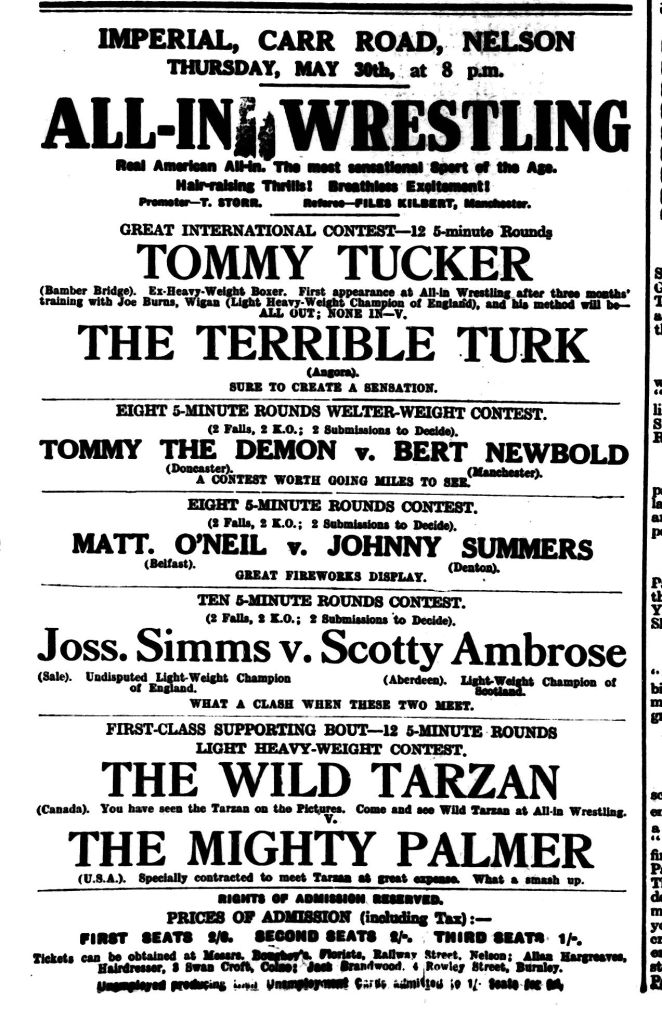
The date was 30th May, 1935, the venue was the Imperial, Nelson, the opponent The Terrible Turk and the result a predictable knock out win for Tommy in three rounds. The following night it was Tommy knocking out Giant Delaney in Newcastle and on Saturday putting Jock McFane out for the count in Dundee; a busy start to his new career.
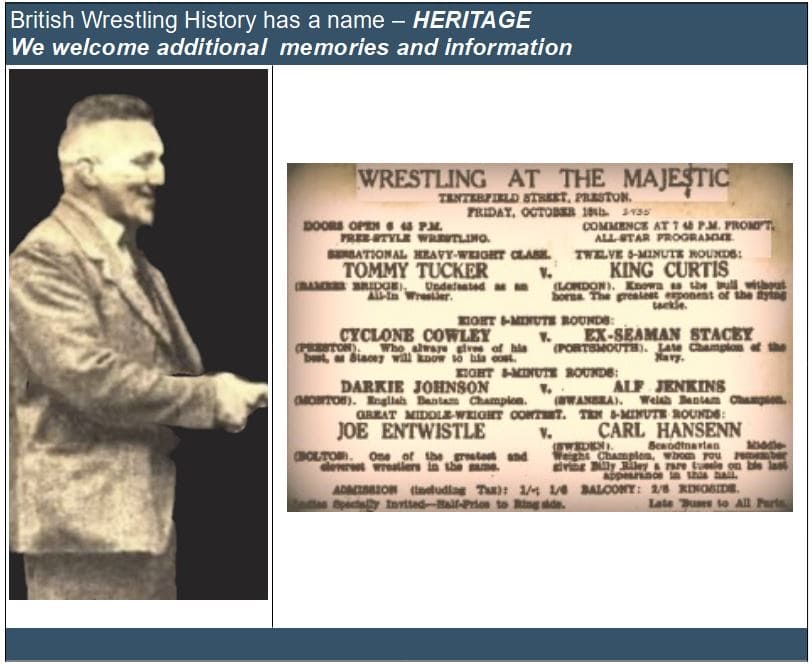
Tommy’s presence in the wrestling ring was certainly a popular novelty but we can see no evidence of him developing into a significant force. Opponents included men of the calibre of King Curtis and the Red Devil, many lesser known men and in September, 1936 he finally got that match with Reggie Meen, who had also turned to professional wrestling. The match, in Halifax, was reportedly a disappointment for wrestling fans. There was plenty of punching but neither man displayed much wrestling skill. Meen was a comfortable winner, knocking out Tommy in rounds two and three (in those days some halls a k.o. ended a round and not the complete match).
Tommy retired from wrestling shortly afterwards (1). He told the press that he did not take to wrestling, but an interview he had given in May 1935 gave a further clue. He told the Lancashire Daily Post that his weight had reached 18 stones and his plan was to wrestle in order to lose four stones and return to boxing, which he missed so much. Maybe it was the realisation that at 34 his wish was not going to materialise led Tommy to give up wrestling.
He did maintain a connection with boxing and promoted four shows at Preston Public Hall in 1948. Other sporting interests included crown green bowling and soccer, playing as goalkeeper for Dick, Kerr & Company, the engineering and transport firm.
He remained landlord of the School Lane Hotel until his death on 10th July, 1959. He was survived by his widow, three sons and two daughters. A local hero, a man of many achievements who brought fame to Bamber Bridge throughout all our research we have heard comments that Tommy remained a modest, down to earth man. A man who never got too big for his ‘at.
(1) There are reports of a Tommy Tucker wrestling between 1942 and 1952. Tommy’s family and his obituary have led us to conclude this was not Thomas Fletcher.
Page added 29/03/2026
2114
 Wrestling Heritage