
Wrestling Heritage welcomes memories, further information and corrections.
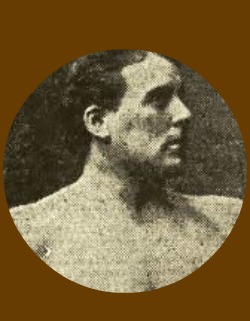
William Bankier is a name known to quite a few old school fans, but many may not remember why. In most cases it is because they fleetingly read about him as a wrestling promoter in Count Bartelli’s book or the pages of Heritage. Or they may be aware of him as the Scottish Hercules, Apollo, a music hall strongman in the early years of the twentieth century. Yet William Bankier was one of the most influential men in 1930’s wrestling. No one had a greater pedigree than William Bankier with a wrestling heritage that dated back to the beginning of the twentieth century and the famous wrestling tournaments at the Alhambra Theatre.
Surprisingly you will learn little about William Bankier in Atholl Oakeley’s “Blue Blood On The Mat,” a history of 1930s wrestling with a tilt towards the world that Oakeley would like us to know. He has been almost erased from wrestling history as this one time strong man known in the early days of the Twentieth century as Apollo was a fierce rival of fellow promoter Atholl Oakeley. Oakeley makes only a couple of fleeting references to Bankier, one of them recalling the occasion, in 1936, when Jack Sherry and Bill Garnon sued Bankier for questioning the claims of Sherry’s championship credentials. Irrespective of Oakeley’s disregard it is clear that William Bankier was one of the real pioneers of 1930s wrestling promotion, often promoting in conjunction with local partners.
William “Apollo” Bankier was born in Banff on 10th December, 1870, a childhood in which he was fascinated by the circus, especially the acrobats and the strongman.. .His ambition to emulate those he saw in the circus ring led to him running away from home and joining a circus as a labourer.
Having been tracked down by his father and returned home did nothing to dampen his enthusiasm. There are many claims that young William ran away again, this time to Canada. We can’t discount these claims but the short biography in the Music Hall and Theatre Review (01/08/1902) sounds more feasible to us. Their version of the story is that William was sent by his father to live with an uncle in Manitoba, sailing on the Cynthia,
Unconfirmed reports are that in Canada his circus dreams remained as strong as ever and he joined a travelling strongman show, working as a labourer whilst quietly studying the strongman act sufficiently well to stand in for the strongman when he was ill or drunk according to some reports. Looking for another string to add to his bow young William added wrestling to his repertoire.
By the time he returned to Britain in the late 1890s Bankier had learned a great deal about performance. These were a combination of practical demonstration, revelations and more than a touch of humour. The end of the performance would often end in a dramatic act, such as five people in a motor car driving over his prostate body or lifting a platform on which was a piano, six men and a dancer. He turned to the music halls and travelled the country, and abroad, under the name Apollo the Strongman. He took exception to another strongman, Eugen Sandow, because Bankier thought Sandow’s act contained more posing than strongman feats. He challenged Sandow to compete with him in weightlifting, wrestling, running and jumping. Sandow refused the challenge.
Bankier also wrote a book, “Ideal Physical Culture and The Truth About The Strong Man”
By 1904 William Bankier was well and truly involved in wrestling management, making challenges on behalf of the wrestlers in his charge in music halls around the country. Amongst his proteges we can include the Oriental Yukio Tani.
When he retired from performance Bankier went into business with another strongman, Monte Saldo. They formed the “Apollo/Saldo Academy”, which attracted all the best wrestlers and strongmen for training, including Georges Hackenschmidt and George DeRelwyskow.
In 1899 the Variety Artists Federation had formed a charity known as the “Grand Order of the Water Rats,” with many stars of Hollywood and Britain becoming members. The highest honour for a water rat is to be appointed King Rat for the year. William Bankier was King Rat for his charitable work in 1915 and 1919.
The showmanship of Apollo William Bankier was all ready for the 1930s and re-introduction of professional wrestling, making his public challenge to George Boganski and Athol Oakeley to face a man of his choice.
Yet it as a wrestling promoter that William Bankier should most be remembered by professional wrestling fans. He introduced wrestling to Liverpool Stadium in 1932, promoting in 1937 what is believed to be his only match outside of London by Jim Londos when he defeated Jack Pye. It was Bankier to whom the National Sporting Club turned when introducing wrestling in London.
It was not a career without controversy. Bankier lost a court case against Jack Sherry and Bill Garnon. The wrestlers alleged that promoter Bankier had used the Liverpool Stadium programme to make a brutal attack on their honesty and standing. The offending programme referred to a contest between Sherry and Garnon at the Stanley Greyhound Track in Liverpool.
In 1939 a judge at Westminster County Court found in favour of wrestler Leo Lightbody when he sued William Bankier for breach of contract after the promoter had inexplicably cancelled two wrestling engagements, at Liverpool and Belfast.
Bankier continued to promote during the Second World War and his halls included Ulster and Kings Halls in Belfast, New Brighton Tower, Blackpool Tower and Liverpool Stadium.
He died, aged 79, on 4th September 1949.
13862
 Wrestling Heritage