
These are our shorter Biographical portraits which we would like to extend if you can provide information or memories.
Black Devil
The original Black Devil was the French based Congolese heavyweight, Jim Wango, brought to Britain in the early 1930s by promoter Atholl Oakeley. Events leading up to his tragic death are told in Wrestling’s First Martyr.
Following Wango’s death the name Black Devil continued to be used by a wrestler of West Indies descent, Dave Smith, who lived in Dewsbury. Like his predecessor Dave Smith was an extrovert character with one report, whilst in the process of defeating the Japanese wrestler Yoshoko, declaring the Black Devil “…screamed and ran around the ring as if he had been stung by a swarm of bees.”
Black Diamond
No we are not talking about the famous tag team of the 1960s and 1970s. Our Black Diamond goes back more than a decade earlier. A masked man weighing around 15 stones briefly seen in the rings around 1950, with opponents that included Padvo Peltonin, Bill Coverdale, Charlie Scott and Jack Atherton. Prior to matches he would demonstrate his strength by breaking a horse shoe in two and tearing a telephone directory in half.
Black Salem
A name used at least twice in the post war years. A smiling Tunisian ,El Babri Lel Mamrouni Touhani, used the name and visited Britain in 1962. He was a powerful heavyweight who held the undefeated masked man Count Bartelli, to a draw. Opponents also included Tony Mancelli, Ernie Riley, Bruno Elrington, Tibor Szakacs and Jack Pye. Made his only television appearance against Digger Rowell in November 1962 at Hull. . The name resurfaced again in the 1980s as another identity for George Burgess, also known as Jamaica George, Jamaica Kid and a multitude of other names.
Lewis Blain
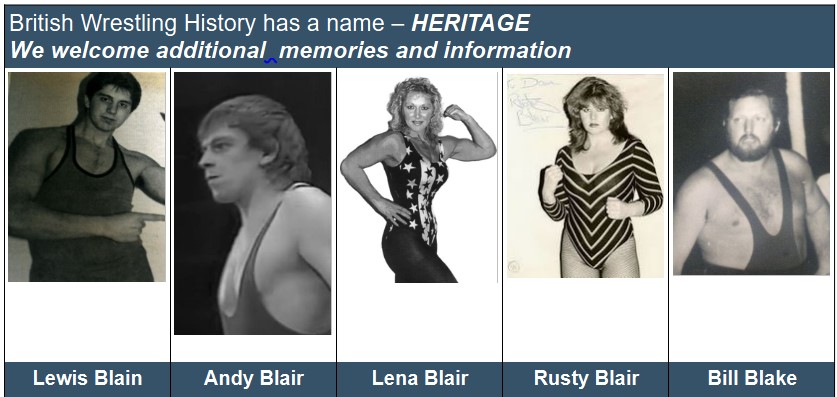
Lewis Blain, the Wessex Warrior from Salisbury, was one of that small and illustrious group from the Heritage Years still active until well into the twenty-first century. We think that anyone who has devoted their life to professional wrestling in the post 1988 years deserves our respect. It was a man rooted well and truly in the Heritage years that had a big influence on Lewis and encouraged him to turn professional. That man was Evan R. Treharne, owner of Ringsport magazine and Ringsport Promotions. Following Evan’s guidance teenager Lewis turned professional in 1983. We all know that the 1980s were a difficult time for young professionals but Lewis persevered and gained experience not just with the independent promoters but also travelling frequently to work in Europe. 1987 was the year of his big break, being noticed initially by Ken Joyce who employed him on Devereux shows, and shortly afterwards by Max Crabtree for Dale Martin Promotions. During wrestling’s short lived post 1988 renaissance Lewis was well placed to work around the south against the likes of Pat O’Sullivan, Keith Myatt, Steve Grey and Syd Cooper. At about this time Lewis also began promoting across Wiltshire, Somerset and Dorset, a business that continued until 2003.
Andy Blair
Watching Andy Blair in action we wondered what might have happened in a parallel universe? A universe where promoters did not rely on a few over-sized heavyweights and gave fair opportunities to more talented newcomers. Andy Blair was in that class. He was one of the good guys and looked the part, one of the tag partners of Big Daddy, doing the right thing suffering at the hands of villainous giants until saved by the oversized super hero. Then there were the occasions he was put in against the villains of the day, like the time he was set up to face Red Ivan so that the villainous foreigner could set up a match with Big Daddy. Andy did have around ten televised matches in the 1980s, including a British light heavyweight title match against Alan Kilby, but we do feel the world (or at least Max Crabtree) could have been much kinder to him.
Lena Blair (Also known as Leather Lena, Miss Lena,Lena Stromm)
Merseysider Barbara Ann Swan took up wrestling at the age of 16 and retired 20 years later She then graduated at art college. During her two decades in the ring she was a regular opponent of the other top names and continually battled Rusty Blair.
Contributed by James Morton
Marcel Blaise
Marcel Blaise was billed as the “Canadian Golden Boy” when he wrestled in Britain during the spring of 1963. The mid heavyweight from Montreal had actually been born in Belgium and moved to Canada when he was twenty. He was very much a novice on his arrival in Britain, having turned professional less than a year earlier. Not surprisingly he didn’t seem to set the place alight. Earlier opponents included powerful heavies like Willem Hall and Frank Hurley whilst later opposition were more realistically matched light heavyweights such as Ray Fury and Harry Kendall. Following his visit to Britain Marcel pursued his career back home in Canada.
Bill Blake (Also known as Fergus Cameron)
Bill Blake was often billed as “Bearded” or “Big”. A native of Newton-le-Willows, a rugby player and fan of St Helens.
Described as rawboned, Bill was a tough, hard competitor whose inner nature was sometimes diguised by a cheerful smiling face, even when he hit you! Billy’s forearm smashes went in full whack and shook your breastbone against your spine. Bill was regular at the Black Panther gym in Manchester and made training nights somewhat uncomfortable for other wrestlers with his whole-hearted approach to sparring.
He ran his own business and this often kept his bookings to an easy reach of his home in Ashton-under-Lyne. He had some memorable tussles in the 60s & 70s with Monty Britton, Brendan Moriarty, Pete Lindberg, Paul Carpentier, Hillbilly Bert and Chief Thundercloud on whom he once turned the tables and KO-ed him with a Bill Blake version of the tomahawk chop much to the consternation of the audience (and Thunderbird himself).
Bill was a hundred and one percenter who never shirked an opponent and should have gone further except for business and family commitments. “Always a man you were pleased to See the entry for …and, good fun on a night out!” said Eddie Rose.
Rafael Blasco
Spanish campaigner visited in 1955, 1956 and 1960, and claimant of the European Light Heavyweight Championship. Worked mainly in the south with occasional jaunts into Northern England.

George Blemenschultz
The bearded heavyweight goliath from Austria visited Britain for three months in 1957. A big name of the big European tournaments. George was a rugged and unorthodox opponent as he travelled up and down the country meeting top men such as Norman Walsh, Mike Marino, Dave Armstrong and Vic Hessle. Matches also included a main event appearance at the Royal Albert Hall loss to the popular Yorkshireman Dennis Mitchell.
Tom Blinkhorn
Wrestling was a second career for Tommy Blinkhorn. It is rugby for which the Wigan Highfield, Warrington, Broughton Rangers, England and Great Britain player is mostly celebrated. Born on 23rd April, 1903, in Wigan. With a rugby career behind him we find Tom wrestling in April, 1937 and in 1939 his occupation listed as a canal bargeman. Weighing around 14 stones Tom’s opponents include Leo Lightbody, Dick Wills, Carl Van Wurden, Billy Riley and Padvo Peltonin. Tom Blinkhorn’s last sighting was on 10th May, 1944, wrestling Cab Cashford in Hamilton. Tom Blinkhorn died in 1976, aged 73.
Aimedee Blomme
One criticism that cannot be levelled against the promoters of the 1930s was a failure to import overseas wrestlers. At the start of the decade there was certainly a shortage of national talent and the rapid popularity of the sport resulted in visits from continental and North American stars. Their quality was variable but Aimedee Blomme was a class act and Belgian heavyweight champion. He was a powerful 16 stone heavyweight who visited between 1932 and 1934. The strength and brute force of the man made him a formidable opponent, and it was said in 1932 that he had provided British champion Atholl Oakeley with his sternest challenge. Press reports said their match was “one of the greatest duels of strength pitted against craft that the new sport has produced.” For the most part the bulk and power of the Belgian champion overcame opponents such as the Golden Hawk, King Curtis, Jack Pye and Francis St Clair Gregory.
Andy Bloomfield
Hailing from Holkham in Norfolk Andy Bloomfield turned professional in 1986 and worked until 1993. Although his appearances were mostly in East Anglia he did travel further afield working for Brian Dixon against a variety of opponents that included King Ben, Ian Wilson, Tony Stewart, Shane Stevens, Ivan Trevors, and Jimmy Ocean. Andy retired from wrestling when he became disillusioned with the ever increasing use of gimmicks, though he did return a couple of years ago as the Russian lightweight Vladimir Volkov! These days Andy finds it far more satisfying leading wildlife tours. He wrote ‘Birds of the Holkham Area’ in 1993 and made major contributions to ‘The Birds of Norfolk’ (1999) and ‘The Turn of the Tide‘ (2005) as well as contributing to a range of ornithological journals.
Roger Boileau (Also known as Billy Red Cloud)
French Canadian Roger Boileau was the teenage idol when he first zipped across the Atlantic in December, 1961. He was trained by professionals Bob Lortie and Tony Lanza, both of whom encouraged him to gain further experience in Britain. His acrobatic style made him a popular visitor, none more so than when he was knocked out by Jackie Pallo on television in January 1962. Roger worked in Britain for Dale Martin Promotions for three months, opponents including Mick McManus, Eddie Capelli and Steve Logan. Mid March he disappeared from the rings, seemingly lost to British fans. This was not the case. For Roger it was a new outfit and a new image. Cashing in on the success of Billy Two Rivers he had a mohican haircut, bought a headdress, took the name Billy Red Cloud and started to work for Paul Lincoln and the independent promoters.
Bobby Bold Eagle
Yet another of the whooping headdresses native Americans who followed Billy Two Rivers and featured in our 1980s wrestling rings.
Bold Eagle was here for much of the 1980s, setting up home at Wallasey in Merseyside, where he became good friends with Heritage member Arty Drummer.
He made an impressive sight as he made his entrance. Removal of the costume and as wrestlers go he certainly looked the part. Bold Eagle whooped, war danced and tomahawked his way to victory against a multitude of 1980s villains. The fans loved his appearances.
He came to national attention on television, where he partnered Big Daddy (in 1981) to overcome Wild Angus (a frequent foe) and Bull Pratt. Other television opponents were Pete Lapaque and Mark Rocco. Take note of the poster below, a high profile contest at London’s Royal Albert Hall against the country’s number one villain, Mick McManus.
The man behind the war cries was twenty-something Robert Cortes, an American from Arizona trained by the great Argentina Rocca.
An experienced professional he had turned professional in 1968, working at the time for the WWWF, forerunner of the WWE.
During his career Bobby Bold Eagle travelled the world, and worked in much of Europe, North and Central America, Japan, Guatemala, and Saudi Arabia.
Following his UK sojourn he wrestled in Spain and Germany, finally retiring in 1991 to start the Bobby Bold Eagle Wrestling Academy.
Andre Bollet
A powerful continental heavyweight from France who visited Britain in the 1950s and 1960s. Despite his impressive power and skill he suffered notable Royal Albert Hall losses against Tony Mancelli (1954) Tibor Szakacs (1964) and Josef Zaranoff (1964).
Appearing throughout Britain at all the largest venues against the biggest names his record was surprisingly lacklustre, with losses recorded against Billy Robinson, Ernie Baldwin, Tibor Szakacs, Billy Two Rivers, John da Silva, Billy Joyce, Earl Maynard and Gordon Nelson.
Born in Paris, in 1924, Andre was French heavyweight champion, and formed a formidable tag partnership with Roger Delaporte. He went on to wrestle in North America and appeared in numerous films.
Page Reviewed 03/01/2023
691
 Wrestling Heritage