
These are our shorter Biographical portraits which we would like to extend if you can provide information or memories.
Dany Brecht
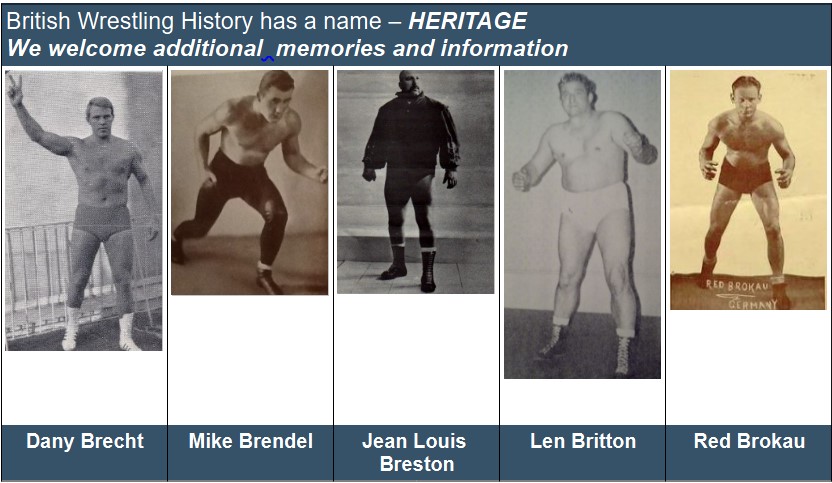
However much the fans may have taken to the blond haired, muscular German heavyweight the promoters did him no favours at all. Unless you welcome being put in with the very best during a four day visit. Four days that included getting knocked out in front of 5,000 fans by Tibor Szakacs at the Royal Albert Hall, witnessed by television fans nationwide losing by the odd fall to World Mid Heavyweight champion Mike Marino, and going down in the relative obscurity of the Wirina Stadium, Peterborough to the powerful Pat Roach. There was a fourth match in Southampton but we have no record of his opponent or the result.
Bill Brennan
A regular worker in the 1940s and 1950s about whom we would welcome more information.
Pat Brennan
A regular worker in the 1940s and 1950s about whom we would welcome more information.
Jean Louis Breston
The Belgian colossus visited the UK in 1974 with mixed fortunes. Defeated Terry Rudge and Judd Harris in his televised contests. Harris reversed the decision off screen and the Belgian was disqualified in contests against top rate heavyweights such as Gwyn Davies, Judd Harris and Bruno Elrington.
Rev Danny Brett
Holy Moses! A man of the cloth? Well, no we would bet our last half crown that the Rev Danny was no more than a creation of promoter Jack Taylor. The Rev Michael Brooks was indeed the genuine article, but the creation of the Reverend Danny Brett and his tag partner Reverend Mark Forrest were almost certainly more mammon than Godly. In the 1960s they toured independent rings delivering their rumbustious style of redemption to villains like the Undertakers. In singles matches Danny did wrestle some opponents of note that included Don Mendoza, Karl Von Kramer, Jack Cassidy and Azam Bholu.
Paul Britton
Paul Britton made one televised appearance, a July 1983 odd fall loss to the Cypriot Tony Costas. In the 1980s Paul worked on Joint Promotion shows mainly in the south of England for Max Crabtree and Ken Joyce.
John Brocklebank
A powerful heavyweight around for a short time who remained a bit of a mystery for many years. Turns out that John Brocklebank was the well known Cumberland and Westmorland style wrestler with a wrestling heritage going back generations. We found only a handful of professional matches for John, amongst them wrestling three times on one night – John beating Shirley at Cumberland and Westmorland style, with Shirley reversing the decision in arm wrestling and professional freestyle. He would have been twenty-eight years old in 1967 when first sighted, with his last appearance two years later. It seems feasible he didn’t take to the entertainment style of professional wrestling, but in November, 1967, he was featured in the Daily Mirror where it was said he was having difficulty finding opponents. But this is professional wrestling so you might want to pass the salt.
Red Brokau
A busy worker around the UK between 1933 and 1945, we have only one post war record. Reports make reference to his dreaded speciality “The Crucifix Hold” though our record of his wins show little evidence of it being put to effect!
Fritz “Red” Brokau was said to be a German-Canadian, though we have knowledge if this is true. He continued working in Britain throughout the second world war, which would cast serious doubt on his Germanic lineage. Following his retirement in the mid 1940s Red Brokau we have been told settled in Manchester, which seems a more realistic proposition.
The name re-surfaced once again in the 1980s.
Bill Bromley (Also known as Emperor, Bill Freeman, Big Bertha, Colossus)
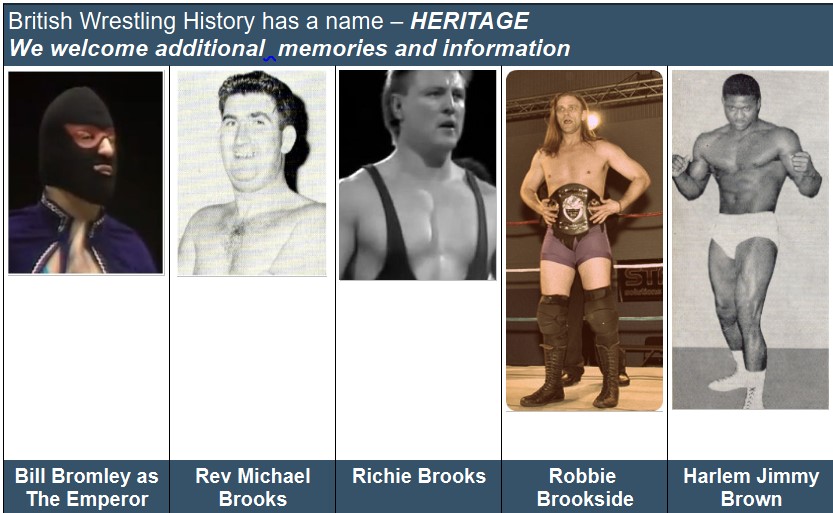
Standing over six feet tall Bill Bromley was an imposing figure. He begn appearing on Dale Martin bills in the south during the late 1970s and was a busy worker gaining some short term success in the 1980s. He used a variety of names: Bill Bromley, Bill Freeman Big Bertha, and The Colossus. He made half a dozen or so television appearances during 1981 and 1982, notably remembered for partnering Giant Haystacks against Big Daddy and Jim Moser televised from Derby in October, 1982. Other tv opponents included Wayne Bridges and John Elijah.
In the 1980s Bill Bromley assumed another identity. By the 1980s the days of the career masked man was long gone. Kendo Nagasaki, Count Bartelli, The Ghoul and quite a few others had entertained the fans for many years but in the 1980s the gimmick of a masked man was over-used and devalued. Bill Bromley was The Emperor. The Emperor was better than many, but even he failed to make a lasting impression. As always it all came down to promotion, and it was short sighted management seeking a quick return that was at fault. Adrian Pollard said: “If his character had been better ‘managed’ he might have been more than just ‘ordinary,’ but he had a huge task to fill the boots of the likes of Doctor Death and The Zebra Kid! So Big Bill Bromley didn’t become a career masked wrestler but was instead ‘mis-used’ by Promoters as Big Daddy fodder when the Sport was crying out for an injection of new life.”
As The Emperor he made a further two television appearances, in 1985, against Drew McDonald and Pat Roach.
Stoker Brookes (Also known as Petty Officer Brookes)
Bearded and muscular Barnsley’s Ronnie Brookes looked the part. He was one of Charlie Glover’s lads, learning boxing and wrestling at Charlie’s Junction Gym in Barnsley alongside Dwight J Ingleburgh, Pedro the Gypsy, Max Raeger and the rest of Charlie’s troupe. With a boxing background Stoker was one of those rough and tumble wrestlers who usually worked within the rules but could never be described as a clean shaven hero. Let’s just call it a robust style. Very robust. He was a reliable worker for the prominent opposition promoters of the late fifties, sixties and seventies. We watched him in the 1960s and (much as he planned) would never have guessed the real life personality behind this robust wrestling persona. A farm worker and miner, which he was before becoming a builder, would have been believable enough, but the precision of a signwriter and water colour artist would certainly have surprised us. In later years Ronnie put his artist skills to the benefit of the community when he tutored twice weekly at Age Concern art classes. A down to earth, humble man Ronnie was also a member of the “Raggy Lads,” a social group of working class men. Stoker Ronnie Brookes was born in June, 1933 and died in January 2008.
Ed “Strangler” Brooks
Professional wrestling was never sophisticated or too far distanced from bad taste. So, how about Bradford’s 1930 villain Strangler Brooks, whose dressing gown displayed an image of a man hanging from the gallows. Not bad enough? How about his habit of taking a mouthful of water and spurting it into his opponents face. Unsurprisingly, reports suggest his wrestling style was not exactly sophisticated either, punching and biting appeared to be favourite forms of offence.
George Brooks
George Brooks of Huddersfield is a bit of a mystery. The only book on 1930s wrestling (Blue Blood on the Mat) makes no mention of him but does mention the more famous Harry Brooks, also of Huddersfield.
Searching the newspaper archives he is only mentioned a few times, all between September 1934 and February 1935, and all matches within a 20 mile radius of Birmingham. This is odd, but not proof of a short career in a restricted area as the archives are not complete.
There may have been confusion between George and Harry Brooks, but appearances on the same bill proves they were not the same man
He was said to be a skilled wrestler, praised in reports of his defeats of the Iron Duke, Dave Armstrong and Len Franklin.
Rev Michael Brooks
Illusion may have been an essential part of professional wrestling, but Michael Brooks was no illusion; he was a genuine Methodist minister. His wrestling experience began as a twelve year old in the lake district where he wrestled Cumberland and Westmorland style in the Lakeland sports. He took up freestyle wrestling as a fourteen year old when he joined Lancaster Lads Club. The church came later. He had a few bouts for the independent promoters before his church work took him to South Africa. The Morecambe born middleweight combined church work with wrestling in South Africa. He claimed (and we can hardly doubt the word of a man of the cloth) to have held the Middleweight championship of Namibia for seven years. On his return visits to Britain he combined his ministry work with wrestling, saying that the wrestling helped him make contact with people otherwise out of the reach of a Methodist Minister. Wrestling Heritage member 1978 Kid has reported that Michael took early retirement from the ministry due to arthritis, and died suddenly on 7th March, 2000, aged 64.
Richie Brooks (Also known as Golden Apollon)
Bath’s Richie Brooks certainly made his mark on the British wrestling scene. He may only have gained national exposure on television in 1985, but he made more than twenty further appearances over the following three years until wrestling disappeared from our screens, and would most likely have still been one of today’s big names if things had turned out different for the sport. Seen at his best defeating villains such as Peter Kaye and Black Jack Mulligan, and stylists such as Steve Grey; at his worst partnering Big Daddy. A stocky middleweight, he stood only 5’6″ tall, Richie’s all action style made him a popular addition to any bill.
Saxon Brooks
Saxon Brooks was around in the 1980s, working for Max Crabtree, who was by then heading Joint Promotions. He was a more than capable performer with a couple of impressive television showings against Alan Kilby and Dave Lawrence. Around the halls the Nottinghamshire six footer had good bouts with others that included Alan Dennison, Jim Breaks and Johnny South. He was one of those we thought we would see far more of, and we may well have done so had wrestling in Britain not been in such a perilous state by then. Sensing a limited long term future for the business, and with a young family to support, Saxon made a thirty year career for himself in the police. He maintained an active interest in judo, his first love, and took up mixed martial arts. “I had great respect for many of the guys. Its a hard job to learn that’s for sure. They were good times, “ he told Wrestling Heritage.
Robbie Brookside
There are only a handful of wrestlers listed in the Heritage A-Z with whom modern day fans can associate. Robbie Brookside is one of those few, because when we added him to the A-Z in 2011 he was still one of the top wrestling stars in Britain, working regularly throughout the country and overseas.
Very few in the business persisted with wrestling during the leanest of years. Robbie did, and emerged in the twenty first century as not just a survivor, but a top star.
Sixteen year old Robbie Brookside turned professional in 1982, and became one of the most successful and popular wrestlers of the late twentieth and early twenty-first century. His age and agility made him an immediate success on the show of Bobby Barron and Brian Dixon, and the impact was replicated as soon as he appeared on television, both in singles bouts and as one of the Liverpool Lads Tag Team, remembered for great matches against Kendo Nagasaki and Blondie Barratt.
It is a tribute to Robbie that he continued to work in the wrestling business during the dark years following the removal of wrestling from British television screens. His skill has taken him across the world, with tours of the USA, Japan, Mexico, Europe and the Middle East.
Pedro Brosatti
A colourful 1951 visitor from Spain reportedly with the grace of a matador about to slay the bull. Brosatti was a good humoured wrestler popular with the fans and a sight to behold as he entered the ring in his silk gown. He worked for Dale Martin Promotions in the south of England with opponents that included Mike Marino, Black Butcher Johnson, and Vic Hessle.
Jan Brouwers
Jan Brouwers was a classy Belgium wrestler who was Heavy Middlweight Champion of his country on his first visit in the 1950s. He made later visits, going up the weight divisions in his later years, but always retaining a classical style of wrestling that was appreciated by the purist fans.
“Harlem” Jimmy Brown
America’s Jimmy Brown was born in New York in 1934 and came to Europe when he was in the American Armed Forces, based in Frankfurt. He was a master of many sports with a physique to match. Jimmy later moved to Paris and consequently worked on the continent before making his first visit to Britain in 1958 for Joint Promotions. His muscular physique made him a popular figure amongst fans. High calibre opponents included Ernest Baldwin, Ernie Riley, Alan Garfield, Eric Taylor, and Gordon Nelson. He was back in Britain in 1962 on Paul Lincoln shows against the likes of Don Mendoza, Doctor Death and Don Stedman Jimmy Brown’s highlight was probably a 1962 victory over Johnny Yearsley at the Royal Albert Hall. Heritage member Tom H remembers him, “He was billed as, the coloured junior heavyweight champion of the world, I’ve never seen anyone do the flying head scissors as good as this man.” Tragedy struck on 11th June, 1966, when Jimmy Brown was killed in a car crash in France.
Page reviewed 05/01/2023
696
 Wrestling Heritage