
These are our shorter Biographical portraits which we would like to extend if you can provide information or memories.

Judo John Brown
Dudley’s Judo John Brown was trained by Alan “Tarantula” Turner. Worked for the independent promoters in the 1970s and 1980s, and continued involvement in the sport following his retirement as a referee and trainer of young hopefuls.
The Brown Masked Marvel
A myriad of Masked Marvels have appeared in British wrestling rings, none of them career masked men. Yet we find only one Brown Masked Marvel, of whom the American magazine, The Ring, reported in March, 1938, ” … a supporting bout saw the “Brown Masked Marvel,” a hooded light heavy, take two straight from Jack Atherton of Lancashire . . .”
We came across him in Preston in November, 1937, wrestling Vic Hessle and said to be “The Unknown! The Unbeaten.” We then uncovered another dozen or so matches, up to September, 1939. All of them were in Lancashire, all unbeaten, which makes us suspect that a tough Lancashire wrestler was beneath the mask.
The hyperbole increased with each appearance: “The Unknown! The Unbeaten. The fastest wrestler in the world. Challenges any wrestler at his weight. His speed and anticipation is astonishing. Has appeared at all the principal halls in England and on the Continent. Clean, clever and good.”
George Bryan
A name not often remembered, but George Bryan of Leeds was a true pioneer. On the day usually acknowledged as the launch day of British all-in wrestling, 15th December, 1930, George Bryan was in action. Not at the London or Manchester shows celebrated so often, but in a Doncaster show promoted by Harold Angus. Bryan defeated another Leeds wrestler, Tom McDermot, by two falls to nil in five minutes thirty seconds. He was to remain a stalwart, low key player in British wrestling until the early 1940s.
Dave Bryson
Trained by veteran Norman Carter Lincoln’s Dave Bryson came to our attention in 1967. The boy was popular and he was everywhere. Well, everywhere around the Midlands with the odd jaunt northwards.
Opponents included Kendo Nagasaki, Barry Douglas, Mal Kirk, Les Kellett; most of the mid heavies and heavyweights in the north.
Two of wrestling’s mysteries surround Dave Bryson. What was it with the gloves he wore? Was there some medical reason or just one of wrestling’s most subtle gimmicks? Secondly, after three years why did he disappear as quickly as he arrived?
Blue Buchanan
Bad boy of the late 1980s, sometimes tag partner of Fit Finlay, who we have been told was his step father, being the son of Princess Paula. Made one television appearance, an August 1988 match with Danny Collins. A good, hard wrestler according to colleague Keith Myatt.
Ray Bukovac
French heavyweight made regular visits to Britain between 1946 and 1950. Brother of Rene Bukovac.
Rene Bukovac
The French mid heavyweight, and one time European champion, visited Britain in the 1950s with a 1950 victory over Ernest Baldwin at Belle Vue, Manchester. Brother of Ray Bukovac.
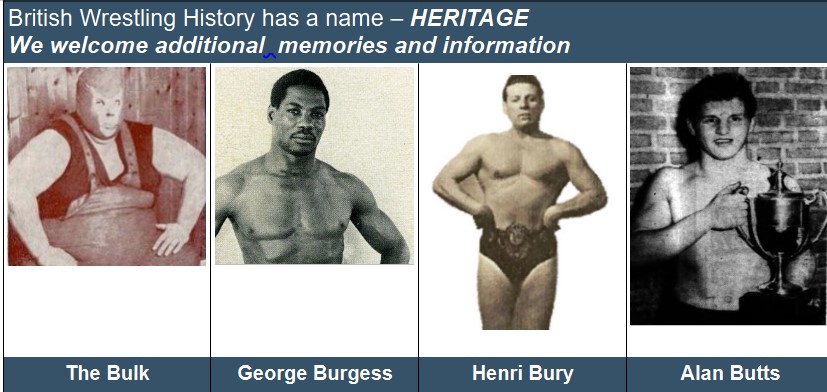
The Bulk (Also known as The Incredible Bulk)
We will just settle for Bulk, being of an age the Incredible tag just didn’t see authentic; not that we would wish to disrespect a most likely decent man earning a bit of money within the context of the time. With the novelty of perhaps weighing in even heavier than Giant Haystacks at his peak, 42-stones The Bulk represented one of many eighties lows in professional wrestling. He made a ring appearance at a Wembley Extravaganza and then challenged Big Daddy in Gloucester.
By the time of his sole tv appearance this poor young chap had still not mastered the role he had hastily been engaged to fill, that of a villainous foil to Big Daddy. Now maskless, he moved slowly around the ring, forgetful of what to do. Then he stomped up and down but faced the wrong direction and it looked ridiculous.
Even his opponent was guiding him as to what to do, and an improvised early finish was sensibly arranged, and the completely bewildered Bulk was ushered away to the dressing rooms. Even the programmes said he had limitations and weak spots, even the promoters said he was grotesque. Wrestling Heritage does not blame the wrestler. Who can blame someone for seeking a moment of glory and earning a honest crust? Yet we ask, how could the administrators have brought the sport into such pitiful disrepute?
George Bullock
George looked like his name: five foot eight and seventeen stone of fast moving aggressive bad temper in the ring. Worked for both Joint Promotions and Independent promoters in the 50s & 60s. Featured in bouts with Dennis and Jack Keegan, Jack Beaumont, Bill Coverdale, Jack Cassidy and was one of Billy Two Rivers first opponents in the UK. He had a series of bouts with another Red Indian, Chief Thunderbird who was based in Levenshulme Manchester that used to draw good crowds at local shows.
George ran into health problems in his early middle age and died suddenly in the early 70s. Unheralded but a good, solid heavyweight who could give and take with the best of them.
George Burgess (Also known as Jamaica kid, Jamaica George, Coolcat Jackson, Samson Negro, Coolcat Virgil, Zulu Warrior, Black Salem)
A man of many names who we first came across in the late 1960s on the Blackpool summer shows staged by Dominic Pye. His career was to last a quarter of a century.
George Burgess was a popular Barbados born heavyweight, based in Leeds, coming to national attention in the 1970s, later to gain greater fame as the Jamaica Kid. Although a muscular heavyweight George was a very nimble mover with a powerful physique, and his speciality drop kick always impressed. George travelled the world and was popular in Indian rings. His wrestling career spanned a quarter of a century, last seen in the early 1990s.
Surely a contender in any competition for the wrestler who used most names?
George Burgess died, aged 88, on 5th October, 2024.
Jock Burke
Dave Sutherland brought up the subject of Jock Burke: “At St James, Newcastle, back in April 1964; The main bout was Arthur Ricardo against Jock Burke who either wrestled in his kilt or certainly arrived in the ring wearing one. I don’t remember him ever appearing at Newcastle again.”
That got everyone thinking, but with little success. All we came up with were matches for the independent promoters between 1959 and 1963, then a flurry of activity for Joint Promotions in 1964 before returning to the independents the following year.
Jim Burnett
Vancouver’s Klondike Jim Burnett was the Canadian Heavyweight, and one time gold miner in South Africa, who made his way across the Atlantic in 1934. His earlier professional contests seem to have been in Britain between 1934 and 1938, wrestling top British heavyweights such as Bert Mansfield and Bulldog Bill Garnon. He disappeared from our rings in 1938, presumably pursuing his career back home as the prospect pf war began to loom on the horizon. Jim was back in Britain for a short time following the end of hostilities, and spent much of the following seven or eight years here in clashes with top men Jack Pye and Dave Armstrong. Post war, though, we shared him with the rest of the world, with Jim wrestling in South Africa, the United States and his native Canada.
Rocky Burnett
We would like more information on Rocky Burnett, for whom we have recorded matches in the early 1960s for the independent promoters against quality opposition Doctor Death, Randy Turpin, Bobo Matu, Terry O’Neill and The Mighty Chang.
Joe Burns
Killer Joe Burns was an Irish born middleweight, and one time British middleweight champion, for the independent promoters in the 1960s and 1970s. One time tag partner of Sabu the Indian, collectively known as The Karate Killers.
Bill Burton
Quite a few servicemen popped up to wrestle during the Second World War and disappeared following the end of hostilities. One of them was Bill Burton, a sergeant in the Army. We presume he was based in or around Newcastle as we have over a dozen records of him appearing at the New St James Hall, Newcastle, between January 1942 and December 1945. Opponents included Cyril Knowles, Jim Lewis, Jack Harris and James Blears.
Ted Burton
Like Bill Burton (above) we suspect a wartime activities connection for Staff Sergeant Ted Burton, a low key wrestler who worked frequently at Belle Vue, Manchester, between 1942 and 1945. Opponents included Carlton Smith, Jack Harris, Hec Trudeau and Jack Beaumont.
Henri Bury
The muscular and powerful Belgian heavyweight champion from Liege visited Britain on numerous occasions in the 1950s. Our earliest recording is a 1952 match against Dominic Pye, and the last against Tony Zale in 1959. Between times opponents included Bert Assirati, Alan Garfield, Gordon Nelson and Jack Pye.
Tom Bury
Billed from Choppington in Northumberland Tom Bury appeared in Joint Promotion rings in 1956, with opponents that included Alan Colbeck, Ted Hannon, Chic Purvey and Brian Trevors, working mostly in the North East of England. He left Joint Promotions in 1958 to work for the independent promoters until disappearing in the mid 1960s.
Mohammed Butt
Mohammed Butt was one of the strongest 1980s heavyweight wrestlers. He would often give a demonstration of power lifting prior to his contests. Appeared on television against Len Hurst, John Elijah and Barry Douglas.
Alan Butts
We head back to the summer of 1960, Rome and the Olympic Games. Britain deployed a contingent of six wrestling representatives. Veteran Ken Richmond was making his fourth Olympic Games outing whilst amongst the other five, all making their Olympic debut, was a young Birmingham lad called Alan Butts.
Born on 11th April, 1940, Butts had already won the British middleweight championship in 1960 before travelling to Rome. Having just turned twenty he was the youngest member of the British team. Alan lost both his Olympic matches, against Madho Singh of India and Viljo Punkari of Finland. Disappointing, maybe, but quite an achievement, especially for someone who reckoned he weighed a far from athletic 15 stones when he was sixteen years old. That’s when he joined the Birmingham Athletic Institute and took up amateur wrestling.
Four years of dedication, training three nights a week led to Saturday 30th April, 1960, when he travelled to London to beat Scotland’s George Farquhar to win the British middleweight championship. By the summer of 1961 Alan had made his professional debut and was working for Joint Promotions against the likes of Bob Anthony, Jackie Pallo, Arthur Fisher and Cliff Beaumont. Maybe the professional style just didn’t appeal to the twenty-one year old amateur champion as he disappeared from our sights in February, 1962. We believe Alan still lives in Birmingham, so if he’d like to get in touch and tell us more we’d be pleased to hear from him.
Mike Byrnes
We know precious little about heavyweight Mike Byrnes, other than he was a busy worker over a short period and was featured in the wrestling holds book “Wrestling – The Admiral Lord Mount Evans Style,” photographed demonstrating holds with Dave Armstrong. Mike appeared in British rings between 1940 and 1943, mostly in northern England, though we have one recorded match at Harringay against Tiger Joe Robinson. He reappeared in 1949, and was around for a couple of years, again mostly in Northern England and Scotland.
Maurice Byron (Also known as Mad Maurice and The Lynx)
Maurice Byron was no champion wrestler, we have found only a handful of matches, but he was a champion at courting publicity. He was an unconventional character who wrestled from the end of 1931 until 1934. Not just wrestling mind, Maurice proclaimed himself the All-Round Athlete of the World. Wrestling, boxing, swimming, running, roller skating … Maurice invited challenges from anyone in more than forty sporting events. Then it came to wrestling he played it for laughs, even turning up in his pyjamas on occasions. Maurice made outdoor public appearances of his strength by forming a bridge and inviting adult men to stand on his stomach. It was claimed he had learned to wrestle whilst serving in the army in Egypt in 1925. Although his identity was never concealed Maurice was widely known as Mad Maurice and The Lynx.
Page reviewed 05/01/2023
699
 Wrestling Heritage