
These are our shorter Biographical portraits which we would like to extend if you can provide information or memories.
Rene Cabellec
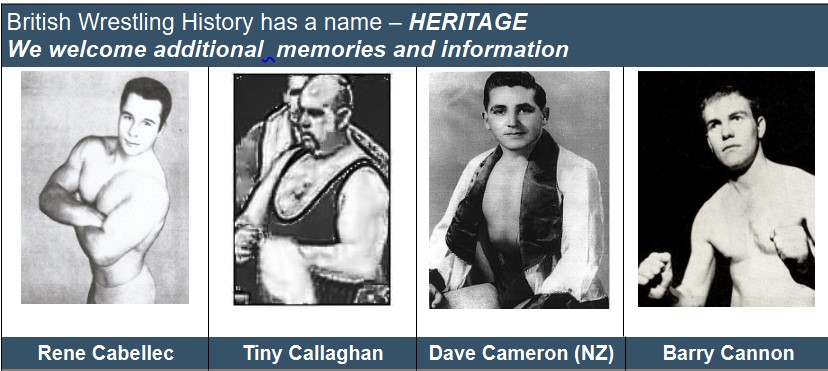
Rene Cabellec popped over the channel in 1964, working for Dale Martin Promotions. The good looking, muscular twenty-seven year old picked up many admiring fans whilst battling with opponents that included Jackie Pallo, Johnny Kwango and Jack Dempsey.
Sonny Caldinez
Well over six feet tall and very muscular Sonny Caldinez was a heavyweight campaigner born in Trinidad and living in London. He trained at Forresters Amateur Wrestling Club and worked mainly for Dale Martin Promotions in the mid 1960s. Sonny later went on to film and television work, and David Mantell told us that he played various demonic roles in Dr Who. He also had roles in high profile films including The Man With The Golden Gun and Raiders of the Lost Ark. In 1976 he appeared in “Sunshine in Brixton,” a play in the BBC tv series “Plays for Britain,” written by the wrestler Brian Glover (Leon Arras).
Tiny Callaghan
Tiny by name, but that was about all. Tiny Callaghan was one of the 1980s heavyweight big boys, weighing in at around 30 stones. Eric Callaghan worked our rings for eight years and often found himself in tag action, the villainous fall-guy in the opposite corner to Big Daddy and one of his myriad of partners. Televised appearances for Tiny in 1984 saw him partnering Sid Cooper, Lucky Gordon and Scrubber Daly, with Big Daddy one of the opponents in each match. At the Royal Albert Hall he partnered Lucky Gordon to dutifully go down to Big Daddy and Danny Collins. For a short time in 1984 Tiny revived one of the great names of British wrestling, The Ghoul. Tiny’s biggest challenge came twenty years later, when he began the battle against the bulge. As we made contact with him in the 2010s he was a shadow of his former self and tipped the scales at around twenty stones, and going down.
Clive Cannell
A man who just slipped into the Heritage Years Salisbury wrestler Clive Cannell’s career lasted long into the twenty-first century. Born in 1963 Clive turned professional in 1986, not good timing for someone wanting to make a career out of pro wrestling. Nonetheless, he did receive regular bookings, mainly in southern England during the 1990s. An ambition was achived ehen he travelled across the Atlantic to wrestle in the United States in 2003. Whilst there he and Gareth Humphries from Trowbridgewon a Trans Atlantic Tag Team Championship bout and Clive won the United States East Coast Championship belt.
Barry Cannon
In the early 1960s, with the number of shows nearing their mid decade peak an influx of new stars came onto the professional circuit. It is a credit to the promoters of the day that the quality of those newcomers was so high. One of the most promising was a young wrestler named Barry Cannon. A highly skilled, fast and popular Bradford welterweight Barry gained increasing recognition in the 1960s following his 1962 debut at Colne. Having become interested in wrestling whilst participating in his national service, Barry returned to Britain and was trained by Les Kellett. The Wrestler magazine featured Barry only weeks after his professional debut and made much of “the fact” his father was a good friend of Kellett on more than one occasion that w e wonder if this was a lad with friends in high places. Suspicions more aroused with a television debut at Preston against Eric Sands less than two years after his debut. Barry was a popular and regular contestant on the small screen, no fewer than ten matches in the next couple of years, culminating in his final and predictable loss against Mick McManus in 1967. Matched against the top welterweights of the day, but rarely above preliminary level, fans were disappointed when he disappeared from the scene in 1968. We suspect there is more to his story and would like to hear more.
Pietro Capello (Also known as Maurice La Chapelle, Rene La Chapelle)
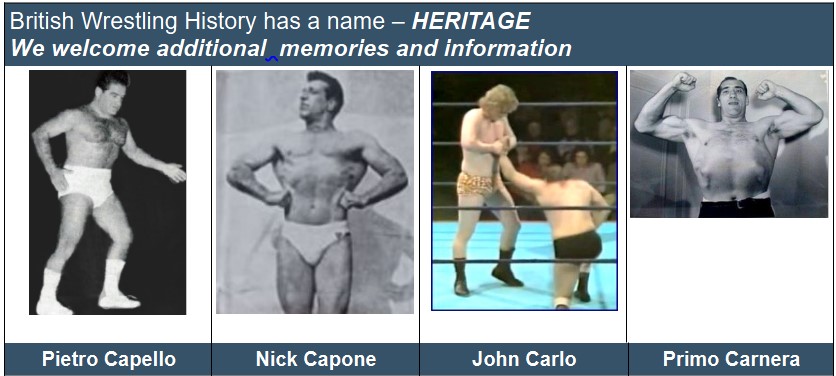
Italy’s Pietro Capello, known in parts as Maurice La Chapelle or Rene La Chapelle, was one of the great villains of the 1950s and 1960s. “There was no pretence of orthodox wrestling…hit hard and hit first to survive,” Eddie Rose remembers. He moved from Italy to Canada, to follow a career as a chef we were told at the time, where he was trained to wrestle by Tony Lanza. Shortly after turning professional he moved on to Australia before arriving in Britain in 1962. He was to remain a regular feature of the British wrestling landscape for the next three years. Television executives selected opponents to show him at his villainous best – Masambula, Czeslaw, Cornelius, Veidor and Ricky Starr amongst others.His contest against Ricky Starr is a popular view on You Tube. Pietro Capello sneered at the crowd and oozed self confidence, usually en-route to defeat against the good guy of the day. He was one of those wrestlers who turned villainy into a work of art. Pietro’s career was cut short in 1966 when he suffered a severe heart attack shortly after leaving the ring. Interestingly wore a gold earring in those days when men didn’t do such things. We just put it down to him being foreign.
Nick Capone (Also known as Lee Gordon)
Muscular heavyweight of the 1970s independent scene in the north of England Nick Capone was Gordon Mudd, who also used the ring name Lee Gordon. The name lived on into the twenty-first century with the opening of Capone’s Pizzeria in Coulby Newham.
John Carlo
The tall, muscular blond wavy haired John Carlo was another of the new wave of wrestlers who permeated through Dale Martin bills in the mid 1970s. His style made him a popular addition to the ranks of the mid heavyweights. From Ashford in Kent he turned professional in the late 1960s. A tough 1973 televised debut against the heavier and experienced Johnny Yearsley was followed the next year with matches against against El Extioco, Terry Rudge and Bob Kirkwood. Kent Walton forecast great things for the youngster, but he disappeared from our sight shortly afterwards.
Terry Carnell
Terry Carnell was a promising heavy middleweight of the early 1970s. His home was in Bradford Upon Avon but he trained at Bristol Amateur Wrestling Club under the guidance of Tony Charles and Johnny Czeslaw. Terry turned professional in 1966 working for independent promoters in south Wales and the West Country. In the mid 1970s we have reports that he wrestled for Joint Promotions in the North East.
Primo Carnera
Yes, the Ambling Alp and World Heavyweight Boxing champion Primo Carnera did turn his hand (and feet) to wrestling.
In fact it was the other way around and Carnera was a wrestler in his native Italy long before finding fame as a professional boxer.
Fame maybe, but fortune certainly did not come his way in the boxing ring. The story of Primo Carnera is one that professional boxing has little to be proud of.
At six eight and twenty stone the former circus strong-man looked threatening enough but was a cumbersome and one dimensional fighter.
Carnera turned to wrestling once again after leaving the boxing ring and his visit to the UK for Joint Promotions is documented in Blood, Sweat and Speedway elsewhere on this site.
Around the time the ex World heavyweight boxing champion Primo Carnera turned to wrestling and toured the UK in the 1960s the heavyweight Gino Carnera appeared on the independent circuit. Now don’t call us suspicious.

Paul Carpentier
“The darling of Paris” and a “Favourite of the boulevards” proclaimed the posters. Paul Carpentier was a popular Mancunian heavyweight masquerading as Anglo French. No doubt George Shaw thought the name Paul Carpentier far more exotic than his given name, most likely aware of the Frenchman Edouard Carpentier. He regularly travelled to venues with his friends Pat Curry and Billy Graham, both of whom also borrowed their names from famous overseas stars. Paul turned professional in the late 1950s and it was a career that lasted until around 1980. His looks and tendency to play the good guy made him a popular hero as he tackled the likes of Cowboy Cassidy, Hans Streiger, Lord Bertie Topham and Klondyke Bill. His good friend Eddie Rose said, “He was a good looking, well muscled wrestler and a favourite with the fans.” Paul Carpentier often promoted in the north west in conjunction with Jack Cassidy, their shows at the Houldsworth Hall In Manchester were talked about for many years. “A good man with family and many friends who always dealt fairly with the wrestlers who worked for him,” said Eddie. Paul Carpentier died in July, 2023, aged 86.
Ron Carroll
Ron Caroll worked for independent promoters and we have found him on programmes from 1958 until 1968. We are surprised at his disappearance and would like to learn more. Billed from Ireland or Lewisham. He often tagged with fellow Irishman, Pat Kloke, as The Emeralds. We confess to having no first hand experience of this villain and fall back on a 1962 report from the Norwood News to create the image: “None performed better than crew-cropped villain Ron Carrol who extracted enough hisses and boos to satisfy any Victorian melodrama with an exhibition of all the wrestling moves that are not in the book.” Nonetheless he got his come-uppance when opponent Basil Coulolias got his fifth round submission.”
Norman Carter
Yorkshireman, Norman Carter was a 1950s wrestler frequently found in the rings of northern England. We found him as early as 1949, wrestling Fred Unwin. Other opponents included Harry Fields, Johnny Kwango, and Eric Taylor. Our last sighting was in 1954. Norman went on to train Lincolnshire wrestler Dave Bryson. We would like to hear more about him.
Francis Cartwright
One of the two Cartwright brothers, born in Wrexham, and a popular 1970s wrestler working mainly in south Wales and southern England for the independent promoters, often seen tagging with his brother, Mel.
Mel Cartwright
Popular 1970s welterweight wrestler working mainly in south Wales and southern England for the independent promoters, often seen tagging with his brother, Francis.
Mel was born in Wrexham but based in Oxford for most of his wrestling career. He trained as an amateur in Oxford and gained a lot of experience working on the fairground booths.
Jon Casanova (Also known as Johnny Halsop)
A bit of a mystery here, but then wrestling is full of mysteries. A star in the making it seemed . And then what? A man that disappeared, even leaving his local fellow professionals flummoxed. In 2016 Eddie Rose told us he had heard a rumour that Jon Casanova was living in Bolton “He was a regular attender at Wryton Stadium on Sunday mornings for training sessions with Jack Atherton and Ken Cadman in charge. Others included Bobby Ryan, Paul Mitchell, Mark Wayne, Ian Wilson, Paul Duval, Alan Woods and Jack Fallon (plus me). If anyone is in touch with him please pass on my best wishes.”
Bolton’s John Halsop was quietly making his way on Wryton Promotion bills when BBC television launched their 1971 series Casanova. Taking the opportunity that presented itself Johnny Halsop bought some flashy gear and was soon transformed into Jon Casanova.
It was a successful transition and for a short time our wrestling Casanova seemed to be everywhere. He met rising stars of the day such as Marty Jones and Mark Rocco as well as established stars like Les Kellett and Adrian Street. At the Royal Albert Hall in December 1972 he held Jim Breaks to a one fall apiece draw. Made his television debut in April 1972 against Tug Wilson and went on to have television wins over Marty Jones whilst losing against Mark Rocco, Jackie Pallo and Ivan Penzecoff. We liked him. Lots of fans liked him. “His debut TV fight against Tug Wilson held the crowd spellbound at Wolves Civic Hal in 1972” said Peter, “A very good wrestler with a great gimmick!” according to Frank Thomas.
As speedily as he had exploded onto our wrestling radar he disappeared again at the end of 1973. We welcome news of what became of him.
Bill Case
One of three brothers who wrestled in the West Country in the 1930s, Bill Case was born on 6th July, 1914. According to our records Bill was the least active of the three and we can find records between 1935 and 1939, all in Devon. In 1939 Bill listed his occupation as a Store House Assistant in Devonport Docks. William Joseph Case died in 1999.
Charlie Case
Charlie Case of Plymouth was born on 10th January, 1910. Although well known in Devon and Cornwall the brothers didn’t travel far though we have found Charlie in northern England and Wales. Of the three Charlie was the most prolific with the highest profile. Charlie started wrestling professionally in 1935 and our last sighting was a match on an independent promotion at Truro in December, 1959, by which time he would be nearing his fiftieth birthday. He was still hailed as Heavyweight Champion of the West Country.
In 1939 he was living in Plymouth and working for Great Western Railways as one of the Decontamination Squad. Charlie was also a keen football player and played for Truro F.C. In 1962 we found reports of Charlie as the referee at Carolyn Bay. Charles Raymond Case died on 15th February, 1973.
Ron Case
Plymouth’s Ron Case was both professional boxer and wrestler in the second half of the 1930s. We have found reports of wrestling matches from 1935 until 1939 and three boxing contests in 1937 and 1938. Wrestled as a light heavyweight mostly in the west of England, with reports of a skilful wrestler but never more than a supporting player. He was the brother of Bill and Charlie Case.
866
 Wrestling Heritage