
These are our shorter Biographical portraits which we would like to extend if you can provide information or memories.

Texas Buddy Cody
The sturdy Texan heavyweight, surprisingly only five feet nine inches tall, hailed from Dallas and brought with him the sort of seemingly stereotypical American style that made him far from popular with British fans. Having turned professional in the early 1950s Cody first made it to Britain during the winter of November 1955. A knock out win over the tough as nails Wiganite Arthur Beaumont in one of his first contests was a signal to everyone that here was a man not to be taken lightly. During the following seven years Cody was to become a regular feature of British and European rings facing the biggest names of the day with mixed results and frequently falling victim of the referees disqualification verdict.
Rob Cody
Another of the myriad of wrestlers who appeared on Dale Martin bills around 1977, heavyweight Rob Cody didn’t seem to be around for long.
Micky Coen
Micky Coen spelt his name the Irish way and he was as Irish as they come! From the West of Ireland, Micky was another product of Panther’s Gym in Manchester and enjoyed a successful career with mainly independent promoters in the North West.Eddie Rose told us of his first bout with Micky, “A blistering baptism of six rounds during which I think he gave me one drink of water! He was a no frills, all-action man. Like Jimmy McCormack, he did not take a count but just bounced back up and carried on fighting.”
Micky wrestled men like Billy Graham, Dave Reynolds, Brendan Moriarty, Red Naylor, Dave Grant, Tommy Bailey, El Medico and Johnny South. He was a wise lad: he put his earnings into his construction business and made a very good living for himself.
Eddie continued, “I don’t know whether the lads were winding me up, but when they found outI I was on a show with him they told me all kinds of stories about him once being charged with manslaughter in court! He was nothing like that. He was a quiet, good humoured man and good company outside the ring!”
Sammy Cohen
Powerful and unpredictable that was South African heavyweight Alec Simpson, billed in Britain as South African, Kenyan or Israeli, the Jewish heavyweight champion,. He worked in Britain during the winters of 1957-58 and 1960-1961. We were surprised to discover a reappearance in September, 1970. Most of his contests were in southern England facing the best that promoters Dale Martin could throw at him, Big Bill Verna, Alan Garfield and Gordon Nelson among them. Sammy had turned professional in the mid 1940s and his involvement continued in the wrestling business as promoter, as well as bestowing three sons on the wrestling business.
Welsh Davey remembers Sammy’s appearance in Cardiff, and he wasn’t impressed:
“My only memory of Sammy was the night at Cardiff’s Drill Hall when he was roundly booed from the ring after a truly woeful performance. So atypical and strong was this response from the normally generous Cardiff crowd that MC Sammy King immediately announced that Cohen would never step inside a Cardiff ring again. And to my knowledge he kept his word.”
Bob Collins
Malcolm Daintry was born in Southampton in September, 1941. He went on to become a bad boy of the 1970s and 1980s rings, and sometimes referee, of southern England. Bob Collins was involved in many memorable matches with Tiny Tom Thumb. He worked for both the independent promoters and Joint Promotions.
Derek Collins
Like so many Wrestling Heritage readers Derek Collins interest in wrestling began as a ten year old child when he joined the fans at Leeds Town Hall. Wrestling wasn’t his first sports love. As a schoolboy he was a successful runner, representing Yorkshire Youth. It was whilst running that he took up wrestling in order to keep his weight down!
Derek was an amateur wrestler for nine years at the Hilltop Wrestling Club in Bradford. Derek would go along to the Hilltop when he wasn’t at work down the coal mine, not just earning an honest crust but also building up the strength and stamina necessary for a career in the ring. With a good amateur grounding Derek moved to Ernest Baldwin’s Tingley gymnasium in preparation for his professional debut. That moment came in 1962, but Derek’s career was soon to be put on hold due to a serious knee injury. After more than a year out of wrestling Derek returned and established himself as a popular worker throughout northern England and and Scotland, working for all the major promotions.
Pete Collins (Also known as College Boy)
Peter Collins was a Bristol youngster who followed brother Danny into the world of wrestling in the 1980s, making a professional debut around 1980. Despite Danny having already made a name for himself Peter took his own path and created his own identity by re-creating a persona from the past, College Boy. His style was very different from his clean-cut brother which led to their tag partnership having only a short life. After a while Peter dropped the College Boy name to use his own name, though unlike good guy Danny Peter’s style led to the nickname “Mr Vain,” upsetting fans not with his rule bending and antics and frequently taunting and arguing with them.
Rocco Colombo
Speedy and acrobatic the high flying Rocco Colombo was known as the Whirling Dervish.In the spring of 1962 he made a two month visit to Britain and impresses those who watched him in action. Rocco was born in . New York and was already well known to wrestling fans throughout North America when he crossed the Atlantic. He was an impressive addition to (usually) southern rings, beating Francis Sullivan at the Royal Albert Hall, Candian Georges Gordienko, and Les Kellett. Not bad for starters. Rocco Colombo passed away in 1964.
Chris Colt (Also known as The American Dream Machine)
The American Dream, the Promoter’s Nightmare. Heritage member Bill Smith remembers the 1980 UK visit of Chris Colt (real name Charles Harris), who came to the UK and wrestled as “The American Dream” and as “The American Dream Machine.” Colt was actually a Canadian but much of his career was in the United States, where ee was a member of the “California Hells Angels”Tag Team who were title holders in the USA.
Chris Colt caused a sensation with his tactics inside and outside the ring. With his multi-coloured tights and elaborate make-up he made a colourful, albeit controversial, addition to the British wrestling scene. Bill recalls, “He was a very good worker who was not afraid to take a few ‘bumps’. His best match in the UK is reckoned by many people to be the one against Dynamite Kid (Tom Billingham) at Wolverhampton Civic Hall. ” Another Heritage member, Norfolk Snake told us, “Can recall seeing The American Dream at King’s Lynn Corn Exchange taking on Kung Fu for Brian Dixon – at the time I had never seen anything like it, the heat, the image and the violence that erupted in and outside the ring; punters included!”
A watershed moment for Colt during his British tour came the night he faced Big Daddy in a tag match for promoter Max Crabtree. That was the night the dream turned to nightmare for Max after allegedly failing to follow the plan in the high profile Royal Albert Hall bout in November 1980. Following this match Chris went to work for Brian Dixon’s All-Star Promotions. Dixon must have thought Christmas had come early as the big name American filled the venues as the man who had to be seen to be believed.
Controversial maybe, but certainly Chris Colt was an innovator and colourful character who could wrestle.

Kevin Conneely
It would be so easy to fall into the trap of rolling out a list of stereotypical labels to describe the Irish born Kevin Conneally. We won’t. We will just tell you of the joy the Liverpool wrestler’s appearance could bring to fans. A great wrestler and comedian of the ring. Liverpool wrestler Kevin Conneelly began his career with the independent promoters around 1960, coming first to our attention on an independent show against masked man Mitzuko Chango in 1965. By then he had around five years experience against top opposition men such as Jack and Ray Taylor, Johnny Saint and Bill Tunney.
Outside the ring he was owner of a general store and newsagents in Liverpool. His Nephew, Patrick, told us, “Kevin was my uncle and was always the life and soul of the party. When all the three brothers got together, Kevin my Dad Pat and my uncle Sean, you were guaranteed a few laughs. He is sadly missed by all his friends & family”
In 1969 he was signed up by Wryton Promotions and was an immediate success in Joint Promotion rings, with fans appreciating the combination of wrestling ability and humour. He was to remain a popular figure on Joint Promotion bills throughout the 1970s, returning to the independents in the 1980s. Wrestling enthusiast Peter M. told us, “My memories of Kevin are of a genius who knew how to get the ladies on his side. I remember he would walk around the front rows shaking every hand. He could spend ten minutes oblivious to the ‘heel’ complaining to the referee to start the bout. Kevin’s friendly banter with the crowd continued often in mid-bout, having everyone in stitches.”
Kevin disappeared from the ring around 1989, thirty years of providing the laughs.
Bill Connor (Also known as Bull Carter)
Our comment that Bill Connor had a well worn face are uttered only with warmth for a fine wrestler that we always enjoyed watching. Eddie Rose put it far more eloquently, “Bill was a powerful, wonderfully competent wrestler, whose trade mark was a beaming smile and an out sized sense of humour.”
His wiry body zipped round the ring, slowing down just enough to reveal a grin as he had outfoxed his opponent yet again. An ex paratrooper from Salford Bill learned to wrestled at the Manco Amateur Wrestling Club in Stretford. His first love was boxing but Bill was encouraged to try his hand at pro wrestling by Ken Cadman. Like so many Lancashire lads he was taught the professional side of the business at the Wryton Stadium, Bolton, turning professional after a decade in the amateur ranks. Bill was a regular worker, mainly for Wryton Promotions, for around ten years before disappearing in the mid 1970s. Wrestling enthusiast Romeo alerted us to 1975 appearances under the name Bull Carter. Outside the ring he was a builder by trade.
William Henry Connor: Born 5th November, 1936, died 2005.
Barry Cooper
Barry Cooper came onto the wrestling scene long after our interest had waned and so we would welcome more information. Barry was trained to wrestle by his father Reg at the Brighton Boys Club. We find him in 1987 and he continued to entertain fans until well into the 21st Century. Barry laid claim to the Sussex lightweight title at Hove following his win over Tony Grant on 14th December, 1987. This was the first wrestling promotion of John Fremantle. Barry remained a regular worker for Fremantle, who continued showcase traditional British wrestling style into the 2010s. Twice winner of the Ken Joyce Trophy, in 2000 and 2014.
Tomislav Copkov
Yugoslavian born heavyweight made a three week visit to Britain for Joint Promotions in June 1962. Opponents included Albert Wall, Dave Armstrong, Jack Pye and Kiwi Kingston. We thank Heritage member Tessa Milenkovic for sending us the photo above, treasured by her grandmother who was a friend of the wrestler in the 1960s.
Polo Cordova
In 1957 when Mexican Polo Cordova made a short visit to Britain he was already an experienced grappler of almost twenty years. In January, 1957, he visited Spain, the birthplace of his parents, and made a fleeting visit to Britain, losing to Alan Garfield at the Royal Albert Hall and Mike Marino in Beckenham. Polo Cordova died in August 1975, aged 61.
Tony Corletti
Promising 1970s lightweight of the 1970s from Stoke Ferry, Norfolk, was featured in The Wrestler magazine in March 1972. His promise seemed to fizzle out and we heard no more about him
Jean Corne
Frenchmen frequently popped across the channel to wrestle in the South of England. Some, such as Julien Morice became resident Britons, whilst others, such as Jean Corne, travelled back and forth from his home in Brittany. In fact he travelled back and forth frequently over a decade that spanned from 1959 until 1969. Fledgling promoter Paul Lincoln enticed the French middleweight to our shores in 1959, and the stylish technician remained a frequent and popular figure on the independent circuit until 1964, opposing other Lincoln regulars such as Eddie Capelli, Ken Joyce, Joe Murphy and Doctor Death. He also formed a popular and successful tag team with Judah Ischa Israel. . He was then tempted across to the Joint Promotion camp where television exposure and Royal Albert Hall appearances were part of the attraction. A Royal Albert Hall loss to McManus was followed by a win over rising star Brian Maxine. The crowning glory was a Royal Albert Hall appearance in July, 1968 in the presence of HRH Prince Philip when the French team of Jean Corne, Gil Cesca, Jacques Lageat and Bruno Asquini won the hearts of the fans against the London team of Mick McManus, Jackie Pallo, Steve Logan and Al Hayes. Later in his career Corne formed a tag team, Les Celtes, with his son Michel Falempin. He also authored a book about wrestling, “La vérité sur le catch” (The Truth About Wrestling).
George Corrigan
We have found only two references to this man who was said to be Heavyweight Champion of South Africa in 1933. On 3rd March he lost to Bert Assirati in Nottingham. Two weeks later he pulled out of the return match due to injury.
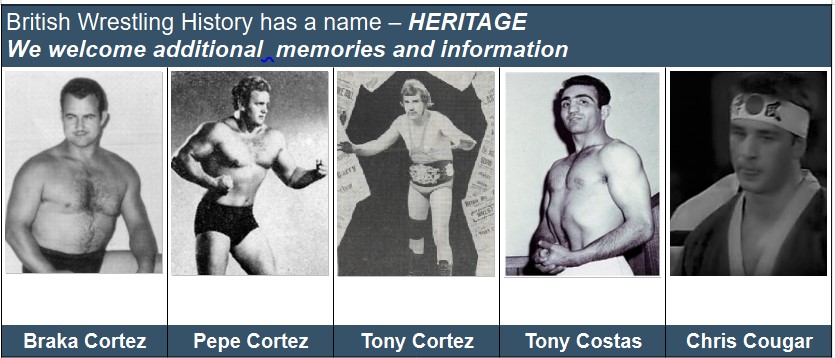
Braka Cortez
Billed as Brazilian, maybe he was born there, Braka Cortez will be forever linked with the Australian wrestling scene of the 1960s, particularly with the WCW. Whilst he did dutifully go down to the visiting international stars Braka Cortez was a versatile, hard working wrestler worthy of respect. A consumate professional we are told that Braka was willing to do whatever was required. A good guy one week, a villain the next Braka was willing to fill the role required to make a show a success. One man who gained his respect was wrestler Big John Marshall, a man who was often in the oppositie corner. Big John told us that he enjoyed working with Braka more than about enyone else.
Braka lived in Bonnyrigg, a suburb twenty-three miles west of the centre of Sydney, New South Wales. We discovered him wrestling in 1958, his debut year, working in Sydney clubs for promoter George Gardiner.
A muscular, powerful heavyweight he came to Britain the following year, a four week tour November, 1959. Top class opponents included Norman Walsh, Ray Apollon, Johnny DaSilva and Alan Garfield. At the Royal Albert Hall he had the dubious privilege of being matched with Mike Marino, dutifully going down to the popular Brit.
Heritage member Graeme Cameron has told us Braka inadvertently found himself in a position of power in late 1969 when a group of twelve wrestlers, including himself, broke away from Hal Morgan to form their own promotion after being refused a pay rise. He was appointed matchmaker, referee and liaison to WCW promoter Jim Barnett, handling the arrangements for supplying talent to the larger promotion, mainly because he got along with everyone.
Braka Cortez moved to Brisbane in the early 1970s and turned to refereeing. By the mid 1970′ he was a full time referee for WCW. (the independent promotion only lasted two years) . Braka Cortex died in Brisbane in 2014 from Alzheimer’s Disease.
Pepe Cortez
Standing 6’4” tall and weighing over twenty stones Spanish heavyweight Pepe Cortez visited the UK in the fifties and sixties, before going on to further success in the USA, where he was known as Hercules Romero, Hercules Cortez and a variety of other names.
He was born on 7th July, 1932 named Alfonso Carlos Chicharro. He arrived in Britain in 1957, staying about a month and losing to Bill Verna at the Royal Albert Hall. He returned for another short visit in November, 1963, this time working mainly in northern England and Scotland.Greatest success came in the United States where he settled on the name as Hercules Cortez.
Pepe Cortez, as he was always known in the UK, was tragically killed in a car crash on the return from a wrestling show on 24th July, 1971, aged 39.
Tony Cortez
We feel we should know much more about this lightweight who came on the scene around 1965. We didn’t see him in action but he certainly looked the part and independent promoters crowned European lightweight champion. Worked mostly around the east of England. We last saw him advertised in 1974 until one isolated billing against Ricky Scarlo at Hertford in January, 1990. Please get in touch if you can fill the many gaps.
Tony Costas
A skilful wrestler who was part of the regular 1960s to 1980s roster of Dale Martin wrestlers. To note he was not a main event performer is not disrespectful because there was so much talent around at the time and it was the vast majority who were like Tony that made the whole business work.
One of fifteen siblings Tony Costas came to the UK in 1961 as an engineering student, and turned professional wrestler only a year later. By then he had served a three year apprenticeship as an amateur in both Cypus and Britain. Mercifully for MC’s and television commentators Tony dropped the name of Antonias Haji Hannas when he turned professional. Costas would also save a lot of time when signing autographs!
A speedy, technical wrestler Tony was renowned for his drop kick and seen at his best in matches against other technicians such as Jon Cortez, Al Miquet and Leon Fortuna. On one of his return visits to Cyprus he defeated Apostolos Souclekas to win the Cypriot welterweight title.
Our last recorded contest for Tony Costas is in 1986. After retiring from the ring Tony returned to Cyprus and became owners and hosts of the Amore Hotel.
Chris Cougar
A bundle of dynamite yet a hard wrestler of the 1980s, from Douglas in the Isle of Man. Chris was an all action wrestler trained by Ted Betley, mentor of Dynamite Kid, after Ted moved to the Isle of Man. He made two television showings, losing to Richie Brooks after taking the opening fall, and then unluckily losing to Alan Kilby in a British light heavyweight championship clash at Keighley in September, 1988. Had wrestling on television continued we are sure Chris Cougar would have become a popular and well known name.
879C4
 Wrestling Heritage