
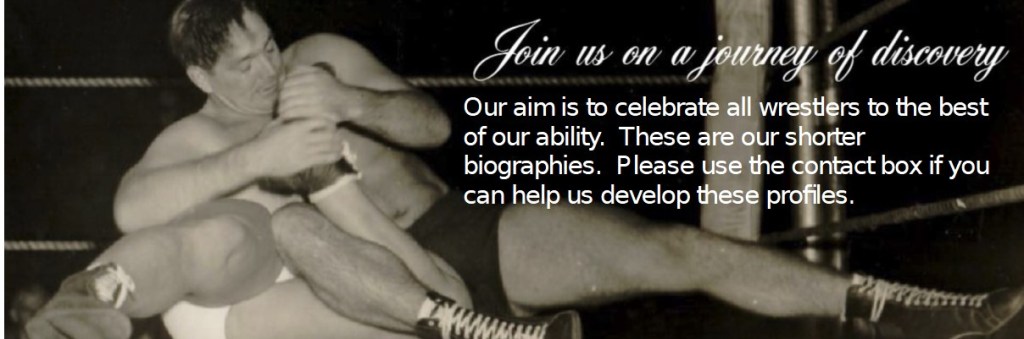
These are our shorter Biographical portraits which we would like to extend if you can provide information or memories.

Bull Dagnas
Between January 1937 and July 1939 we have found around forty matches of Bull Dagnas, opponents including Jack Dale, Rex Maxine and Harry Brooks. Bull was described as a short, heavily built wrestler with a devastating Boston Crab specialty. His other specialty was breaking the rules, earning the nickname “The Terror of the Ring.” He was consistently said to be from Chicago, which he may well have been but we have found no evidence of him in American rings.
Count Daidone (Also known as Conte Dia Donde)
The bearded Italian Count Daidone visited Britain during the winter of 1960-1961, journeying frequently between Britain and the continent, where he wrestled for much of the 1960s. Working throughout the country for Joint Promotions he met a wide range of opponents from 12 stones Johnny Kwango to heavyweights Alan Garfield and Billy Robinson. He failed in his challenge of Mike Marino in their World Mid heavyweight Championship clash held at Sheffield on 14th December, 1960. Heritage member Pantaleon Manlapig has told us that Daidone was well known throughout Europe and often competed in the Austrian and Germany tournaments in the 1960s and 1970s. Additional information was received from heritage member Indikator, who told us he was surprised to find Daidone wrestling in California in 1956 and apparently he was also in Japan for IWE as Daidone Mussolini in 1972. Other similarly themed names included Giuseppi Daidone and Mario Daidone.
Mick Dalby
A short professional boxing career led to a longer wrestling career for Loughborough’s Mick Dalby. A trainee of Jack Taylor he worked for the independent
promoters from the early 1960s until the mid 1970s, in the 1960s, billed as Midlands heavyweight champion.
Martin Campbell told us, “Mick Dalby always fascinated me. He only had two fights as a pro middleweight boxer (one tko loss and one points loss) but he did the rounds (no pun intended) for Jack Taylor, nearly always against Legs Valentine in boxer vs wrestler matches and, as I remember it, was usually a ko winner.”
We have an unconfirmed report that Mick Dalby died on 19th January, 2020. Please contact us if you can provide more information.
Johnny Dallas
A bulky 15 stone billed from Chicago Johnny Dallas worked in Britain between November 1936 and August, 1939. A wrestler capable of displeasing the fans with his rough house tactics. Occasionally nicknamed the “Golden Greek,” suggests possible Greek parents. We have found no evidence of his American credentials but there was a Johnny Dallas working in the United States immediately before and after his British bookings.
Scrubber Daly (Also known as Malcolm Hardyman, Masked Marauder, Red Mack)
Scrubber Daly was one of those less than scientific heavyweights used by promoter Max Crabtree to perpetuate the myth that his brother, Big Shirley, was invincible. Having said that if you are looking for a man who could snarl, growl and wind up the fans then Scrubber was your man. Men like Scrubber took the bumps to enhance the stars of the day, and for that reason alone played an important role in 1980s British wrestling for which us fans should be grateful. Wrestling Heritage reader Paul Evans was only a child when he watched Scrubber Daly at Weymouth while on holiday and Cheltenham Town Hall, but told us “So to me Scrubber was a real hero. He scared the life out of me the few times I met him in the flesh!” In the flesh Scrubber Daly was Malcolm Hardiman, a milkman from Nuneaton. That might not sound quite so glamorous but didn’t stop Scrubber wrestling in the Middle East and India. Trained by Birmingham’s Pat Roach he was initially known as Red Mac, but within a matter of weeks given the name Scrubber Daly by Max Crabtree, often remembered as tag partner of Giant Haystacks, and later pulled on a hood to become one half of the Masked Marauders tag team.
Pete Danby
Warrington middleweight from the Ted Betley stable with a short lived career in the second half of the 1960s.
Tommy Dance
Never let it be said that Heritage fails to reach parts that other sites don’t reach. Tommy Dance was certainly a name we hadn’t come across but Heritage members changed that. A bit of research and we found our earliest reference to Tommy Dance, wrestler from Barnsley, in the Morecambe Guardian of 23rd February, 1924, when it was reported the “British Lion” had defeated Tommy Dance. This was six years before the introduction of professional all-in wrestling. An even earlier reference, in December, 1916, was found to Tommy Dance of Hindley, but we don’t know if this was the same man.
In the 1930s we find half a dozen newspaper reports of Tommy Dance of Barnsley (or Doncaster) wrestling the All-In style. In the first Tommy was beaten by Harold Angus at Doncaster in March, 1931, though the newspaper report does refer to a win by Dance in an earlier match. Interestingly three months earlier Tommy had been the referee when professional wrestling had returned to Doncaster following a twenty year break, on 15th December, 1930.
In June, 1931, we found him at Leeds as “Featherweight Champion of Great Britain.” and in a handful of matches up to 1933.
It was Ray Hulm that first raised the subject of Tommy Dance. Ray wrote:
“About the same time that I started attending wrestling shows (1957) I spent some of my hard earned cash enrolling with the Woodward School of Physical Culture. This was one of the many postal training courses available at the time and specialised in teaching all kinds of training including wrestling, hand balancing, strand pulling and much more. They also published a lovely little magazine called SKILL that carried articles on an eclectic range of subjects including professional wrestling and the circus. The school was run by ex wrestler Tom Woodward and his son, Ken and operated out of Blackpool.”
Eddie Rose added more information:
“I worked for the Woodwards and eventually took over their business – “The Northern Institute of Massage, then at Blackpool but transferred to Bury in 2000. Ken showed me a bill once “Tommy Dance versus The British Bulldog” -Tom being his dad. He was a contemporary of Charlie Glover, perhaps the first Red Devil! He wrestled mainly in the period 1920 – 1940s. As well as aspects of physical culture they focused on Massage & Sports Therapy.
Carl Dane (Also known as The Outlaw)
Yorkshire born and Manchester domiciled Carl Dane is just the sort of wrestler that we cherish here at Wrestling Heritage. Whilst other websites are content with the likes of McManus, Pallo and Nagasaki we celebrate the unsung stars of wrestling, the lesser known names who allowed the stars to shine. Carl Dane fits into that unsung hero category, one of the essential deep seam of British wrestling talent. Following his national service an interest in boxing led to Carl meeting up with Charlie Glover who had a boxing and wrestling gymnasium in Barnsley. Charlie, who wrestled as the Red Devil, encouraged Carl and trained him for a career in wrestling, with a helping hand from other Glover boys such as Jack Land and Dwight J Ingleburgh.
Son Peter Bradbury told us, “My Dad took his name Carl Dane from the guy who hit the gong at the start of the films.”
By the late 1950s Carl was mixing it with some of the hardest wrestlers in the business, men like Jimmy Hart, John Foley and Billy Joyce. In April, 1968, a match with Ian Campbell at Belle Vue ended with a “No Contest” decision and was talked about for a long time afterwards. Carl was a popular heavyweight of the 1950s and 1960s, working mostly for Wryton promotions in the North and Midlands. When he retired from the ring he turned his hand to refereeing at which he was equally successful. “A good heavyweight and first class referee,” recalled ex wrestler Eddie Rose. Carl wasn’t quite so popular when he pulled on a black mask and wrestled as The Outlaw. Not the original admittedly, but rated highly by all who saw him, and we did! He is also remembered, particularly by fellow wrestlers, as mine host at the Robin Hood public house, close to Manchester city centre, as this was a place they often ended up following a bout at one of the many Manchester venues. Carl Dane died in April, 2008.
Marius Daniels
Belgian heavyweight visited Britain in 1962, opponents including Billy Robinson, Alf Cadman and Matthias Rosges . Lost to Gerhardt DeJager at the Royal Albert Hall in October 1962.

Dan Darby
Londoner who competed in the 1951 Empire middleweight championship tournament at Wimbledon and challenged for the British light heavyweight championship.
Dave Daring
1970s and 1980s heavyweight trained by Brian Trevors who could often be found masquerading hooded as The Mummy or long suffering opponent of Big Daddy in partnership with Colin Craig. Dave worked for both the independent and Joint Promotions.
Johnny Dark
In the early sixties Wimbledon’s Johnny Dark seemed to have a promising career ahead of him, having made the transition from a wrestling second at Wimbledon Palais to wrestler. After five years as an amateur he was twenty years old when he turned professional in 1959. Most of his contests were in the south for Dale Martin Promotions against the likes of Bobby Barnes, Ray Fury and Steve Logan. Johnny remained a firm favourite around the south for the best part of a decade. He even made it onto television, unenviably having Steve Logan in the opposite corner. Our memories of Johnny Dark are limited. We do know that we saw him, and we liked him.
Tarzan Boy Darren
When Leeds heavyweight Darren Ward adopted the name Tarzan Boy Darren it was with good justification. Boy, this boy had muscles. Darren was a Yorkshire amateur champion before turning professional in 1985, making his debut against Crazy Dave Adams.Darren was a busy worker in the 1980s and 1990s with a career that ended in the mid 2,000s due to a serious back injury. In addition to his success as a wrestler Darren was also a successful promoter at a time when business was hard for anyone involved in professional wrestling. Darren’s contribution to wrestling has continued as a founder organiser, along with Steve Fury, of the Leeds Wrestlers Reunion.
John Datus
We have included John (sometimes Johan) Datus not because we can offer much information but because we have found quite a few matches for him between 1957 and 1964. He was billed from Nottingham as a welterweight or middleweight. All matches were for the independent promoters, throughout he country but mostly in the midlands. Roy La Rue was a frequent opponent; we suspect a connection with promoter Jack Taylor.
Killer Ken Davies (Tredegar)
In the 1960s and 1970s a bald headed, mean looking welterweight more than slightly annoyed fans in the midlands and Wales. He was Killer Ken Davies, and apart from the name there was little similarity with the heavyweight of the same name. This Killer Ken, billed from Tredegar, was a long time Welsh welterweight champion and a 1962 win over Cheshire’s Ken Else grabbed for him the independent promoters British welterweight crown. He was introduced to wrestling whilst working down the coal mines where he met another Welsh wrestler, John Paul. Turning professional in 1959 it was the beginning of a successful career in which he gained the respect of colleagues and is still spoken of as a hard man to beat. Al Tarzo worked with Ken, “Ken was a guy that could get the crowd wound up in a big way, I remember a show at Tamworth when he had the crowd crying for his blood. When he came back to the dressing room his back was covered with his own blood. A woman in the front row got to the ringside and attacked him with her shoe. He had holes in his back from her stiletto heels to prove it.” It is one of wrestling’s mysteries why Killer Ken worked only for the opposition promoters and was never attracted to Joint Promotions. Maybe someone out there can tell us.
Ron Davis
The muscular young middleweight from Rotherham started out around 1959 and was around the rings quite a bit until the late sixties. Opponents included Leon Fortuna, Linde Caulder, Jon Cortez, Jim Breaks and both of the St Clair boys.
Alf “Man Mountain” Dean
Alf “Man Mountain” Dean is something of a mystery. One of those wrestling conundrums that we haven’t even started to unravel. We first became aware of him when we read a 1961 Sunday newspaper expose of professional wrestling where Man Mountain Dean revealed all. But this wasn’t Frank Simmons Leavitt, the famous American Man Mountain, who had died in 1953 anyway. This was Alf Dean, who claimed to have been an All-In wrestler. Searches for information about Alf Dean discovered that he was a small part actor. With only a handful of findings our Man Mountain, and even those were not definitely Alf, we would have concluded that any involvement in pro wrestling was extremely limited. Maybe it was, but we were surprised to find that Alfred James Dean listed his occupation as Professional wrestler and wire worker in the 1939 census. His date of birth was given as 20th April, 1915. His given address at the time was listed as H M Prison, Wandsworth, London, which may have accounted for his limited wrestling appearances.
Danny Dean
We have scant information about this Irish heritage welterweight with a judo background who, between 1954 and 1956, faced opponents including the experienced Arthur Fisher and Bob Archer O’Brien as well as new kids on the block like Jackie Pallo and Peter Rann. We would welcome more information from anyone in the know.
Desmond Dean
We have a run of matches for heavyweight Desmond Dean, who was said to be from South Africa, between April 1947 and February, 1948. Opponents included Jack Pye, Hassan Ali Bey, Dave Armstrong and Vic Hessle. We would welcome more information.
Mike “Man Mountain” Dean
Bearded heavyweight villain from Garforth weighed in around the twenty stones mark. He was one of a number of 1980s super sized heavyweights caught up in the Big Daddy parade of fall guys. We own up to not having seen him first hand and may be doing him an injustice. We would welcome further information.
Brother Death
Yes, there was an attempt to extract a bit more cash out of the Dr Death success. For those with a half-full outlook the creation of Brother Death was a touch of creative genius. From a half-empty perspective it’s a sign of just how low a promoter could stoop. Brother Death was a short lived invention of promoter Jack Taylor to fill the void left by Dr Death.
Page reviewed 28/04/2023
968
 Wrestling Heritage