
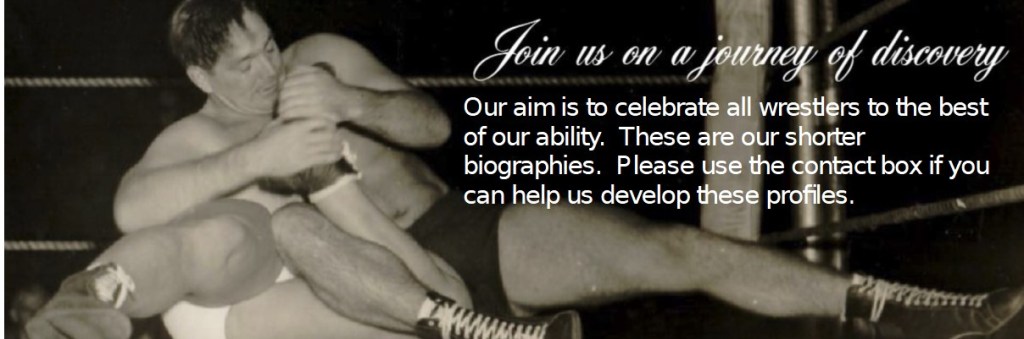
These are our shorter Biographical portraits which we would like to extend if you can provide information or memories.

Don Eagle
Made a couple of television appearances in the autumn of 1986, one in which he tagged with Johnny Wilson, and the second facing Birmingham’s Steve Logan. Not to be confused with the original and highly acclaimed Don Eagle, who died in 1966.
Mir Zaffer Ealam
Pakistani Welterweight who made the first of three televised appearances against Jim Breaks in 1963, the following year versus Bob Archer O’Brien and in 1966 knocked out Tony Borg when the Maltese wrestler made his 1966 televised debut.
Vince Earnshaw
Vince Earnshaw was the brother of Huddersfield rugby player Terry Earnshaw. He embarked on a short wrestling career early in 1952. In December, 1951 we have reports of an amateur competition with Vince listed as Yorkshire champion. The following May 1952 we find him wrestling professionally against Arthur Jackson in Middlesbrough. Opponents included Jack Atherton Vic Stewart and Dave Valentine, with our last sighting in 1953.
Flash Lee Edwards
Lee Edwards had the ability to upset the fans before he entered the ring. Long before, in fact, as his entrance was often interrupted by frequent stops to sneer at the audience and give them that familiar Lee Edwards “look.” It was a look of arrogance and conceit for those around him as he swaggered towards the ring. Once he eventually made it in to the ring Edwards would slowly removed his satin robe. As the ring lights caught the sequins of his robe and the wavy blond hair fans would have no thoughts of later more famous sequined blonds because Lee Edwards pre-dated flamboyant blonds by quite a few years. As was to be expected by his entrance Edwards wrestling style paid little attention to the rules; he was a tempestuous brawler who appeared in a hurry to end his bouts as quickly as possible. A regular in British rings from the mid 1950s onwards Edwards was at his most prominent when he became a regular on the Paul Lincoln independent shows of the early 1960s.
Vince Edwards
A stocky blond haired 18 stone heavyweight from Manchester who was a bill topper for the independent promoters in the 1960s, opponents included Dominic Pye, Jim Foy and Wild Angus Campbell. Our earliest documented record is from September, 1960, when Vince wrestled Earl Maynard in the main event at Chester. His career lasted from the late 1950s until the late 1970s, but he remained relatively unknown in Britain as much of his work was overseas, working at times with the Bholu brothers.
The Eel
Low key masked wrestler with a short run of appearances in Derbyshire in 1938 against little known opponents.
Joe Egan
We have around a dozen recorded appearances in the midlands and northern England for in 1952 and 1953, opponents including Alan Colbeck, Jim Mellor and Bernard Murray. In 1952 he was said to be Britain’s youngestprofessional wrestler and described as “The Adonis of the ring.”
Wolfgang Ehrl
German Wolfgang Ehrl was a scientific wrestler who visited Britain in the mid 1950s defeating George Kidd amongst others, and often matched with far heavier opponents including the likes of Ernie Riley and Les Kellett. Ehrl’s credentials were outstanding, being a silver medallist in the 1932 and 1936 Olympic Games and European champion in 1934. Born in Munich on 4th March, 1912, Wolfgang Ehrl died on 11th June, 1980.
Jim Elder
Dundee’s Scottish Lightweight Champion seemed a very promising prospect in the early 1960s; we have found his earliest appearances in 1959. A skilful wrestler he rarely travelled far south of the border. He entered wrestling following completion of his national service and trained in Dundee alongside other Scottish professional such as George Kidd, Ted Hannon and Chic Purvey. Jim’s professional career was shortened by other interests, and the world of wrestling prematurely lost another potential star. On television he defeated Eric Cutler and drew with Steve Best. We have been told that Jim emigrated to the United States in the 1970s, last seen on the posters in 1976.
Count Eley
Teenage welterweight of the late 1950s, said to have a judo background, billed from Italy, and likened to a young Eddie Capelli. Reality wasn’t quite as exotic as the young Count was actually named Brian from Heanor in Derbyshire and another protege of Jack Taylor.

John Elijah (Also known as John Elisha)
One Biblical name wasn’t enough for the 17 stone Bearman from Walthamstow, who was known as both John Elijah and John Elisha. Big John turned professional in 1970, beating Bob Kirkwood at Folkestone, following an amateur career at the Sparta Wrestling Club, Shoreditch.
He shared wrestling with a job in the carpet trade, which he moved on to after working in the advertising business, and one forum wag famously commented that he looked like he had a roll of lino under each arm as he approached the ring.
His style, relying on power holds, failed to excite fans, but he certainly had a niche as one of those valuable supporting wrestlers who were the foundation of the business. During a long and busy career he earned respect from promoters as a reliable and dependable wrestler, and genuine affection from fans around the country.
Career highlights were challenging Bruno Elrington in Bognor Regis for the southern Area championship and wrestling Big Daddy in a clean almost technical bout on television. That year he wrestled Big Daddy many, many times. One amusing story recalled by fans is that of John assuming the role of the masked Dr Death. On entering the hall the way he walked made the identity of the masked man obvious and he was greeted with calls of “Hello John.”
Chick Elliott (Rotherham)
Salfordian Chick Elliott can be found under The Black Mask listing, but we have a second Chick Elliott for you.
Our second Chick Elliott was a Yorkshire lad, billed from Ilkeston but billed from Rotherham (maybe promoters thought it sounded grander). He was trained by wrestler/promoter Jack Taylor in his Derbyshire gym in the mid 1950s alongside Al Tarzo, Roy LaRue and Spike O’Reilly. We have seen him billed as Chick Elliott Junior, but are unaware of any relationship with the Salford heavyweight.
Chick dressed to impress. An impressive quiff and elaborate silk dressing gown gained him the nickname “The Liberace of Wrestling.”
A recurring back injury forced Chick into retirement from wrestling after only around eight years in the business. We have been told he got married and took up pub management in Leicester. One of the first things he did was to go out and buy a pair of Boxing gloves to hang behind the bar
Morgan Ellis
Morgan Ellis was one of wrestling’s forgotten men until he was re-discovered by Heritage member Gernot Freiberger. Gernot found reference to a wrestler said to be from Scotland, named Bill (sometimes Bob) Ellis in the 1960 Heumarkt tournament in Vienna. Only one match was recorded and that was a loss to Hungarian Josef Kovacs.
We didscovered that Bill Ellis had made a fleeting encounter with wrestling in Britain, using the name Morgan Ellis, and not to be confused with the much lighter Ellis Morgan. Josef Kovacs in Vienna must have been a highlight of a short lived wrestling career.
Bill Ellis was a former professional boxer, born in Wales, who took up boxing while in the army. One report we read of forty pro boxing bouts seems an exaggeration and boxing records showed no more than seven contests. When Bill Ellis turned to wrestling he cashed in witha few boxer v wrestler matches against Don Stedman and then a few conventional matches before getting a proper job. That proper job was in youth work, at the Stamford House Remand Home in Shepherd’s Bush aand then running the First Feathers Youth Club in Ladbroke Grove, Notting Hill, London.
Emerald Phantom
We have just a handful of Emerald Phantom matches, working for independent promoter Jack Taylor in 1957 and 1958 for this masked man, so we are not talking of a career masked man. Catching our attention was that one of his opponents was Bobby Palmer, who went on to become a very successful referee and MC for Dale Martin Promotions. Heritage member Main Mask added: “Not many masked wrestlers in the lower weights were around in the 1950’s! But for some months in 1958 a masked Middleweight Clad from top to toe all in green suddenly appeared in our rings-Emerald Phantom! If you were a ‘purist’ wrestling follower then this mystery man’s skilful scientific style was right up your street! In order to perpetuate the run of this type of masked man-the promoters decided to stipulate that hooded wrestlers like this Phantom would only have to unmask if they were beaten by two straight falls!”
The Emperor (1950s)
Most memories of a masked Emperor go back no further than Big Bill Bromley donning the mask in the 1980s. A quarter of a century earlier, in 1959, a young promoter called Paul Lincoln presented a masked Emperor, reputed to weigh 20 stones (but Lincoln did tend to have a way with statistics). In true Lincoln codology the man behind the mask was said to be a successful business executive needing to hide his identity. Whatever his success elsewhere it was not to replicated in the wrestling ring and the late 1950s masked Emperor failed to make an impression. The Emperor returned in the 1980s; see the entry for Bill Bromley.
Bobby England
Kent’s Bobby England could be seen flying around the rings of southern independent shows in the 1970s. Like many others Tunbridge Wells born Bobby turned to wrestling after watching the sport at his local hall and then joining a gymnasium, the Teen and Twenty Club, to lift weights. At the club he met up with a group of wrestlers and accepted their invitation to join them and learn the rudiments of professional wrestling. From the gymnasium he graduated to working the fairground booths, and became one of the regulars taking on challengers for Mickey Kylie in the West Country. His professional debut came along in August 1968, a home town promotion in Tunbridge Wells facing the colourful sounding Sabu Perera. Bobby continued wrestling after moving to Brighton but work commitments restricted his appearances and led to his retirement in the late 1970s.
Tarzan John England
Long before “Mr Muscles” posed for the fans there was an earlier Johnny England in British rings, Tarzan England. That was the wrestling name of John Mountford, born in Blackpool in 1928. His reign was brief, 1950 and 1951, retiring from wrestling, and returning to Blackpool, following the death of his father. Matches were mainly in the north of England and Scotland, with opponents including Ron Jackson, Jim Hussey, Norman Walsh, Bill Verna and Ken Davies.
Johnny “Mr Muscles” England
A shooting star with high impact but vanishing as quickly as he appeared. Johnny England created a minor sensation when he first appeared on television. His arrogant nature, tendency to sneer at the fans and predisposition to punctuate bouts with displays of his physique antagonised those who had paid their hard earned cash. And they loved every minute of it. Those who knew him testified to what a nice man he was, but his wrestling personae of the mouthy big head was one he carried off to perfection. Fans did admire his wrestling skill, and an ability to outwit far more experienced opponents. His prominence seemed short lived, but he did continue in the wrestling business long after leaving Joint Promotions.
Guillaume Estelles
The alleged Heavyweight Champ of Switzerland (sometimes France) weighed 17 stones and first appeared in British rings from 1934 to 1937. He worked as an engineer in London and met the biggest names of the time, including Jack Sherry, Karl Pojello, Mitchell Gill and Bill Garnon, with mixed results. One report tells of Estelles succumbing to a fall in the first round of a one fall match against Cordite Conroy. Protests from the crowd were so great that the match was allowed to continue as a three fall contest with Estelles coming out the winner.
Bryn Evans
The young welterweight started out with Paul Lincoln promotions in his native south Wales in 1960. With a bit more experience he began appearing throughout the country and was working for other independent promoters by the mid sixties. We wonder what happened to him, possibly a change of name?
Glyn Evans
We would like to learn more about this wrestler from South Wales who turned professional in the late 1930s and wrestled until 1950, seemingly every week at Blackpool. Posters proclaimed him as a former international rugby player and one of the best heavyweights from Wales.
Sam Evans
It’s not unknown for a sportsman to turn to wrestling as a second career. That was the case for the burly 1960s heavyweight Sam Evans. Sam was known to rugby followers as a player for Hull Kingston Rovers and Wakefield Trinity before turning to wrestling in 1962. His background also included a six year stint in the Household cavalry, which led to him standing guard at Buckingham Palace and performing duties at the state opening of Parliament and trooping the colour. Tall, muscular, and broad shouldered the bearded heavyweight Sam Evans appeared, and indeed was, something of a giant as he leaned over the top rope to interact with the ringside fans. That interaction normally consisted of mutual abuse as Sam’s style was not one that appealed to the purist! The initial interest aroused by his fame as a professional rugby player was sustained when he showed that he had the natural ability to succeed in the rough and tumble world of professional wrestling. His professional debut, in 1963 against Bob McDonald, led to a disqualification defeat, which must be quite a distinction for a first outing. At Belle Vue, Manchester, Sam even managed to get himself disqualified against the villainous Italian, Pietro Capello, in itself quite an achievement! Within a short time Sam was appearing regularly in northern rings against top men such as Les Kellett, Albert Wall and Dave Armstrong. In the mid 1960s Sam fell from the limelight, working for the independent promoters, until re-emerging onto the Joint Promotions circuit in 1970.
The Executioner
The Executioner has been a frequent name for masked men from the 1950s onwards, with the name most often associated with Birmingham wrestler Gordon Corbett in the 1970s.
Page reviewed 30/04/2023
1014
.
 Wrestling Heritage