
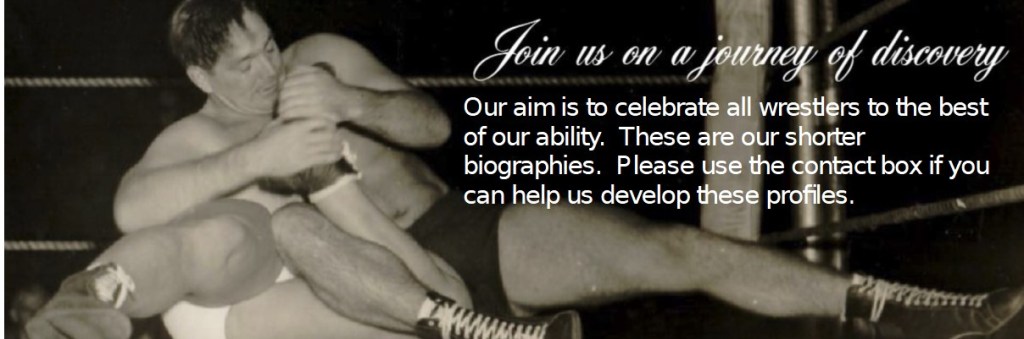
These are our shorter biographical portraits which we would like to extend if you can provide information or memories.

Pat Flanagan
“The Fighting Irishman” Pat Flanagan, real name Winnett Wallingford Watson. He was a Canadian, from Toronto, who was encouraged to come Britain in 1936 by his friend and mentor Whipper Billy Watson. Watson was already working in Britain at the time, along with fellow Canadians Al Korman, Tommy Nelson and Ken Tasker. Flanagan wrestled in the UK from 1936 until 1938, returning home as the shadows of war gathered. He pursued a long and successful career in North America that extended into the 1960s, and his final contest in 1968. Pat Flanagan died in 1985.
Joe Fletcher
Joe Fletcher, was a very strong heavyweight who wrestled quality opponents such as Stan Roberts, Dick Wills, Jack Atherton and Mike Delaney. George Jackson was the name with which Joe was born and our earliest record of Joe in action was in 1932, losing at Belle Vue, Manchester, to Sam Rabin. Rabin, one of the greatest wrestlers of the 1930s seems to have been one of the most prolific of Joe’s opponents, and this itself tells us that Joe was a more than capable wrestler. By the end of 1932 Joe was billed as Lancashire heavyweight champion, though without a Governing Body such a claim could not be universally recognised. Joe served in the Royal Air Force during the war, but did manage to keep his career going when leave from the forces permitted. Following the war he resumed his wrestling career and continued until 1950, with post war opponents including Billy Joyce, Vic Hessle, Bill Garnon and Alf Cadman.
Legs Fletcher
It was a localised short lived career for welterweight Harold Fletcher, the coal miner from Nottinghamshire who was from the Jack Taylor camp, though Taylor did grace him with the Midlands Area welterweight championship. Harold was born in Bulwell, Nottinghamshire in 1937. We have a handful of matches, all in Heanor, from 1955 to 1957. The local newspaper reported that work commitments are limiting his training and wrestling opportunities. In 1957 harold announced that he was giving up wrestling to concentrate on body building.
Lucien Fleurot
Swiss heavyweight Lucien Fleurot made a six week visit to Britain in December and January of 1954-5. He worked for Joint Promotions and opponents included Jack Pye, Mike Marino, Pat Curry and Tony Mancelli.
Flower Child
Everything would be alright if Flower Child caused any damage to his opponent. That’s because he was a practising doctor at Northwick Park Hospital, Wembley . Truth is we have only found two matches, one at at St Bartholomew’s Hospital. in 1976 and the other at Liverpool Stadium. We can confidently say he was a better doctor than wrestler. Flower Child’s ring attire consisted of a kaftan and flower coloured tights. A villain in the ring (hopefully better behaved in the hospital) he would blow kisses to the audience who would reciprocate with insults and jeering.
Patrick Flyer
Patrick Flyer was a colourful lightweight who was involved in an entertaining televised match against Pete Lapaque in 1986. He was Patrick Ncube Paraze from Harare in Zimbabwe. Patrick died in Harare in 2002, aged 50.Patrick Flyer was a colourful lightweight who was involved in an entertaining televised match against Pete Lapaque in 1986. He was Patrick Ncube Paraze from Harare in Zimbabwe. Patrick died in Harare in 2002, aged 50.
Billy Fogg
Mid heavyweight Billy Fogg, the one time baker from Warrington, started wrestling during the Second World War and we came across him for the first time in 1941 using the name Young Apollo. The following year we came across a knock out win over Wigan’s Ernie Riley. Shortly afterwards Billy went into retirement until 1959 when a newspaper announced he was returning to the ring with a match against Jim Foy, which he won. He continued to work for the independent promoters until he was signed up by Joint Promotions in 1961. Within a short time he was a regular fixture on the northern circuit clashing with the likes of Jack Pye, Francis St Clair Gregory, Mike Marino and Billy Howes. Nationwide exposure came in December, 1961, with a television defeat at the hands of Jack Beaumont at Bolton. The following year he disappeared from our rings.

John Foley (Also known as The Katt)
Trained at Billy Riley’s Wigan gymnasium John Foley was one of the hardest and most skilful 1950s and 1960s middleweights. He came into wrestling after working as a coal miner, making his professional debut against Tommy Milo. Well regarded as a one of the country’s top middleweights, journalist Charles Mascall said John was one of the world’s best middleweights of all time. His greatest notoriety came in the 1960s as a member of the Black Diamonds tag team, partnering Abe Ginsberg. Distinguished with black leather helmets, which Kent Walton was forever telling us he was inundated with letters saying these should be illegal and removed, the two villains had memorable clashes against the Stewarts, The White Eagles and the Royal Brothers.
For a short time John Foley also wrestled in northern England and Scotland as the masked wrestler, The Katt, with the real mystery being why a wrestler of his calibre chose to have his identity concealed. Well travelled throughout most of Western Europe later in his career he travelled to Canada and Japan, achieving further success. John’s son in law was Ted Heath, and when the two of them wrestled as a tag team in the USA in 1975/6 they called themselves “The British Bulldogs,” and carried a large stuffed bulldog (called Winston) into the ring, pre-dating another higher profile British Bulldogs team by quite a few years.
Al Fontayne
A light heavyweight, known as the “Jewish whirlwind,” whose rugged style was never going to make him a fan’s favourite. Bethnal Green’s Al Fontayne gained his early experience in the rings of Paul Lincoln and the independent promoters.
Trained by veteran Al Lipman, Fontayne turned professional in 1958, following a stint in the RAF and boxing as an amateur. Al worked extensively in southern England, Austria and Germany before being signed up by Joint Promotions in the mid 1960s.
Those early Continental bouts included matches against far more experience wrestlers such as Rene Lasartesse, Leif Rasmussen, Felix Gregor and George Blemenshultz.
He was equally at home in rings against the smaller acrobatic antics of Johnny Kwango or the rugged heavyweight slugger Johnny Yearsley. Frequent encounters were made with Bob Kirkwood in the early days and later for Dale Martin Promotions. His 1966 ko by Ricky Starr in Leeds was the talk of the town for years afterwards.
He was a regular mid carder in Joint Promotion rings before disappearing from our rings around the middle of 1969.
Tony Ford
Our only knowledge of this Bradford heavyweight is a television match against Ezzard Hart at Bermondsey Baths on 15th January, 1966. Possibly an early name for Tony Orford, son of Sandy Orford.
Roy Fortuna
Manchester was a hotbed of young wrestling talent in the late 1960s. Whilst Al Marquette, Johnny Saint, Pete Lindbergh, Bob Francini and Eddie Rose had already begun to make their mark a younger generation was snapping at their heels. Amongst these was a schoolboy, or at least very recent schoolboy, going by the name Roy Fortuna. The older guard listed above each had a hand in helping the youngster develop from the time we first took an interest in his career which was in 1969. We watched him grow in confidence and skill for the following seven or eight years but then Roy Fortuna disappeared from our horizon as quickly as he had arrived. Eddie Rose enlightens us that Roy went on to become a major figure in the trade union movement.
Eddie Fox
A popular wrestler for the independent promoters in the 1960s and 1970s Middlesbrough’s Eddie Fox was well known in the North East during the 1960s, working regularly for Don Robinson, Cyril Knowles, and Allen & Taylor. Eddie learned to wrestle at the St Lukes Wrestling Club in Middlesbrough which also introduced Ian Gilmour, Tony Elsdon, Ray Leslie and Les Prest to the world of professional wrestling. He died on December 26th, 2008.
Page reviewed 15/05/2023
1044
 Wrestling Heritage