
These are our shorter biographical portraits which we would like to extend if you can provide information or memories.
Len Franklin
Standing six feet tall and weighing around 14 stones Len Franklin was known as the Elstree Adonis and was part of the All-In wrestling scene from the outset. We first come across Len on 9th February, 1931 when he wrestled Yugoslav George Modrich at Belle Vue, Manchester, in a wrestling bout on a boxing show.
From a seemingly lacklustre start to his professional career in 1931 Len began to sparkle the following year with impressive wins over Sam Rabin, Jack Pye, Barney O’Brien, Stan Roberts and George Gregory. Atholl Oakeley listed him an equal to Bert Assirati, Douglas Clark and Barney O’Brien.
He was certainly good enough to challenge Atholl Oakeley for the British heavyweight championship, having won through a series of eliminating contests. He was deemed unfortunate to have lost to Oakeley after sustaining a knee injury in the third round of their contest at the New Victoria Halls, Nottingham, on 29th August 1932. A return contest, on 25th September, 1932, again resulted in a victory for Oakeley, but Len reportedly “gave the champion one of his hardest fights of the year.”
Although Len’s scientific knowledge of wrestling was surpassed by few, if any, as shown in matches against Sam Rabin and Jim Wango, we wouldn’t rate him alongside those greats because his record was far more patchy and his career short; we have no records beyond April, 1935.
Tony Fraser
Huddersfield based Scots wrestler from Motherwell billed as Bantamweight Champion of Scotland in 1936. Moved up to lightweight and claimed the Scottish lightweight championship. Had some cracking matches against former Olympian Joe Reid. We have found active years 1935 to 1938.
Glen Frazer
Stockton’s Brian Eeles was born in June, 1930, one of the multitude of Teesiders who worked for independent promoters in the 1970s. A giant of a man, standing well over six feet tall and tipping the scales at 19 stones he used the ring name of Glen Frazer. Glen trained at Alex McDonald’s gymnasium, the Alexandra Wrestling Club in Cannon Street, Middlesbrough. Glen worked mostly in the North East of England alongside the likes of Les Prest, Pete Ross, and Jimmy Devlin. He died suddenly on November 15th, 2015, aged 75 years. His wife, Margaret, died eight days later.
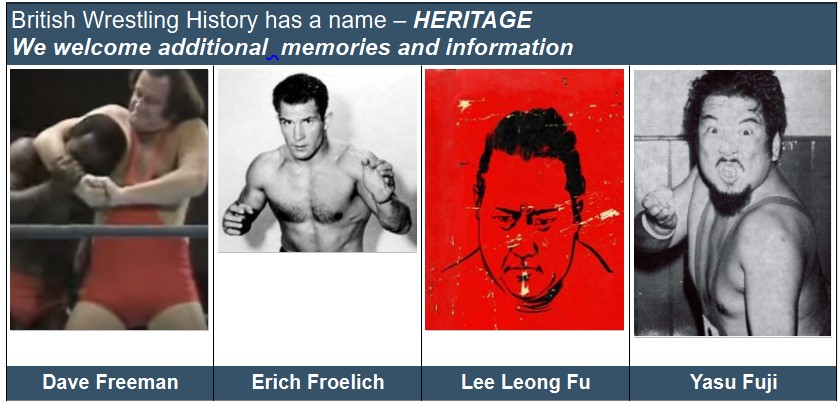
Dave Freeman
Dave Freeman trained at the Chelmsford Amateur Wrestling Club. He turned professional around 1967 and worked for Dale Martin Promotions in the 1970s. He made a couple of television appearances in 1975, losing by the odd fall to bothe Johnny Kwango and Catweazle. Dave retired in 1979 and went into pub management as licensee of the Waggon and Horses in Saffron Walden. Dave Freeman died in August, 2023.
George French
Known as “Little Hack” in his native Australia George was a 12 stone wrestler of considerable strength and skill, shown in matches with Dick Wills, Billy Riley, Rashid Anwar and Harold Angus. George visited Britain from 1936 – 7, billed as the welterweight champion of is country. Eddie Capelli said it was a contest at Blackfriars between Harold and George French that had inspired him to take up wrestling. A match against Cliff Warner was reported as the best of the evening, full of splendid locks and holds.
Heinrich Froehner
A powerful heavyweight who weighed over 16 stone German champion Heinrich Froehner wrestled fairly regularly in Britain between 1932 and 1937, twice holding the European heavyweight championship, by defeating and losing it again to Atholl Oakeley and Karl Pojello.
Froehner decisively defeated British heavyweight champion Atholl Oakeley, the Nottingham Evening Post reporting, “The German was the more accomplished wrestler, and this with his prodigious strength, was responsible for Oakeley’s first defeat in the local ring.”
In February, 1933, Pojello beat Froehner at Nottingham in the sixth round to win the European Heavyweight Championship. Froehner had taken the title from Oakeley some six weeks earlier.
Lee Leong Fu
Lee Leong Fu (family name Edward Leong Choo Liang) combined judo and wrestling skills when he flew to the UK from his home in Ipoh, Malaysia for his three month tour in 1957. He had learned Ju Jitsu whilst a teenager from Japanese officers following the invasion of Malaysia. From his knowledge of different Aikido, Judo, Ju Jitsu, Karate and Kung Fu, Leong Fu developed a system called Atado.
Although he stood only 5’2″ tall Leong Le Fu was immensely strong.
Opponents included Tony Mancelli, Bill Howes, Emil Poilve and Alf Cadman. The name with the international kudos was obviously Ernest Baldwin as this was the name on which he cashed-in when advertising his classes back home in Malaysia.
Following his British tour he travelled to Singapore where he faced the giant King Kong. In their contest at the Happy World Stadium on 2nd November, 1957, King Kong took the first fall in the second round, Lee equalised with a submission in the fifth, but then injured his hand when a chop aimed at his opponent missed and landed in the ring post. The match was declared a No Contest.
Lee retired from wrestling around 1963, following which he set up a food stall with his wife in Ipoh. He died in 1991, aged 59.
Yasu Fuji
A champion at smiling, polite bowing and the most dastardly acts of villainy. Yasu Fuji came to Britain in 1980, a genuine Japanese import brought over to help the short lived renaissance of British wrestling. He made his UK debut on 25th February with a No Contest result against young Chris Adams. He was to remain a fixture of British wrestling throughout the early eighties, eventually making the transition from Joint Promotions to the independents. Whilst his record is littered with disqualification losses against bigger and lesser names at small halls Yasu Fuji was the man for the big occasion. David Mantell reminded us that after John Quinn won the World Heavyweight title from Wayne Bridges on Cup Final Day 1980, Daddy stormed the ring to protest the decision, thus setting up the much-hyped Daddy & Bridges vs Quinn & Mr Yasu Fuji non-televised Wembley match – a rare British use of the old American Territories era tactic of using TV to have an angle to sell tickets for a non-televised Arena show. Quinn and Fuji lost by two straight falls. Although John Quinn was Fuji’s most celebrated partner he also tagged with others willing to share his art of villainy; partnering Mark Rocco to lose to Big Daddy & Steve Grey at the Royal Albert Hall
Kono Fu Manchu
He appears to be one of those stereotypical dastardly Oriental villains who would commit all sorts of skulduggery and then bow low and grin at his opponent. Annoying or what? He certainly looked the part. Shaven head, short and wide with the obligatory facial hair. Other than that we can report little of substance about this villainous heavyweight who worked Joint Promotion rings during the winter of 1964-5, mainly in the north of England and Scotland, against top class opponents that included Gordon Nelson, John Allan, John Da Silva, Bill Howes and Billy Joyce. Quite a few of those bouts seemed to end in his disqualification; evidence no doubt that our referees never did quite understand the workings of the Oriental mind.
He appears to be one of those stereotypical dastardly Oriental villains who would commit all sorts of skulduggery and then bow low and grin at his opponent. Annoying or what? He certainly looked the part. Shaven head, short and wide with the obligatory facial hair. Other than that we can report little of substance about this villainous heavyweight who worked Joint Promotion rings during the winter of 1964-5, mainly in the north of England and Scotland, against top class opponents that included Gordon Nelson, John Allan, John Da Silva, Bill Howes and Billy Joyce. Quite a few of those bouts seemed to end in his disqualification; evidence no doubt that our referees never did quite understand the workings of the Oriental mind.
Adrian Pollard recalls, “This Oriental didn’t do much wrestling and seemed hell-bent on causing mayhem and chaos in the ring; causing uproar in the crowd as he disregarded the rules and the referees. Nearly all his Bouts ended in ‘an early shower’ after his manic; often sadistic ring antics!”
Stan Furness
A rough, tough 1950s bearded heavyweight from Manchester Stan Furness hit the scales at the near 20 stones mark. Dwight J Ingleburgh remembered the time when he too grew beard and decided to shave it off. Conrad Davies, promoter at the Embassy Sportsdrome in Birmingham spotted the opportunity and arranged a “loser shaves beard” match. Disappeared from our rings around 1960.
Ray Fury
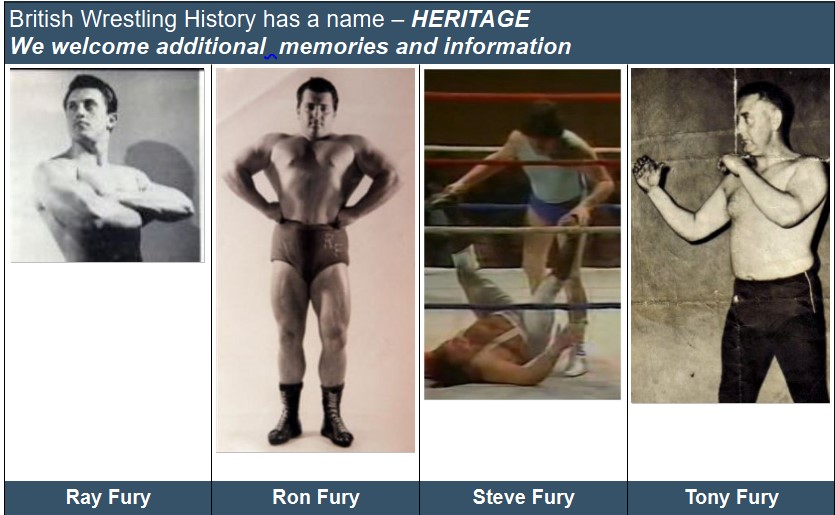
In a sport filled with hooded terrors, colourful characters, the weird and bizarre it was always the case that fans were more than willing to appreciate the wrestler who relied on ability and hard graft. Such a wrestler was Dagenham’s Ray Fury. He was neither flamboyant or dull, just a more than competent wrestler who would entertain fans by skill alone.In fact those in the know, the wrestlers themselves, testify to Ray being one of the real shoot wrestlers of the time. Born in Istanbul to British parents, and spending his childhood in Greece, Egypt and India meant that his personal life was more colourful than his professional one. Learning to wrestle at the Foresters Club and the London Central YMCA he was guided by ex wrestler Mike Demitre who encouraged him to turn professional, which he did in 1961, eleven years after entering Britain. After that first bout against Monty Swann it took just twenty-five months for him to win the Southern England Light Heavyweight Title and simultaneously established himself as a tv favourite. Fans were shocked when Ray left Joint Promotionsin January 1971. He had formed a new company with another ex Joints wrestler, Frank Rimer, and the two of them set themselves up as opposition promoters known as Independent Joint Promotions. Big names such as Joe Zaranoff, Hans Streiger, Don Stedman and The Wild Man of Borneo were soon working for the company.
Ron Fury
Australian Ron Fury was a powerful heavyweight who visited Britain in the early 1960s. Earl Black told us “Ronnie Fury was a powerlifter who started wrestling for Hal Morgan in Sydney. He was a larger than life character, always amusing.” Made one television appearance, against Steve Logan, in January 1963. Heritage member Blueboy told us: “Ron Fury [real name Ron Matthews] wrestled all the overseas stars on WCW. Lost most, but on the licence club scene he was one of the best. Ron toured the uk. He was a water side worker in his day job. Wrestled at Leichhardt, Newtown, Newcastle and in Victoria. Ron was born with his right arm/leg shorter then his left arm/leg. Sadly Ron took his own life on 21/3/98 age 66. So sad.
Steve Fury
The decision of teenager Steve Fury to leave home and move from his Lancashire home town of Leyland to the seaside resort of Blackpool proved a fortunate one for the youngster who was keen on wrestling. In Blackpool he discovered that one of his friend’s father was none other than the wrestler and promoter Bobby Barron. Steve began working for Bobby putting up the ring, setting out the chairs and all those other behind the scenes jobs. Bobby started teaching Steve a few wrestling moves until one day he was a wrestler short and asked Steve to step into the ring and begin his career as a pro wrestler. Steve admits his opponent was kind to him that day, so much so that he didn’t realise just how much he had to learn. It was John Naylor that taught him that lesson! Soon Steve was working every day of the week, often more than once on the same day, wrestling on Blackpool Pleasure Beach, holiday camps around the north and Scotland, and the halls of the independent promoters. Eventually Max Crabtree asked Steve to work for Joint Promotions, and this led to television appearances against Peter Kaye, Lucky Gordon, Steve Peacock, Rollerball Rocco, and a tag match partnering Ringo Rigby. In the years following his retirement Steve has remained involved with wrestling in various ways and is now one of the organisers of the Wrestlers Reunion Leeds.
Tony Fury
Liverpool’s Tony Fury was a busy worker for the independent promoters of the north and midlands in the 1960s. Tony is the grandfather of female wrestler, Lisa Fury.
Lisa credits her grandfather as the greatest influence on her wrestling career and has contributed these photos to the Wrestling Heritage website. Lisa told us Tony died when she was a toddler.
“My family showed me pictures of him. He looked like a hard man but my Mum says he was a gentle giant. He’s probably looking down on me when I’m fighting.”
Mike Futa
Mike Futa was just 19 years old when he visited Britain. A Canadian wrestler of Russian descent he was often billed as Ukrainian when he worked here for around a year from the spring of 1937. He weighed around 12 stones and worked mostly in supporting contests, opponents including Johnny Katsulos and Stan Stone. He set sail for his return journey home on 6th May, 1938.
Page reviewed 15/05/2023
1046
 Wrestling Heritage