
These are our shorter biographical portraits which we would like to extend if you can provide information or memories.

Giant Jumbo
Nuneaton’s Ron Townsend adopted the name Giant Jumbo and worked the independent shows, mostly in the eastern counties, from the mid 1960s until well into the 1970s. He weighed well over twenty stones with the posters proclaiming anything up to thirty. With that girth he could hardly be expected to be Britain’s most skilful heavyweight of the 1970s. He wasn’t, but he was surprisingly nimble for his size. Opponents included some well known names such as Count Bartelli, Cowboy Jack Cassidy and Vince Apollo. We would like to learn more.
Gideon Gidea
Gideon Gidea wrestled in Britain between 1954 and 1965. I didn’t see him wrestle as I only started going in 1965. He did have a very good reputation. A one month visit in 1954 was followed by annual short visits (with the exception of 1955) until January, 1965.
The Wrestler magazine told readers that he was often saddened by the sound of Hungarian music. We couldn’t believe everything we read.
Our earliest records in 1954 find him in northern England, in Manchester at Belle Vue, one of the biggest halls in the country. Opponents included Man Mountain Benny, Dominic Pye and Vic Hessle. A return in October, 1956, saw a debut at the Royal Albert Hall, with a win over Dennis Mitchell. He was back there on 19th March, 1958, this time losng to Alan Garfield. Opponents were the best on offer- Robinson, Cornelius, Verna, Nelson, Robinson and the like
Jumbo Giles
Another of Atholl Oakeley’s cavalcade of colourful characters with a career that was mercifully short lived.. Oakeley said he had met Giles in the Oxfordshire and Buckinghamshire Light Infantry, where Giles was serving as a cook. Said to weigh anything between 22 stones and 25 stones Giles seems to have made little impression on the British wrestling public around 1933 – 1934. Oakeley said Giles was averse to training and despite his nickname of “The Oxford Hercules” we can find little evidence of sporting skill, and despite his size he offered lightweight resistance against top men such as Atholl Oakeley and Dave Armstrong.
Hamid Ali Gill
We have little knowledge of this 1960s wrestler working for the independent promoters, other than he was a fast and technical middleweight who we enjoyed watching on numerous occasions.
Slim Gillan (Also known as Klondyke Jed)
Liverpudlian Robert Gillan came onto the wrestling scene around 1970, introduced mainly as a fall-guy for Big Daddy. He regularly faced the so-called people’s favourite, often as a tag partner to fellow villains Banger Walsh or Giant Haystacks. In a parallel world we also found Gillan working for independent promoters as Klondyke Jed. Born on 31st October, 1946, Robert Gillan died of lung cancer on 17th November, 1987, aged 40.
Leo Giroux
A big man even amongst the heavyweight Leo Giroux stood 6’ 5” tall and weighed around 20 stone. French-Canadian. Leo Giroux, from Ottawa, was just twenty years old when he wrestled in Britain during 1943 and 1944, presumably serving in the American forces. He returned to Britain following the Second World War in 1947 and 1948, finally departing our shores from Southampton on 25th September, 1948, bound for Halifax, Nova Scotia.
Angelo Giusto
The Italian heavyweight from Rome performed high wire and trapeze feats before turning to wrestling. It was good training as the speed and force of his dropkicks made the fans gasp. Not as much as Johnny Czeslaw, however, who Angelo knocked out in the second round at the Royal Albert Hall in October, 1964 during the brothers’ 1964-5 British tour.
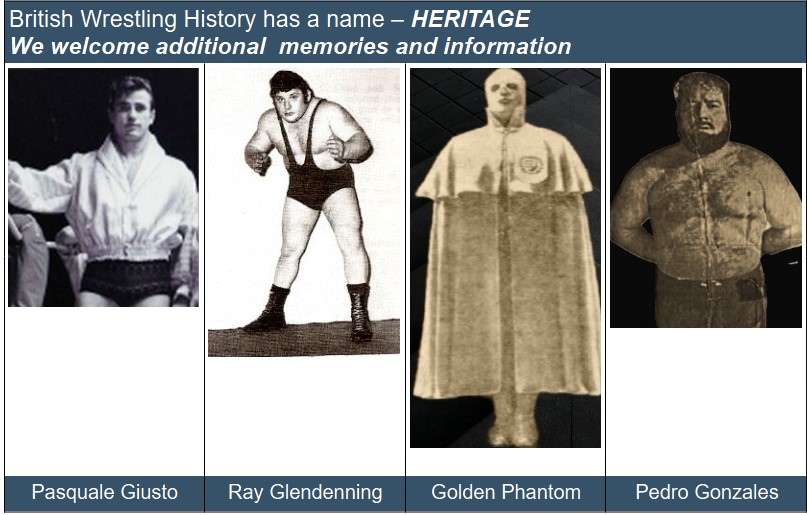
Pasquale Giusto
The younger of the high flying brothers who had been professional for just a couple of years when he came to Britain for the first time in 1964.
Ray Glendenning (Also known as Mr Hercules, Ray Thunder, Thunder Glendenning, Thunder Glenn, Stomper Thunder)
A hard grafter of a wrestler from Bury, Lancashire, this squarely built heavyweight came to national prominence after being featured in a television programme “So You Want To Be A Wrestler.” Glendenning joined the professional ranks in 1963 working for the independent promoters, alongside his day job as a plumber and glazier. It was working for the independents we first came across him one summer in Southport going by the name Mr Hercules. Working for the independents he opposed men such as Jack Beaumont, Cowboy Cassidy, Bobo Matu and Jack Martin. Eventually Ray’s potential was spotted and he was signed up by Joint Promotions. He had a blustery, no-nonsense style relying on strength and size rather than wrestling skill, not that he was short of that either. Never matching the star status of the big names of the time Glendenning was an important part of that backbone of wrestling that made the sport so rich in talent. He wrestled throughout the world where it seemed that his talent was recognised more than it was at home. During the final part of his career in the name which had gained respect and a following was oddly dropped on his return to Britain he was known by the name Ray Thunder. Ray Glendenning died on 19th October, 2007.
Golden Hawk
He was no masked man, just a case of a birth name as mundane as Norman Warton Johnson was not in the spirit of All-In wrestling, hence the entrance of The Golden Hawk.
He was born in Liverpool, the son of Lieutenant Commander Walter Johnson, who was a ships captain for the Cunard Line, known among family and friends as Warton.
A one time member of the Royal Air Force Warton, sorry Golden Hawk, was known as “The Gentleman Grappler,” and a regular participant of the 1930s wrestling scene from 1932 until an abrupt disappearance in 1937.
He boxed, wrestled, rowed and played rugby while in the Air Force, based in Oxfordhire, though had left the Forces by 1933 to concentrate on his interests in professional wrestling and sculpture.
Standing six feet tall and weighing fourteen stones he had a reputation as an outstanding wrestler, with his speciality Hawk Hold, and wins over top notch opponents such as Norman the Butcher, King Curtis, Dave Armstrong and Sam Rabin, and more than once challenged for the British heavyweight championship. There were certainly defeats, but these were against only the best of opponents: Atholl Oakeley, Karl Pojello, Bill Garnon, and the like.
Presumably otherwise occupied during the Second World War he went into teaching following the war and taught art and sport at Sherley House School in Watford. He gained considerable recognition with his art work in painting and sculpture and exhibited around the country.
Golden Phantom
Something of a rarity in the 1930s, a masked wrestler, announced as the Mystery Man of Hungary. The Hungarian credentials are unproven as his identity was never revealed. It does seem an odd claim if untrue as the number of Hungarians who had wrestled in Britain during that decade could be counted on less than one hand. Should he have been Hungarian our most likely suspect would be Mike Brendel.
The Golden Phantom made a magnificent entrance. A matching gold mask, singlet and tights hidden until the announcements were over by a splendid gold cloak just to add to the effect. His speciality move was a debilitating headlock applied with sufficient force for his opponent to collapse to the mat for the count, an occurrence met by astonishment or derision by the fans.
The Golden Phantom was present in our rings from June 1938 to June, 1939 (a 1940s Belfast appearance may have been a copy). Opponents included Jack Atherton, Black Butcher Johnson, George Gregory and Vic Hessle.
Pedro Gonzales
This man was around long enough to merit a listing yet we know precious little about him and would like to learn more. We do know he was big (claimed 6’1″ and 22 stones in weight), bearded and said to have been born in Argentina and resident in Spain. He visited Britain in 1947 and 1948, working mostly for Wryton Promotions, opponents included Vic Hessle, Bert Mansfield and the Black Mask. He returned to Britain in 1952 as Gonzales the Gorilla for promoter Atholl Oakeley and took part in a couple of high profile matches at Harringay and the Royal Albert Hall. His final visit came in May and June of 1953.
Roy Goodall
Here at Wrestling Heritage Roy Goodall is more of a mystery than any masked wrestler. He appeared on the scene in 1969, a youthful welterweight working in northern England for Morrell Beresford. Dave Barrie was a regular opponent. Was there a Les Kellett link we wonder? More experienced men Mick McMichael, Ian Gilmore, Alan Bardouille, and Peter Preston were sometimes in the opposite corner. Was Roy a fall-guy for the promising young Dave Barrie? Surely Barrie wasn’t experienced enough to “carry” another novice; and in any case Goodall seemed more than capable of looking after himself. Disappeared less than two years after coming to our notice. So many questions. Such a short wrestling life. We would like to learn more.
George Goodyear
Doncaster Rugby League prop forward George Goodyear wrestled professionally for the independent promoters in the 1960s.
Page reviewed 17/05/2023
1140
 Wrestling Heritage