
These are our shorter biographical portraits which we would like to extend if you can provide information or memories.
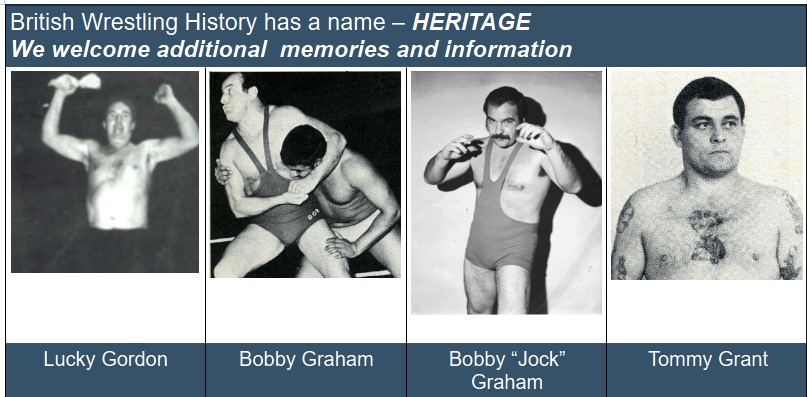
Lucky Gordon (Also known as Billy Jordan, Masked Marauder)
Birmingham’s Billy Jordan was an ex coalminer who started out on the independent circuit during the 1960s against the likes of Al Marquette, Bob Sherry and Killer Ken Davies
In the late 1970s he moved across to Joint Promotions rings and acquired a new name, Lucky Gordon. He made around thirty television appearances from 1978 onwards, in singles matches often going down to the blue eyed heroes, and in tag matches where his fate was similar! . He is fondly remembered by Heritage mambers in both guises;
Ballymoss, “He was a terrific ‘heel’ who knew how to work up any crowd with his usually blatant ‘rule bending’ tactics.”
Mark, “I always enjoyed his bouts as he was on the bill a lot of times at the Brent Town Hall Wembley back in the late 70’s and early 80’s. Solid Wrestler and great performer who always got the crowd on their feet.A real entertainer and always great to watch.”
Rasit Huseyin, “A good solid pro, very could at generating heat, and he didn’t win too many bouts, I often saw him face Ringo Rigby most of the time. Remember Lucky Gordon fondly, “
Frank Thomas, “One of those wrestlers that the sport couldn’t have done without I always thought.”
Like so many others Lucky Gordon succumbed to the roll of the frequent fall guy to Big Daddy in tag matches around the country.
Yet another name in the 1980s when he pulled on a mask and became one half of the Masked Marauders (the other Marauder being Scrubber Daly).
Billy Graham
If you’d turned up in the 1960s, handed over your seven and six and expected to see the American superstar you would have been disappointed. On the other hand if you’d expected to see an all-action welterweight from Manchester who knew how to work a crowd and might even have known more wrestling holds than the American of the same name you would have gone home in a much happier frame of mind.
Graham Brook remembers a tag match in which Billy Graham partnered Reg Yates against the Borg Twins. Graham entered in dressing gown and smoking a cigar and for quite a lengthy period stayed on the apron in his dressing gown smoking his cigar despite referee Harry Yardley’s instructions for him to disrobe. Although the Borgs and Yates were swapping holds cleanly inside the ring, Graham’s demeanour on the apron was bringing the crowd to boiling point. He did extinguish the cigar before taking a tag from Yates, but entered still wearing his dressing-gown and started kicking and punching. The match ended in a near riot with Graham being disqualified and the other wrestlers on the card having to surround him as he escaped back to the dressing-room. And Reg Yates wrestled cleanly all the way though.”
Graham also recalled being told that Billy owned a snake but wondered if it was a wind up. We can confirm that not only was it not a wind up but that in October, 1969, Billy was bitten by the snake, an African puff-adder, at his home in Salford. The snake fell to the floor and bit Billy as he picked it up. Phials of serum were rushed from Chester Zoo to Salford’s Royal Hospital where Billy was being treated.
The pet shop owner from Manchester also claims to have discovered Giant Haystacks, or at least bumped into Martin Ruane in a busy street and said, “You’d make a great wrestler.”
Bobby Graham
The true stars of professional wrestling were those whose skills permitted the so-called stars to shine. Pallo, McManus, Kidd; however well known the name the very nature of wrestling meant they were only as good as their opponent allowed them to be. Introducing in the blue corner, Bobby Graham. Whether it was being outfoxed by Les Kellett or playing second fiddle to tag partner Leon Arras as part of the Untouchables tag team, Sheffield’s Bobby Graham was one of wrestling’s many unsung heroes who gave the bigger names the space to get on with their job. A real grafter, Bobby put all his energy into his matches with little reward other than the satisfaction of knowing he was sending fans home with the enjoyment of a good night out.
.
We admit to being surprised by just how little was ever recorded of the exploits of light heavyweight Bobby. A steel worker in the fifties he was encouraged to take up wrestling by Bradford’s Joe Hill. In 1954 promoter Norman Morrell gave Bobby the opportunity to turn professional, with early career matches against Eric Taylor, Cyril Knowles and Maurice Atkinson. In the second half of the 1950s Bobby was working most nights of the week, mainly in the north for Morrell, Relwyskow and Green and Wryton Promotions. It was a pattern that continued throughout the 1960s and 1970s when the tenacious Yorkshireman was a regular on the bills of the north and midlands of England, and Scotland. Rough and tough, he could never be described as a purist, Bobby’s style would prevent him becoming a crowd favourite. In 1961 Bobby made his debut on television, facing the heavier Great Togo. It was to be the first of some forty televised contests with Masambula, Les Kellett, Mike Marino and Jackie Pallo amongst his opponents. From 1965 onwards Bobby was often seen in tag action partnering the irrepressible Leon Arras. Anyone partnering Arras was likely to be overshadowed. Nevertheless, Bobby Graham, played a significant role both in The Untouchables tag team and British wrestling in general.
Maybe it was a lack of charisma, maybe single combat opportunities were overshadowed by his tag success, maybe it was the time he devoted to his grocery shop, or maybe he was just never in the right place at the right time, but Bobby Graham is one of those to whom fate could have dealt a kinder hand. Bobby Graham died August 2012; he was eighty three.
Bobby “Jock” Graham
Not the Sheffield bruiser this was a powerful wrestler from Ayrshire who trained at the Mossblown gym of Dale Storm and Tommy Stephenson’s gym in Brig. . Bobby, otherwise Ronnie Grajam Archer, had limited experience in Scotland due to leaving for Australia in 1979, cutting short what could well have been a long and successful career according to his mentor Dale Storm. Bobby continued wrestling, moving on from Australia to New Zealand, Malaysia, The Phillipines and Fiji. In Singapore he studied Tai Kwon Do and Wa Su.
Tommy Grant
The rough, tough Tommy Grant was an all action middleweight who joined the professional wrestling ranks following his national service and day job as a lorry driver. When Dale Martin Promotions signed him up Tommy already had around five years amateur experience wrestling experience. As we were often reminded there was a world of difference between the amateur and professional codes. Fortunately for Tommy he made the transition successfully and was a regular worker around the south of England in the 1960s and early 1970s. Away from wrestling Tommy had a keen interest in athletics, boxing and swimming. Tommy Grant died in 2010.
Tony Granzi (Also known as Young Alexander)
A villain of the ring on the independent circuit from the mid 1950s until the late 1960s Tony Granzi was inspired by the legendary Bert Assirati and a (pre Big Daddy) muscular heavyweight named Shirley Crabtree. Tony dreamed of being a wrestler from his early teens and was introduced to the sport by London’s Frankie Price and Sid Ross. Born Tony Alexander he turned professional, in 1958, aged seventeen. In those early days he was billed Young Alexander. Wanting to add a bit of colour Tony soon dropped his birth name in favour of the more exotic sounding Tony Granzi. During the decade he worked the rings of Britain (Tony retired in 1967) he recalled for Heritage readers many memorable moments. Amongst them was appearing on television against Peter Kelly, when the BBC broadcast wrestling from Brighton in May, 1965. That was the night Jim Armstrong faced Edouardo Carpentier in the main event. He also fondly recalls his matches working for Jack Taylor at the Granby Hall, Leicester, memorable for its cavernous size and likened by many to wrestling in an aircraft hangar! Of all his wrestling memories the greatest of all is a bout that did not include Tony at all! It was the night at Poplar Baths when he witnessed a thrilling contest in which former world champion boxer Randolph Turpin defeated the Sydenham Cyclone, Frankie Hughes, in a boxer versus wrestler match.
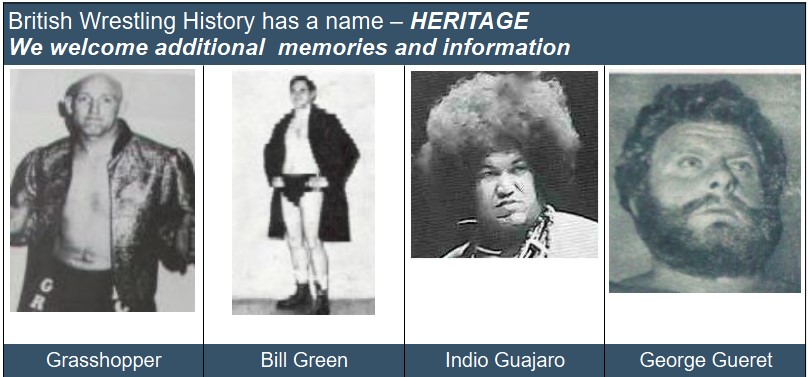
Grasshopper
A popular 1980s shaven headed. barefoot welterweight was Grasshopper, otherwise known as Phil Johnson from Leabrooks in Derbyshire.
The clean and skilful wrestler made around ten television appearances against mostly unremarkable opponents, but also faced up to the much more challenging Dave Finlay and Jim Breaks.
Prior to wrestling Phil was a regular competitor in judo competitions around the country. Had wrestling not disappeared from our television screens we may well have seen much more of this young man.
Please get in touch if you can help us to improve this entry.
Bill Green
Charlie’s son, Bill, continued the family tradition for a short time. Twenty year old Bill Green stood 6 feet tall and nudged the top end of the light heavyweight division. He trained at the United Amateur Wrestling Club before going along to the Dale Martin gymnasium in preparation of his professional career. He made his professional debut in 1964, a Normal Morrell Promotion at the Lime Grove Baths, and the combination of judo and amateur wrestling knowledge made him a promising star of the 1964-5 season. Alas it was not to be. After sixty or so bouts Bill decided professional wrestling was not for him. His short lived career included bouts against Tug Holton, Sean Regan and Ray Fury.
Felix Gregor
Felix Gregor was born in Berlin on 25th October, 1934. He was eighteen years old when he started his pro wrestling career in 1952. Eleven years later, in October 1963, the German heavyweight made a four week tour of Britain for Dale Martin Promotions. Time enough to lose to Norman Walsh at the Royal Albert Hall. Other opponents included George Gordienko, Tibor Szakacs, Bill Robinson and Joe Cornelius.
Indio Guajaro
The tough guy tearaway heavyweight from Columbia visited the UK in the 1970s. professional for only around a year he came to Britain in January 1974. A charismatic and entertaining wrestler he lost to Count Bartelli at the Royal Albert Hall on 16th January. The following day he recorded a televised loss against Roy St Clair, broadcast on 26th January. Other opponents included Steve Viedor and Mike Marino.
He wrestled extensively throughout Europe, mostly in Austria and Germany. Heritage member Pantaleon Manlapig remembers the big man when he wrestled in Austria and Germany, where he spent much of his career: “He entered the ring with feathers, traditional attire and of course shrunken heads. According to him the head belonged to his grandfather.”
Indio Guajaro returned to Britain for a short tour in 1985 and wrestled Pete Roberts on television. We understand that he died from a heart attack in September 1996, two years after retiring from the ring.
George Gueret
French heavyweight wrestler visited Britain on numerous occasions between the mid 1950s and 1960s. Appeared at the Royal Albert Hall three times and on television against Peter Maivia and Monty Swann. Gueret was a stuntman and actor in many films. He died in May, 2018.
Gunner Guest
Bill Angus, the nephew of Harold, assumed the name Gunner Guest after serving as an artilleryman in the Second World War. He was the nephew of the great Harold Angus Gunner didn’t assume the glorious heights of his famous uncle. As a demonstration that wrestling wasn’t all Royal Albert Hall and Belle Vue shows. Gunner’s son sent us an eye-witness account of a less illustrious post-war wrestling tour. The account was written over sixty years ago by Ray Atherton, who also wrestled on the tour.
1947 – The Big Top Wrestling Tour
Mr Jarman & Jim Angus were the promoters, Mr Jarman was to pay all wages.
A team of eight wrestlers were organised, and in addition to wrestling at different venues, they also erected and dismantled the Big Top.
The other members of the team were:- Ray Atherton, Bill Angus, Gordon Richards, Glyn Morgan,and a lad from Wigan (cannot remember other names).
The lorry carrying the Big Top was driven by Bill Angus, accompanied by Ray Atherton. A Horrifying incident occurred when coming down a steep hill by Lincoln Cathedral. The brakes failed & Bill pumped the brake peddle and got enough pressure back to stop the lorry at the bottom of the hill—-safely!
The places they performed at were :- Rotherham, Worksop, Gainsbrough, Lincoln, Newark, Nottingham, Derby, Tamworth, Evesham, Ross on Wye, Monmouth & Pontypool.
Not only did the team attend to the Big Top twice a day, they were also responsible for all the seating arrangements & Ring.
This was to be the last venue of the tour. They were to be paid in full on the morning of the last show. They slept underneath the lorry, covered with hessian sacks. They ate when and where they could. The following morning on awakening they found that Mr Jarman and “his lady friend” who had both lived comfortably in a touring caravan throughout the tour had absconded with the money and the team were left penniless, no money either for families waiting at home.
They abandoned the Big Top and lorry & hitch hiked home!!!
Donkey Work!!! (for nought)
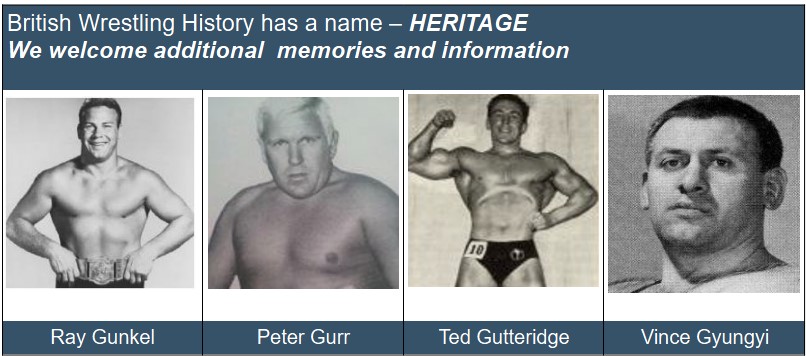
Ray Gunkel
Back in the 1950s and 1960s British wrestling fans eagerly read of the exploits of American wrestlers in magazines that made their way across the Atlantic weeks after publication. Those wrestlers seemed more colourful and larger than life than the wrestlers we saw in our halls. On the rare occasions the Americans visited Britain we were usually disappointed. Although we didn’t see Ray Gunkel on what seems to have been his one and only appearance in British rings we are sure we would not have been disappointed. Ray was a man with genuine amateur credentials. A top 1950s contender for Lou Thesz’s NWA World heavyweight title.
A top 1950s contender for Lou Thesz’s NWA World heavyweight title Ray visited Britain in May, 1960, losing to George Gordienko at the Royal Albert Hall. Ray Gunkel died in 1972 following a match with Ox Baker.
Peter Gurr
Ashford’s Peter Gurr was one of a group of kent wrestlers who established themselves on the British wrestling scene in the early 1970s. Alongside Jon Carlo, Crusher Mason, Aaron Stone, John Hurley, Kurt and Karl Heinz he was a student of the great heavyweight Danny Lynch. Peter worked mostly for the independent promoters until the late 1970s alongside some of the biggest names in the business that included Ricky Starr, Danny Lynch and Cowboy Cassidy. In later life Peter emigrated to Alberta, Canada, where he worked in the film industry. In Calgary Peter was a Security Department Coordinator taking charge of security on more than 100 big budget film sets. Peter was also an active and significant member of the International Alliance of Theatrical Stage Employees, and devoted much of his time to charity work. Peter Gurr died in November, 2015.
Ted Gutteridge (Also known as Young Hackenschmidt)
The name we mostly associate with Young Hackenschmidt is the Winchester heavyweight Dave Larsen who used the moniker on some of his early Paul Lincoln appearances. However, there was at least one other Young Hack, namely the renowned body builder, Ted Gutteridge. He stood only 5’5” tall and weighed around thirteen stones but in 1963 Ted won the title of Mr Britain. Success had begun ten years earlier when Ted won the Mr Junior North Britain title at the Seaburn Hall, Sunderland. Ted, a draughtsman from Whitley Bay, dabbled in wrestling for a short time in the early 1960s. His brief career came to an end on 14th May, 1964, when he and his wife Lillian set sail for Australia and set up home in Sydney. Ted was placed third in the 1966 Mr Australia contest, reportedly pleased with his ranking as he had not trained for two years. Ted died on 18th December, 1969, we have an unconfirmed report that he was killed in a car crash.
Vince Gyungyi (Also known as Venzyl Gyguyi)
The spelling of the name is not the only mystery. The former appeared in the “The Who’s Who of Wrestling,” the latter a variation on some posters, including the one sent to us by “Main Mask.”
Wrestling enthusiast “Main Mask” queried this Hungarian heavyweight who appeared on the scene in December, 1968, “I have him taking on Tiger Lombardo at De Montfort Hall Leicester.”
Well, we have scant information, but do remember him. We remember him nicknamed “The Golden Eagle” when he wrestled on a Norman Morrell show at Blackburn in January 1969. On that occasion he was Vince Gyguyi. Our earliest discovery of him was a few weeks earlier, losing to Pat Roach in Leeds on 10th December, 1968. He appeared sporadically throughout 1969, finally disappearing in December. Most of our recorded results ended in a loss, opponents including Gwyn Davies, Geoff Portz, Jock Cameron and Hans Streiger. Tiger Lombardo was a frequent opponent. Matches were in the midlands, north of England and Scotland, working for promoters Relwyskow-Green, Morrell-Beresford and Wryton.
In 1971 “The Who’s Who of Wrestling” said he was Hungarian born, now living in Birmingham and was a former press operator who maintained a fitness regime at the Birmingham University Gymnasium.
18/05/2023 Page reviewed
1143
 Wrestling Heritage