
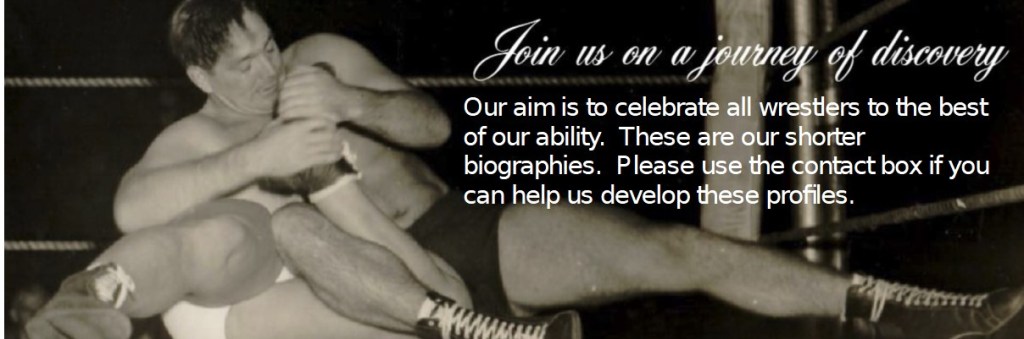
These are our shorter biographical portraits which we would like to extend if you can provide information or memories.

John Kenny
The first time we saw Widnes’s John Kenny in the ring he must have been a professional for only a couple of years It was the summer of 1973 and he was unfortunately injured in a bout with another newcomer, Mark Rocco. Even then he showed potential, having been trained by Widnes hard man Harry Paliin. In the years that followed we always enjoyed watching John in action, a good humoured wrestler who always seemed to give his best. He never made it to the top rung amongst the McManuss and Pallos, but such was the standard of wrestling in those days that such a statement should not be taken as criticism of a very talented middleweight. John kenny had some cracking matches with Kevin Conneally, Eddie Rose, Catweazle, Paul Mitchell and other Northern regulars in both independent and Joint Promotion rings. His career extended more than two decades and after retiring from wrestling John could still be seen officiating as a referee.
Jeff Kerry
Bristol’s Jeff Kerry was trained by Roy Harley (who wrestled as Peter Falcon) alongside Danny and Peter Collins and the man who was to become his tag partner, Richie Brooks. He was a popular worker towards the end of the Heritage years in the 1980s, making half a dozen or so television appearances in 1986 and 1987.
Leon Ketchell
Poland’s Leon Ketchell. Leon Grabowski to give him his birth name, was a big man, claiming to be 7’2″ tall, but that seems to be on the generous side. We find him reported in the British press from 1935 onwards, said to be a professional wrestler in Poland. He came to Britain to improve his boxing skills, going on to the United States for a short lived boxing career. Claims of seventeen fights seem unsubstantiated, with http://www.boxingrec.com listing only one match. His wrestling in Britain seems to have been limited to December 1936 and January, 1937.
Half Nelson Keys
Fred Keys was a prolific star of the 1930s rings, wrestling up and down the country against the likes of Len Franklin, Carver Doone, Atholl Oakeley, and Bulldog Bill Garnon, and all went down to Keys at one time or another. Admittedly, Half Nelson’s results were a mixed bag, but he was definitely one of the busiest workers of the period. Acknowledged for his strength he was labelled “The Hendon Hercules,” and tipped the scales at around seventeen stones. He was a significant part of the British wrestling scene from the start of the 1930 wrestling revival, with an impressive draw against Bill Garnon at Belle Vue, Manchester, in January, 1931. This was a powerful man who worked with the best of them all in a career that looks to have lasted only about five years. Half Nelson Keys appeared (uncredited) in the 1934 British comedy “Without You.”
Frederick William Keys, born 2nd May, 1902, died June,1962.
Iska Khan
Barefoot Mongolian heavyweight who visited Britain annually 1955 to 1962, probably from a Parisian base. His Royal Albert Hall victims included Portz, Hayes, Garfield and Apollon; he only lost there twice, once to Mike Marino and once when clear he wasn’t returning, to Wild Ian Campbell.
Dave Sutherland recalls 1962 controversy in his televised k.o. defeat of Johnny Yearsley. James Morton recalls him being billed as The Wall of China in France. In the sixties and seventies he appeared in French movies, right. He was the featured wrestler in the BBC’s 1962 Grandstand Sports Book (thanks Palais Fan). And in the same year he was the key featured wrestler in a TV Times full spread article on dancing wrestlers, in which Ski Hi Lee and Wild Ian Campbell were also photographed.
Away from the ring he appeared in a number of French language films, specialising in the role of Oriental villains
Not to be confused with a moustachioed 80s Blackpool wrestler known by the same name.
Gordon Kilmartin (Tommy Kilmartin)
The heavyweight from Pontefract was liked by fans and fellow wrestlers. He had the look of a bruiser and fans expected action when Gordon Kilmartin got into the ring, and they usually got it.
Gordon was one of Charlie Glover’s lads, learning the business at Charlie’s gym behind the Junction Public House. We have been told that Gordon was one of the hard men of the gym, and would be called upon if any of the youngsters needed a bit of come-uppance.
His entrance to the ring in a colourful red and gold coat belied a gritty, tenacious wrestler who knew all the moves. Gordon boxed as an amateur going on to learn the professional trade in the boxing and wrestling booths of the north. Other sporting interests included rugby union which he pursued during his national service. It might have been fifteen years of pit work that gave him courage, but it was hard work and natural ability that gave Yorkshireman Gordon the skill to become a popular heavyweight of the 1950s and 1960s. He retired from the ring in the mid sixties and became a pub landlord at the Gardeners Arms in Pontefract.

Masahiko Kimura
A combination of judo and wrestling holds from this Japanese visitor in 1957. He was considered one of the greatest judoka of all time, becoming the youngest ever 5th degree black belt in 1938, aged just eighteen. At the Royal Albert Hall he defeated Judo Al Hayes in May 1957, returning to the Kensington venue to knock out Jim Hussey the following October. Other British opponents included Vic Hessle, Alan Garfield, Black Butcher Johnson, Dai Sullivan and Tony Mancelli. He famously lost to Japanese legend Rikidozan and later claimed he had been double-crossed as the bout was planned to end in a draw. Masahiko Kimura died from lung cancer on 18th April, 1993.
Curly King
Wigan’s Freddy Morley was active in the 1940s and 1950s, given his ring name as a result of his curly hair. Our earliest record is of a contest in January, 1947, against Sankey Allan at the Caird Hall, Dundee.
Kiwi Kingston (Also known as The Great Karloff)
Lanky Sussex-based equestrian and 6″5″ heavyweight wrestler whose features assured him a movie role as Frankenstein’s Monster. On the back of his film stardom, he wrestled for a while also under the intriguing name, The Great Karloff
In-ring master of the spinning cradle hold, this New Zealander faced all the great heavyweights of British wrestling in a two-decade career that came to an end in 1970.
The tough New Zealander came to Britain after serving in the air force and in 1946 was well placed at a time professional wrestling was re-establishing itself as a popular spectator sport.
Before the war Ernie Kingston had been runner up in the New Zealand heavyweight amateur boxing championships of 1938, and also played rugby.
In Britain he established himself as one of the country’s most popular heavyweights of the 1950s and 1960s, and found similar success wrestling on mainland Europe.
Ernie is also remembered as an excellent horse rider, and in Germany would ride his horse into the stadium and up to the ringside.
Red Kirkpatrick
A villainous American who made his way across the pond from his home in Brooklyn. Bernard Hughes recalls visits to Britain in the 1950s of Red Kirkpatrick, “He was a real rough house, and a handful for the referee.”
The American had little time for the scientific aspects of the sport and Bernard tells us he was disqualified on the first three (of six) occasions he saw him at the New St James Hall, Newcastle. Red was easily identified by the bluebirds tattooed below each collarbone. “A handy bloke to have in a streetfight!” said Bernard. Another member who remembers Red is Raven, who told us that unlike his ring persona Red was a lovely man to talk to after the show.
Alan Kitto
The Light heavyweight from Romford was a promising star in Dale Martin rings of the early to mid 1960s, with the added interest of living on a boat according to The Wrestler magazine! . A good amateur foundation led to a promising career in the mid sixties, mainly in the south of England. Opponents included Johnny Kwango, Linde Caulder, Tug Holton and, quite often it seemed, Tony Bates. Shortly after The Wrestler magazines prediction of stardom Alan seemed to disappear from our rings; we would welcome more information.
Chris Knowles
Leeds lightweight Chris Knowles was a sensation when he made his professional debut as a fifteen year old. The blond hair, the looks, the speed and the technical skill taught by his grandfather the great Cyril Knowles quickly established the teenager as a firm favourite on the northern independent scene in the mid 1970s. Cyril was immensely proud that his grandson was carrying on the family tradition in style. Chris mostly worked in singles matches against the likes of Al Marshall, Dirty Billy Bates and Shaun Lavery, but also learned a great deal partnering the veteran Gorilla Reg Ray in tag matches. Tragically Chris’s promising career, and his life, was cut short when he was killed in a motorcycle accident when he was just twenty years old.
Gil Knutson
Our earliest record of Gil Knutson is in British Columbia, Canada, in March, 1934. By 1937, and into 1938, he was wrestling in Britain, facing the likes of Francis St Clair Gregory, Karl Reginsky and Benny Engblom. Gil was billed as light heavyweight champion of Norway. Except, that is, when he was Swedish, or Danish. He may well have been of Scandinavian birth but was certainly wrestling in North America prior to his tour of Britain. Numerous reports of Gil Knutson’s matches indicate he was a wrestler of some considerable skill.
An eagerly anticipated fight between two unbeaten masked wrestlers took place at the Majestic Ice Rink in Preston on 31st March, 1939. In one corner was The Wizard and his opponent was The Brown Mask Marvel. The loser would unmask.
The Wizard had appeared twice at Preston, the only times we could find him anywhere, with wins over Black Butcher Johnson and Vic Hessle. The Brown Mask Marvel was a far more familiar figure.
It was a frantic encounter with the Wizard on the offensive from the start and little defence from the Brown Mask Marvel for the first two minute. It was only when one of the Marvel’s kicks caught The Wizard in the eye that the Mask Marvel began to assert himself. The Wizard took the first fall after sixteen minutes of wrestling, this was a no rounds fight to the finish. When the match resumed The Marvel began to gain the upper hand.
In the 22nd minute a pile-driver put The Wizard down for a count of eight. As he rose to his feet the Marvel repeated the move and The Wizard was counted out.
The mask was ceremoniously removed to reveal Gil Knutson, who had been wrestling in Britain since his arrival from Canada in 1937.
After retiring from wrestling Gilman went into a career in banking, and was made Director of the Desert Empire Bank in California in 1974.
Gil Knutson died in Hawaii in 1997; he was 86 years old.
Shozo Koboyashi
Visiting overseas wrestlers seemed to fall into one of two categories; there were the invincible ones who defeated all before them, and there were the fall guys who made the gallant Brits look good. When the twenty stones Japanese heavyweight Shozo Kobayashi arrived on our shores in October, 1968 it was quickly apparent that although he was something of a novice sent to Britain as part of his wrestling education, he was definitely placed in the first category. An opening win over Roy Bull Davis was followed by a first round knock out of Les Herberts in front of an astonished tv audience, and completed his first ten days in the country with a Royal Albert Hall destruction of John Cox. The following few months saw Shozo go on to defeat the best that we could offer, including Albert Wall, Al Hayes, Bruno Elrington (at the RAH), Tibor Szakacs (on tv), Pat Roach, Ian Campbell, and even a straight falls win over Dory Dixon.. Breaking the mould of the dastardly Orientals usually portrayed in British wrestling the fans rather took to the genial twenty-four year old. He was a popular visitor to Britain during the 1968-9 winter before going on to greater things in the USA as Strong Kobayashi
Billy Kohnk
Said to be Swedish, but most likely Canadian, as it was here we find his earliest records in 1933. Kohnk was an all action blond tiger of the 1930s ring. Wrestled in Britain for about a year in 1938 and 1939 before returning to Canada where he continued wrestling until 1957. A strong swimmer, his stated ambition was to swim the English Channel.
Tony Kolokotroni
Wrestler Tony Kolokotroni worked the independent rings of southern England in the 1960s. At other times, as Tony Ellis, he worked behind the scenes as a fight arranger on numerous films and acted on tv as a supporting role actor in programmes that included The Avengers and Coronation Street. Tony Ellis also staged wrestling shows, mainly in London, featuring big names such as Count Bartelli in aid of charities for those facing difficulties in society.
1347
 Wrestling Heritage