
These are our shorter biographical portraits which we would like to extend if you can provide information or memories.

Joachim LaBarba (Also known as Pancho Zapatta)
With the looks that only a mother could love the middleweight made quite an impression with fans who disliked his rough tactics when he tangled with the likes of Jack Dempsey, Cliff Belshaw and Tommy Mann during a three week visit for Joint Promotions in 1958.
Always billed as Mexican we have yet to uncover evidence that he was Mexican, though our scepticism is only because this is professional wrestling and it’s a good guide to question everything. Our search through the archives uncovers the wrestler first of all eight years prior to his British debut working in Paris with the name Joachim LaBarba and Germany as Judas LaBarba.
He returned for a longer visit of around three months in October, 1961, again working for Joint Promotion. On television he lost a November, 1961, contest when he was knocked out by Mick McManus. This was on the same bill that the American Luther Lindsay knocked out Joe Zaranoff in his historic sole British television appearance. There was a further visit in March, 1963.
Joachim La Barba went on to re-emerge in 1965 as the Mexican Thunderbolt Pancho Zapatta, an unmistakable Mexican villain with moustache, a shaven head and a poncho. Oh, and a tendency to get disqualified. By now he had filled out and was sharing the ring with light heavyweights Les Kellett, Johnny Czeslaw and Tony Charles. Highlight of the UK visits were most likely two appearances at London’s Royal Albert Hall, in September, 1965 going down to George Kidd, and in June 1966 his contest with Jackie Pallo beamed live to eleven cinemas around the country.
Rene LaBelle
Born in 1914 the Flying French born Canadian was a claimant of world titles at welterweight, middleweight and light heavyweight. His speciality flying tackle was said to be a sight to behold. A scientific wrestler by all accounts, with with a superb physique, he worked in Britain from 1936 until 1938. Although these matches pre-date any career record we can find for North America, there is a 1937 newspaper report that states he had wrestled more than one hundred matches in America. Weighing around thirteen stones British opponents included Johnny Katsulos, Tony Pastor and College Boy.
Leo Labriola (Also known as Mustapha Labriola)
The globetrotting heavyweight was a veteran of twenty odd years when he worked the rings of Britain between 1950 and 1952, already well known in Australia, Europe, America and the Far East. Something of a hellraiser in the ring the Melbourne Argus reported from Labriola’s match against George Pencheff, “Labriola had been thrown and when he rose he struck the referee George Thompson, a former heavyweight champion boxer, on the back of the neck rendering him unconcious…..Thompson recovered and assailed the Italian whereupon several policeman rushed to the ring and quelled the occasion.”
Sus Labrosse
Belgian heavyweight Sus Labrosse headed into Britain in February, 1955. In his debut match against Charlie Green it looked as though he would live up to his promise. The Sevenoaks Chronicle reported that he brought cheers from the crowd as he exhibited his enormous strength. Although he was giving away over two stones Labrosse took the first fall and the reporter sensed the Belgian was on the way to victory. It was not to be, as in the third round Green gained an equalising submission with a Boston Crab. Two days later the Liverpool Echo reported that Labrosse had withdrawn from his forthcoming match and returned to Belgium following injury in his first match. Sus Labrosse was the father of Eric Brazil who impressed two decades later.
John Lacey
A one time rugby player for Bath, the Light Heavyweight John Lacey worked for Dale Martin Promotions from 1960 until 1964, with opponents that included Johnny Czeslaw, Steve Logan and Arthur Fisher.
Guy Lamarre
French heavyweight visited Britain for a month in 1964. He lost to Canadian Don Griffin at the Royal Albert Hall. Returned in 1969 for two high profile matches, losing to Sean Regan at the Royal Albert Hall and getting knocked out by Tibor Szakacs on the tele.
Bert Lamb
This low key 1950s light heavyweight from Croydon was often seen in opposition to his friend Kurt Jorgens. Bert was often billed as “Lucky Bert Lamb” on the posters, a reference to his childhood survival of polio, which was a killer in the 1950s. Illness left Bert with a weak and thin leg, which his merciless opponent would repeatedly attack. Fans would scream at the injustice of it all. We just weren’t that sophisticated in those days.
Felix Lamban
Spanish heavyweight visited Britain during the 1950s and 1960s. Credited by wrestling-titles.com as a Spanish and European champion in the 1940s details and dates are scant. He was nicknamed “El Strangulador” as a consequence of a tendency to use a rather lethal looking headlock.
Wrestling enthusiast Adrian Pollard said of Felix: “A tough, sturdy character – he could certainly wrestle with a high degree of prowess and easily made most of the lady fans-possibly some of the men (just being fair) swoon a bit with his Latin charm and Hollywood looks! As well as his persona he had the ring attire to match and was a colourful addition to the wrestling bills on which he featured.”
Felix made his first short visit, of about a week, to Britain in 1953. He rturned for a more extensive tour between November 196o and March 1961. He wrestled mostly for the northern promoters and met most of the top mid heavyweights and heavies, including a television loss against British heavy middleweight champion Eric Taylor.
Apart from working throughout Europe he went on to work extensively in the United States, using the name Felix Godo, returning to Spain shortly before his retirement in 1967.
Andreas Lambrakis
Greek heavyweight Andreas Lambrakis was born in Athens. He visited Britain in the spring of 1960, having previously worked in Australia, mostly main events for George Gardiner, including a Greek Heavyweight title match with Con Papalazarou, which ended in a No Contest due to the rough tactics of both men.
In Britain he worked mainly for Dale Martin Promotions but with the occasional jaunt further north. Opponents were top of the range including Mike Marino, Georges Gordienko, Joe Cornelius, Ray Apollon and Geoff Portz. He was a rough, tough villain who would swagger around the ring taunting opponents and fans alike. He continued to travel following his UK visit and went on to work in Canada and the USA.
Andreas Lambrakis died in London, where he was living, in 1997.Although their styles were as similar as chalk and cheese the similarity of family names with Spiros Arion has caused confusion at times and, which on the death of Andreas Lambrakis, led to rumours that Spiros Arion had died.
Larry Lancaster
For a couple of years, 1964 and 1965, Larry Lancaster was a busy worker for Joint Promotions, with opponents that included top heavyweights Steve Veidor, Sean Regan and Yuri Borienko. Billed from Tottenham, most of his bouts were for Dale Martin Promotions in the south of England. Regular appearances in Portsmouth lead to a suspicion that he may have lived nearby. To his credit the boy did travel, and he worked in the north of England for Norman Morrell.
Mike Landis
We found only three verified matches for Mancunian Mike Landis in the late 1950s and early 1960s. He is mostly remembered as an independent promoter in Lancashire, Cheshire and Derbyshire.
Bob “Legs” Langevin
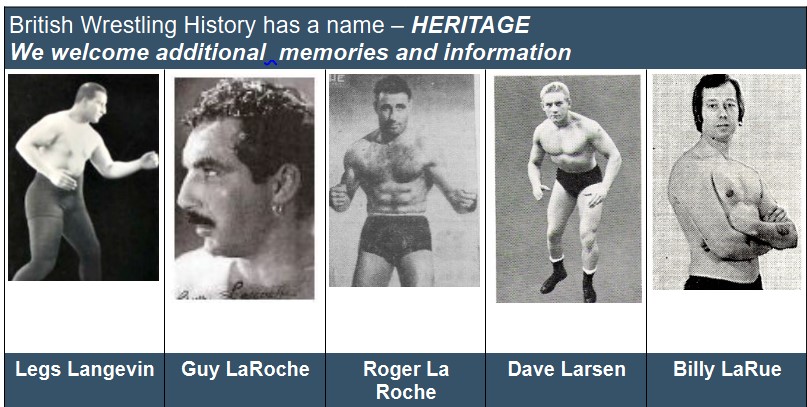
Legs Langevin was an adventurous twenty-something when he came from his Canadian home to wrestle in Britain between 1936 and the outbreak of world war two. He went on to a career of almost forty years and travelled extensively, wrestling legendary stars that included Strangler Lewis, Jim Londos, and Lou Thesz. In Britain he shared a ring with top overseas visitors that included Jack Sherry and Karl Pojello as well as domestic stars. Born in Quebec Bob worked as a farm worker and in a brewery before taking up wrestling. Both were physical jobs and developed the enormous strength that was to serve him well in the wrestling rings. At the Montreal YMCA he came under the guidance of pro wrestlers Leo Lefebvre, Frank Sexton and Yvon Roberts. Unsurprisingly the nickname “Legs” resulted from his strong legs and a specialty move, the airplane head scissors, which he claimed was no longer used following his retirement. With the outbreak of war approaching Bob returned to Canada where he joined the Montreal police for the duration of the war. He resumed his wrestling career in 1945 and was to remain working for more than a quarter of a century and then became involved in the promotional side.
Bob Legs Langevin died on October 8th, 2005, aged 91.
Steve Studs Lannigan
A man who was at the front of the queue when the facial hair was dished out. He was a rumbustious Salford heavyweight who fans seemed to enjoy watching but made little long term impact on the wrestling scene. Nevertheless, he did notch up around half a dozen television appearances between 1982 and 1986, so that’s not too bad.
Guy LaRoche
Gypsy Guy LaRoche was a rule bending French middleweight who made frequent visits to the United Kingdom during the 1950s. The photograph shows LaRoche about to throw Rene Ben Chemoul from the ring.
Roger LaRoche
One time European and World middleweight champion who visited Britain in the 1950s and early 1960s. In September 1954 he defeated Jack Beaumont at Belle Vue, Manchester, in a bout for the World Middleweight Championship. LaRoche visited Britain during the 1950s and 1960s, wrestling Steve Logan on tv in April, 1962.
Dave Larsen (Also known as Young Hackenschmidt)
The wunderkind of the Paul Lincoln set-up seemed headed for high places as 1966 dawned. Made premature screen appearances whilst working for the independents in the 1962 film The Wrestling Game (he partnered Ray Hunter against Dennis Dean and Don Steadman), and again in 1965 when BBC tv showed wrestling (in London and the South East only) on their new channel, BBC2. Less than a year later he was part of the Paul Lincoln invasion force that made their way into Joint Promotion rings. He featured at home as the blue-eyed golden boy, struggling against villains and particularly regular foe, Steve Haggetty. Lincoln wrestlers had a pathway to Paris and it was in France that Larson wrestled as Batman. But he seemed to go part-time after the 1966 merger and eventually disappeared from the scene completely in the very early seventies.
Dave Larsen died on 10th October, 2024.
Billy La Rue
Battersea born, Kent based, middleweight wrestler Billy La Rue turned professional in 1968 following a stint in the merchant navy. Boxing was his firs interest until his friend Basil Riley encouraged him to take up wrestling,
He was trained by former wrestler Frank Price at his Canterbury gym before undergoing his wrestling apprenticeship on the independent circuit, facing the likes of Tony Scarlo who he held in high esteem. It was Frank Price that created the name Billy La Rue, a colourful exchange for his birth name of Brian Thomas.
Having worked the independent circuit for a few years Billy moved across to Joint Promotions in the early 1970s. He went on to work for Joint Promotions around Britain, Germany and Spain.
Jack LaRue
A name used on both sides of the Atlantic, with two of them in Britain alone. In Britain to add a touch of colour to a local boy. Our local boy on this occasion was Harry Rose of Thornaby in Teeside, just south of the River Tees. Harry was a trainee from the St Lukes Club in Middlesbrough. By day Harry drove a hearse for the local undertaker, by night he was Jack LaRue, a lightweight wrestler from South Africa. He wrestled for independent promoters in the north east of England in the 1960s. The name was also used by Stockport wrestler Bob Francini.
1411
 Wrestling Heritage