
These are our shorter biographical portraits which we would like to extend if you can provide information or memories.

Jack Lasar (Also known as Rene Lasartesse)
Stamping Jack Lasar, the arrogant strutting villain of the 1960s had something of an identity crisis. In Britain Stamping Jack billed as the American villain who would taunt his opponent, mercillesly punishing him to antagonise the crowds. In To the Germans he was Frenchman Rene Lasartesse, whilst to the French fans he was a German.Influenced by legends such as “Nature Boy” Buddy Rogers, Gorgeous George and Dr Jerry Graham, whom he was able to work with while wrestling in the USA under another identity, German called Ludvig von Krupp, he perfected his antics to drive the audience mad and sometimes cause riot among spectators.
He was actually Edouard Probst, born in Basel, Switzerland, in 1928. His career spanned thirty five years, beginning in 1953 and concluding in 1988 as he neared his sixtieth birthday. International success came in 1958 when he worked in the United States.
Jack Laski
Canadian heavyweight Jack Laski made a six month visit to Britain during the winter of 1956-7 and returned once again the following year. Between times he wrestled in Austria and Germany. Opponents included Jack Pye, Mike Marino, Count Bartelli, Francis St Clair, Ray Apollon on television and Royal Albert Hall bouts against Ray Hunter and Black Butcher Johnson.
Pierre LaTour
A name associated with promoter Jack Taylor from 1958 to the second half of the 1960s. We have been told two wrestlers used this name, Peter Jordan and Peter Measures, who gained popularity as Pete LaPaque. We also found a Pierre LaTour wrestling in Singapore in 1962, but don;t know if this was the same man as he British version.
Scarface Laval
The French villain who appeared fleetingly in Britain at the start of the seventies. Originally he came to the ring dressed Mafia-style as Al Capone, but later assumed a full-length villain’s gown. Previously having wrestled as Philippe Navarro the change of name confirmed his identity as a ring villain. Could it really be coincidence he chose the name Laval, the French prime minister who collaborated with the Nazis and was shot by a firing squad. In April, 1971 he headed for Britain and made his debut in the Royal Albert Hall Trophy Tournament, A victory over Judo Al Hayes was followed by a semi final loss to Steve Viedor. Only one other UK match seems to have materialised, the following night at Cambridge with Mike Marino.
Shaun Lavery (Also known as Shaun Falcon)
Yorkshire based Shaunn Lavery was from Northern Irish stock. He could be seen on the independent circuit of the 1970s, working mostly for Cyril Knowles. Shaun was later signed up for Joint Promotions using the name Shaun Falcon.
Ian Law
Tayside’s Ian Law was a late 1970’s challenger for Johnny Saint’s World lightweight crown and the man credited for training Drew McDonald. In the mid 1980s Ian was laying claim to the world welterweight championship and took part in blood baths with Rollerball Rocco.
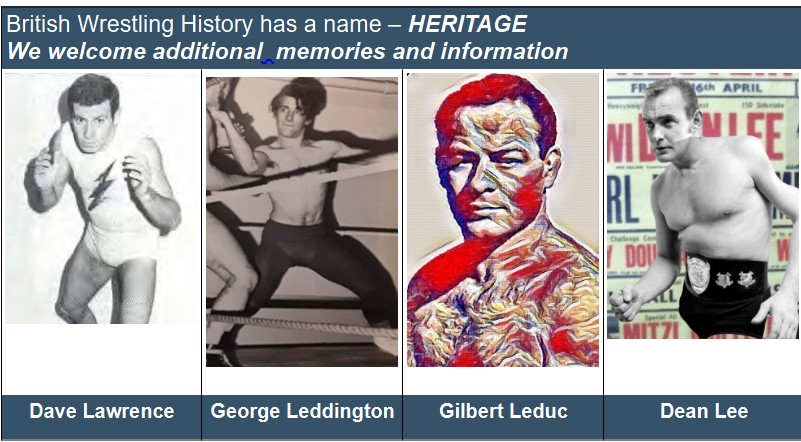
Dave Lawrence
A diminutive bundle of energy that was Nottingham’s Dave Lawrence who bounced around the ring in the 1980s.. In his 1982 Royal Albert Hall appearance Dave’s opponent was Grasshopper, which isn’t surprising as Grasshopper seemed to be his opponent most nights of the week. It was Grasshopper again in one of his three televised matches, the other opponents being Peter Kaye and Saxon Brooks. Time was running out for wrestling and Dave didn’t really make his mark. For an understanding of Dave’s impact on sport do a bit of research on his judo career, a member of the British international judo squad and reaching a very high level.
Whiskers Larry Laycock
Following the second world war bearded Larry “Whiskers” Laycock left the Royal Marines to take up chicken farming in Darlington and professional wrestling. His name was appearing on posters by 1949 and he was a regular on the bills of the midlands, northern England and Scotland until the mid 1950s. He wrestled the big names of the day such as Dave Armstrong, Ken Davies and Jack Pye.
George Leddington
George Leddington was part of a very active wrestling scene around Birmingham and the Black Country in the 1960s. A youngster in Bilston, a couple of miles southeast of Wolverhampton, George was always interested in sport and was a keen amateur footballer. His interest in wrestling led to George turning professional in 1962, his earliest matches being for Oakdale Promotions and Highland Entertainments.
Twice winner of Oakdale’s “Wrestler of the Month” established promoters signed him up and soon he was wrestling for Cyril Knowles, Jerry Jeary, Lew Philips and other independent promoters. Philips promoted weekly at Digbeth Civic Hall, one of George’s favourite halls in Birmingham city centre. Another enjoyable venue for George was Dudley Hippodrome, which also put on weekly shows in the early 1960s, and was the home to one of his most memorable matches, against Birmingham’s Deep River.
Considering how much he worked the name George Leddington was less known that might have been expected, this was a result of his identity often being hidden as he was billed as “The Red Devil,” who unusually for the name was not a masked wrestler. At the time of taking his place in Wrestling Heritage George still lives in the West Midlands and enjoys supporting his favourite football team, Wolverhampton Wanderers.
Gilbert Leduc
World class French mid heavyweight, erstwhile world champion, made a number of visits to Britain, usually of a short duration. His first visit, to northern England was in 1949, numerous short visits during the 1950s and finally tours for Paul Lincoln Management in 1964 and 1965
Dean Lee
When heavyweight Dean Lee came to our notice he was Kiwi Dean Lee, New Zealand champion no less, or so the promoters claimed. Reality was that he was a Yorkshireman, and although resident in New Zealand for quite a number of years this was a homecoming. When Dean Lee and his wife packed their bags for New Zealand in 1963 his sporting background was confined to boxing and judo. Interest in wrestling developed in New Zealand where he was trained by John DaSilva, a man already well known to British fans. Our earliest sighting of Kiwi Dean Lee back in Britain is an Edinburgh show in December 1970. Opponents included Andy Robin, John Lees and Tony St Clair. He then moved to work for the independent promoters and we last found him at Tamworth in 1973 wrestling The Wild Man of Borneo. We would like to learn more.

Kwik Kick Lee
Not as acrobatic as his namesake, Sammy, young Kwik Kick (Akira Maeda) came to Britain in 1982 and 1983 where his not inconsiderable skill was placed on the back burner in matches against Giant Haystacks and Big Daddy. Lee returned to japan where he established himself as one of the country’s top wrestlers and promoters. He allegedly fell out of favour with Japanese promoters when he began to take the combative element of the sport just a little bit too seriously!
Tiny Pat Lee
A young lightweight who worked in the north and Scotland during the late sixties and 1970s. Trained by Leon Arras he worked for the independent promoters before being signed up by George deRelwyskow for Joint Promotions. Tagged with Tom Jowett as The Dons, with reference to their home town of Doncaster.
Sammy Lee
Sammy lee was unknown to ritish fans when he came to our shores but his speed and agility led to an immediate acceptance by the UK fans. Flying head scissors, dropkicks and a succession of leg executed throws following one after the other at bewildering speed made the young Japanese wrestler unique in British rings. Sammy Lee was trained by Karl Gotch, the American based Belgian who had learned his trade from the Wigan wrestlers in the 1950s. Unsurprisingly Lee was chosen as a frequent tag partner of Big Daddy, but we won’t hold that against him. The name Lee was bestowed on him, real name Satoru Sayama, to capitalise on the martial arts film star BruceLee. On returning to Japan Lee took to wearing a mask and became Tiger Mask, going on to become a legend of Japanese professional wrestling.
Leo Lefebvre
Billed as French heavyweight champion as he wrestled up and down the land between 1936-9; we don’t know if he was honoured in the same way across the channel. Was oddly allowed to challenge for the British Empire title. Work that out. It might well have been because he was Canadian!
Jacques LeJaque
French welterweight visited Britain in the mid 1980s. Jacques made two television appearances; the first an impressive straight falls win over Ray Crawley in December 1985, followed a few weeks later when he failed to capture Danny Collins European welterweight title when he lost by the odd fall.
Benny Lema
The globetrotting Italian heavyweight visited Britain in November, 1954, wrestling Britain’s best, including Norman Walsh and Farmer Johnny Allan.
1415
 Wrestling Heritage