
These are our shorter biographical portraits which we would like to extend if you can provide information or memories.
The Mad Axeman
The second half of the 1970s saw the emergence of a period that could never be described as the glory years of British professional wrestling. The business was going into decline with gimmicks that showed little respect for the professionals in the ring or the enthusiasts who paid their wages.
The Mad Axeman was not one of the great career masked men that we treasure here at Heritage. By the 1970s masked men proliferated and towards the end of the decade it seemed that anyone could be given a hood and be deemed a hooded terror for the night. The Mad Axeman was a (number of) 1970s masked men who failed to make it into the premier league, or even the old first division, of British masked men.
It was a name we first came across in 1973, working for independent promoters in the east of England working for Bill Clark and Jack Taylor. By 1975 the name was used by Max Crabtree on Joint Promotion bills, and whether this was the same wrestler or not we have no idea. With Max Crabtree at the helm opponents were of a higher class, Wayne Bridges, Count Bartelli, Mike Marino.
Graham Brook recalled “I saw The Mad Axeman once as part of a four man K.O. tournament at Liverpool Stadium. It was one of Max Crabtree’s early shows there and his brother Shirley faced The Mad Axeman in the first contest. I recall him being quite a weedy guy, much lighter than Crabtree who soon pinned and unmasked him. I did not recognise him but recall being told that, without the bonnet, he worked as “Gypsy” Joe Romero.”
By 1978 he (or they) was back with the independents, popping up sporadically until 1987, we find him back in the east of England, at Holbeach, against Klondyke Jim, turning full circle. Maybe there is more to this man than we give him credit, get in touch if you can let us know.
Pat Magee
Bearded Irish light heavyweight Pat Magee was born in Ballycastle in County Antrim. He got into the wrestling business from the outset of the all-in days and was certainly working as early as 1931. His matches were described as skilful exhibitions, something of a rarity in the 1930s.
During the war he served, minus beard but with moustache, as a P.T. Instructor in H.M. Forces. Whilst serving he organised boxing and wrestling shows for the entertainment of the troops.
After what appears to have been a career as a well respected wrestler a report in 1947 describes Vic Coleman wrestling for the second time in one night to defeat an ageing Pat Magee.
Following the war Pat was employed as a P.T. Instructor at St Ignatius’ College, Tottenham.
We may well have thought that was the end of Pat Magee’s career. However, promoter Atholl Oakeley who was keen to rebuild his wrestling promoting empire had other ideas. He gave Pat’s career a new lease of life, wrestling Guido Ronga for the World Middleweight Championship in December 1952, and Jack Beaumont in March, 1953, both Oakeley promotions at the Royal Albert Hall. Pat Magee was also the referee Oakeley’s matching of Jack Doyle against Martin Bucht at the Harringay Arena in February, 1950. He finally disappeared following one last high profile outing, a win over Bruno Forte at the Royal Albert Hall in May, 1953.
Mike Mahoney
We would love to learn more about Mad Mike Mahoney. We enjoyed him on our first live wrestling show and a few more in the 1960s. He was a wild man; you could tell by looking at his face and staring eyes, a rugged and unpredictable man of around twelve stones. In the north of England he was one of those ever present wrestlers who never failed to give audiences value for money. Notable opponents included Fred Woolley, Cyril Knowles, Red Callaghan, Jack Dempsey, John Foley, Jim Lewis, Johnny Willis and a couple of the Beaumonts, Jack and Cliff. By 1967 we found Mad Mike living in Dundee, but then he mysteriously dropped off the wrestling radar in the late 1960s. Wrestler Eddie Rose told us he disappeared only to emerge about 30 years later at a reunion in Ellesmere Port along with his old mate Cowboy Jack Cassidy. “Where had he been for all those years? God only knows. One look at those mad staring eyes and his high pitched laugh reminded everyone he was not called “Mad Mike” for nothing. Then he disappeared again.”
Johnny Major
It seems to have been a short lived professional career for John Major. We discovered him for the first time in August 1960, still an amateur at the United Amateur Wrestling Club, beating G. Anderson, also of the United Club, in the final of the 11 stone competition. At the time he was living in Upper Norwood, a residential district of South London. Two months later, in November, we found John working professionally for Dale Martin Promotions and losing to Stefan Milla in Bristol. Opponents during the following eighteen months included experienced men such as Bob Archer O’Brien and less experienced men that included Adrian Street and Young Robby. In mid 1962 he was one of the many tempted across the great divide to join the opposition promoters. He continued working, mostly for Paul Lincoln Management, until the company was absorbed into Joint Promotions in January 1966. We can find no record of him transferring back to Joint Promotions and he seems to have disappeared from the wrestling scene.
Bill Malloy
Billed as the Irish heavyweight champion but apparently based in the north of England and a regular worker in those parts during the 1950s, wrestling the likes of Ernie Baldwin, Alf Rawlings and Geoff Portz. We first come across Bill in 1949, wrestling Eric Day in Newcastle. Bill wrestled Billy Joyce on television in the early days of televised wrestling back in 1958. Whether he was Irish, let alone a champion, we don’t know. But he was a busy 1950s worker and we’d like to learn more. Last sighting, 1973, against Tony St Clair.
Brian Malloy
1970s heavyweight from Woolwich turned professional for Joint Promotions in 1971 and was around for about five years, with the occasional outing for the independents following that. He worked almost always for Dale Martin Promotions in southern England, with only the occasional journey north.
Frank Malmoa
We always thought there was something very exotic sounding about Frank Malmoa. Not just the sound of his name but the fact he came from Sweden. We were easily impressed forty years ago.
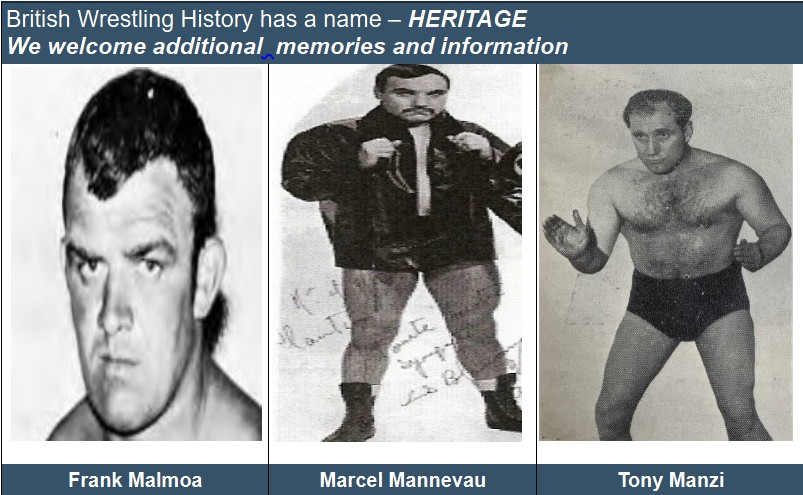
Born in Malmoa, Sweden, but based in Belgium light heavyweight Frank Malmoa brougt a splash of colour to our rings, could mix it with the best, and wasn’t afraid of breaking the rules and upsetting the fans.
He visited Britain twice, both of them short visits for Dale Martin Promotions in 1972 and again in 1974. In most contests he seemed to face lighter opponents, usually wrestlers with impressive pedigrees.
But saying that his record was not overly impressive.
On both visits he was granted Royal Albert Hall showings, both against lighter middleweight opponents. In September, 1972, he drew with Clayton Thomson, and in November 1974 he lost to Bert Royal.
Jim Maloney
The temperamental Irish middleweight, known for speed and agility, nicknamed Jumping Jim, was a busy worker around the country in the 1930s, our first sighting being in April, 1931, when he wrestled Harold Angus at the London Sports Club. Even at that early date he was billed as middleweight champion of Ireland. Only in wrestling could we find him returning to Belfast and billed as champion of Scotland. High calibre opponents included Harold Angus, Harry Rabi and Jack Harris. Reports suggest that Maloney was an energetic, athletic and skilful wrestler who could wrestle with the best. Our last recorded match for Jim is in December, 1946 wrestling Jim O’Connor in Coventry. Not to be confused with an American of the same name.
Dick Mann
Raymond Mann of Camborne, Cornwall was known professionally as Dick Mann, both as a professional boxer from 1931 until 1935 and then wrestler in the West country from 1936 until the outbreak of war. He weighed around thirteen stones and whilst opponents were mostly local men they did include visitors such as Vic Coleman, Cyril Knowles and Guido Ronga. Wrestling aspirations were interrupted by the war when he joined The Royal Army Physical Training Corps. Following the war Dick was appointed assistant trainer at Bristol Rovers Football Club, a post he held until 1950. Dick Mann was brother of the Cornish boxing promoter Ron Mann.
Marcel Mannevau
The black jackets worn by the stocky, unruly Marcel Mannevau (he was the one with the moustache) and tag partner, Claude Gessat , as they swaggered towards the ring gave a far from subtle hint about their wrestling style. The two Frenchmen were disliked by the British fans from their first venture across the English channel at the invitation of independent promoter Paul Lincoln to later 1960s bouts in Joint Promotion rings. Inevitably promoters lined up a range of popular teams such as Ken Joyce and Eddie Capelli, with whom they had many tussles, and the Cortez brothers. British fans couldn’t be bothered with the linguistic niceties of translating their “Les Blousons Noirs” name and knew them as The French Teddy Boys.
Ken Manning
Wakefield heavyweight trained by Ernie Baldwin turned professional in 1962 and was seen around northern rings until 1967.
Midge Manto
Another from the famous Barnsley clan who came onto the scene in the early 1950s, considerably lighter than his famous father and uncle, Derrick Manterfield was the son of Frank Manto. He worked in British rings, sometimes for Atholl Oakeley, during the 1950s.
Marcel Manuel
We have ten matches recorded for this heavyweight between June and October, 1946, all of them at Belle Vue, Manchester. Opponents included Charlie Green, Sonny Wallis and Ernie Baldwin.
Tony Manzi
Tony Manzi was a light heavyweight for whom we have found three or four years activity from 1947. Described as a light heavyweight with a judo and Royal Navy background opponents included Charlie Fisher, Norman Thomas and Milo Popocopolis. Our belief that he was a genuine Italian is based on our finding in 1986 Backhill, an Italian community magazine said that ex wrestler Tony Manzi was running a gym in Mount Pleasant, Islington, and was the masseur and osteopath for the Coach and Horses F.C., also in Islington. Ron Historyo checked the name and found it was a real name with three or four people of that name in the country. Seemingly all Londoners. Ron said, “Of the candidates there is one born in 1918 who was not born here and very clear his father Luigi was Italian. Dad and son were hairdressers. Pure guesswork though.”
Apart from wrestling Manzi was also an hypnotist. Extraordinary spectacles were reported of Manzi selecting members of the wrestling audience, fourteen on one occasion, and hypnotising them. Another report states that Manxi, who weighed fourteen stones, selected one slim subject, suspended him by head and feet between two chairs and then sat on his stomach whilst raising both his feet clear of the ground.
The Great Marcus
The Great Marcus had a great teacher; because he was Marcus Reid, the son of former Olympian and professional Joe Reid. We have found a few pro matches for The Great Marcus in the mid 1960s, but he seems to have made little impact. Opponents included Jim Bevan, Mike Agusta, Don Boardman and his old man Joe Reid. Marcus Reid was born in 1937 and died 21st May, 2007, aged 69.
Manie Maritz
One of his country’s top wrestlers, and equally famous as a political activist in his native South Africa, Manie Marits was the son of General Gerrit Maritz who played an important role in the Boer War.
Manie visited Britain in the spring of 1948, encountering opponents that included Tony Mancelli, Flash Barker and Mike Delaney.
Manie Maritz died on 19th April, 2018.
Gypsy Gino Marlow
Standing well over six feet tall Gino was billed as champion of the gypsies in the 1930s. Tangled with other supersized heavyweights such as Scot John Bell and Exmoor’s Carver Doone. A rough and energetic fighter in one match against Jack Pye he dashed from his corner at the opening bell grabbed Pye and took the first fall in the opening seconds.
1563
 Wrestling Heritage