
These are our shorter biographical portraits which we would like to extend if you can provide information or memories.
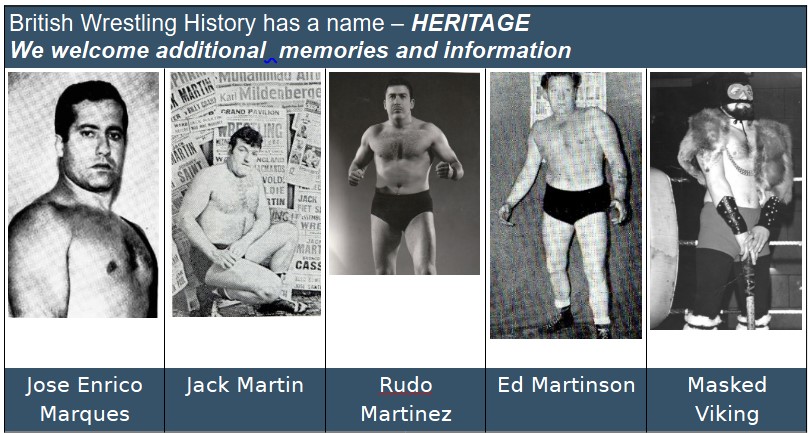
Jose Enrico Marques
The high flying dropkick specialist from Madrid toured Britain frequently during the late 1950s and 1960s. We first discover him during a 1958 visit, working around the country against the likes of Johnny Kwango, Chic Purvey, Jack Dempsey and George Kidd. Highlight of the tour was, no doubt, an appearance at the Royal Albert Hall with Mick McManus in the opposite corner. He was back to Britain in 1960 and each year until 1967, filling out until he was tackling fully blown heavyweights. He gained nationwide admirers during his 1962 television clash with Dai Sullivan in 1962, considered unlucky by viewers to go down by the odd fall. A tall dark heavyweight with a pleasing technical style he won lots of fans even if he didn’t win lots of matches.
Clive Marshall
A protege of Brian Trevors East Anglian Clive Marshall worked for both the independent and Dale Martin Promotions in the second half of the 1970s. He was followed into the wrestling business by his daughter, who wrestled as Little Lulu.
Brett Martin
Nottingham’s Martin Burdett was another of the Jack Taylor lads who was trained by the Accrington born promoter at his gym in Leicestershire, changing his name to the American sounding Brett Martin. A bit unruly at times, sometimes with the name tag “”The Nottingham Nutter.” Worked for the independent promoters from the mid 1960s with our last sighting in 1977, but we have been told he continued working for a few more years.
Jack Martin (Also known as Al Martin, Buster Martin)
The Wrexham tearaway who rarely bothered with niceties but gave a great mid-heavyweight villain’s performance unfailingly every time. Here was a man who really looked as though he wanted to win. Billed as Jack Martin in the north and Al Martin at other times, be him Jack, Al, Buster or Rough House Wrestling Heritage members have fond memories, “One of the real unsung heroes, a most convincing villain,” recalled Frank Thomas. Graham Brooks: “I saw “Roughouse” Al Martin (as I recall him being billed) on various occasions and he had some great bouts with Les Kellett in particular.”
He was a long time independent stalwart with a successful Joint Promotions run in the early seventies and even a couple of Royal Albert Hall appearances to his name. Another great favourite of ours.
Tagged unusually with Keith Martinelli in The Martinis, a pairing forced through by name rather than style. A regular and ideal television and halls opponent of Masambula and Les Kellett.
Al Martinelli
Heavyweight Allen Martin from Castleford in Yorkshire, was a burly 16 stoner who could certainly looke after himself in the ring. Professionally he was known as Al Martinelli and worked for independent promoters. His father, also Allen, was a referee and ring man for promoter Cyril Knowles.
Rudo Martinez
Colombian heavyweight Rudo Martinez worked for Dale Martin Promotions in the autumn of 1965 with an undistinguished record against domestic opposition that included Johnny Czeslaw, Ray Fury and more powerful forces such as Gordon Nelson
Ivar Martinsen
The Danish heavyweight, and one time European Heavyweight champion, is best remembered for wrestling his way through to the final of the World Heavyweight Championship tournament held at Harringay in 1947. In the final, held on March 4th 1947, he lost by a KO to Britain’s Bert Assirati, in a bout refereed by Lou Marco. On the way to the final he had beaten Phil Siki, Karl Reginsky and Bert Mansfield. Martinsen In the return contest, fought in Paris in October of the same year, Martinsen took the title from Assirati. In 1952 Ivar defeated Felix Miquet to claim the European version of the World Heavyweight Championship. He is said to have taken part in the first ever tag match in France, around 1955, partnering Francois Miquet against Eddie Brush and Jack Wentworth. Ivar Martinsen passed away on 22nd July, 1975.
Ed Martinson
Billed as the “Dockland’s strong boy” 1950s and 1960s heavyweight working for independent promoters mainly in the south and midlands of England. Opponents included top opposition men such as Tiger Ed Bright, Mike Demitre and Ron Harrison.
Masked Marvel
Ah, the Masked Marvel. There were so many of them over the years, one of them was a driver on our local buses in the 1960s! We wouldn’t know where to begin (or end), but it is certainly a name with a place in Britain’s wrestling heritage. Wrestling historian Charles Mascall claimed to have known at least thirty of them. The earliest Masked Marvel we have come across made his debut on 18th December, 1931, when he beat Angus McCheyne in Manchester.
Masked Viking
Masked Viking There were other Vikings but only one Masked Viking. A man wearing a mask dressed in a lot of fur and wielding a big double sided axe. Don’t forget the cow horn sided metal helmet. Did quite a bit of grunting too. A marauding northern European character it was true, but a birth place of Prestwick in Scotland was not quite as Scandinavian as his mystique suggested. Beneath the mask was Tam Campbell, a Spartan Promotions favourite. Out of the ring he was a man who brewed his own beer and smoked a pipe. This was the same man who would charge across the ring and threaten to do something nasty to opponents with a two sided axe. Who would have guessed it? Tam was a founder member of the Old Mossblown Gym, a sixteen year old turning up on an AJS motorbike wanting to know what all this was about a wrestling club getting started. Well, he got well and truly involved and went on to have a long wrestling career working for independent promoters around Scotland.
Le Masque
An unimaginative name for a masked man, add Le Masque Rouge or Le Masque Noir for a bit more exotica. None were of consequence. On December 14th, 1957 in Kings Lynn Dark Owl defeated and unmasked Le Masque to reveal Bill Coverdale.

Mario Matassa
Mario Matassa was billed as Belgian heavyweight champion on his first British visit in 1948. We believe he lived in Belgium though had been born in Genoa, Italy, where his family owned an ice cream shop. From 1951 he returned just about every year until 1962, now Italian heavyweight champion with wins over top class opposition such as Joe Cornelius, Frank Manto and Mike Marino.
Magnificent Maurice (Also known as Colonel Brody)
The name may not have been an original, and we should not confuse this gentleman with the extrovert we read about in those 1960s American magazines that eventually made their way into our newsagents.
In the 1980s the British version of Magnificent Maurice was an impressive figure as he stood shaven headed. moustachioed and totooed centre ring. Here was a man who knew how to upset the punters; not just by disregarding the rules but by his ring presence and camp gimmick. Strutting around the ring, taunting his opponent and jeering at the audience, let alone his rule bending tendencies, led to him being hated by fans throughout the world.
Steve Regal (William Regal) praises the colourful character who was his first professional opponent. The villainous heavyweight was solid northern. His name was Shaun Arnott, a bricklayer by trade, and he went on to wrestling reincarnation as Colonel Brody, the shaven headed bad boy of the 1980s heavyweight scene.
Whilst the shaven head and the handlebar moustache remained the same the distinguished military figure of Colonel Brody was a stark contrast with the camp Magnificent Maurice, but none the more popular.
Gomez Maximiliano
We think we are safe to say that back in the 1960s most wrestling fans knew very little about the distant land of Peru. They did know a powerful man with long black curly hair who went by the name Gomez Maximiliano, or Ernesto Conde Maximiliano to give him his family name. By the time he set foot in Britain, his first visit being in 1961, he had left Peru and set up home in Spain.
It was from here that he made his annual 1960s jaunts to Britain to rough it with our top heavyweights, almost always for Dale Martin Promotions. A sturdy sixteen stoner, with his long straggly hair reaching halfway down his back, Maximiliano was a colourful addition to British rings. By the end of 1961 he was known to television fans and had beaten Johnny Yearsley at the Royal Albert Hall. No one was safe – Earl Maynard, Gordon Nelson and Joe Cornelius all went down to the wild Peruvian on occasions; though promoters used him increasingly as target practice for domestic talent from 1965 onwards.
Visits to Britain were often alongside appearances in the major tournaments held in Austria and Germany. Gomez Maximiliano was last seen wrestling in Britain in 1967. We are told he moved to Vienna where he lived until his death.
Jackie McCann
Jackie McCann wowed the fans in the 1980s, winning the BWA championship in the process. In 1987 she defeated Stella Fox to take the title and held it until her retirement in 1989. A superb wrestler with power and skill Jackie was one of the top female wrestlers of the 1980s. Retiring as undefeated British champion wasn’t quite the end of the road for Jackie who made a one-off return to the ring in 2008, an exciting match with Shelby Beach. Jackie’s interest in wrestling is no lessened today, as an enthusiastic wrestling historian and founder of the Blackpool Wrestlers Reunion.
Earl McCready (Doncaster)
He may have acquired the name from a more famous Canadian, but Doncaster’s Earl McCready was a stylish and skilful middleweight on the independent circuit in the 1960s. The technical accomplishment was, no doubt, due to him being the son of heavyweight Dai Sullivan. Earl was one of the wrestlers featured in the short lived BBC venture into televising wrestling, meeting Tony Rocca in the televised show from Southend in January, 1965. He was advertised as “TV star” for a some time afterwards. Earl worked for major independent promoters including Don Robinson, Jack Taylor, Eric Taylor and Cape Promotions. Seen at his best against fellow high flyers such as Johnny Saint and Boy Devlin.
1568
 Wrestling Heritage