
These are our shorter Biographical portraits which we would like to extend if you can provide information or memories.
Kendo Nagasaki MkII
With Kendo Nagasaki and King kendo now working for the independents Joint Promotions turned to plan C, Kendo Nagasaki MkII. It was mercifully a short lived plan, for this much lighter masked man had nothing in common with Kendo Nagasaki other than a name. We have only eleven bouts on record, in a four week period from 22nd December 1979 until 18th January 1980. He failed to appear in at least five of those matches. Heritage member BuckTaylor64 tells us the masked man was Nick Heywood.
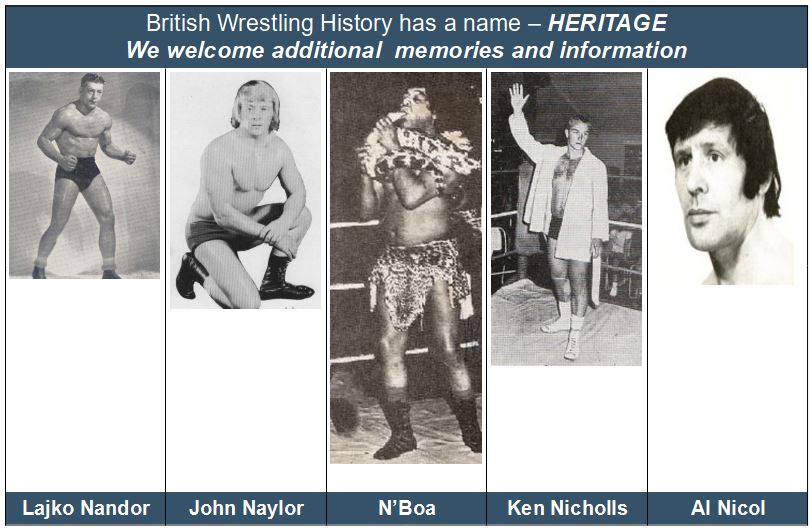
Lajko Nandor
Hungarian light heavyweight visited during the winter of 1951-2, meeting the likes of Tony Mancelli, Milo Popocpolous, light heavyweight champion Sonny Wallis and inevitably losing to Bert Assiratti.
Nawamba
The 1960s witchdoctor wrestler was covered head to toe in a one-piece outfit and green mask to cover his face. The outfit was for good reason. Nawamba’s nationality was not all it seemed. The outfit was worn by a number of wrestlers with links closer to Newark, Northampton or Nottingham. We suspect his studying of voodoo was also something of an exaggeration. The gimmick, used mostly on Jack Taylor shows, was around from 1962 until 1967, with the name revived again in the mid 1970s.
John Naylor (Also known as Golden Ace)
Standing on the top rope facing the audience, a backwards summersault on to his astonished opponent and the inevitable result was a pinfall for John Naylor. Such moves were to become almost commonplace thirty years later, but in the early 1970s they helped make “The Golden Ace” John Naylor one of the new breed of wrestling stars.
Wigan’s John Naylor brought a breath of fresh air to the northern wrestling scene when he appeared in the early 1970s. Here was someone with skill, style, speed, and a healthy amount of aggression. The speed and agility should not disguise just how the hardness of John Naylor. Wrestler Tony Francis recalls, “Many Moons ago I was billed to wrestle Ray Steele on the pier at Morecambe. When I arrived at the venue I felt quite ill, and even more so when I saw the poster; Ray was never known for his gentleness! Anyway I had to cry off, and as it was too late to get a substitute it was down to Steve Fury to appear twice. Steve did his best, took the bout to round five, and left the ring absolutely exhausted. Now,the plot thickens. Steves’original opponent,The Little Prince, had also cried off, but this time a sub had been found….John Naylor!! Well,if Steve thought his match with Ray was hard, John took him to a different plane. Strangely enough,after a large whisky in the bar I was able to enjoy both bouts in comfort. I don’t think Steve Fury has ever forgiven me! ”
Having learnt the business at Riley’s gym he could certainly wrestle, and his early professional experiences came on weekend visits to France. Along with contemporaries Steve Wright, Dynamite Kid and Mark Rocco, John Naylor played just as significant part in changing the style of 1970s wrestling, but often seems one of the forgotten men of the new breed.
Red Naylor (Also known as Fireball Naylor)
A busy Welterweight on the north and midlands independent circuit in the first half of the 1960s; Fred Naylor was a frequent opponent of Kevin Conneely, Shem Singh, Colin McDonald,Johnny Saint. On the nights he wasn’t wrestling Red could be found refereeing for independent promoters. A referee of some merit according to Heritage member, Duncan, who told us he was “A good ref. though who knew when to turn his back!” Barbara Sandwell told us, “I worked with him at Imperial Chemical Industries, Thornton Cleveleys in Lancashire. One morning shift we worked together and imagine my surprise when that evening he wrestled on Dominic Pye’s bill at Blackpool Central Club.”
N’boa the Snakeman (Also known as The Headhunter)
Said to be from darkest Africa N’Boa the Snakeman was Bob Elandon from Leopoldville in the Belgian Congo, a Belgian colony in central Africa, now the Democratic Republic of Congo. He toured Britain several times in the sixties, initially billed as Elandon the Headhunter and later N’B oa the Snakeman. What a sight he was as he brought with him to the ring a six-foot python, a gimmick subsequently copied by others. N’Boa walked slowly to the ring with the python wrapped around his shoulders, causing gasps from the audience as they moved quickly a few feet backwards. With hindsight we can see that there was no danger to anyone, but this was a very effective and original gimmick at the time.
Once he had entered the ring N’Boa the Snakeman showed himself to be a colourful bare-footed and barely-toothed light-heavyweight baddie from wrestling’s golden era, who topped the Royal Albert Hall bill when he faced Steve Viedor.
Robert Negrete
South American middleweight visitor in the winter of 1966 and often tag partner of Inca Peruano.
Johnny Nelson
Life in Lancashire during the 1920s and 1930s was hard, and it produced hard men. Amongst them an accomplished catch wrestler and amateur champion Johnny Nelson. Bolton’s Johnny Nelson turned professional in the mid 1930s, having been an accomplished amateur who wrestled in the British amateur lightweight championships in 1933 and 1934. One of the top 1930s Bolton wrestlers he didn’t confine his appearances to northern England but travelled the country meeting the best of the lighter men. Reports suggest that Johnny was a skillful wrestling, in one report said to have held his own with Olympian Norman Morrell, whilst a rough character who lost by disqualification on occasions. War interrupted Johnny’s wrestling activities from 1941 onwards, though he returned to the ring in 1946 and continued wrestling until 1950. After retiring from wrestling he continued as a trainer at the club where he had learned the sport, The Bolton United Harriers and Athletic Club. Johnny is credited with having taught fellow Boltonian Bob Sherry to wrestle.
Janos Nemeth
Hungarian Janos Nemeth was an agricultural student and teenager when he left his native land during the 1956 uprising. He got a job working in the south Yorkshire coal mines before moving to Southend. James pursued the amateur wrestling career he had started in Hungary, and turned professional early in 1962. Weighing under twelve stones Janos worked for independent promoters for a couple of years, facing other promising lighter men of the independent circuit such as Zoltan Boscik, Reg Trood and Peter Rann.
David Nenic
The Belgian mid heavyweight visited Britain in November 1959. He obviously appreciated the British winter because he came back again in 1960 and again early in 1962.
Tom Newton
Tom Newton was an amateur weight-lifter from Crewe who took up professional wrestling in the 1930s, previously Cheshire amateur champion in 1931. At a gymnasium in Brooklyn Street Tom taught a young Geoff Condliffe to wrestle. Condliffe went on to become masked man Count Bartelli. Tom Newton was referee at Hanley from 1945 and a regular referee in many hall from then until the mid 1960s.
He was also an independent promoter, notably at Chester, Whitchurch and Oswestry. Away from wrestling he was a keen gardener, and was a judge in dahlia competitions.
He was 63 years old in January, 1971 when he was killed in a coach crash near Munich whilst returning from a ski-ing holiday in Austria. His son, Arthur, who was also a referee, was also injured in the crash.
Ken “Hercules” Nichols
Popular supermarket manager and young middleweight from Caister Ken Nichols came from the Brian Trevors school at Fleggburgh and was a regular on the East Anglian independent circuit from the mid sixties through to the late seventies. Fellow wrestler Stephen St John remembers Ken as a brilliant wrestlers and one of the Brian Trevor’s star wrestlers. A body building enthusiast Ken was not only surprisingly strong for his weight but also a highly skilled technician who always stayed on the right side of the referee. Ken was tipped for success when given the double page spread treatment in “The Wrestler” magazine, but failed to fulfil that initial promise.
Phil Nieman
The man who beat the gong for Rank Cinemas from 1946-1955. You can learn such interesting facts here on Wrestling Heritage. Not just that professional wrestler of the 1940s and 1950s, Phil Nieman, was one of four men who struck the gong for Rank films over the years. Also, that the filming of this introductory sequence was filmed frequently because the film deteriorated so quickly, and that the sound was recorded separately because the gong was made of papier mache. Unfortunately we are unable to tell you much about the success of film extra, stuntman, and gong striker Phil Nieman as a wrestler.
Vicomte Joel de Noirbreuil
The dashing young French viscount toured Britain twice in the mid-sixties and is seen left with an armlock on Gentleman Jim Lewis. Born in Paris and mentored by Georges Cohen, he was trained for the ring by Albert Ben Chemoul, father of the European Middleweight Champion, René, and became a favourite on French televised wrestling. 5’5″ Noirbreuil wrestled all over France and tagged surpisingly with N’boa the Snakeman, see above.
On his UK tour he challenged Alan Colbeck for the European Welterweight Championship and faced many of the UK’s top middle and welterweights. His sole UK tv bout was against Jon Cortez. But his record shows four 1965 losses against Jackie Pallo, all at coastal locations. Joel was back in Britain in the 1980s, dutifully losing to Rollerball Rocco on 26th August, 1981 in a World Heavy Middleweight championship contest.
Digger Nolan
Top recording artists have to do something before they become famous. Australia’s country music star Colin Purssey was the 19stone bruiser who was knocked out by Marty Jones on television in October 1985. That match was said by Digger to be the high point of his wrestling career. Digger, or Colin in those days, was born in the the Illawarra region of New South Wales, south of Sidney. Whilst working as a security guard at ABC in Melbourne he developed his song writing skills, which proved less painful than taking the bumps in the wrestling ring.
GI Joe Nolan
1960s GI Joe Nolan entered the ring in army gear and wrestled for the independent promoters in the 1960s and 1970s. Out of the ring he was landlord of The Champion Public House in Leicester. There may well have been other GI Joes.
Oscar Norden
Heavyweight bruiser working for the independent promoters in the first half of the 1960s.
Gunther Nordhoff
Germany’s Gunther Nordhoff visited Britain during the winter of 1960-61. He was well known in Germany as the face for a polish commercial over many years. In the commercial he used the name “Meister Propper” which he then adopted in the ring for a short time. A German amateur champion in 1953 he turned professional in the late 1950s, and it was the beginning of a career that was to span thirty years, working throughout Germany and Austria, notably at the famous Heumarkt in Vienna. When he came to Britain, for Joint Promotions, opponents included Bob Sweeney, Ernie Riley, Francis St Clair Gregory, Billy Howes and Arthur Beaumont. Gunther Nordhoff died on 22nd November, 2020.
Fred Norman
We came across the Isle of Man’s Fred Norman for the first time in 1935 in a middleweight contest at Preston. Reports suggest that Fred was a fast and skilled wrestler yet also extremely rough, and could hold his own with most, including Empire Games silver medalist and renowned catch wrestler Joe Reid. Most of the matches we found were in the north of England, suggesting that this was where he was based. By 1948 we find him with increased weight with a number of matches at Belle Vue, Manchester against Francis St Clair Gregory, George Gregory, Clem Lawrence, Harry Brooks and Pat Curry.
Stefan Novotny
We have been unable to find any biographical information on Hungarian Stefan Novotny though have a record of more than a dozen matches in Britain. All but one are appearances in 1946. We were very surprised to find a report in the Western Morning News of a contest at Plymouth twelve years earlier, 8th June, 1934, between Stefan Novotny and Harry Brooks. The match ended in a draw though it was said Brooks was the more skilful of the pair.
Novotny returned to Britain following the Second World War. We have found records of sixteen matches between May and December, 1946, all of them surprisingly at Belle Vue, Manchester. Although we do not have any match reports he must have improved and grown somewhat since his match with Brooks as opponents were big, powerful heavyweights that included Bert Assirati, Chick Knight, Charlie Green, Bill Garnon, and Anaconda.
Karol Nowina
Krakow’s Karol Szczerbinski took the professional name Karol Nowina after turning professional in the United States in 1929; having moved there from his native Poland five years earlier. He wrestled in Britain in 1937, mostly in the south, but taking occasional jaunts north.
Bert Nuttall
Stockport’s Bert Nuttall was the oldest of the Nuttall brothers who boxed briefly and turned to working as a policeman and professional wrestling after serving in France during the Second World War. He was a tall, slim heavyweight who wrestled throughout the north for many years, mainly for the independent promoters. In one of his Joint Promotions matches, against Ian Campbell in 1961, Bob Andrews reported, “Bert dictated much of the first two rounds, but in the third Mr.Scotland took over. He threw Bert on to a corner post and applied a back-breaker over the shoulder which forced Bert to submit. Unfortunately, Bert hurt his shoulder in this round and was unable to carry on. Ian thus gained the verdict.”
Remembered by ex wrestler Eddie Rose as a quiet, well mannered man whilst neighbour and Heritage reader Ray Noble remembers “a real gentleman.”
Brother George can be found under the Black Mask entry.
1607
 Wrestling Heritage