
These are our shorter Biographical portraits which we would like to extend if you can provide information or memories.

Chick Rolfe (1930s)
We know very little about Chick Rolfe despite his presence in British rings for twenty plus years. We came across him for the first time in 1933, fighting Phil Siki. Billed from America, “The tough guy from Bowery, New York,” this may well have been promoters hype, and the later billing of Birmingham (that’s Birmingham, UK) was probably more accurate. Although there are reports that Chick could wrestle, there are more frequent reports of a more rugged character, on one occasion tearing the referees trousers to shreds! In his twenty year career Chick met most of the big names, Black Butcher Johnson, Dave Armstrong and Vic Hessle.
Chick Rolfe (March, 1970s)
We have a second Chick Rolfe, this one from March in Cambridgeshire. His birth name was Michael Sharder and he worked frequently for Jack Taylor and Terry Goodrum in the 1960s and 1970s. Martin Campbell recalled him: “He hovered around light-heavy, so he could take on the Ghoul, which he did on many occasions as well as middleweights. Another good worker. Travelled, I think, around the south-east with others who never really made it, like Digger Summers and Hardy Lingus.”
Mick Sharder briefly assumed another identity also. Here’s a glass half-full or glass half-empty test. For those with a half-full outlook the creation of Brother Death was a touch of creative genius. From a half-empty perspective it’s a sign of just how low a promoter could stoop. Brother Death was a short lived invention of promoter Jack Taylor to fill the void left by Dr Death when he went to work for the rival Joint Promotions. Mr X was an even shorter lived creation, we suspect for the sole purpose of being unmasked by the Brother. Mr X was unmasked as Chick Rolfe. He’s probably had more glorious nights.
John Romeiro
Martin Campbell recalled John Romeiro, “John Romeiro was used by Jack Taylor a lot in the late sixties He was a good worker … heel or very occasionally baby face depending on the bill, but usually heel. He wore a black leotard and was used by Jack as a tag partner for Dr Death, with whom he ‘fell out’ and fought. He was a good-looking swarthy lad, quite tall. Like most ‘swarthy’ wrestlers he was occasionally billed as Gypsy John Romeiro, but mostly it was John Romeiro, Latin American glamour boy. He could work a crowd and I was mystified that he didn’t go further, because outside East Anglia and the south-east and into the 70s he seems to have fallen off the radar. He really is one wrestler I’d like to know more about.”
Rito Romero
Mexican heavyweight Rito Romero was a good friend of World heavyweight champion Lou Thesz and travelled to Europe with Thesz during the winter of 1957-8. Whilst his early career was in his native Mexico Rito settled in the United States, winning the NWA Pacific Coast Heavyweight Championship, defeating Verne Gagne for the Texas Heavyweight Championship and twice holding the NWA World Tag Team Championship. In Britain Rito faced the likes of Jack Pye, Sandy Orford and Dennis Mitchell, going down to the Bradfordian at the Royal Albert Hall in February, 1958. Rito Romero died of a heart attack on 17th January, 2001.
Guido Ronga
Now here’s a name. Guido Ronga, the man from the Ashdown Wrestling Club who trained Bert Assirati and prepared him for the professional wrestling ring.
A skilled amateur Guido himself turned to the professional style in the 1930s and we have found him on the bills from 1935. In 1952 we find Guido working for Atholl Oakeley and winning a World Middleweight Championship contest against Pat McGee. Following Oakeley’s demise Guido continued wrestling with our last reference in 1956. Surely a man about whom we should know much more.
Bob Roop
By the time Bob Roop came to Britain in 1972 Wrestling Heritage writers had been around long enough to know the ropes – American wrestler was over-hyped by the wrestling press, came to Britain, showed little wrestling ability, broke the rules and disappointed immensely. Then came Bob Roop. He was different. He could wrestle, and did wrestle, and we rather liked him. We now look back on his UK record and see quite a few disqualification losses. Those losses conflict with our memories of a skilful heavyweight who could work with the best we could offer. Little wonder, because Bob Roop had represented the USA in the 1968 Olympic Games. The year following the Olympics (he came seventh) Bob turned professional and so had three years pro experience when he came to the UK. Bob Roop retired from wrestling in 1988 as a result of injuries received in a car accident.
Globe trotting heavyweight Earl Black told Wrestling Heritage:
“I first met Bob Roop in Tampa, Florida. I had never heard of him. To me, he looked like a big, chubby, 13-year-old, though he was actually 25 at the time. He just did not look like a Special Forces paratrooper, which of course he had been. Two other wrestlers also thought he did not look so tough. They challenged him to a fight in the gym, and these were big, strong guys. Never one to back down, Bob climbed into the ring, and punched one between the eyes, which was the end of the line for him. The other one tried to grab Bob, but he turned him upside down and drove him head first into the mat. You just can’t judge a book by its cover. “
Paul Rose
Loughborough’s Paul Rose came into wrestling via the physical culture route, given a helping hand by Leicestershire based wrestler and promoter, Jack Taylor. A muscular six footer of sixteen stones turned professional in 1957. Our first sighting came at Rugby in December, 1957, when he was on the losing end against Tug Holton. Other opponents included Haystack Ed Bright, Flash Lee Edwards, Spike O’Reilly and Jack Rowlands. We found Paul Rose working frequently around Leicestershire until October, 1962, always for Jack Taylor. We would very much like to learn more.
Herbie Rosenberg
“Hard-boiled Herbie Rosenberg, The sneering, jeering Jew”, from Chicago, well that’s what the posters told us. What we do know was that Herbie liked to play rough, with one report announcing “Such was the scene, the worst in local sporting circles for many years, which brought forth loud and long bursts of booing from the crowd.” Never seemingly a regular main eventer Herbie obviously entertained the fans and was active in British rings from 1934 until 1945.
Matthias Rosges
The scientific Scientific German heavyweight was a frequent visitor to Britain from 1960 until 1962. Working in the north in the winter of 1960 later visits concentrated more in the south, with Royal Albert Hall losses against Joe Cornelius and Tibor Szakacs. The wrestling world was shocked when it was reported that Matthias Rosges had been murdered in Dusseldorf in 1962.
Pete Ross
A popular wrestler in the 1970s Pete Ross was the “Farmer’s Boy” from Rushyford in County Durham who worked for both independent and Joint Promotions in the 1970s and 1980s. The Farmers Boy nickname was genuine, with Pete still involved in the agricultural business
Pete Ross worked mainly in northern England and Scotland. He made a handful of television appearances between 1979 and 1984, singles matches against Lucky Gordon, Johnny England and Elvis Jerome as well as the near inevitable tag pairing with Big Daddy.
Steve Rowe
Eric Savage was just 16 years old when he became Steve Rowe, a fast moving lightweight who the fans took to straight away.
That was in 1968 following a grounding in the rudiments of the professional ring by wrestler and promoter Terry Goodrum. At the same time the youngster was training as a nurse and working in a hospital. Between shifts he would be travelling around working for the independent promoters.
He made a good impression and in March, 1972, was featured in The Wrestler magazine where he was named one of the most promising wrestlers on the scene.
Although he worked mostly for the independent promoters, such as Terry Goodrum and Allan & Taylor, Steve was signed up by Joint Promotions and the youngster was soon sharing a dressing room with the idols he had watched on television only a few years earlier – Les Kellett, Shirley Crabtree and the Cortez brothers amongst them.
For Steve it was a short lived career, though one he enjoyed immensely, as he took the decision to concentrate on work outside the ring and retired in 1975.
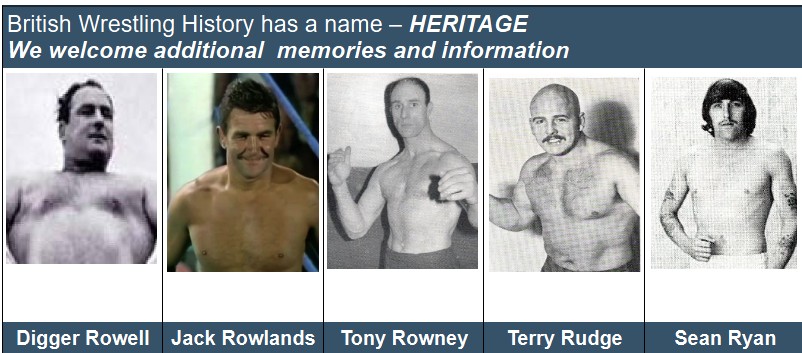
Digger Rowell (Black Mask, Dr No)
Not the most skilful wrestler in the world, but an all action style and thorough wrestling knowledge made this globe trotting Australian (born in Sunderland, England) a favourite around Europe. Charles Rowell, that was his real name, began wrestling whilst a PT instructor in the Australian army. In 1954 he won the “Mr Sydney” title. His style was one that excited fans, combining strength, speed and ruggedness with the aim of wearing down opponents and winning by submission. Moved around continental Europe, the UK with the odd visit home throughout the first half of the 1960s decade. Occasionally donned an appropriately coloured hood and wrestled as The Black Mask or Dr No.
Jack Rowlands (Beau Jack)
Stockport heavyweight Jack Rowlands, whose athletic build and dark, handsome features led to an alternative billing as “Beau Jack” graduated through the 1960s independent rings into Joint Promotion territory. As a youngster Jack watched the wrestling near his home at the Levenshulme Ice Rink, where his favourites included Jack Pye and Tommy Mann. He trained at the Manchester YMCA, encouraged by the Canadian Carl Van Wurden, before turning professional in 1960 for the independent promoters. In those days there were sufficient independent shows every night in southern Lancashire and Yorkshire to give a youngster an excellent grounding in the professional business. We always felt that those early matches in which we saw him against villains such as The Ghoul, Lord Bertie Topham and Dai Sullivan were the ones where we enjoyed him the most. On Monday 10th October, 1966, he moved across to Joint Promotions, losing to Don Vines at Carlisle. For the following fifteen years Jack remained a popular figure in British and overseas ring, holding his own against the top heavyweights but never really making it into the big league. His career extended into the early 1980s.
Tony Rowney (Tony Rowley, Ring Gladiator)
Proud Yorkshireman Tony Rowney wrestled in the latter part of his career as the Ring Gladiator out of Kettering, where he had a parallel career as an unarmed combat instructor, both in the forces and in civilian life. Northamptonshire was of course Ken Joyce territory and the two had an ongoing feud, with Rowney ever the one booed by the fans. We had first become aware of him in the very early seventies with tales of wrestling lions inside their cages at the zoo His first televised bout was in 1977 against Dynamite Kid. Due to his daytime job at a steelworks, Tony was greatly limited travel-wise throughout his career, but we are sure he would have become a big name had he chosen to dedicate himself full-time to wrestling.
Tony died on 25th June 2009.
Roy Royal
Wrestling Heritage member Duncan remembers 1960s independent wrestler Roy Royal billed as “A famous wrestler from a famous family.” Duncan posed the question, which famous family? Please get in touch if you can provide
Izzy Rudd
Jack “Izzy” Rudd was a powerful, strong stocky light heavyweight of London in the 1930s who never really seemed to extend beyond the supporting role of enhancing the reputation of the stars. Opponents included Atholl Oakeley, Golden Hawk and White Owl. Having repeatedly carried White Owl to the side of the ring and deliberately thrown him over the top rope fans at Nottingham cheered when White Owl returned the favour, with Rudd counted out by the referee.
Jimmy Rudd
Post war we find Jimmy Rudd working the professional rings of northern England against the likes of Tiger Woods, Jim Mellor and Carlton Smith. We can only guess that this was the same RAF airman who, during the war, performed exhibition matches with another young airman by the name of Mick McManus. We have no further information but would like to know more.
Paul Rudean
Schoolboy Paul was a Lincolnshire lad from Boston and a regular fan of the wrestling shows put on fortnightly by Jack Taylor at the Drill Hall. Paul and his school friend, Ricky Wise, arrived early one Saturday to find the ring being offloaded from the van and into the hall. Paul and Ricky asked if they could take a look inside the hall and helped set out the chairs for that evenings show which got them free tickets.
The boys were in the wrestling business and returned to the hall to help prepare for each show. Once the preparations were complete they would climb into the ring for their fantasy wrestling bouts. Jack and Doug Taylor encouraged the youngsters to learn how to wrestle properly, and so they began to train at a local boxing club. A few months later Rick and Paul joined Taylor’s wrestling club where they met Mick Collins and Taffy Jenkins.
Following a show Jack gave them a poster for the next event. There was a tag match with Mick and Bobby Bierne wrestling “The Boston Stumpers” with Boston Stump being the local name for the parish church of St Botolph.
When the boys asked Taylor he told them their efforts had paid off and now it was time for them to make their debut and continue their training in front of the paying public. No one was more shocked than Rick and Paul to find that they were The Boston Stumpers.
More tag matches followed and then singles bouts for Paul. Opponents included Karl Von Kramer, Gorilla Reg Ray and Mick Collins. We’d like to learn more about Paul Rudean and what became of him if anyone can help.
Terry Rudge
An often overlooked wrestler who looked the part. Forgotten by many fans, respected and remembered by colleagues. Terry was a long-term career mid-heavyweight who could wrestle clean or dirty, bald or hairy, tanned or pale. Blocked at the Royal Albert Hall by Mike Marino in his title bid, this was the story in the over-crowded Mid-Heavyweight division all along for the this London born wrestler.
Terry turned professional in the late 1960s, quickly gaining experience and weight before taking part in the German summer tournaments, and was in time he was to find himself working frequently overseas. As he matured Terry developed a harder edge style which didn’t endear him to fans. David Franklin remembers; “The wrestler who returned to Britain from these foreign travels was unrecognisable to those who remembered the handsome young prospect of a few years earlier. The hair was gone and he had put in a couple of stones of solid muscle, but most of all he had now developed an aggressive attitude that stayed with him for the rest of his career.”
Another wrestler who went in to pub management on retirement. Can claim one of the most outrageous quotes in wrestling (if we can believe The Wrestler magazine): that his toughest opponent was Tornado Torontos!
David Franklin again: “However let’s now remember all those great matches. He was a top professional who was never in a bad match. Terry Rudge guaranteed you a great contest and his win/loss record was highly creditable for somebody who fought all the very best although never really a big star name himself.”
Billy Ryan
We saw Birmingham middleweight Billy Ryan a couple of times in the early 1970s, against Sabu (Gurdial Singh) and Earl McCready in the independent rings. We remember a skilful, fast and popular wrestler, and have since been told, but not confirmed, that he was the son of veteran heavyweight Harry Yardley.
Pat (Paddy) Ryan
We have found a handful of reports on Ireland’s Pat Ryan with contests between 1934 and 1951 He was said to be a fast and skilful wrestler and in a match against Philo Vance fans were said to be thrilled by the speed of the bout At times he often showed a rather different temperament, on one occasion Pat was disqualified and then said to “get to grips” with the referee, and following another match, after being knocked out, attempted to hit his opponent with a glass bottle.
Sean Ryan
Born in Hudderfield in 1945 and trained by Ian St John the Yorkshireman had moved to the Isle of Man before making his professional debut. He was in his mid twenties when we last saw him in action and longing for his big chance on the mainland.
Fortunately for Sean there was a healthy wrestling scene in the Isle of Man at the time with a dozen or so youngsters training together and working regularly with weekly shows during the summer season.
Sean was one of these dozen or so youngsters who trained regularly at the George Barnabus wrestling club. When he was deemed ready to set foot in the profeesional ring Sean’made his debut against fellow Manx man Leon Ski at the Isle of Man Holiday Centre.
Sean was a clean and skilful wrestler who was very popular with fans.
We last saw Sean wrestling around the Isle of Magic some forty years ago, and would welcome news of what happened next.
1911
 Wrestling Heritage